A med spa booking app is not a website with a download button. Your website wins the first visit. An app earns its keep on the second, fifth and twentieth visit, when a client is on a membership, halfway through a treatment package and due back in eleven weeks.
That difference decides whether an app is worth building at all. This guide covers which features a med spa client app actually needs, what it costs in 2026, how long it takes, and when you are better off without one.
When a med spa actually needs an app
Most med spas do not need an app on day one. A fast website with good online booking covers new clients well, and we have written about exactly that in our med spa website design guide.
An app starts to make sense when repeat clients are the business. The usual signs:
- **Memberships or monthly plans** are a real share of revenue, and members keep asking how many credits they have left.
- **Treatment packages** (a course of six sessions, for example) are tracked on paper or in a spreadsheet.
- **Rebooking is manual.** Staff call or message clients when they are due back, and some never hear from you.
- **Intake and consent forms** are filled in on a clipboard at reception every single visit.
- **You run more than one location,** or several providers with their own schedules and rooms.
If none of those apply, a booking platform subscription is probably the right call. We set out that comparison honestly in salon and spa booking: build vs buy.
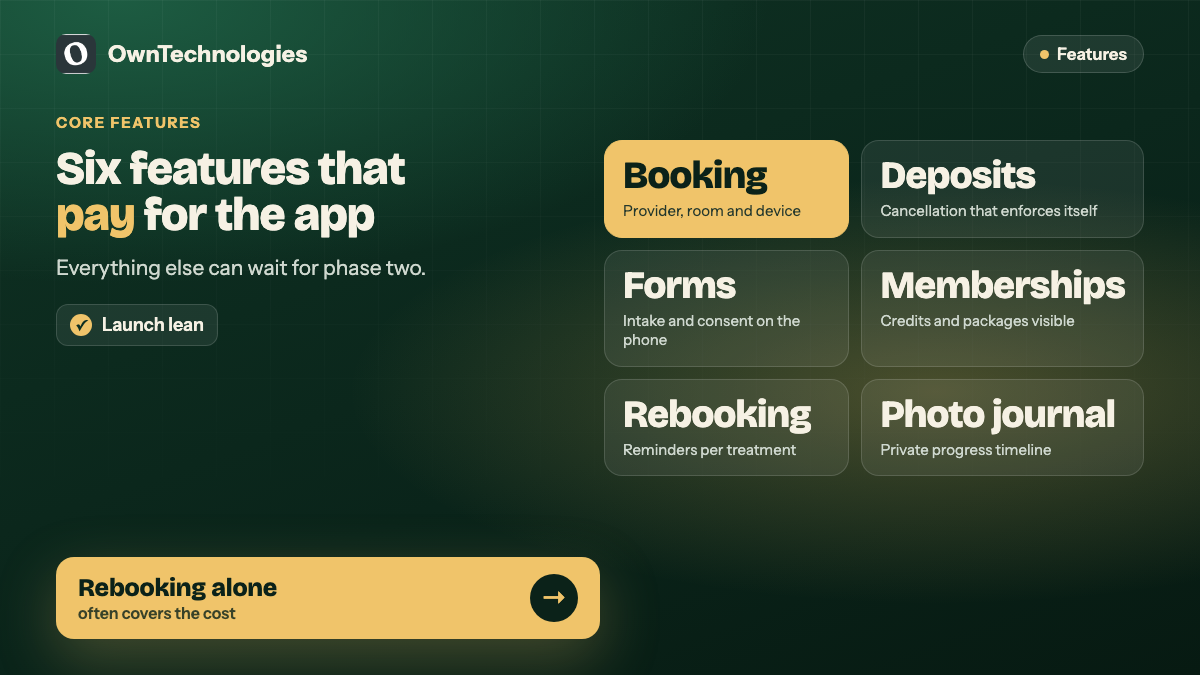
Core features of a med spa booking app
Booking that understands treatments, not just time slots
A haircut needs a chair and a stylist. A laser treatment needs a qualified provider, a specific room and a specific device, all free at the same time. The booking engine should check all three, and block treatments a client cannot have yet (a consultation first, or a gap since the last session).
Deposits and a cancellation policy that enforces itself
No-shows hurt med spas more than most businesses because a treatment slot is long and expensive. Take a deposit at booking through a payment provider such as Stripe, show the cancellation window clearly, and release or keep the deposit automatically.
Digital intake and consent forms
Clients complete medical history and consent on their phone before they arrive, sign once, and only update what has changed on later visits. Reception stops chasing clipboards, and the provider sees the answers before the client walks in.
Memberships, packages and credits
The client sees exactly what they have: “3 of 6 sessions used”, “2 credits left this month”, renewal date and price. This one screen removes a large share of the questions your front desk answers every day.
Rebooking reminders based on the treatment
Each treatment gets a rebooking interval that you set. When a client is due, the app sends a push notification with a one-tap link to the right treatment and provider. This is the feature that most directly pays for the app.
A private before and after photo journal
Providers capture progress photos in the clinic. The client can view their own timeline in the app, privately, and nothing is shared publicly without separate written consent.
Features that can wait for phase two
- Loyalty points and referral rewards
- In-app product shop for skincare retail
- Gift cards and gifting a treatment
- Video consultations
- Multi-location switching and transfers
- Integration with your accounting software
Launching with all of these at once doubles the cost and the timeline. Launch with booking, deposits, forms, memberships and reminders, then add what clients actually ask for.
Privacy and compliance
A med spa app handles health information: medical history, medications, photos of the face and body. That changes the build:
- **Encryption** in transit and at rest, including stored photos
- **Role-based access,** so a receptionist does not see clinical notes
- **Audit logs** showing who viewed or changed a record
- **Consent records** tied to each form version the client signed
- **Data location and retention** rules agreed before development starts
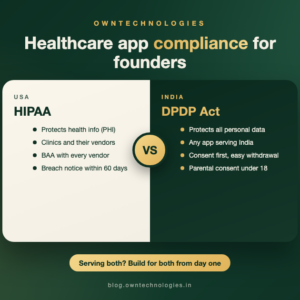
In the US this usually means building to HIPAA expectations, and in India the DPDP Act applies. We explain both in our healthcare app compliance guide. Apple also reviews health-related apps carefully, so read the App Store Review Guidelines before you plan the launch date.
Med spa app cost in 2026
These ranges assume one cross-platform app (iOS and Android from a single Flutter codebase), an admin panel for staff, and an experienced offshore or hybrid team.
| Scope | What it includes | Typical cost | Timeline |
|---|---|---|---|
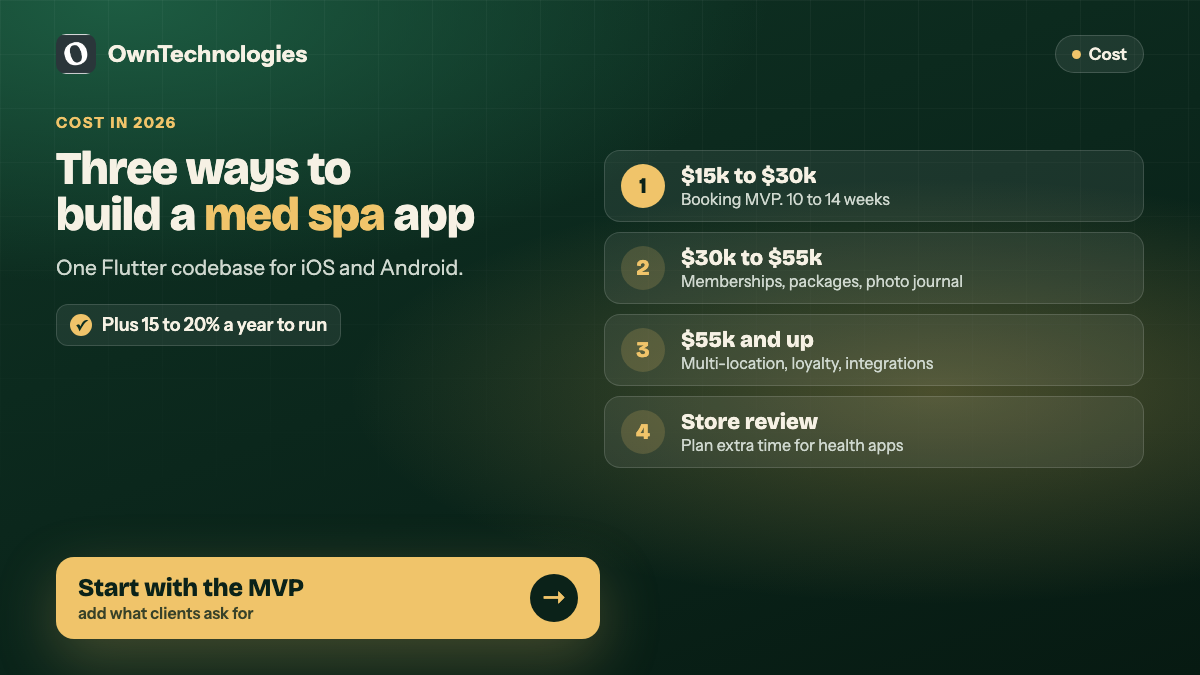
| Booking app MVP | Treatment booking, deposits, digital forms, reminders, staff admin | $15,000 to $30,000 (around 12.5 to 25 lakh INR) | 10 to 14 weeks |
| Membership app | MVP plus memberships, packages, credits, photo journal, rebooking logic | $30,000 to $55,000 (around 25 to 46 lakh INR) | 14 to 20 weeks |
| Multi-location platform | Above plus multiple locations, loyalty, retail, integrations, reporting | $55,000 and up (around 46 lakh INR and up) | 20 weeks and up |
Ongoing costs come on top: hosting, app store fees, payment processing, notification services and maintenance, typically 15 to 20 percent of the build cost per year. For how these numbers compare by region, see mobile app development cost: USA vs India.
How long it takes, step by step
- **Discovery, 1 to 2 weeks.** Treatments, rooms, devices, providers, memberships and cancellation rules written down.
- **Design, 2 to 3 weeks.** Every screen approved before code, including the staff admin.
- **Build, 6 to 12 weeks.** Booking engine first, then payments, forms, memberships and reminders.
- **Testing, 2 weeks.** Real staff booking real (test) clients on real phones.
- **Store review and launch, 1 to 2 weeks.** Apple review for health-adjacent apps can take longer, so plan for it.
What to prepare before you brief a developer
The fastest way to get an accurate quote is to arrive with your rules written down. You do not need a technical document. A simple spreadsheet with these answers saves weeks of back and forth:
- **Your treatment list,** with duration, price, which providers can perform each one, and which room or device it needs.
- **Your membership and package rules:** what a credit buys, whether credits roll over, and what happens when a client cancels.
- **Your cancellation and deposit policy,** exactly as you want it enforced, including the exceptions staff make today.
- **Your current forms,** both intake and consent, so they can be rebuilt digitally without losing anything your insurer requires.
- **Your current tools:** booking platform, payment provider, accounting software and anything else the app must talk to.
With that in hand, a developer can quote a fixed price for the first version instead of a vague range, and you can compare quotes like for like.
Mistakes we see med spas make
- **Building the app before the website works.** New clients still find you on Google first.
- **Treating treatments like time slots.** Ignoring rooms and devices leads to double bookings.
- **No deposit.** The app makes booking easy, which also makes not showing up easy.
- **Paper consent alongside digital forms.** Pick one, or staff will maintain both.
- **Launching every feature at once.** Clients use five features. Build those well.
Frequently Asked Questions
In 2026 a booking app MVP with deposits, digital forms, reminders and a staff admin costs about $15,000 to $30,000. Adding memberships, packages and a photo journal takes it to $30,000 to $55,000.
A focused MVP takes 10 to 14 weeks from discovery to launch. A full membership app usually takes 14 to 20 weeks, plus time for app store review.
If most of your revenue comes from new clients, online booking on a fast website is enough. An app pays off when memberships, packages and rebooking repeat clients are a large share of revenue.
Yes. We build with Flutter, which ships iOS and Android from one codebase, so you pay for one build and one set of updates.
If it stores medical history, consent forms or treatment photos for US clients, you should build to HIPAA expectations: encryption, access controls, audit logs and a signed agreement with any vendor that handles the data.
Often, yes, if your current platform has an API. Many med spas start with an app layered on their existing system and move the booking engine later.
Final Thoughts
A med spa app is worth building when your business runs on repeat clients: memberships, packages and rebooking. Start with booking that understands treatments, deposits, digital forms, memberships and smart reminders. Get those right and the app pays for itself in rebookings alone.
If you are weighing an app for your med spa or clinic, we can help you decide whether it is worth it yet. Our app development team builds Flutter apps for health and wellness brands, including the CITE Lifestyle family health apps, our CRM team builds the staff admin behind them, and our website team makes sure new clients find you first. Book a free consultation and we will map your features against your budget.