Ask three development companies to quote your MVP and you might hear $6,000, $30,000, and $90,000 for what sounds like the same idea. The gap usually comes from three different ideas of what “minimum” means, not from price gouging.
This guide explains what an MVP actually is, what it should cost in 2026 by product type, what drives the price, and how to tell whether a quote is realistic. It is written for founders and business owners, not developers.
What Is an MVP? A Plain-English Definition
An MVP, or minimum viable product, is the smallest version of your product that real customers can use to solve one real problem. The idea comes from the Lean Startup method: build a first version, measure how people use it, and learn what to build next before you spend the full budget.
An MVP is not a demo, a slide deck, or a half-finished app full of bugs. It should be:
- Usable: a customer can sign up and complete the core task without help.
- Focused: one main user flow done well, not ten flows done poorly.
- Measurable: analytics are built in so you can see what people actually do.
- Extendable: the code and database can grow into the full product without a rewrite.
If you are still deciding how much to build before launch, our comparison of MVP vs full product covers that decision in detail. This post focuses on the budget.
How Much Should an MVP Cost in 2026? The Short Answer
Most MVPs built by an experienced offshore or hybrid team cost between $8,000 and $50,000 (around 6.5 lakh to 41 lakh INR). A clickable prototype for testing the idea costs less. A US-only agency will usually quote two to three times more for the same scope.
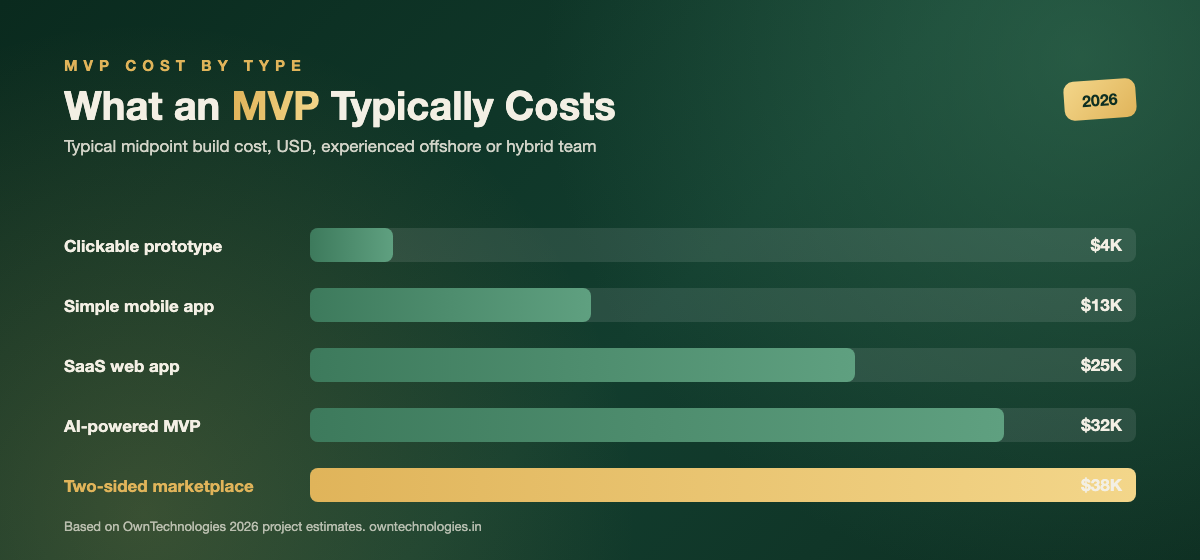
| MVP type | Typical scope | 2026 cost range | Timeline |
|---|---|---|---|
| Clickable prototype | Designed screens you can tap through, no real backend | $2,000 to $6,000 (around 1.6 to 5 lakh INR) | 1 to 3 weeks |
| Simple mobile app MVP | Login, one core flow, admin panel, basic analytics | $8,000 to $18,000 (around 6.5 to 15 lakh INR) | 6 to 10 weeks |
| SaaS web app MVP | User accounts, dashboard, subscriptions, one key workflow | $15,000 to $35,000 (around 12.5 to 29 lakh INR) | 8 to 12 weeks |
| AI-powered MVP | Core app plus one AI feature such as chat, summaries, or recommendations | $20,000 to $45,000 (around 16.5 to 37 lakh INR) | 8 to 14 weeks |
| Two-sided marketplace MVP | Buyer and seller apps, listings, payments, admin | $25,000 to $50,000 (around 20 to 41 lakh INR) | 10 to 16 weeks |
If your quote is well outside these ranges, the scope probably is too. The next section shows where the money goes.
What Drives the Cost of an MVP
Every MVP quote is the sum of a handful of decisions. Knowing them lets you control the budget instead of just accepting a number.
1. Number of user types
An app with one type of user (customers) is far cheaper than one with three (customers, providers, and admins). Every extra role needs its own screens, permissions, and testing. A marketplace costs more mainly because it is really two products in one.
2. Platforms
Web only is the cheapest way to launch. iOS and Android together with a cross-platform framework adds roughly 30 to 50 percent over a single web app. Building two separate native apps for an MVP is rarely worth it.
3. Integrations
Payments, maps, SMS, WhatsApp, calendars, and accounting tools each add work. Budget around $1,000 to $3,000 per integration, depending on how well documented the third-party service is. Keep only the ones your core flow cannot work without.
4. Design depth
A clean, consistent design built on a proven component library is enough for most MVPs. Custom illustrations, animations, and a full brand system can add $3,000 to $10,000 and rarely change whether early users stay.
5. AI features
Connecting to an existing AI model for chat or summaries is moderate work. Training your own model or building complex data pipelines is not an MVP task. Start with an API, prove people want the feature, then invest further.
6. Who builds it
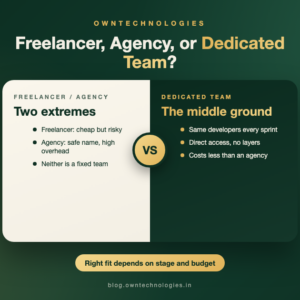
A solo freelancer is cheapest up front but carries the most risk if they disappear mid-project. A large US agency is the most expensive. A mid-sized development company with a dedicated team usually sits in between on price and includes project management, QA, and post-launch support. Our breakdown of mobile app development cost in India shows how rates compare by region.
What a Typical MVP Includes (and Leaves Out)
A well-scoped MVP in the $8,000 to $25,000 range usually includes:
- Sign up and login with email, phone, or Google
- One core user flow, built end to end
- A simple admin panel to manage users and content
- Basic notifications by email or push
- Payments, if charging is part of what you are testing
- Analytics to track sign-ups, activation, and retention
It usually leaves out: multiple languages, advanced reporting, referral programs, complex permission levels, offline mode, and every “nice to have” feature from the original wish list. Those belong in phase two, once real users tell you which ones matter.
The MVP Timeline: 8 to 12 Weeks
Time is money in software, so the timeline shapes the cost. A typical MVP runs through five stages.
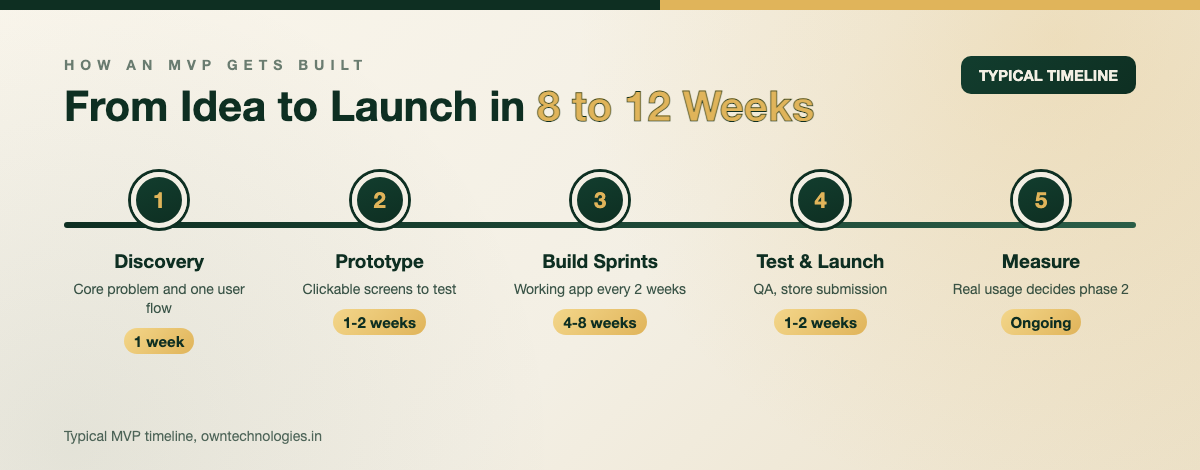
- Discovery (1 week): agree on the one problem, the one user flow, and what success looks like.
- Prototype (1 to 2 weeks): clickable screens you can show to five or ten potential customers before any code is written.
- Build sprints (4 to 8 weeks): development in two-week cycles, with a working version you can log into after each sprint.
- Test and launch (1 to 2 weeks): QA, fixes, and app store submission.
- Measure (ongoing): real usage data decides what goes into phase two.
A clear requirements document can take a week or more off discovery. Our free app requirements template shows what to write down before your first call.
Hidden and Ongoing Costs After Launch
The build is not the whole budget. Plan for these from day one:
- App store accounts: the Apple Developer Program charges an annual membership fee, and Google Play charges a one-time registration fee.
- Hosting and infrastructure: usually $50 to $300 per month for an MVP, growing with users.
- Third-party usage fees: payment processing, SMS, maps, and AI API calls are billed per use.
- Maintenance and fixes: set aside 15 to 20 percent of the build cost per year for updates, security patches, and OS changes.
- Phase two budget: keep at least 30 to 50 percent of your total budget in reserve for what users ask for after launch.
How to Keep Your MVP Cost Under Control
- Write one sentence for the MVP. “Customers can book a cleaner in under two minutes” is a scope. “An app for home services” is not.
- Test the prototype before coding. Five honest user interviews on clickable screens can save weeks of building the wrong thing.
- Launch on one platform first if your users are mostly on one, or use a cross-platform framework for both.
- Use proven building blocks. Login, payments, and admin panels should not be built from scratch. Ask what the team reuses.
- Ask for a fixed-scope phase one. A clear list of screens and features makes a fixed quote possible and protects you from surprise invoices.
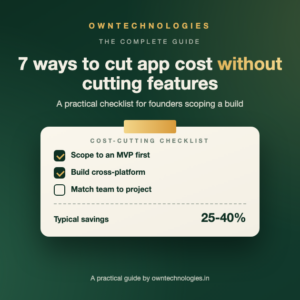
For more ways to trim a budget without hurting the product, see our guide on how to reduce mobile app development cost.
Signs Your MVP Quote Is Too Low or Too High
A quote far below the ranges above often means no QA, no admin panel, no documentation, or code you will not own. A quote far above them often means the team has scoped a full product and called it an MVP.
Before you sign, ask every vendor the same questions: which screens and features are included, who owns the source code, what happens after launch, how many revisions are covered, and what the payment milestones are. Comparing written answers side by side tells you much more than comparing totals.
How OwnTechnologies Builds MVPs
We start every MVP with a short discovery call to find the one flow worth building first, then share a clickable prototype before development begins. You get a working build after every two-week sprint and full ownership of the code at the end. We also offer 48-hour developer onboarding if you would rather hire a dedicated team by the hour or month.
Our mobile app development team builds MVPs for iOS and Android, and our website development team handles SaaS and web app MVPs. If your MVP is an internal tool or a sales system, our CRM development work is a good fit. You can see past projects in our portfolio.
Frequently Asked Questions
An MVP, or minimum viable product, is the smallest usable version of a product that solves one real problem for real customers. It is built to launch quickly, measure how people use it, and decide what to build next before spending the full budget.
Most MVPs cost $8,000 to $50,000 (around 6.5 lakh to 41 lakh INR) when built by an experienced offshore or hybrid team. A clickable prototype costs $2,000 to $6,000, a simple mobile app MVP $8,000 to $18,000, and a two-sided marketplace MVP $25,000 to $50,000.
A typical MVP takes 8 to 12 weeks from discovery to launch. Simple app MVPs can launch in 6 weeks, while marketplaces and AI-powered MVPs can take 12 to 16 weeks.
You can usually get a clickable prototype or a very narrow no-code tool for under $5,000. A coded MVP with a backend, admin panel, and app store release usually starts around $8,000 with an experienced team.
Plan for hosting ($50 to $300 per month at MVP scale), app store fees, third-party usage fees such as payments and SMS, and about 15 to 20 percent of the build cost per year for maintenance. Keep 30 to 50 percent of your total budget for phase two.
Final Thoughts
An MVP should cost enough to be genuinely usable and measurable, and no more. For most founders in 2026 that means $8,000 to $50,000 and 8 to 12 weeks, with a clear reserve for phase two. The cheapest MVP is the one that answers your biggest question with the smallest build.
Want a real number for your idea? Talk to OwnTechnologies for a free consultation. Send us a few lines about your product and we will reply with a phased MVP estimate, no commitment required.