You have a healthcare app idea, a budget, and maybe a developer lined up. Then someone asks: “Is it HIPAA compliant? What about India’s DPDP Act?” Most founders freeze at that point, because the rules sound like a legal project, not a product one.
This guide explains HIPAA and DPDP compliance in plain English: which law applies to your app, what each one actually asks your product to do, how they differ, and what compliance adds to your cost and timeline. It is written for founders and clinic owners, not lawyers, so treat it as a planning guide and confirm the final details with a qualified adviser.
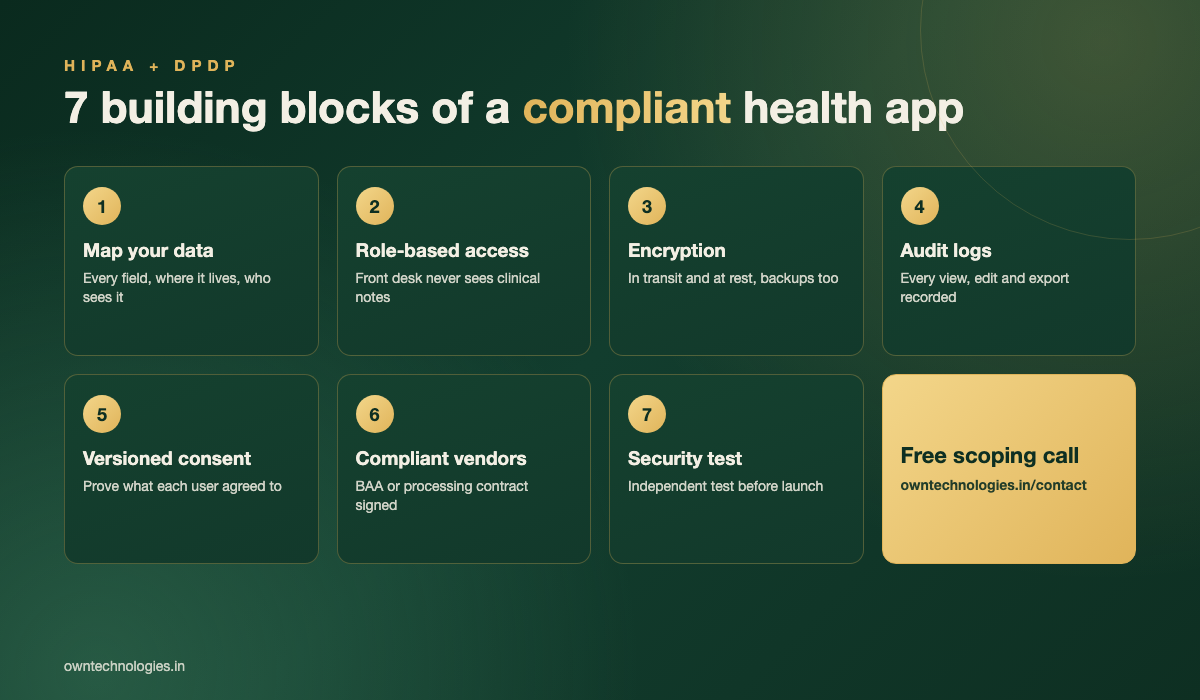
HIPAA and DPDP Compliance in One Paragraph
HIPAA is the US law that protects health information handled by healthcare providers, insurers, and the vendors who work for them. DPDP is India’s Digital Personal Data Protection Act, 2023, which protects all digital personal data, health data included, with its operating rules notified in late 2025 and being phased in. If your app serves US patients through a clinic, HIPAA is the one to plan for. If it serves users in India, DPDP applies. If it serves both, you design for both from day one, which is cheaper than retrofitting later.
Which Law Applies to Your Healthcare App?
This is the first question to answer, because it changes your architecture, your hosting, and your contracts. Use the table below as a starting point.
| Your app | Users in | Main law to plan for | Why |
|---|---|---|---|
| Clinic booking and patient records app built for a US practice | USA | HIPAA | The clinic is a covered entity and you become its business associate |
| Telemedicine platform for Indian patients and doctors | India | DPDP Act | You process digital personal data of people in India |
| Consumer fitness or diet tracker, not linked to a clinic | USA | FTC Health Breach Notification Rule (often not HIPAA) | HIPAA usually covers providers and their vendors, not standalone consumer apps |
| Diagnostics or pharmacy app serving India and the US | Both | DPDP and HIPAA | Each law follows the user and the business relationship, not the server location |
| Internal CRM for a hospital group in India | India | DPDP Act | Patient and staff data are personal data under DPDP |
The consumer app row surprises many founders. In the US, a wellness app that is not working on behalf of a clinic or insurer is often outside HIPAA, but the FTC Health Breach Notification Rule can still require you to notify users after a breach. “Not HIPAA” does not mean “no rules”.
HIPAA Basics: What It Asks Your App to Do
HIPAA protects PHI, or protected health information: anything that links a person to their health, care, or payment for care. A booking record that says “Jane Doe, knee physio, Tuesday 10am” is PHI. For a product team, HIPAA boils down to three sets of rules.
The Privacy Rule
Who may see and share PHI, and why. In the app this means role-based access (a receptionist sees the schedule, not clinical notes), a “minimum necessary” approach to what each screen shows, and patients being able to request their records.
The Security Rule
How electronic PHI is protected. Expect encryption in transit and at rest, unique user logins, automatic logout, audit logs of who viewed or changed what, backups, and a written risk assessment. Your hosting must also be HIPAA eligible. Large clouds such as AWS offer HIPAA-eligible services and will sign an agreement, but only the listed services are covered and you still have to configure them correctly.
The Breach Notification Rule
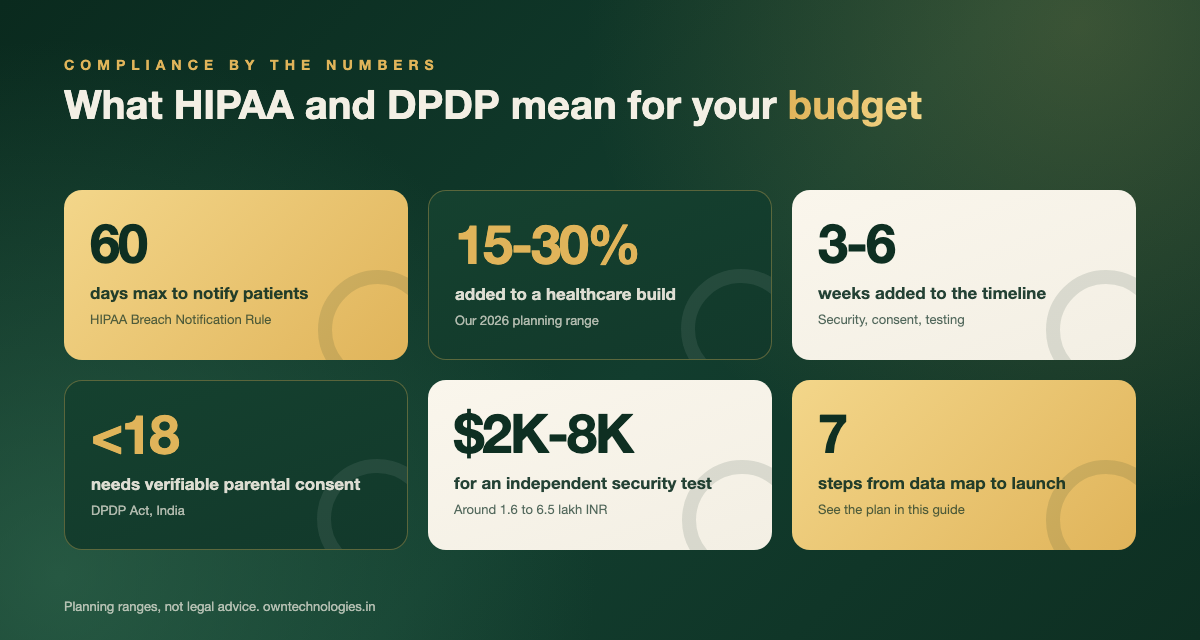
If PHI leaks, affected patients must be told without unreasonable delay and no later than 60 days after discovery, and larger breaches must also be reported to the US Department of Health and Human Services. Your app needs the logging to work out what happened and who was affected.
One more piece matters for anyone building for a US clinic: the Business Associate Agreement (BAA). The clinic signs a BAA with you, and you sign BAAs with vendors that touch PHI, such as your cloud host, SMS provider, or email service. No BAA, no PHI in that tool.
DPDP Basics: What India’s Law Asks Your App to Do
The DPDP Act covers all digital personal data, not only health data, and it applies to processing in India and to businesses outside India that offer services to people in India. The official text and rules are on the MeitY data protection framework page. Under DPDP your company is a “Data Fiduciary” and the patient is a “Data Principal”. In product terms, it asks for:
- Clear consent: a plain-language notice explaining what data you collect and why, with a specific opt-in, not a pre-ticked box buried in terms.
- Purpose limits: data collected for appointments should not quietly feed a marketing list.
- Easy withdrawal: withdrawing consent must be as easy as giving it, ideally one tap in the app.
- User rights: access, correction, and erasure requests, plus a named grievance contact.
- Children’s data: verifiable parental consent for users under 18, which matters for paediatric and school health apps.
- Security safeguards and breach reporting: reasonable protection, and notifying the Data Protection Board and affected users after a breach.
- Deletion: erase data once the purpose is served, unless another law requires you to keep it.
Penalties under DPDP can reach hundreds of crores of rupees for failing to take reasonable security safeguards, so this is not a box-ticking exercise for larger platforms.
HIPAA vs DPDP: The Key Differences
The two laws overlap on security but differ sharply on scope and consent. Here is the side-by-side view most founders need.
| Topic | HIPAA (USA) | DPDP Act (India) |
|---|---|---|
| What it protects | Health information held by providers, plans, and their vendors | All digital personal data, health included |
| Who must comply | Covered entities and business associates | Any Data Fiduciary processing data of people in India |
| Legal basis | Treatment, payment, and operations allowed without separate consent | Consent first, with a few listed exceptions |
| Vendor contracts | Business Associate Agreement required | Contract with each Data Processor required |
| Breach notice | Patients within 60 days, HHS for larger breaches | Data Protection Board and affected users |
| Children | No special consent rule under HIPAA itself | Verifiable parental consent under 18 |
| Deleting data | Retention driven by medical record laws | Erase once the purpose is served |
The practical takeaway: if you build to DPDP’s consent and deletion standards and HIPAA’s security and audit standards, you are covered on most of the product work for both markets.
Features Every Compliant Healthcare App Needs
Compliance shows up in the product as a handful of concrete features. If a quote does not mention these, ask why.
- Role-based access for doctors, nurses, front desk, and admins
- Encryption in transit (TLS) and at rest for databases, files, and backups
- An audit log that records every view, edit, export, and deletion of patient data
- Session timeout and optional two-factor login for staff
- A consent screen with versioning, so you can prove what each user agreed to and when
- Self-service data export and deletion requests
- No patient details in push notifications, SMS previews, or email subject lines
- Secure file storage for reports and prescriptions with expiring links
If you are still writing the brief, our app requirements document template has a section where these can go as non-negotiables, so every vendor quotes the same scope.
What Compliance Adds to Cost and Timeline
Compliance is not a separate product, it is extra work spread across design, development, hosting, and testing. From our project experience, these are realistic 2026 planning ranges for a small to mid-size clinic or telehealth app.
| Item | Typical cost | Time added |
|---|---|---|
| Access control, audit logs, consent screens | $3,000 to $8,000 (around 2.5 to 6.5 lakh INR) | 2 to 3 weeks |
| Encryption, secure file storage, key management | $1,500 to $4,000 (around 1.2 to 3.3 lakh INR) | 1 to 2 weeks |
| Compliant hosting and monitoring | $150 to $800 per month (around 12,000 to 66,000 INR) | Setup in days |
| Third-party security test | $2,000 to $8,000 (around 1.6 to 6.5 lakh INR) | 1 to 2 weeks |
| Policies, risk assessment, legal review | $1,500 to $5,000 (around 1.2 to 4 lakh INR) | Runs in parallel |
Put together, compliance usually adds 15 to 30 percent to a healthcare app build and 3 to 6 weeks to the timeline. For the full picture of what the app itself costs, see our healthcare app development guide.
A Step-by-Step Compliance Plan for Founders
You do not need a compliance department to start. You need a sequence.
- Map your data. List every piece of personal and health data the app collects, where it is stored, and who can see it.
- Decide which laws apply. Use the table above, then confirm with a lawyer for your markets.
- Pick compliant vendors. Hosting, SMS, email, video calls, and analytics must support a BAA (US) or a proper processing contract (India).
- Design consent and privacy screens early. They affect onboarding, so they belong in the first wireframes, not the last sprint.
- Build security into the first release. Audit logs and encryption are painful to add to a live app with real patient data.
- Test before launch. Run an independent security test and fix findings before patients sign up.
- Write the boring documents. Privacy notice, breach response plan, and a risk assessment you review every year.
Common Compliance Mistakes Healthcare Startups Make
Most problems we see are not exotic hacks. They are everyday shortcuts that nobody questioned.
Using everyday tools for patient data
Sending reports over personal WhatsApp, logging patients in a shared spreadsheet, or pasting notes into a chatbot without an agreement in place. Each one moves health data outside your controls.
Analytics that leak health data
Tracking pixels and analytics SDKs can capture page names such as “book-hiv-test” alongside a device ID. Strip health details from events or use a privacy-safe analytics setup.
Treating consent as a checkbox
Under DPDP a single “I agree to everything” box is weak. Separate consent for care, for reminders, and for marketing, and store which version each user accepted.
Leaving compliance to the end
Retrofitting audit logs and encryption after launch often costs twice as much as building them in, and it usually means a migration of live patient records.
How OwnTechnologies Builds Compliant Healthcare Software
We have delivered 100+ projects over 8+ years for clients in 15+ countries, including healthcare CRMs such as the Aarogya platform you can see in our portfolio. On healthcare work, the compliance features above are part of the scope from the first estimate, not an upsell later.
Whether you need a patient-facing app through our mobile app development team or a clinic back office through our custom CRM development service, we map your data flows, recommend compliant hosting, and document the controls so your lawyer and auditor have something concrete to review. The same thinking applies in other regulated sectors, as our fintech compliance checklist shows.
Frequently Asked Questions
Your app needs HIPAA compliance if it creates, stores, or shares health information on behalf of a US healthcare provider, health plan, or clearinghouse. Standalone consumer wellness apps are often outside HIPAA but may fall under the FTC Health Breach Notification Rule.
Yes. The DPDP Act, 2023 covers all digital personal data of people in India, including health data. Health apps need clear consent, purpose limits, security safeguards, breach reporting, and ways for users to access, correct, and erase their data.
Yes. Build to DPDP standards for consent, purpose limits, and deletion, and to HIPAA standards for security, audit logs, and vendor agreements. That combination covers most product requirements for both the US and Indian markets.
Compliance usually adds 15 to 30 percent to a healthcare app build and 3 to 6 weeks to the timeline, covering access control, audit logs, encryption, compliant hosting, a security test, and policy documents.
No government body certifies apps as HIPAA or DPDP compliant. Compliance is shown through your controls, contracts, risk assessments, and independent security testing, which is why documentation matters.
Final Thoughts
HIPAA and DPDP compliance feel heavy because they are usually explained by lawyers. For a founder, they come down to knowing which law applies, building a short list of security and consent features into the first release, choosing vendors who will sign the right agreements, and keeping the paperwork current. Plan for it from day one and it costs a fraction of fixing it after launch.
Planning a healthcare app for the US, India, or both? Book a free consultation with OwnTechnologies and we will map your data flows, flag the compliance work, and give you a clear scope and estimate.