Most fintech apps do not get delayed by code. They get delayed by a compliance question nobody asked in week one: who holds the licence, where the data lives, or how KYC records are kept. By the time a bank partner or regulator asks, the app has to be partly rebuilt.
This fintech app compliance checklist covers what founders building for India and the GCC (UAE, Saudi Arabia, Bahrain, Qatar) need to plan before development starts. You will get a market-by-market checklist, the security controls every app needs, and what compliance adds to cost and timeline. It is a build checklist, not legal advice, so confirm the final list with licensed counsel in each market.
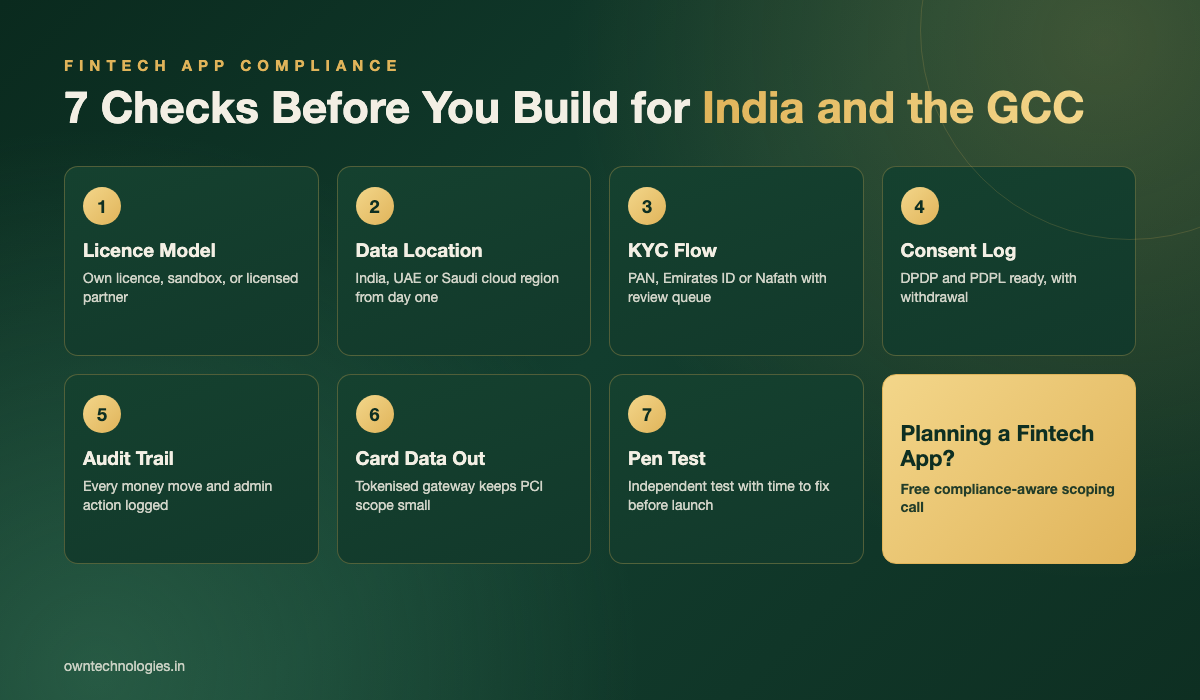
Why Compliance Decides Your Fintech Launch Date
In a normal app, compliance is a privacy policy and a cookie banner. In fintech, it shapes the architecture: where servers sit, how money moves, what gets logged, and which screens a user must see before they can transact.
That is why the same feature list can take 10 weeks for one founder and 6 months for another. The difference is usually whether compliance was scoped at the start or discovered at the bank partner’s due diligence call. Things that are cheap to decide early and expensive to change later:
- Hosting region: moving a live database to another country is a project on its own.
- Money flow: whether funds ever touch your account, or only a licensed partner’s.
- Audit logging: logs you did not capture from day one cannot be recreated for an auditor.
- Consent records: proof of what each user agreed to, and when.
- Identity data: which KYC documents you store yourself and which stay with a verification vendor.
First Question: Do You Need a Licence or a Licensed Partner?
Before any checklist, decide your regulatory model. Almost every early-stage fintech falls into one of three:
- Technology layer on a licensed partner: a bank, NBFC, or licensed payment company holds the licence and the money. You build the app and the customer experience. This is the fastest route to market and the most common for MVPs.
- Sandbox entry: regulators such as the RBI, ADGM, SAMA, and the Central Bank of Bahrain run regulatory sandboxes where you test a new product with limited users under supervision.
- Own licence: you apply as a payment aggregator, lender, or stored value provider. This takes longer, needs capital, and puts the full compliance burden on your team.
Your model decides how much of the checklist below you own directly and how much you inherit from the partner. Even in the partner model, the partner will audit your app against their obligations, so you still build most of it.
India Fintech Compliance Checklist
India’s rules come mainly from the Reserve Bank of India, plus the data protection law and CERT-In cyber security directions. The items that most often affect the build:
RBI rules for your product type
Lending apps follow the RBI’s digital lending rules: loan money flows directly between the borrower and the regulated lender’s accounts, borrowers get a Key Fact Statement before signing, and the lending partner must be named clearly in the app. Payment apps fall under payment aggregator or prepaid instrument rules.
KYC and video KYC
KYC follows the RBI’s KYC Master Direction. Most apps use a licensed verification vendor for PAN checks, DigiLocker documents, and video KYC. Plan for retry flows, manual review queues, and storing verification results rather than raw document images where possible.
Payment data localisation
Payment system data must be stored only in India. In practice that means hosting your production database in an Indian cloud region and checking that analytics, logging, and support tools are not quietly copying transaction data abroad.
DPDP Act and consent
The Digital Personal Data Protection Act 2023 and its rules, published by MeitY, require clear notice, purpose-bound consent, a way to withdraw consent, and breach notification. Build a consent log and a data deletion workflow, not just a privacy page.
CERT-In, tokenisation, and authentication
- Report cyber incidents to CERT-In within 6 hours and keep system logs for 180 days.
- Never store full card numbers. Use tokenised cards through your payment gateway.
- Use strong customer authentication (such as OTP plus device binding) for payments.
- If you handle suspicious transactions, plan for anti-money laundering reporting to FIU-IND through your regulated partner.
GCC Fintech Compliance Checklist
The GCC is not one market. Each country has its own central bank, and the UAE alone has three regulatory zones. Decide your first country before you design the data architecture.
United Arab Emirates
- Regulator: the Central Bank of the UAE onshore, the DFSA in DIFC, and the FSRA in ADGM. Your licence or partner decides which rules apply.
- Data: the federal Personal Data Protection Law onshore, with separate data protection laws in DIFC and ADGM.
- KYC: Emirates ID verification, with UAE PASS as a common digital identity option.
- AML: suspicious transaction reporting through the goAML system, handled with your licensed partner.
Saudi Arabia
- Regulator: the Saudi Central Bank (SAMA), with a well-used regulatory sandbox for new fintech models.
- Data: the Personal Data Protection Law, with strict limits on transferring personal data outside the Kingdom. Plan for in-country hosting.
- Identity: Nafath is the standard national digital identity for onboarding.
- Security: SAMA’s cyber security framework is expected by bank partners.
Bahrain and Qatar
Bahrain’s Central Bank runs one of the region’s oldest fintech sandboxes and is often the first stop for regional startups. Qatar’s Central Bank has its own fintech licensing track. Both have national data protection laws, so plan local hosting, consent records, and an audit trail.
India vs GCC Compliance at a Glance
| Area | India | UAE | Saudi Arabia |
|---|---|---|---|
| Main regulator | RBI (plus SEBI, IRDAI by product) | CBUAE, DFSA (DIFC), FSRA (ADGM) | SAMA |
| Data protection law | DPDP Act 2023 | Federal PDPL, DIFC and ADGM laws | PDPL |
| Data location | Payment data in India only | Depends on licence and zone | In-Kingdom hosting expected |
| Digital identity for KYC | PAN, DigiLocker, video KYC | Emirates ID, UAE PASS | Nafath |
| Sandbox available | Yes, RBI | Yes, ADGM and DIFC | Yes, SAMA |
| Fastest route for an MVP | Partner with a bank or NBFC | Partner with a licensed PSP or bank | Sandbox or licensed partner |
Security Controls Every Fintech App Needs
Regulators and bank partners in both regions ask for broadly the same technical controls.:
- Encryption: TLS 1.2 or higher in transit, and encryption at rest for databases, backups, and file storage.
- Access control: role-based access for staff, multi-factor login for the admin panel, and no shared accounts.
- Audit trail: every money movement, status change, and admin action logged with who, what, and when, and protected from editing.
- App hardening: root and jailbreak detection, certificate pinning, and no secrets inside the app bundle.
- Card data out of scope: use a gateway’s hosted fields or tokenisation so card numbers never touch your servers. That keeps your PCI DSS scope to the simplest self-assessment.
- Penetration test: an independent test before launch and after major releases.
Building Compliance Into the App, Not Bolting It On
Compliance is mostly software. Most of it sits in the backend and admin panel, which is why it gets underestimated. The components we scope into every fintech build:
- Consent service: stores each consent with version, timestamp, and channel, and supports withdrawal.
- KYC state machine: clear statuses (pending, verified, rejected, expired, re-KYC due) that block risky actions automatically.
- Transaction monitoring rules: limits, velocity checks, and flags that route unusual activity to a review queue.
- Compliance dashboard: an internal view for your ops team to review cases, export reports, and answer auditor requests.
- Data retention jobs: scheduled deletion or archiving when retention periods end.
Many of these look like CRM features: case queues, statuses, assignments, and notes. Teams that already use our CRM development work often build the compliance back office on the same platform instead of buying a separate tool.
What Compliance Adds to Cost and Timeline
Founders often budget for features and forget the compliance layer. These are typical 2026 planning ranges for the compliance portion of a fintech build with an experienced offshore or hybrid team.
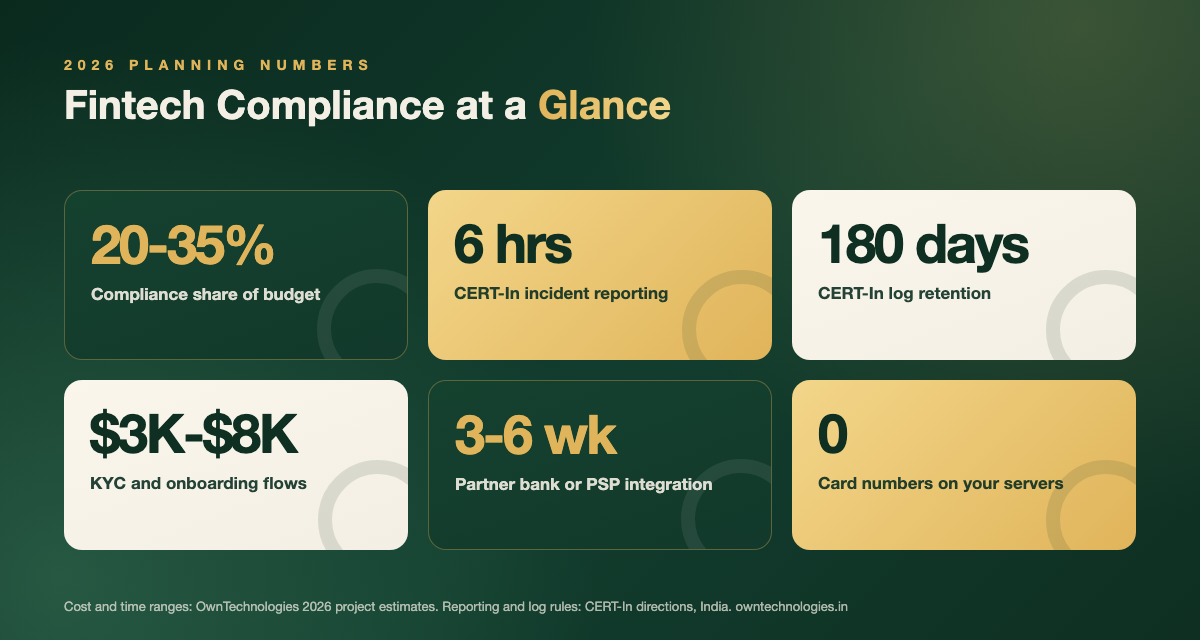
| Compliance item | What it covers | Typical cost (2026) | Time added |
|---|---|---|---|
| KYC and onboarding flows | Vendor integration, retries, manual review queue | $3,000 to $8,000 (around 2.5 to 7 lakh INR) | 2 to 3 weeks |
| Consent, audit trail, retention | Consent service, tamper-proof logs, deletion jobs | $2,500 to $6,000 (around 2 to 5 lakh INR) | 1 to 2 weeks |
| Compliance admin panel | Case review, reports, role-based access | $4,000 to $12,000 (around 3.4 to 10 lakh INR) | 2 to 4 weeks |
| Security hardening and pen test | App hardening, external penetration test, fixes | $3,000 to $10,000 (around 2.5 to 8.5 lakh INR) | 1 to 3 weeks |
| Partner bank or PSP integration | APIs, sandbox testing, partner audit support | $4,000 to $15,000 (around 3.4 to 12.7 lakh INR) | 3 to 6 weeks |
As a rule of thumb, compliance adds 20% to 35% to a fintech budget. Licensing fees, legal opinions, and vendor per-check charges come on top. For the full picture of what drives fintech pricing, see our fintech app development cost guide.
Common Fintech Compliance Mistakes
- Hosting in the wrong region: launching on a US or EU cloud region, then migrating under pressure.
- Routing money through your own account: collecting funds before passing them to a lender or merchant can make you an unlicensed payment business.
- Logging sensitive data: full card numbers, OTPs, or ID images ending up in error logs and analytics tools.
- No written scope: building without a requirements document that lists each regulatory screen and rule.
- Treating the pen test as the last step: leaving no time to fix what it finds before the launch date.
The fix for most of these is a proper scope before the first sprint. Our app requirements document template has a section you can use to list every compliance rule next to the feature it affects.
How OwnTechnologies Approaches Fintech Builds
We start with a compliance scoping session: your market, your regulatory model, and your partner’s requirements. That becomes a feature list where every regulatory item has an owner and a sprint. We then build in two-week sprints, with security controls and audit logging in place from the first release, not added before launch.
Our mobile app development team has delivered 100+ projects across 8+ years for clients in 15+ countries, including India, the UAE, the UK, and the USA. If you also need a customer web portal, our website development team builds it on the same backend. You can see our work in the portfolio.
Frequently Asked Questions
It depends on the product, but most apps need to follow the RBI rules for their product type (digital lending, payment aggregator, or prepaid instruments), the KYC Master Direction, payment data localisation, the DPDP Act 2023 for consent and data rights, and CERT-In directions for incident reporting and log retention.
If your app holds or moves customer money, someone in the chain needs a licence from the Central Bank of the UAE, the DFSA in DIFC, or the FSRA in ADGM. Many startups launch by partnering with a licensed bank or payment company, or by entering a regulatory sandbox.
Saudi Arabia’s Personal Data Protection Law restricts transfers of personal data outside the Kingdom, and SAMA-regulated partners generally expect in-country hosting. Plan for a Saudi cloud region from the start and confirm the details with your partner and counsel.
Compliance work such as KYC flows, consent and audit logging, a compliance admin panel, security hardening, and partner integration typically adds 20% to 35% to a fintech build, or roughly $15,000 to $50,000 (around 12.7 to 42 lakh INR), before licensing and legal fees.
If card numbers never touch your servers because you use a payment gateway’s hosted fields or tokenisation, your PCI DSS scope is usually limited to a short self-assessment questionnaire. Storing or processing raw card data puts you into full PCI DSS scope, which is far more expensive.
Final Thoughts
Fintech compliance in India and the GCC comes down to a few early decisions: who holds the licence, where the data lives, how identity is verified, and whether every action leaves an audit trail. Make those calls before the first sprint and compliance becomes part of the build plan. Leave them late and they become the reason your launch slips.
Planning a fintech app for India, the UAE, or Saudi Arabia? Talk to OwnTechnologies for a free consultation. Share your product idea and target market, and we will send back a compliance-aware scope and a phased estimate, no commitment required.