Most marketplace apps do not fail because the code is bad. They fail because visitors cannot tell, in the first ten seconds, who the platform is for, what they can do on it, and why they should trust it with their work or their money.
We ran into exactly this problem while building Hissini, a creative marketplace that connects people with ideas to the musicians, actors, and producers who need them. This post shares the lessons from that build, the features every marketplace needs, and what marketplace app development costs in 2026, so you can plan yours with fewer surprises.
What Hissini Is and Why It Was a Hard Marketplace to Explain
Hissini is a creative marketplace with an unusual model. On one side are Inspirers, people who share scripts, lyrics, riffs, monologues, and raw ideas. On the other side are musicians, actors, directors, and film producers who are looking for inspiration they can preview, unlock, and license for their own projects.
That is a new idea for most people. A visitor needs to understand who uploads, who reviews the work, who pays to unlock it, and how the original creator earns when rights are transferred. If any part of that chain is unclear, the platform sounds like a vague “social network for artists”, and nobody signs up for one of those.
The brand also had to feel premium and cinematic, because its audience works in music and film, while still being easy to scan for writers, musicians, and producers who each arrive with a different goal.
What We Built: Three Products, One Story
Our work on Hissini covered three connected products. You can see the full Hissini case study in our portfolio.
| Product | Status | Its job |
|---|---|---|
| Website | Live | Explain the see, unlock, use flow, creator roles, expert review, and earnings, and let creators explore and engage today |
| Mobile app (iOS and Android) | Coming soon | Bring the same marketplace to phones, positioned clearly on the site so visitors know it is on the way |
| Promo video | Live | Sell the “creativity meets opportunity” story in campaigns and social placements |
The key decision was that all three had to carry identical energy. Someone who sees the promo on social media and then lands on the website should feel they are looking at the same product, not two different brands.
Lesson 1: Explain the Core Loop Before You Add Features
Every successful marketplace has one simple loop at its centre. For Hissini it is see, unlock, use: preview an idea, pay to unlock it, then use it in your own work with the rights sorted. For a ride app it is request, match, ride. For a freelance platform it is post, hire, pay.
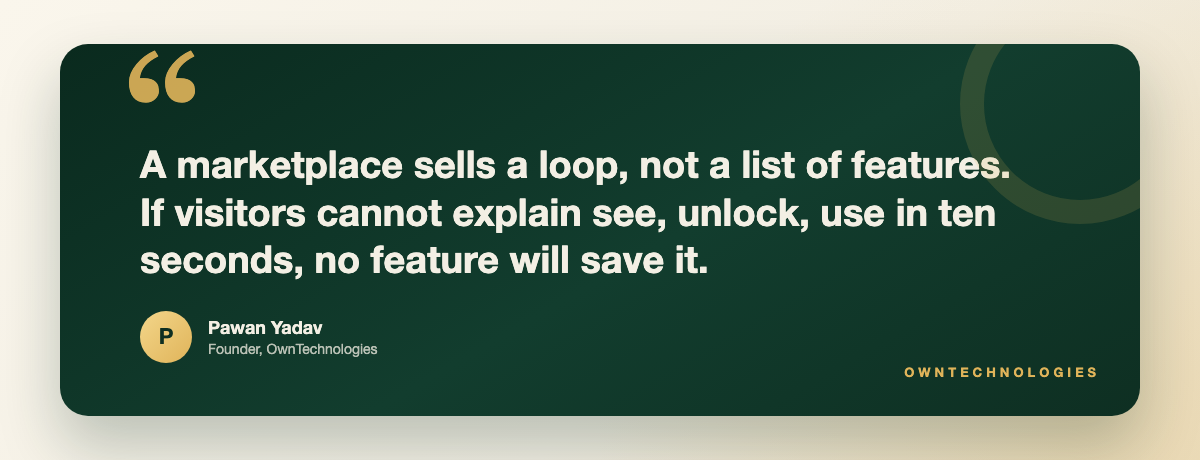
We structured the Hissini site around that loop: creator roles first, then how it works in steps, then inspiration sharing, expert review, the unlock and rights purchase, and finally earnings. Features like AI matching and leaderboards come after, so they support the loop instead of burying it.
Before you write a single user story for your own marketplace, write your loop in three words. If you cannot, your visitors will not be able to either.
Lesson 2: Design for Every Side of the Marketplace
A two-sided marketplace is really two products sharing one database. Hissini actually has more than two sides, and each one asks a different question when it arrives:
- Inspirers: Is my idea safe here, and how do I get paid?
- Musicians: Can I find lyrics or riffs that fit my sound quickly?
- Actors and directors: Are there monologues and scripts worth my time?
- Film producers: Can I license what I unlock without legal headaches?
- Expert reviewers: How do I review and rate submissions?
Your landing page, onboarding, and dashboards should answer each side’s question in its own words. A single generic sign-up flow for everyone usually converts the side you designed it for and loses the rest.
Lesson 3: Trust Features Are Core Features
In a creative marketplace, the biggest fear is theft. Nobody uploads their best lyrics to a platform that might let someone copy them for free. That is why Hissini’s site highlights expert review, protection, attribution, and leaderboards as part of the main story, not hidden in the footer.
The same principle applies to any marketplace. Buyers need proof that sellers are real. Sellers need proof that they will be paid. Trust features to plan from day one include:
- Verified profiles and a review or rating system
- Previews that show enough to judge quality without giving the work away
- Clear attribution so the original creator is always credited
- Transparent payout terms shown before anyone uploads
- A moderation or expert review step for new listings
Lesson 4: Get Payments and Payouts Right Early
A normal online store takes money in. A marketplace takes money in, keeps a commission, and pays the rest out to many sellers, sometimes in different countries. That is a very different engineering problem.
Do not build split payments yourself. Use a payment platform designed for marketplaces, such as Stripe Connect for international payouts or Razorpay Route for Indian sellers. They handle seller onboarding, identity checks, and split settlements, which saves weeks of work and a lot of compliance risk.
Decide these rules before development starts, because they shape your database and admin panel:
- Your commission model: flat fee, percentage, subscription, or a mix
- When sellers get paid: instantly, after delivery, or on a weekly cycle
- How refunds and disputes work, and who decides them
- For content marketplaces like Hissini, exactly what rights a buyer gets when they unlock
Lesson 5: Launch on the Web First and Keep One Story Everywhere
Hissini’s website is live while the iOS and Android apps are marked as coming soon. That is a sensible order for most new marketplaces. A web launch lets you test the loop, gather the first supply of listings, and fix onboarding without waiting on app store reviews for every change.
When you do move to mobile, read the Apple App Store Review Guidelines early, because rules on digital content purchases affect how an unlock-and-pay model works inside an app. Our app store launch checklist covers the rest.
The other half of this lesson is consistency. We edited the Hissini promo video to follow the same narrative arc as the site: inspiration sharing, discovery, unlock, and rights, with pacing suited to social placements. When ads, website, and app all tell one story, every rupee or dollar of marketing works harder.
Core Features Every Marketplace App Needs
You do not need everything on day one. Here is how we usually split marketplace features between the first release and later phases:
| Feature | Why it matters | Phase |
|---|---|---|
| Role-based sign-up and profiles | Each side sees onboarding written for them | MVP |
| Listings with previews | Buyers judge quality before they pay | MVP |
| Search and filters | Supply is useless if buyers cannot find it | MVP |
| Checkout with split payouts | The platform earns, sellers get paid automatically | MVP |
| Admin panel and moderation | Your team approves listings and resolves disputes | MVP |
| Reviews, ratings, leaderboards | Trust and motivation for top sellers | Phase 2 |
| In-app messaging and collaboration | Keeps deals on the platform | Phase 2 |
| AI matching and recommendations | Surfaces the right supply once you have enough of it | Phase 2 or 3 |
| Native iOS and Android apps | Retention and notifications once the loop is proven | Phase 2 |
The admin panel is the feature founders most often underestimate. Your operations team will live in it every day. We build these alongside our CRM and admin panel development work, and the same approach powered our Urban Venue booking platform.
Marketplace App Development Cost in 2026
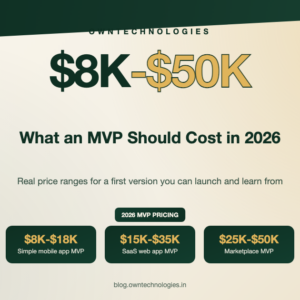
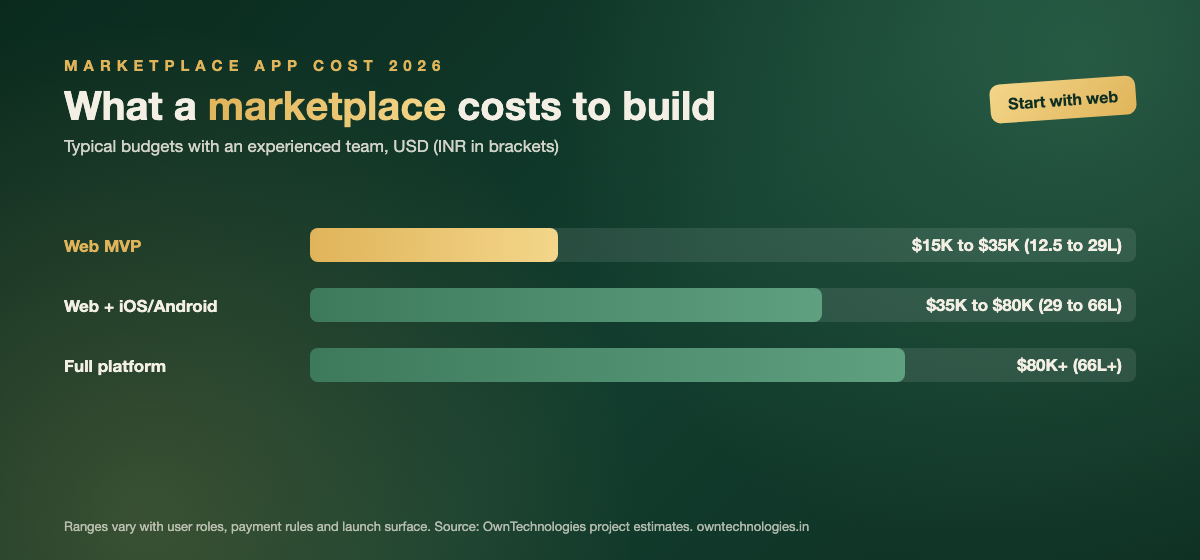
Marketplaces cost more than a standard app because you are building at least two user experiences, a payment layer with payouts, and an admin panel. These are typical ranges with an experienced team:
| Scope | What you get | Typical cost | Timeline |
|---|---|---|---|
| Web marketplace MVP | Two roles, listings, search, checkout with payouts, basic admin | $15,000 to $35,000 (around 12.5 to 29 lakh INR) | 10 to 14 weeks |
| Web + iOS and Android apps | Everything above plus native apps, push notifications, reviews | $35,000 to $80,000 (around 29 to 66 lakh INR) | 4 to 7 months |
| Full platform | Multiple roles, expert review, messaging, AI matching, analytics | $80,000+ (around 66 lakh INR and up) | 7 months+ |
The biggest cost drivers are the number of user roles, how complex the payment and rights rules are, and whether you launch on web, mobile, or both. If you want to start lean, our guide to MVP development cost in 2026 shows how to cut scope without cutting the loop.
How to Plan Your Marketplace Build: 5 Steps
- Write the loop: three words that describe what happens on your platform, like see, unlock, use.
- List every role: for each one, write the question they arrive with and the action you want them to take.
- Fix the money rules: commission, payout timing, refunds, and rights, before design starts.
- Pick the launch surface: usually a marketplace website first, then mobile apps once the loop works.
- Plan supply before launch: a marketplace with no listings is an empty shop. Line up your first sellers before you open to buyers.
Frequently Asked Questions
A web marketplace MVP usually costs $15,000 to $35,000 (around 12.5 to 29 lakh INR). Adding native iOS and Android apps takes it to $35,000 to $80,000 (around 29 to 66 lakh INR), and a full platform with AI matching and messaging starts around $80,000.
A web marketplace MVP takes around 10 to 14 weeks. A version with native mobile apps takes 4 to 7 months, and a full platform with advanced features can take 7 months or more.
For most new marketplaces, web first is safer. You can test the core loop, onboard your first sellers, and fix problems quickly without app store reviews, then launch iOS and Android apps once the model is proven.
Most use a marketplace payment platform such as Stripe Connect or Razorpay Route. These collect the buyer payment, keep the platform commission, and pay sellers automatically, including identity checks and settlement.
We built the Hissini website that explains its see, unlock, use creative marketplace, positioned its iOS and Android app as coming soon, and edited a campaign promo video that tells the same creativity meets opportunity story.
Final Thoughts
Building Hissini taught us that marketplace app development is less about the number of features and more about clarity. Explain the loop, speak to every side, treat trust as a core feature, sort out payments early, and keep one story across web, app, and marketing.
Get those right and the code becomes the easy part. We have delivered 100+ projects for clients in 15+ countries, and the marketplaces that grow are always the ones that are easiest to understand.
Planning a marketplace? Share your idea and we will map the loop, the roles, and a realistic budget with you in a free consultation. Talk to the OwnTechnologies team.