A US development shop just quoted you $180,000 for an app. An Indian team quoted $35,000 for what looks like the same scope on paper. Both numbers can be honest quotes, and the gap between them is exactly why so many founders stall on this decision.
This guide breaks down real 2026 mobile app development costs in the USA versus India, explains what actually drives the price gap, and gives you a framework for deciding which market fits your project, timeline, and risk tolerance.
Mobile App Development Cost in the USA vs India: The Short Answer
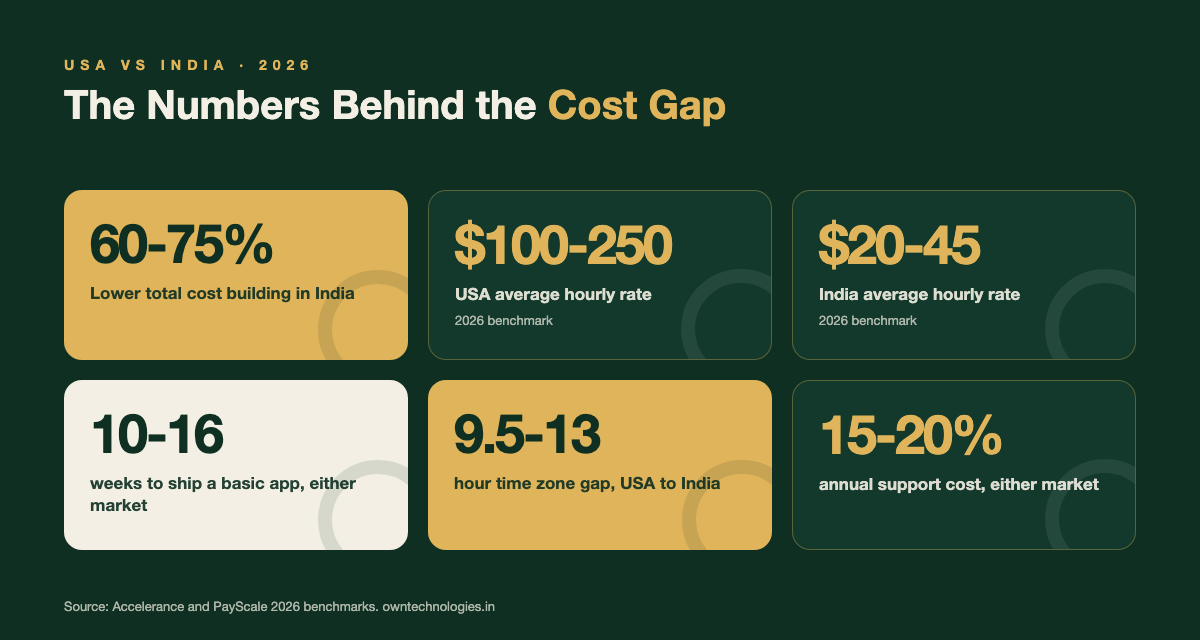
A US agency typically charges $40,000 to $250,000+ for a mobile app depending on complexity. An experienced Indian development company delivers the same scope for roughly $12,000 to $90,000, about 60 to 75 percent less. Both figures assume an experienced team, not the cheapest bidder on a freelance marketplace.
| App complexity | USA cost range | India cost range | Typical timeline |
|---|---|---|---|
| Basic app (single platform focus, core features) | $40,000 to $80,000 | $12,000 to $25,000 | 10 to 16 weeks |
| Mid-complexity (e-commerce, booking, on-demand) | $80,000 to $150,000 | $25,000 to $50,000 | 4 to 6 months |
| Marketplace or multi-vendor platform | $150,000 to $250,000 | $45,000 to $90,000 | 5 to 8 months |
| Enterprise app with integrations and compliance | $250,000+ | $90,000 to $180,000+ | 8 months+ |
In INR, that India range works out to roughly 10 lakh to 1.5 crore depending on scope. For a full breakdown of pricing inside the Indian market alone, see our guide on mobile app development cost in India.
Why the Price Gap Is So Wide
The gap is not developers in India doing less work for less money. It comes down to cost of living, currency, and business overhead, all of which show up directly in the hourly rate a client pays.
| Region | Average hourly rate (USD) |
|---|---|
| United States | $100 to $250 |
| Western Europe | $70 to $150 |
| Eastern Europe | $40 to $80 |
| India | $20 to $45 |
These figures line up with global outsourcing rate benchmarks published by Accelerance, and with India-specific salary data from PayScale. A senior developer earning $140,000 a year in San Francisco and a senior developer earning the India-market equivalent are both being paid fairly for their local market. The client simply pays less because the cost of running a development business is lower in India.
Cost of living and office overhead
Office space, healthcare contributions, and general living costs in US cities are several times higher than in Indian tech hubs like Delhi NCR, Bengaluru, or Pune. Agencies price their hourly rate to cover these costs, not just the developer’s take-home pay.
Currency exchange
A rupee-denominated salary converts to a small dollar figure at current exchange rates, even when it represents a strong income locally. This is the single biggest reason the same skill level costs less in USD terms.
Talent pool size
India graduates one of the largest pools of engineering talent in the world every year. A larger supply of qualified developers keeps rates competitive without necessarily lowering quality, especially at established development companies with a real portfolio.
What You Actually Get for the Price Difference
Price alone does not tell you what to expect. Here is what typically changes, and what does not, between the two markets.
Code quality and technical skill
Not automatically different. An established Indian development company with 8 or more years of client work and a real portfolio ships production apps for banks, healthcare providers, and logistics firms every day. The risk is not the country, it is picking an unvetted freelancer anywhere in the world.
Communication and time zone overlap
This is the real tradeoff. India is 9.5 to 13 hours ahead of US time zones, so live daily standups need one side to work outside normal hours. Most India-based teams solve this with a few overlapping hours in the evening IST or early morning IST, plus async updates through the rest of the day.
Legal protections and IP
A US-based company is easier to sue in a US court if something goes wrong. A reputable Indian development company will still sign a contract that assigns you full IP ownership and includes confidentiality terms, but enforcement across borders is slower. Check this before signing with any vendor, in any country.
Hidden Costs Nobody Mentions in the Quote
- App store fees: $99 a year for Apple, a one-time $25 for Google Play, the same regardless of where you build.
- Third-party APIs: Payment gateways, maps, and SMS or WhatsApp messaging charge per use and are billed separately from the build.
- Post-launch support: Budget 15 to 20 percent of the build cost per year for bug fixes and OS updates, in either country.
- Project management overhead: Some agencies bill a separate PM or account manager rate. Ask if it is included in the hourly quote.
- Design iteration: A quote that includes only two rounds of design revisions will cost more once you need a third. Confirm the number of rounds up front.
When Hiring a US-Based Team Makes Sense
A US team is worth the premium when your app touches heavily regulated data that needs a local legal presence, when your product needs constant same-time-zone collaboration with an in-house team, or when budget genuinely is not the limiting factor and speed of live communication matters more than cost.
When India or a Hybrid Team Makes Sense
India makes sense for the large majority of startups and small to mid-size businesses: when the budget needs to stretch across a longer roadmap, when the founder can commit to a few overlapping hours a day, and when the priority is a working product in market rather than a local office relationship. A common middle path is a hybrid model: a US-based product lead handling client-facing decisions, with the Indian team handling the build. See our mobile app development services for how that setup typically runs.
How to Vet a Development Partner in Either Market
- Ask for apps they shipped, not just designs. A live App Store or Play Store link tells you more than a portfolio screenshot.
- Confirm who owns the code. The contract should state that source code, repository access, and IP transfer to you on final payment.
- Get the team structure in writing. Know exactly who is a developer, who is a project manager, and who you will actually talk to.
- Check reviews outside their own website. Clutch, Google reviews, and direct references from past clients matter more than testimonials on the agency’s own page.
- Ask how they handle time zone overlap. A vendor with a clear daily overlap window and async reporting process has done this before.
- Start with a paid trial sprint. A one to two week paid sprint on a real feature tells you more about working style than any sales call.
What a Real Cross-Border Project Looks Like
Most OwnTechnologies clients outside India follow the same pattern: a founder or product lead in the USA, UK, Canada, or Australia sets direction on a weekly call, and the India-based team ships in two-week sprints with a working build after every sprint. Clients across 15+ countries have used this model to launch apps in 10 to 20 weeks depending on scope. You can see examples in our portfolio. If your app needs city-by-city cost comparisons within India specifically, our guide on app development cost across Indian cities breaks that down further.
Frequently Asked Questions
India-based development typically costs 60 to 75 percent less than a comparable US agency for the same scope, mainly because of lower cost of living, currency exchange, and business overhead rather than lower skill levels.
Quality depends on the specific company, not the country. Established Indian development companies with real portfolios and 8 or more years in business regularly build production apps for US, UK, and Australian clients. The risk lies in choosing an unvetted freelancer, which applies in any country.
Timelines are similar for the same scope, typically 10 to 16 weeks for a basic app and 4 to 8 months for mid-complexity to enterprise apps, since the difference is price per hour rather than working speed.
Many do, especially at the MVP stage when budget needs to stretch further. A common hybrid approach keeps a US-based founder or product lead making client-facing decisions while the India-based team handles development, testing, and deployment.
US developers average $100 to $250 per hour, Eastern European developers average $40 to $80, and India-based developers average $20 to $45, based on 2026 outsourcing rate benchmarks.
Yes. Sign a contract that explicitly assigns you IP ownership and source code rights on final payment, the same way you would with any vendor regardless of country.
Final Thoughts
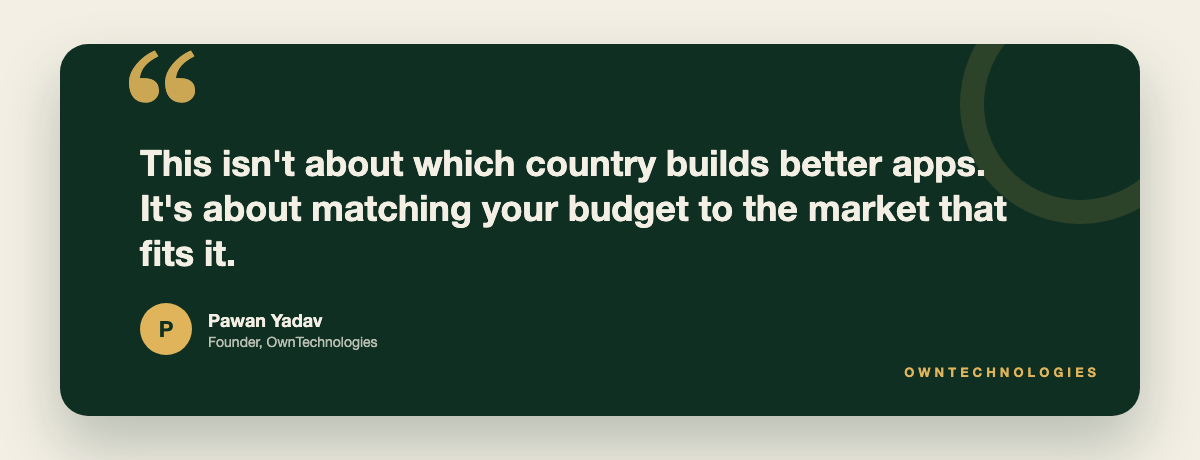
The USA vs India decision is not really about which country builds better apps. It is about matching your budget, timeline, and communication needs to the market that fits them. For most founders outside India, a vetted India-based team or a hybrid setup delivers the same app for a fraction of the cost, without a meaningful quality tradeoff, as long as the vendor is chosen carefully. Global mobile app usage keeps climbing year over year according to Statista, which makes getting the cost equation right early even more important.
Want a real number instead of a range? Talk to OwnTechnologies for a free scoping call. Send us your app idea and we will send back a phased cost and timeline estimate within 48 hours, no commitment required.