Most local businesses claim their Google Business Profile, fill in the hours, upload a few photos and never touch it again. The Posts section sits empty, which is a shame, because it is the one part of the profile you fully control and can change whenever you like.
This is what Google Posts actually do, eight ideas worth posting, and the honest limits of what to expect from them.
What a Google Post is, and what it is not
A Google Post appears on your Business Profile in Search and Maps. It carries an image, a short block of text, an optional button, and for most types it drops off after seven days unless you refresh it.
What it is: a free, controllable surface that shows up next to your reviews and your phone number, at the exact moment someone is deciding whether to call you.
What it is not: a ranking lever. Posting does not directly move you up the map pack. People who promise otherwise are selling something. What posting does is improve the quality of the moment after someone finds you, and that is worth doing on its own terms. Google’s own guidance on posts frames them as a way to share updates and offers, not as a ranking feature, which is a useful sanity check against anyone selling them as one.
The seven day rule changes how you should write
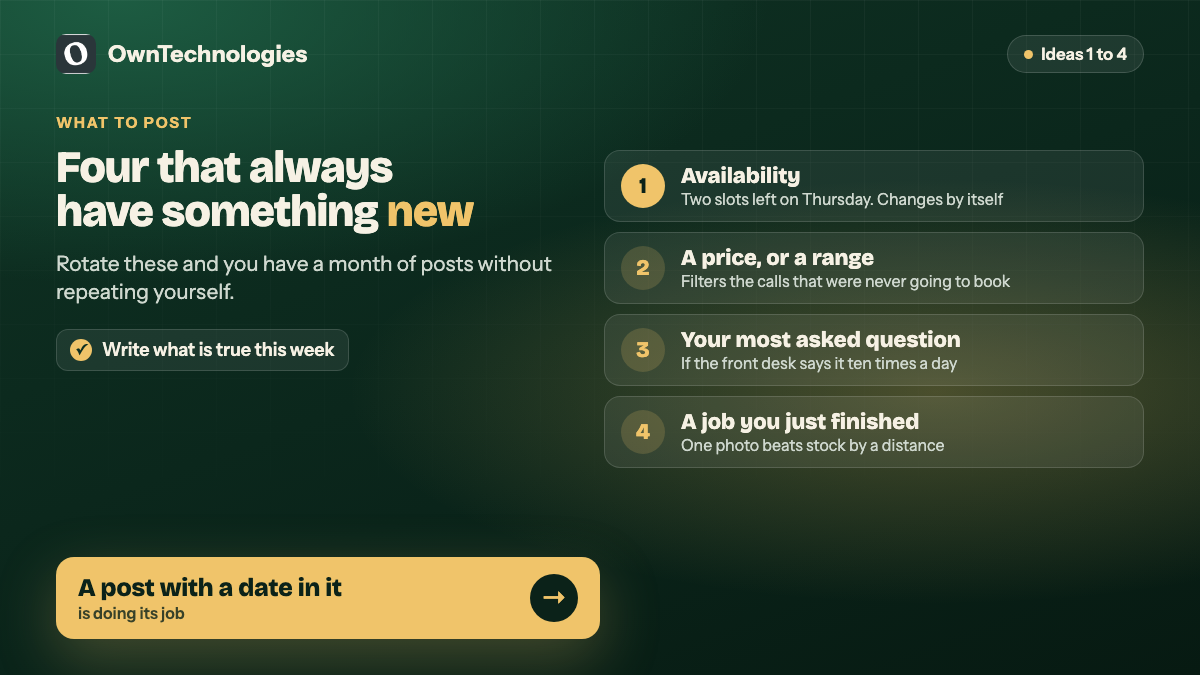
Because most posts expire in a week, there is no point writing an evergreen essay. Write things that are true this week. A post with a date in it is doing its job. A post that could have been published any time in the last two years is wasting the slot.
Eight ideas worth posting
1. This week’s actual availability
“Two slots left on Thursday afternoon” does more work than any amount of describing your service. It answers the question the person is holding, it is obviously current, and it creates a small, honest reason to act now.
This is the single highest value post for any appointment business, and almost nobody does it. It is also the easiest to keep writing, because the answer changes by itself every week. We make a similar argument about publishing batch timings in our local SEO guide: the information a customer has to phone you for is usually the information worth publishing.
2. A price, or a price range
Most local businesses hide pricing and then wonder why they field so many unqualified calls. A post saying a standard service starts at a specific number filters the people who were never going to book, and reassures the ones who were.
You do not have to publish a full price list. One number, honestly framed, changes the quality of your enquiries.
3. The answer to the question you get asked most
Every business has one. Do you take walk-ins. Is there parking. Do you see children. How long does it take.
If your front desk answers it ten times a day, it belongs on the profile, not just in their head. You will not stop the calls entirely, but you will shorten them, and shorter calls mean your team gets through more of them.
4. A piece of work you just finished
Not a portfolio. One job, this week, with a sentence about what the problem was. A photo of the finished thing beats a stock image by a distance, and it quietly demonstrates that you are busy, which is its own trust signal.
5. Something genuinely new
A new service, a new member of staff, new equipment, extended hours. These are the posts people actually read, because they carry information rather than persuasion.
A new member of staff is an underrated one for service businesses. It tells a nervous customer there is capacity, and it puts a human face on the listing.
6. A seasonal or local hook
Not “Happy Diwali” with a generic graphic. Something operationally useful: changed hours over a festival, a monsoon related service, a reminder that something needs doing before winter.
Local and timely is what this surface is for. Google shows your profile to people nearby, right now.
7. An offer with a real deadline
Offers are their own post type with start and end dates. The important part is that the deadline is real. A discount that has been ending since March teaches people to ignore you.
Use these sparingly. A profile that is nothing but offers reads as a business that cannot sell at full price.
8. A short, specific answer to a bad assumption
If people assume you are expensive, or only serve one kind of customer, or are closed on Sundays when you are not, say so plainly. One post. No defensiveness.
This is the post most businesses never think of, and it often does the most work, because it removes a reason not to call.
What to post, how often
| Frequency | Realistic for | What to expect |
|---|---|---|
| Once a week | Most small businesses | The profile always has a live post, which is the point |
| Two or three a week | Businesses with changing availability or stock | Modest lift in profile interactions |
| Daily | Almost nobody | Diminishing returns, high chance of abandonment |
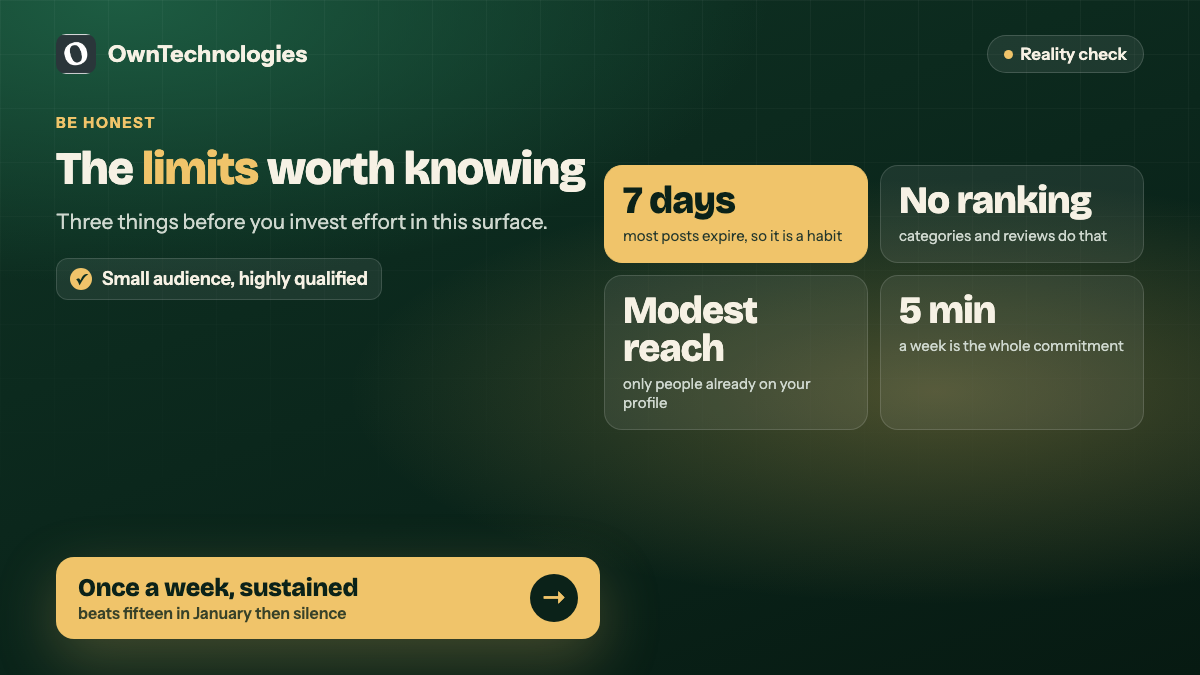
Once a week, sustained, beats a burst of fifteen posts in January followed by silence. The profile with a current post looks open for business. The profile whose last post was eleven months ago quietly says the opposite.
The honest limits
Three things worth knowing before you invest effort:
- **Posts expire.** Most types drop off after seven days. This is a maintenance commitment, not a one-off task.
- **They do not directly improve ranking.** Categories, reviews, proximity and your website do that. Posts affect what happens after you are found.
- **Reach is modest.** These are seen by people already looking at your profile. That is a small number, but it is the most qualified small number you will get all week.
The reason to do it anyway is that the effort is tiny and the audience is people actively deciding about you. Measured against almost any paid channel, that is an unusually good trade for five minutes of someone’s week.
A simple routine that survives a busy week
- Pick one day. Friday works, because availability for next week is known.
- Write one post about something true this week.
- Take one photo on your phone. Real beats polished.
- Check the previous post’s views once a month, not daily.
- When you run out of ideas, go back to number one on this list. Availability is always fresh.
Five minutes, once a week. The businesses that do this are not doing anything clever. They are just the ones still doing it in month six.
Frequently Asked Questions
Once a week is the right target for most local businesses. It keeps a live post on the profile without becoming a chore you abandon. Consistency matters far more than volume.
Not directly. Ranking is driven mainly by categories, proximity, reviews and your website. Posts influence whether someone who has already found you decides to call, which is a different and still valuable job.
Most types stay live for seven days and then move out of the main view. Offer posts run to the end date you set. Plan for it as a weekly habit rather than a one-time setup.
Around 1200 by 900 pixels or similar landscape works well, and avoid putting important text near the edges because the crop varies by device. A real photo of your work or premises outperforms stock imagery.
You can, and it will stop working. The value of this surface is that it is current. Rotating availability, a price, a finished job and an FAQ answer gives you a month of posts without repeating yourself.
Usually yes, because the views you get are people already looking at your business at the moment they are deciding. Few but qualified beats many but irrelevant.
Final Thoughts
Google Posts will not transform your traffic. What they do is make the moment of decision slightly better, every week, for free, on a surface you control completely.
If your profile has an empty Posts section and you want a second opinion on the whole listing, send us your business name and city and we will tell you what we would change, with no obligation. You can also read our 12-point Google Business Profile checklist, or see our SEO services and website development work.