Every week a local business owner gets an email offering “100 high quality backlinks for $49”. Most of those links will do nothing, and some will do harm. Yet backlinks genuinely matter for local search, which is why the offer keeps arriving.
This guide explains how backlinks actually work for a local business website, which links are worth having, where a clinic, restaurant or coaching centre can earn them without buying anything, and what to avoid.
What a backlink is, in plain English
A backlink is a link from another website to yours. Search engines treat links as one signal of how trustworthy and relevant a page is. Google describes links as one of the ways it discovers pages and understands how they relate, in its overview of how Search works.
Not all links count the same. A link from your city’s chamber of commerce says something real about your business. A link from a page of 500 random links on a site nobody visits says nothing at all.
Do backlinks matter for local businesses?
Yes, but they are not the whole story. For local searches like “dentist near me” or “best biryani in Gurugram”, Google’s own guidance on local ranking names three factors: relevance, distance and prominence. Prominence includes how well known your business is across the web, which is where links, mentions and reviews come in.
In practice, for a local business:
- **Your Google Business Profile and reviews** usually move map pack rankings more than anything else.
- **Backlinks** help both the map pack and the normal results below it, especially in competitive categories.
- **Consistent name, address and phone details** across directories support both.
We cover the profile side in Google Business Profile post ideas and the full 90-day local plan in local SEO for dentists, which applies to most local businesses.
What makes a backlink good for a local business
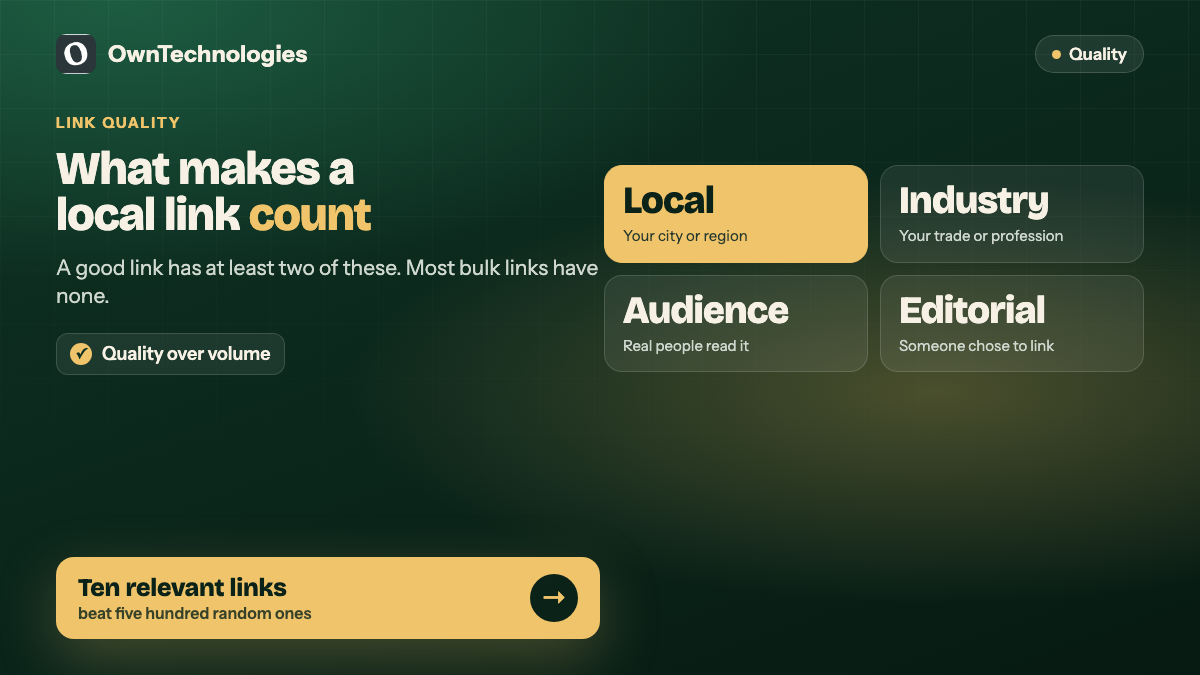
A good local link usually has at least two of these qualities:
| Quality | Good example | Weak example |
|---|---|---|
| Local relevance | Your city’s business association | A directory in another country |
| Industry relevance | A professional body for your trade | A general “submit your URL” list |
| Real audience | A local news site people read | A blog with no visitors |
| Editorial choice | A journalist chose to link to you | A link you paid to insert |
| Context | Link inside an article about your service | Link in a footer of 200 links |
You do not need hundreds. For most local businesses, ten to thirty genuinely relevant links from local and industry sources put you ahead of competitors who have none.
Where local businesses can earn backlinks
1. Local business directories and citations
Start with the obvious ones: Google Business Profile, Bing Places, Apple Business Connect, and the main directories for your country and industry. Many are nofollow, which means they pass little ranking value directly, but they confirm your details and they bring real customers.
2. Associations and memberships
Chambers of commerce, trade associations, professional bodies and franchise networks usually list members with a link. If you are already paying a membership fee, check that your listing has your website on it.
3. Suppliers, partners and brands you stock
A salon that uses a particular product brand, a restaurant that buys from a known local farm, a training institute that is an authorised exam centre: all of these partners often have a “where to find us” or “partners” page. Ask to be included.
4. Local sponsorships and community work
Sponsoring a school event, a local sports team or a charity run usually earns a link from the organiser’s website, plus genuine goodwill. Choose causes you would support anyway.
5. Local press and useful data
Local news sites need stories. A new opening, an unusual service, or simple local data you already have (“the most booked treatment in our city this summer”) can earn a mention and a link.
6. Guest articles on relevant local blogs
A useful article for a local parenting blog, food blog or business blog, written by you and genuinely helpful, is a fair way to earn a link. The article should be good enough that the blog would publish it without the link.
A simple 90-day plan
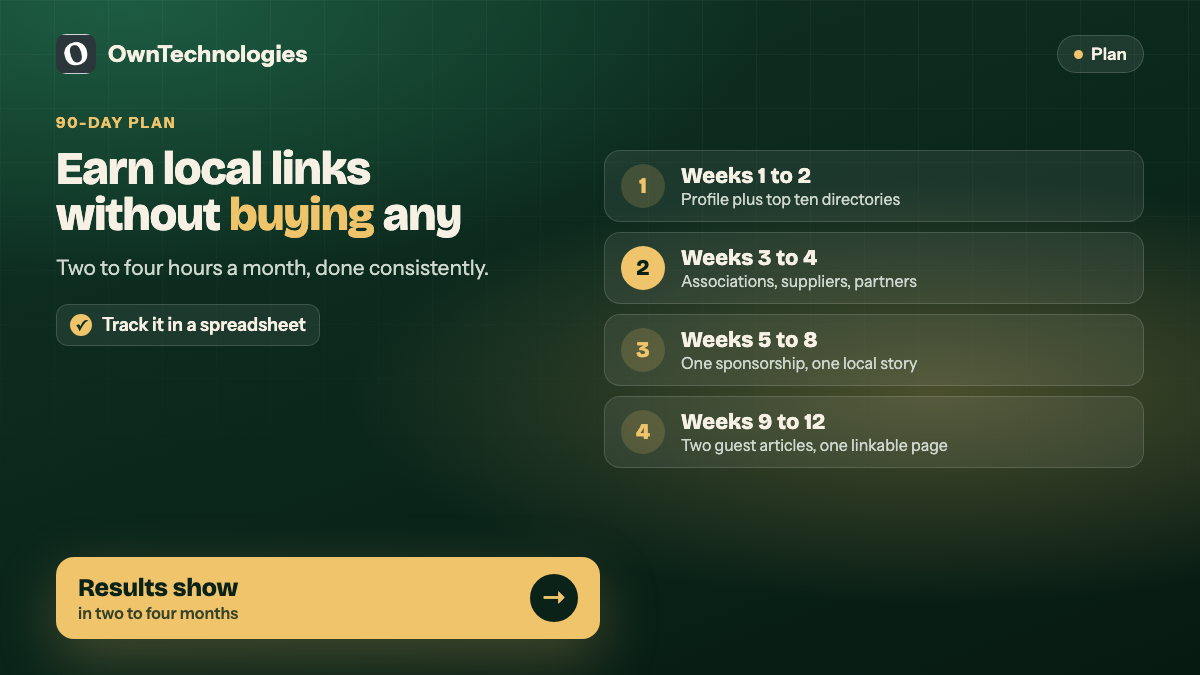
- **Weeks 1 to 2:** fix your Google Business Profile and list your business in the ten most important directories with identical details.
- **Weeks 3 to 4:** list every association, supplier and partner you already work with, and ask each for a listing or partner page link.
- **Weeks 5 to 8:** pick one community activity or sponsorship and one local story you can pitch to a news site.
- **Weeks 9 to 12:** write two useful guest articles for local or industry blogs, and publish one strong page on your own site that people would want to link to, such as a price guide or local guide.
Track it simply: a spreadsheet of who you asked, when, and whether the link went live.
Three backlink myths worth ignoring
**”More links always means higher rankings.”** One relevant link from your local business association is worth more than hundreds from unrelated sites. Volume without relevance is noise.
**”Nofollow links are worthless.”** They pass little ranking value directly, but directory and social links still bring customers, confirm your business details and make your profile look established.
**”Once you have links, you are done.”** Links age. Partners redesign their sites, directories close, and competitors keep earning new ones. A short monthly check keeps you ahead.
Backlinks to avoid
Google is explicit that buying or exchanging links to manipulate rankings breaks its rules. Its spam policies list link schemes, including paid links, excessive link exchanges and automated link creation.
Be wary of:
- **Bulk link packages** (“500 backlinks for $49”)
- **Private blog networks,** groups of sites that exist only to link out
- **Paid guest posts on sites that publish anything** for a fee
- **Irrelevant foreign directories** with thousands of listings
- **Link exchanges** where you link to dozens of unrelated businesses in return
The risk is not only a penalty. Mostly, those links simply do nothing, and you have spent money that could have gone into one good page or one real partnership.
What link building costs
| Approach | Typical cost | What you get |
|---|---|---|
| Do it yourself | Your time, 2 to 4 hours a month | Directories, partners, associations, community |
| Part of a local SEO retainer | $300 to $1,000 a month (around 25,000 to 84,000 INR) | Citations, outreach, content and reporting together |
| Specialist outreach campaign | $1,000 to $3,000 a month (around 84,000 to 2.5 lakh INR) | Press and editorial links for competitive markets |
Most small local businesses do not need the third row. The first two, done consistently, are enough. Our SEO services pricing guide explains what a fair retainer includes.
How to tell whether it is working
- **Google Search Console** shows which sites link to you under Links. Check it monthly.
- **Map pack position** for your main searches, checked from your actual area.
- **Calls, bookings and direction requests** from your Google Business Profile.
- **Referral traffic** in your analytics from the sites that linked to you.
If links are going live but enquiries are not moving after three to four months, the problem is usually the website itself: speed, mobile layout, or pages that do not answer what people searched for.
Frequently Asked Questions
Far fewer than most people think. Ten to thirty relevant links from local and industry sources often put a local business ahead of competitors in its area.
Yes, the main ones. Major directories confirm your name, address and phone details and bring real customers, even if many links are nofollow. Skip low-quality directories with no audience.
No. Google’s spam policies treat paid links meant to manipulate rankings as a link scheme. Most bought links do nothing, and some can harm your rankings.
Usually two to four months after the links go live, depending on how competitive your area and category are.
For the map pack, your Google Business Profile and reviews usually matter more. Backlinks help with prominence and with the regular results below the map. You want both.
Yes. Our SEO team runs local link building as part of an SEO plan, focused on directories, partners, local press and useful content, never bought links.
Final Thoughts
Backlinks still matter for local businesses, but the useful ones are local, relevant and earned: associations, partners, sponsorships, local press and genuinely helpful articles. Pair them with a strong Google Business Profile and a fast website, and skip every bulk link offer in your inbox.
If you want help, our SEO services team builds local link plans for clinics, restaurants, coaching centres and service businesses, and our website development team makes sure the site those links point to actually converts. Ask for a free SEO audit and we will show you where your links stand against your top three local competitors.