“How long will the website take?” is usually the second question a business owner asks, right after the price. The honest answer for most small and mid-size business websites is **three to six weeks** from the day you approve the scope to the day the site goes live. It stretches beyond that for one main reason, and it is rarely the developer’s typing speed.
This guide breaks the three to six weeks down week by week, shows what you need to provide and when, and explains the things that turn a five-week project into a five-month one.
The short answer
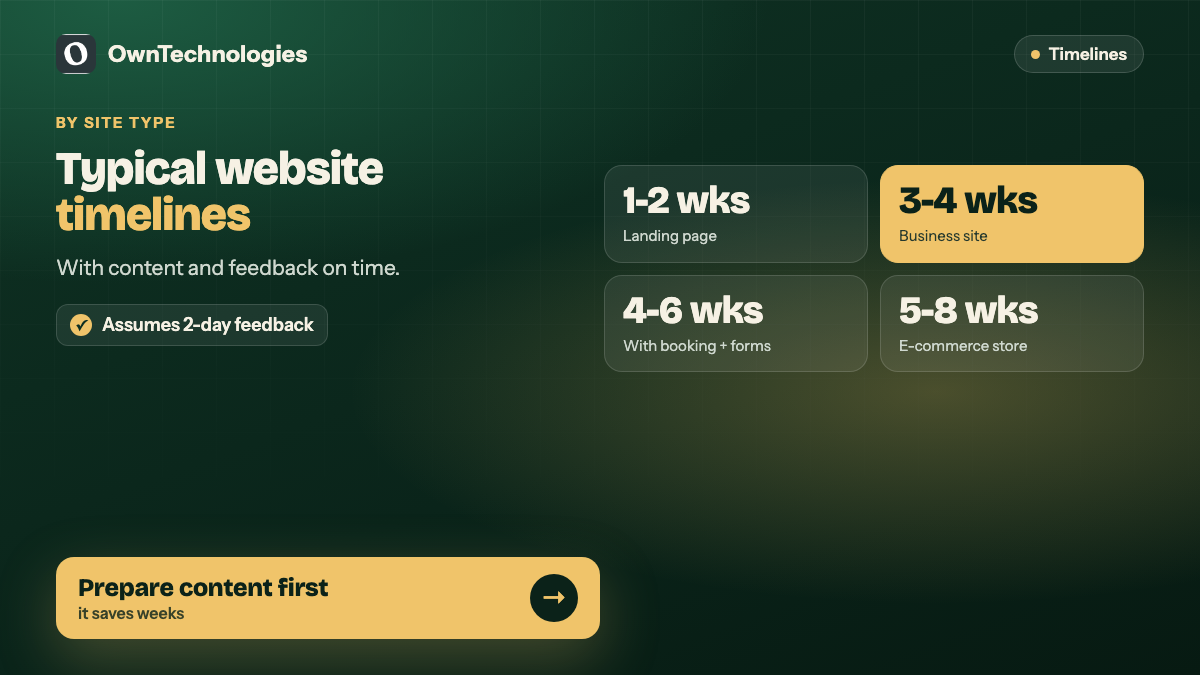
| Type of website | Typical timeline |
|---|---|
| One-page or landing page site | 1 to 2 weeks |
| Business website, 5 to 10 pages | 3 to 4 weeks |
| Business website with booking, forms and integrations | 4 to 6 weeks |
| E-commerce store, under 100 products | 5 to 8 weeks |
| Portal, marketplace or custom web app | 8 weeks and up |
These assume content is ready on time and feedback comes back within two working days. Those two conditions decide most timelines.
The 3 to 6 week breakdown
Week 1: Discovery and structure
- A short call to agree goals, audience, pages and the main action you want visitors to take, such as call, book or buy.
- A sitemap listing every page.
- A content checklist: what you supply (text, photos, logo, prices) and what the team writes.
- Access to your domain, hosting and any existing tools.
**What you do this week:** answer questions, share examples of sites you like, and start collecting content.
Week 2: Design
- The homepage design first, then one or two inner page templates.
- Mobile layouts alongside desktop, because most visitors arrive on a phone.
- One or two rounds of feedback.
**What you do this week:** give clear, consolidated feedback. One person collecting comments from the team saves days.
Weeks 3 and 4: Build
- Pages built from the approved designs.
- Forms, WhatsApp or call buttons, booking tools, maps and analytics connected.
- Your content placed into the pages.
- Basic on-page SEO: titles, descriptions, headings and image alt text.
**What you do this week:** send any missing content and review the staging site as pages appear.
Week 5: Testing and fixes
- Testing on real phones and browsers.
- Every form submitted to check enquiries actually arrive.
- Speed checks and image compression.
- Broken links, spelling and placeholder content fixed.
**What you do this week:** test the site yourself as a customer would, on your own phone.
Week 6: Launch and handover
- Domain pointed to the new site, https enabled, redirects from old pages set up.
- Sitemap submitted to Google Search Console.
- A short handover on how to edit content.
- Logins, code and accounts confirmed in your name.
Smaller sites compress weeks 3 to 5 into two weeks. Larger ones stretch the build.
What actually delays websites
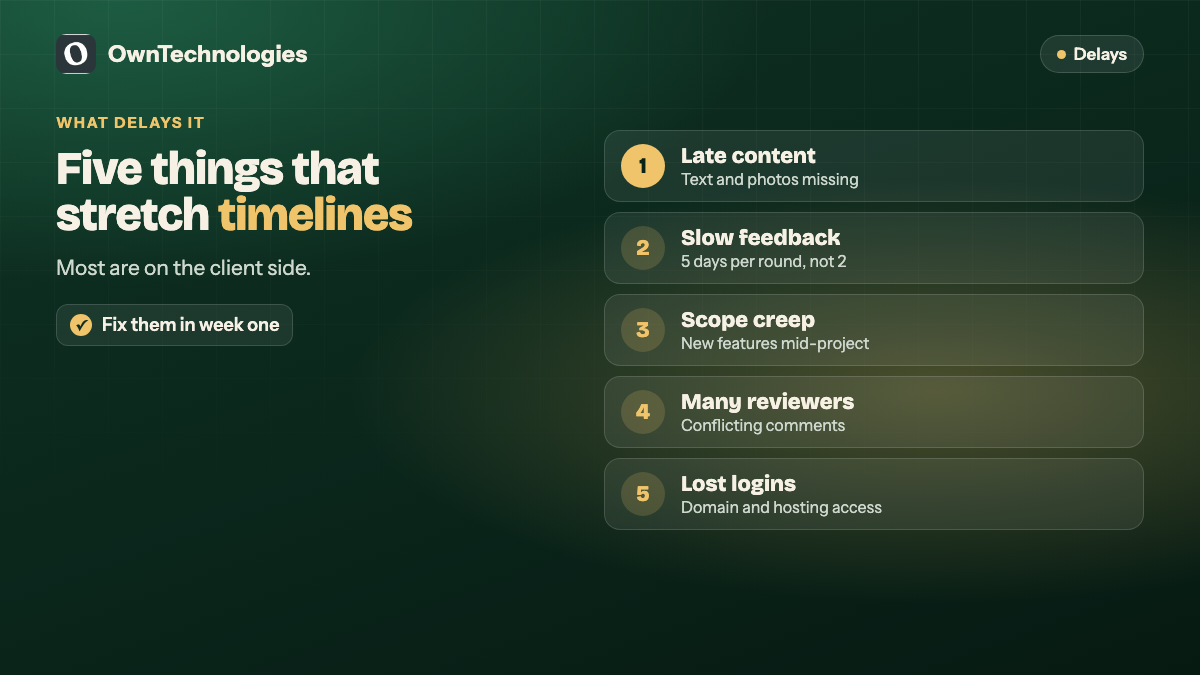
1. Content arrives late
This is the most common delay by far. Design and build can be finished, and the site still cannot launch because the About page, service descriptions or photos are missing. Start writing in week one, or ask your agency to write it.
2. Feedback takes a week each round
Every round of feedback that takes five days instead of two adds a week to the project. Agree a feedback turnaround at the start.
3. Scope grows mid-project
“Can we also add a members area?” after design approval means new design, build and testing. Write new ideas down for phase two unless they are essential to launch.
4. Too many decision-makers
When five people review designs separately, feedback conflicts and rounds multiply. Nominate one decision-maker.
5. Access problems
Waiting for the old developer to hand over the domain or hosting login can stall launch for days. Find those logins in week one.
Who does what during the project
| Task | Agency | You |
|---|---|---|
| Sitemap and page plan | Drafts it | Approves it |
| Design | Creates mobile and desktop layouts | Gives one consolidated round of feedback per stage |
| Copywriting | Writes or edits, if included | Supplies facts, prices and approvals |
| Photos | Sources stock or edits yours | Sends real photos of your team, premises and work |
| Domain and hosting | Sets up and connects | Shares logins or approves purchase |
| Testing | Tests devices, forms and speed | Tests as a customer on your own phone |
| Launch | Points the domain, sets redirects, submits sitemap | Confirms go-live date |
When both columns move at the same speed, three to six weeks is easy to hit.
Redesign vs brand new website
A redesign of an existing site often takes a little longer than a new site of the same size, not less. The extra time goes into auditing old pages, deciding what to keep, rewriting outdated content and setting up redirects so you do not lose the Google rankings you already have. Budget an extra week for a redesign with more than 20 existing pages. Our guide to website redesign vs rebuild helps you decide which you need.
Signs your timeline is unrealistic
- **A full business site promised in three days.** That usually means a template with your logo dropped in.
- **No design approval step.** You will find problems after launch instead of before.
- **No testing week.** Forms that never deliver enquiries are the most expensive bug a business site can have.
- **No date for your content.** If nobody owns the content deadline, it becomes the delay.
How to get your site live faster
- **Write a one-page brief** with your goal, pages, examples you like and your launch date.
- **Gather content first:** logo, photos, prices, team details and service descriptions.
- **Pick one decision-maker** and agree a two-day feedback rule.
- **Launch the core pages first.** A blog, extra landing pages and integrations can follow in week two after launch.
- **Choose a team that shows you progress weekly** on a staging link you can open on your phone.
Timeline vs cost
A faster timeline does not always cost more, but a rushed one often does, because work is done in parallel and mistakes get fixed after launch. For typical prices, see our guide to custom website development cost, and if you are deciding between platforms, CMS-based vs custom websites.
Before you launch
Run a final check before the site goes public: mobile layout, forms, speed, links, contact details and tracking. Our landing page conversion checklist covers the points that most often get missed, and our guide to website speed fixes helps if pages load slowly.
Where OwnTechnologies fits
We build business websites in three to six weeks depending on scope, with weekly progress on a staging link, WhatsApp support and a reply within 24 hours. You approve the design before we build, and the code, domain and accounts stay in your name. See our portfolio for recent sites.
Frequently Asked Questions
Most business websites with 5 to 10 pages take three to four weeks, and four to six weeks with booking, forms and integrations, provided content and feedback arrive on time.
A store with under 100 products usually takes five to eight weeks, including product setup, payments, shipping rules and testing.
Late content is the most common delay, followed by slow feedback rounds, scope added mid-project and missing domain or hosting logins.
A simple one-page or landing page site can be ready in one to two weeks. A full business website in one week usually means skipping design approval or testing.
Your logo, photos, service or product details, prices, contact details, and logins for your domain and hosting.
The sitemap is submitted to Google, tracking is checked, and small fixes are made in the first weeks. Ongoing updates are usually covered by a monthly maintenance plan.
Final Thoughts
Three to six weeks is a realistic timeline for most business websites. The developer controls the design and build; you control the two things that most often stretch the timeline, content and feedback. Prepare both early, keep one decision-maker, and launch the core pages first.
Planning a new site? Our website development team builds business websites in three to six weeks, and our SEO team makes sure people find them. Book a free consultation and we will give you a week-by-week plan for your site.