You need more engineering done than your team can deliver. There are two common ways to get it: add outside developers to your own team, or hand a defined project to an outside company and let them run it. The first is staff augmentation. The second is project outsourcing.
Both work. Both fail in predictable ways when they are used for the wrong job. This guide explains how each model really works, who carries which risk, what each costs in 2026, and a simple way to decide which fits your team right now.
The two models in one paragraph each
**Staff augmentation** means you hire developers from an outside company, and they work inside your team as if they were your own. You set the priorities, run the standups, review the code and own the roadmap. The vendor handles hiring, payroll, equipment and replacements. You pay for time, usually per month or per hour.
**Project outsourcing** means you agree a scope and an outcome, and an outside company delivers it with its own team and its own project management. You approve designs, milestones and the final product. You pay for the result, usually a fixed price split into milestones, or time and materials against an agreed plan.
The simplest way to remember it: with augmentation you rent capacity, with outsourcing you buy an outcome.
Side by side
| Factor | Staff augmentation | Project outsourcing |
|---|---|---|
| Who manages the work | You | The vendor |
| What you pay for | Developer time | A defined result |
| Typical pricing | Monthly or hourly per developer | Fixed price by milestone, or time and materials |
| Scope changes | Easy, you just reprioritise | Need a change request and often a new estimate |
| Your management effort | High | Low to medium |
| Knowledge stays with | Your team | Partly with the vendor unless documented |
| Best for | Ongoing product work, filling skill gaps | New builds with a clear scope and a deadline |
| Biggest risk | Nobody on your side has time to lead the developers | A vague scope becomes an argument about what was promised |
When staff augmentation fits
Augmentation works when you already have the structure to direct developers and you are short of hands or a specific skill.
- **You have a product owner or tech lead** who can write tickets, review pull requests and make decisions every day.
- **The work is ongoing**, such as a SaaS product, an internal platform or a long roadmap, rather than one project with an end date.
- **You need a skill you do not have**, such as Flutter, DevOps or a specific framework, without a long hiring process.
- **Priorities change often.** With augmented developers you can switch focus next week without renegotiating a contract.
- **You want to keep the knowledge in house.** The code, decisions and context live in your repositories and your meetings.
A practical sign that augmentation is right: you can describe what the new developer will work on in their first two weeks, and who will review their work.
When project outsourcing fits
Outsourcing works when the outcome is clear and you do not want to manage the people who build it.
- **You are building something new** with a defined scope: a website, an app MVP, a portal, a CRM.
- **You do not have a technical lead.** Founders and business owners without an engineering team usually get better results from a partner that runs the whole project.
- **You need a fixed budget** approved before work starts.
- **There is a deadline**, such as a launch, a funding round or a season.
- **You want design, development, testing and deployment** from one accountable team.
A practical sign that outsourcing is right: you can write down the screens or pages you need, and you would rather approve milestones than run sprints.
Who carries which risk
This is the part most comparisons skip, and it decides how the engagement feels after month two.
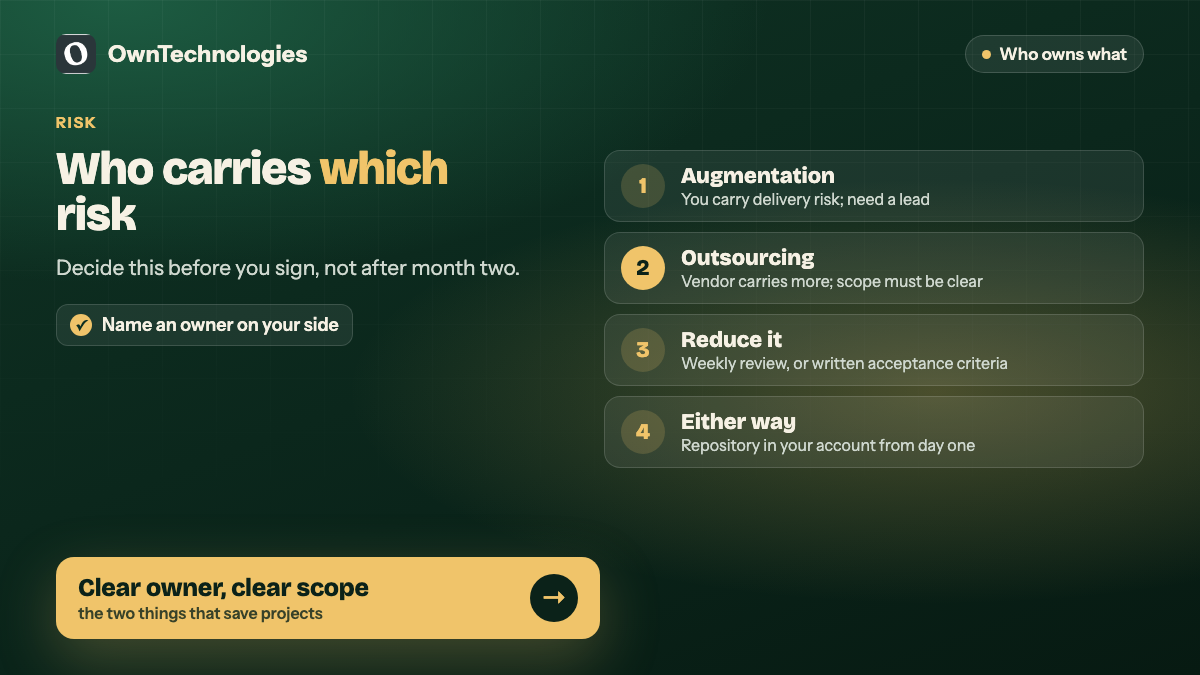
With staff augmentation, you carry delivery risk
If the developer is productive but working on the wrong things, that is on you. If the architecture is poor, you approved it. The vendor’s responsibility is mainly to provide a capable person, replace them if needed, and keep them working the agreed hours. Your risk is management bandwidth.
With project outsourcing, the vendor carries more delivery risk
On a fixed-price milestone project, if the build takes longer than estimated, the vendor absorbs much of that cost. In exchange, they protect themselves with a tight scope. Anything not written down becomes a change request. Your risk is an unclear specification.
How to reduce each risk
- **Augmentation:** name one person on your side who owns the developers’ priorities, and hold a short weekly review of what shipped.
- **Outsourcing:** agree a screen list or feature list, acceptance criteria for each milestone, and how change requests are priced before you sign.
Our contract checks before hiring a development agency list the clauses worth insisting on in either model.
What each model costs in 2026
These are planning ranges for an experienced offshore or hybrid team in India, not quotes.
| Model | How it is priced | Typical range |
|---|---|---|
| Staff augmentation, hourly | Per developer hour | $15 to $90 an hour, mostly $25 to $45 for mid-level |
| Staff augmentation, monthly | Per full-time developer | $2,500 to $14,000 a month, mostly $4,000 to $6,500 for mid-level |
| Outsourced website | Fixed price by milestone | $2,500 to $15,000 |
| Outsourced app MVP | Fixed price by milestone | $15,000 to $35,000 |
| Outsourced custom portal or CRM | Fixed price or time and materials | $15,000 to $45,000 |
The rates match our detailed breakdown of the cost to hire dedicated developers in India. For how a fixed-price project is usually broken into milestones, see our custom software development cost guide.
The hidden cost in each model
- **Augmentation:** your own time. A developer at $5,000 a month who waits two days a week for decisions costs you far more than the invoice.
- **Outsourcing:** change requests. A cheap fixed price with a thin scope often ends up more expensive than an honest estimate with a detailed one.
The hybrid many growing teams use
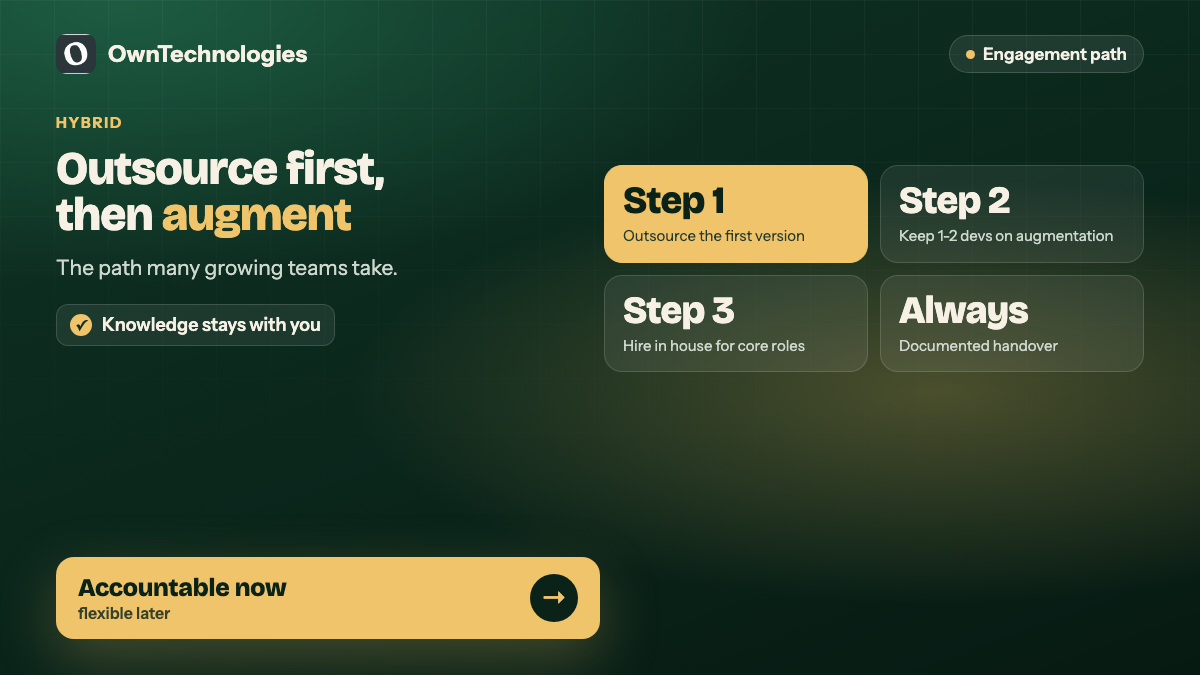
You do not have to choose one forever. A common pattern:
- **Outsource the first version** of a product to a partner who runs design, build and launch.
- **Switch to augmentation** after launch, keeping one or two developers from the same partner who already know the codebase, now working inside your team.
- **Hire in house** for the roles you need permanently, with the augmented developers handing over.
This keeps the early project accountable and the long-term knowledge with you. We describe the hiring side step by step in how to hire dedicated developers in India.
A five-question decision checklist
- **Do you have someone who can lead developers every day?** No points to outsourcing.
- **Is the scope clear enough to write down as screens or features?** Yes points to outsourcing.
- **Is the work ongoing with changing priorities?** Yes points to augmentation.
- **Do you need a fixed budget before you start?** Yes points to outsourcing.
- **Do you want the knowledge to stay inside your team?** Yes points to augmentation, or to outsourcing with strict documentation and a handover.
If you answered “it depends” to most of these, start with a small paid discovery phase. Two weeks of scoping usually makes the right model obvious.
Mistakes we see
- **Augmenting without a lead.** Developers with nobody to direct them build the wrong things quickly.
- **Outsourcing with a one-paragraph brief.** Every missing detail becomes a dispute later.
- **Choosing on hourly rate alone.** The cheapest rate rarely gives the lowest cost per feature shipped.
- **No access to the code.** In either model, the repository should be in your account from day one.
- **No exit plan.** Agree how knowledge is handed over before you need it.
For a wider comparison that includes freelancers, see freelancer vs agency vs dedicated team.
Frequently Asked Questions
With staff augmentation you add outside developers to your own team and manage them yourself, paying for their time. With project outsourcing you agree an outcome and the vendor manages the team and delivers it, usually for a fixed price by milestone.
Neither is cheaper by default. Augmentation looks cheaper per month but costs your management time. Outsourcing costs more upfront but includes project management. Compare the cost of the finished result, not the hourly rate.
In 2026 most augmented developers from India cost $15 to $90 an hour, or $2,500 to $14,000 a month full time, with mid-level developers typically $4,000 to $6,500 a month.
Yes, if the startup has a technical founder or lead who can direct developers. Non-technical founders usually do better outsourcing the first version to a partner who manages the whole build.
Yes. Many teams outsource the first version, then keep one or two developers from the same partner on an augmentation basis to continue the product.
With an established partner, often within days. We can typically onboard a developer within 48 hours once the role is agreed.
Final Thoughts
Staff augmentation rents capacity that you direct. Project outsourcing buys an outcome that someone else delivers. Pick augmentation when you have a lead and an ongoing roadmap, and outsourcing when you have a clear scope and no time to manage developers. Many growing teams use both, in that order.
Not sure which model fits your next project? We offer dedicated developers on hourly, part-time or full-time terms, and our app and website development teams deliver complete projects by milestone. Book a free consultation and we will recommend the model that fits your team today.