Most people searching for an office in Gurugram do not want a property website. They want an answer: which space fits my team, what will it cost, and who will show me around this week? A workspace dealer exists to give that answer across several buildings, and its website has one job: get serious tenants talking to the dealer, not wandering off to a building’s own site.
Coviq is an independent workspace dealer in Gurugram. This case study covers how we approached its website, the three problems it had to solve, and what any broker, dealer or marketplace that sells space it does not own can take from it.
About Coviq
Coviq helps freelancers, startups and teams find hot desks, private offices, meeting rooms and day passes at partner properties in three Gurugram hubs: DLF Phase One, Platina Tower and Vatika Triangle. It does not own the buildings. It shortlists options, arranges tours, introduces the operator and coordinates everything through to handover.
That model is valuable to tenants, because they get independent advice and one point of contact. It is also easy to misunderstand, which is where the website comes in.
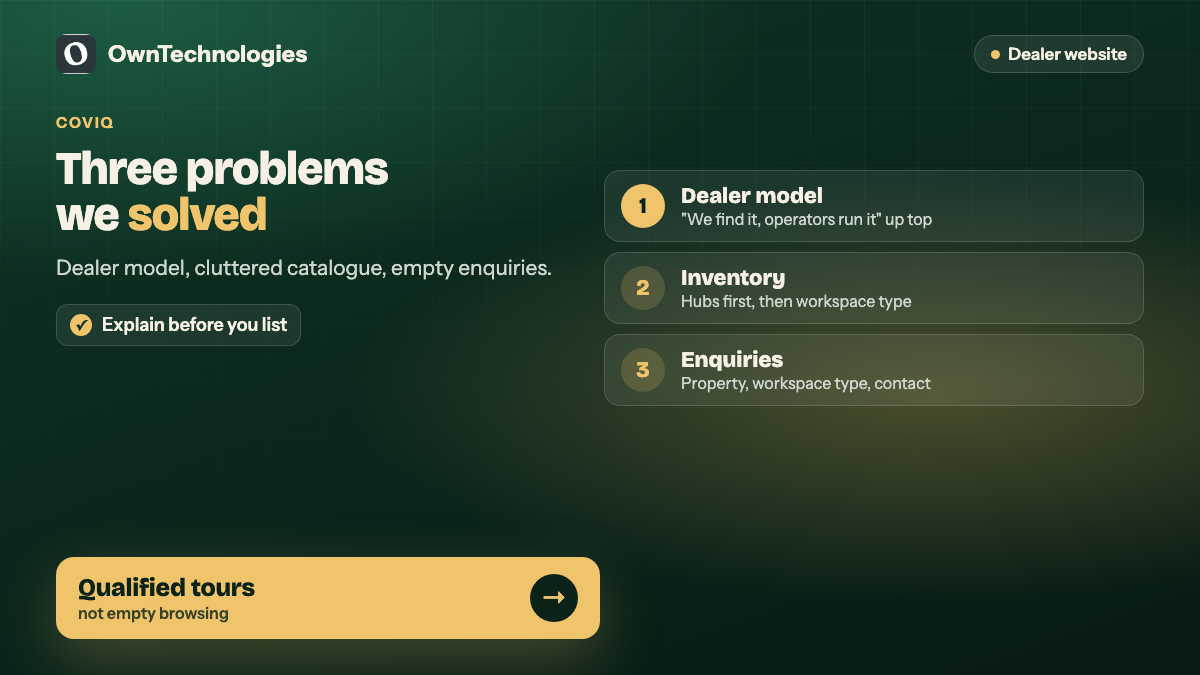
Challenge 1: Visitors assume a coworking site sells its own floors
When someone lands on a site full of office photos, they assume the company owns or runs those offices. For a dealer, that assumption causes problems: visitors expect fixed prices on the page, wonder why the brand name differs from the sign on the building, or go straight to the operator and cut the dealer out.
**What we did:** the messaging leads with the model in one sentence: we find the workspace, partner operators run the centre. A short how-it-works section explains the steps, from telling Coviq what you need to touring shortlisted spaces and moving in.
**The lesson for dealers and brokers:** explain your role before you show the inventory. If visitors do not understand why they should talk to you instead of the building, the best photos in the world will not help.
Challenge 2: Several workspace types across three hubs
Hot desks, private offices, meeting rooms and day passes, multiplied across three locations, can quickly become a cluttered catalogue. Visitors scroll, lose track of what they have seen, and leave.
**What we did:** the site is organised around two simple choices: where (property hubs) and what (workspace-type cards). Each card explains the format in plain words and leads to a clear next step. Clean hierarchy and good photography sell the atmosphere, while practical dealer benefits such as independent advice, end-to-end coordination and a clear handover stay visible.
**The lesson:** structure inventory the way your buyer decides. For workspace that is usually location first, then format, then team size and budget.
Challenge 3: Qualified tour enquiries, not empty browsing
A dealer’s revenue depends on tours that turn into signed agreements. A contact form that only asks for a name and email produces enquiries the team has to chase just to learn the basics.
**What we did:** enquiry forms capture the preferred property, workspace type and contact details, so the team can shortlist and arrange tours quickly. Calls to action sit at natural decision points across the site, not only on a contact page.
**The lesson:** ask the two or three questions your team always asks on the first call. It takes visitors a few seconds and saves your team a day of back and forth.
The outcome
Coviq now has a conversion-focused dealer site that helps prospects compare Gurugram options and reach the team with intent. The brand reads as a trusted matchmaker across DLF Phase One, Platina Tower and Vatika Triangle, not a single-building listing page. You can see the project on our Coviq portfolio page.
What every workspace dealer website needs
Whether you broker coworking, managed offices or traditional leases, these are the elements that earn their place:
| Element | Why it matters | What good looks like |
|---|---|---|
| One-line explanation of your model | Stops visitors assuming you own the space | “We find the workspace, operators run it” near the top |
| Location hubs | Location is the first filter for most tenants | A page or section per area, with travel and amenities |
| Workspace-type cards | Helps visitors self-qualify | Desk, private office, meeting room, day pass, each explained |
| Qualifying enquiry form | Saves the first sales call | Area, workspace type, team size, move-in date |
| WhatsApp and call options | Many tenants prefer to chat | One tap, tracked, routed to the right person |
| Proof | Trust in an independent advisor | Reviews, partner operators, number of teams placed if you track it |
| Fast mobile pages | Most first visits are on phones | Compressed photos, no heavy sliders |
Location pages and local search
Tenants search by place: “coworking space in DLF Phase One” or “private office near Cyber City”. A page for each hub, with genuinely useful local information (transport, food, parking, nearby companies), gives search engines something specific to rank and gives visitors a reason to stay.
Add your business details as structured data so search engines understand the location. Google documents the local business structured data it supports. For the off-site side, a strong Google Business Profile and a handful of relevant local links matter more than volume; see our guide to backlinks for local businesses.
Website or full platform?
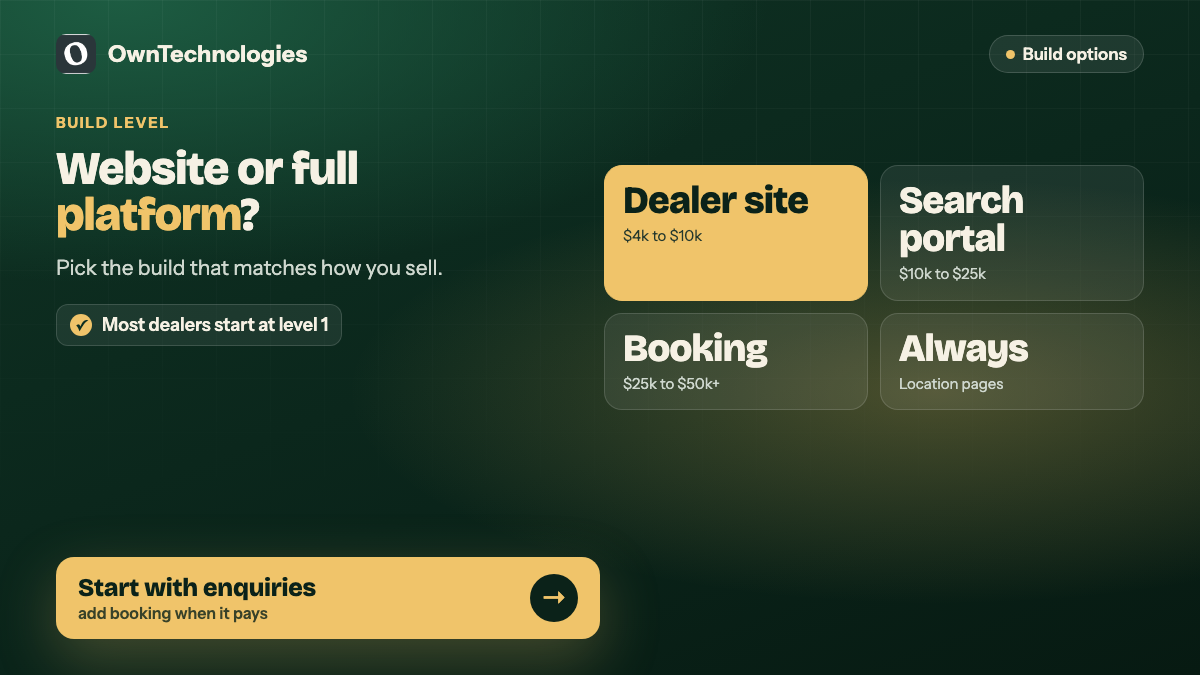
Coviq’s site is a dealer website: inventory presented clearly, with enquiries going to a team that shortlists and arranges tours. Some businesses in this space need more, such as live availability, online booking for meeting rooms and day passes, or operator dashboards. That is a different, larger build.
| Need | What to build | Typical cost (planning range) |
|---|---|---|
| Explain the model and capture tour enquiries | Dealer website with hubs, workspace cards, qualifying forms | $4,000 to $10,000 (around 3.4 to 8.5 lakh INR) |
| Let visitors search many listings by location and filters | Search portal | $10,000 to $25,000 (around 8.5 to 21 lakh INR) |
| Book desks or rooms online, with payments and operator logins | Booking marketplace | $25,000 to $50,000 and up (around 21 to 42 lakh INR and up) |
If you are moving from the first row to the second or third, our guides to property portal development and venue booking platform development cover the search and booking side.
How to tell whether the website is working
- **Tour requests per week**, and how many come with complete requirements
- **Tours that become signed agreements**, by hub and workspace type
- **Enquiry source**: search, Google Business Profile, ads, referrals, WhatsApp
- **Time to first response** on new enquiries
- **Mobile drop-off** on the enquiry form
Review these monthly with the people who run tours. If enquiries are high but tours are low, tighten the form questions. If tours are high but signings are low, the issue is usually pricing clarity or shortlisting, not the website.
Mistakes dealers and brokers make online
- **Hiding the dealer model** until the first call, which makes visitors feel misled.
- **Listing every building with no structure**, so nothing stands out.
- **Generic contact forms** that make the sales team do all the qualifying.
- **Stock photos** instead of real spaces, which tenants spot immediately.
- **No location pages**, which leaves local search traffic to competitors.
Frequently Asked Questions
A one-line explanation of the dealer model, location hubs, workspace-type cards, a qualifying enquiry form, WhatsApp and call options, real photos, proof such as reviews or partner operators, and fast mobile pages.
Lead with one plain sentence near the top, such as “we find the workspace, partner operators run the centre”, and back it with a short how-it-works section.
In 2026 a dealer website with location hubs, workspace cards and qualifying forms typically costs $4,000 to $10,000. A searchable portal or a booking marketplace costs more.
Only if you sell bookable products such as day passes or meeting rooms directly. For private offices and longer agreements, a fast qualified enquiry and tour process usually converts better.
The Coviq dealer website: messaging that explains the independent dealer model, property hubs and workspace-type cards, and enquiry forms that capture preferred property and workspace type so the team can arrange tours quickly.
Final Thoughts
A workspace dealer website wins when visitors understand the model in seconds, can find the right location and format without effort, and reach the team with enough detail for a useful first call. Coviq’s site does that across three Gurugram hubs, and the same structure works for any broker or dealer selling space it does not own.
Planning a website for a brokerage, dealer or listing business? Our website development team builds conversion-focused sites, our CRM team builds the enquiry routing behind them, and our SEO team helps your location pages rank. Book a free consultation and we will map the right build for your model.