Packaged drinking water is one of the hardest products to sell online. Every bottle on the shelf says “pure”, every brand promises safety, and most customers cannot tell the difference. So when a buyer lands on a water brand’s website, they need two answers fast: why this brand, and how do I get it at my door?
CleanSip Water is a packaged drinking water brand, and its website had to answer both questions for families and businesses. This case study covers how we approached it, and what any FMCG brand planning a website with doorstep ordering can take from it.
The brand and the brief
CleanSip’s promise rests on quality backed by process: BIS-aligned quality, a multi-step purification process, family-safe packaging, and convenient formats including doorstep ordering and subscription.
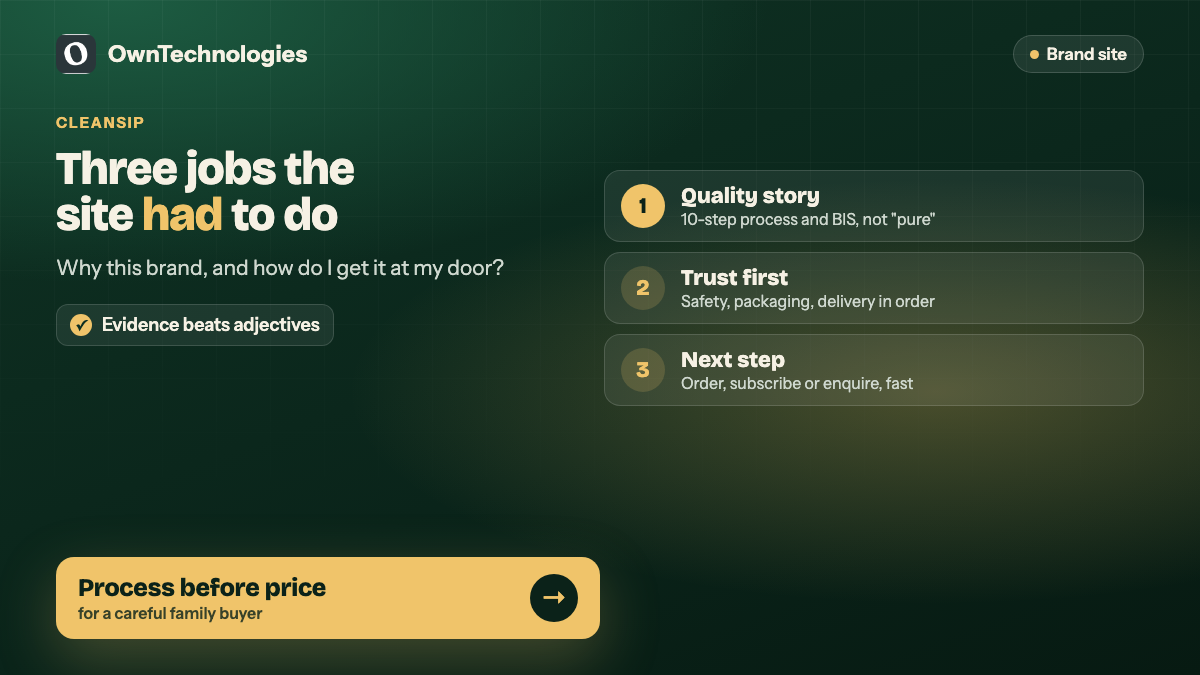
The website had three jobs:
- **Make the quality story concrete** in a market where every competitor uses the same words.
- **Build trust around hygiene, certification and packaging** before anyone orders water for their home or family.
- **Make the next step obvious**: a one-time order, a recurring subscription or an enquiry, without making visitors read a brand essay first.
Challenge 1: “Pure water” means nothing on its own
Every packaged water brand claims purity. If CleanSip said the same thing in the same way, the website would add nothing.
**What we did:** the site leads with the process, not the adjective. CleanSip’s 10-step purification process is laid out as a clear sequence, alongside BIS certification and family-safe packaging. Visitors see how the water is made before they are asked to buy it.
**The lesson for FMCG brands:** replace claims with evidence. A numbered process, a certification, a test standard or a sourcing story does more work than any adjective. In India, packaged drinking water falls under food safety and standards rules, so the Bureau of Indian Standards and FSSAI are the bodies whose marks customers recognise. Show the marks you genuinely hold.
Challenge 2: Trust has to come before the order
People are careful about what their family drinks. A website that jumps straight to “Order now” without addressing safety, packaging and delivery feels pushy.
**What we did:** trust content sits on the path to the order, not on a separate “About” page nobody opens. Packaging, certification and the purification process appear in the order a careful buyer would ask about them.
**The lesson:** map the questions your buyer asks in order, then put the answers on the page in that order. For food and beverage brands the usual sequence is safety, source, packaging, delivery, then price.
Challenge 3: Premium feel, practical next step
A water brand’s site can easily become either a glossy brand film with no way to buy, or a cluttered product catalogue. CleanSip needed to feel fresh and premium while still explaining product sizes and how doorstep delivery works.
**What we did:** crisp imagery and a simple layout carry the brand feel, while product and doorstep or subscription messaging give practical next steps. Enquire and order paths are kept short once interest is established.
**The lesson:** design for two moods. The top of the page sells the feeling, and the rest of the page should make buying effortless.
The outcome
CleanSip’s brand site makes purity, process and convenience easy to understand and act on. Visitors see why the water is different and how to bring it home, without wading through generic beverage marketing. You can see the project on our CleanSip portfolio page.
Doorstep ordering: three levels to choose from
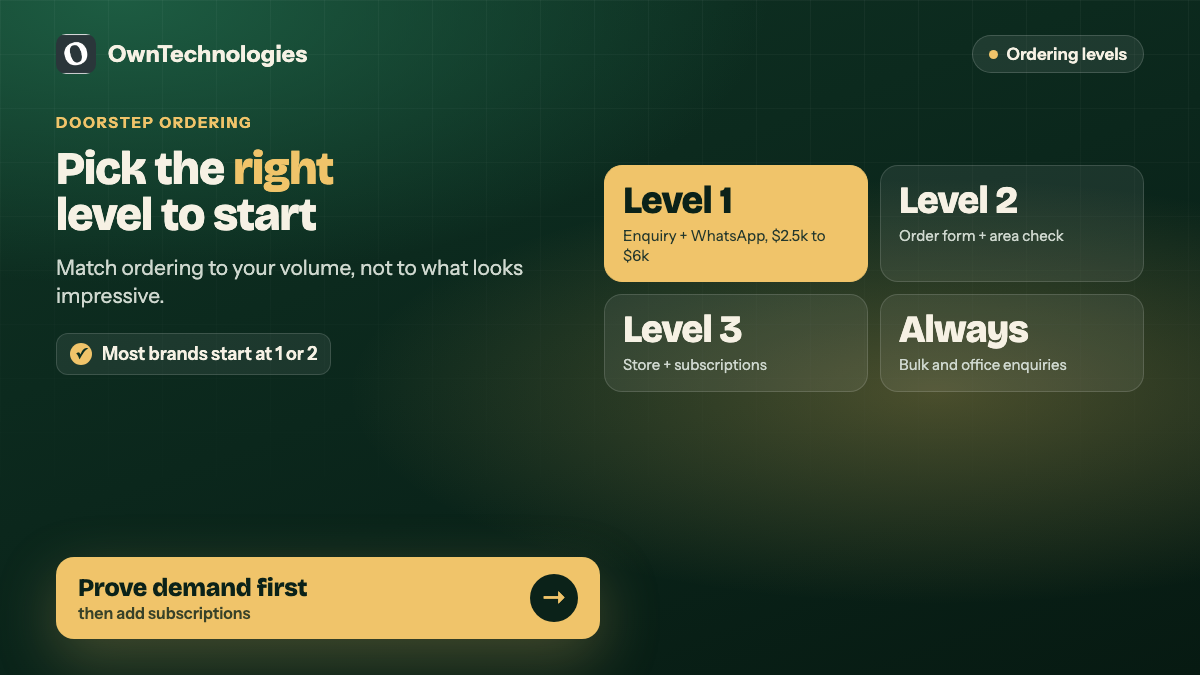
Every FMCG brand that delivers to the door faces the same decision: how much ordering should the website handle? There are three common levels, and the right one depends on your volume and operations, not on what looks impressive.
| Level | How it works | Best for | Typical build cost |
|---|---|---|---|
| Enquiry and WhatsApp ordering | Product pages plus an enquiry form and WhatsApp button; the team confirms orders manually | New brands, local delivery, under about 30 orders a day | $2,500 to $6,000 (around 2 to 5 lakh INR) |
| Order form with area check | Customers choose products, quantity and delivery slot; pin code or area check; cash on delivery or payment link | Growing local delivery with a small operations team | $5,000 to $12,000 (around 4 to 10 lakh INR) |
| Full store with subscriptions | Cart, online payment, recurring deliveries, customer accounts, delivery dashboard | Brands with steady repeat customers and multiple delivery areas | $10,000 to $25,000 (around 8.5 to 21 lakh INR) |
Most brands should start at level one or two. Subscriptions sound attractive, but they need reliable delivery operations, payment retries and an easy way for customers to pause or skip. Payment providers such as Razorpay document how recurring subscriptions work if you plan to go there.
For full store pricing, see our ecommerce website development cost guide and our breakdown of ecommerce website running costs.
What every FMCG brand website needs
Whatever level of ordering you choose, these are the pages and features that earn their place:
- **A clear quality story**: process, certification, sourcing, with real numbers
- **Product pages with sizes and pack options**, photographed properly
- **Delivery information**: areas covered, timings, minimum order, charges
- **A visible ordering path** on every page, including a WhatsApp button for markets where customers prefer to chat
- **Trust signals**: certifications, packaging details, contact address, reviews from real customers
- **Bulk and business enquiries**: offices, gyms, events and retailers often buy more than households
- **Fast mobile pages**, because most food and beverage buyers browse on their phones
Our guide to WhatsApp integration for websites covers the chat-to-order setup, and the landing page conversion checklist applies to any product page you send ad traffic to.
How to tell whether the website is working
A brand site with doorstep ordering should be judged on orders and repeat orders, not on visits or how good it looks. Track these from the first week:
- **Orders and enquiries per week**, split by source: website form, WhatsApp, phone and ads.
- **Repeat order rate.** For water and other daily-use products, the second and third order matter more than the first.
- **Delivery area misses.** How many people try to order from areas you do not serve. This tells you where to expand next.
- **Bulk and business enquiries.** Offices, gyms and events often outweigh household orders in value.
- **Mobile drop-off.** If most visitors are on phones but most orders come from desktops, the mobile ordering path needs work.
Review these monthly with the people who handle delivery. The website and the delivery operation succeed or fail together, and the numbers usually show which one is holding the other back.
What to prepare before you brief a developer
- Your product list with sizes, pack options and prices
- Certifications and test reports you hold, with copies
- Delivery areas, timings, minimum order and charges
- How orders are confirmed and dispatched today, even if it is a phone and a notebook
- Ten real customer questions your team hears every week
With these in hand, a developer can recommend the right ordering level and quote a fixed price instead of a vague range.
Mistakes FMCG brands make online
- **Leading with brand philosophy** instead of what the product is and why it is better.
- **Hiding delivery areas** until checkout, so customers outside them waste time.
- **Building a full store on day one** before knowing how many people will order online.
- **No business enquiry path**, which loses the bulk orders that often matter most.
- **Stock imagery** that looks like every other brand in the category.
Frequently Asked Questions
In 2026 a brand site with enquiry and WhatsApp ordering costs about $2,500 to $6,000, an order form with area checks $5,000 to $12,000, and a full store with subscriptions $10,000 to $25,000, with an experienced offshore or hybrid team.
Not at first. Start with enquiry or WhatsApp ordering, or a simple order form, and move to a full store with subscriptions once you know your online order volume and delivery capacity.
The purification process, certifications you genuinely hold, packaging details, delivery areas and a real contact address. Evidence works better than claims of purity.
Yes, with a store that supports recurring payments and a way to pause or skip deliveries. It needs reliable delivery operations behind it, so most brands add it once demand is proven.
The CleanSip brand website: a quality story built around the purification process and certification, trust content on the path to ordering, and clear doorstep ordering, subscription and enquiry paths.
Final Thoughts
FMCG websites win by replacing claims with evidence and making the next step effortless. CleanSip’s site leads with process and certification, answers trust questions in the order buyers ask them, and keeps the path to doorstep ordering short. Any food or beverage brand can use the same approach, whatever its budget.
Planning a website for a food, beverage or consumer brand? Our website development team builds brand sites and stores, our CRM team builds order and delivery dashboards, and our paid ads team brings customers to them. Book a free consultation and we will recommend the right level of ordering for your brand.