Ask three web development companies for a quote and you will get three numbers that seem to have nothing to do with each other. Without knowing what drives the price, you cannot tell if $3,000 is a bargain or a red flag.
This guide breaks down real 2026 price ranges for a business website, an e-commerce store, and a custom web portal, explains exactly what pushes the cost up or down, and shows how a custom build compares to Shopify, WooCommerce, and other website builders over time.
Custom Website Development Cost in 2026: The Short Answer
Most businesses pay between $2,500 and $45,000 (roughly 2 lakh to 37 lakh INR) for a new website. The gap is wide because a “website” can mean a 5-page brochure site or a full portal with logins, dashboards, and custom workflows.
| Website type | Typical scope | 2026 cost range (USD) | Timeline |
|---|---|---|---|
| Basic business website | 5 to 10 pages, contact forms, mobile-responsive design | $2,500 to $6,000 | 3 to 4 weeks |
| E-commerce website | Product catalog, cart, checkout, payment gateway | $6,000 to $20,000 | 5 to 8 weeks |
| Custom web portal | User accounts, role-based dashboards, custom workflows | $15,000 to $45,000 | 10 to 16 weeks |
| Enterprise platform | Multi-branch, integrations with ERP or CRM, advanced permissions | $45,000+ | 4 months+ |
These ranges assume an experienced offshore or hybrid development team. A US-only or UK-only agency typically quotes 2 to 3 times more for the same scope.
What Actually Drives the Cost of a Custom Website
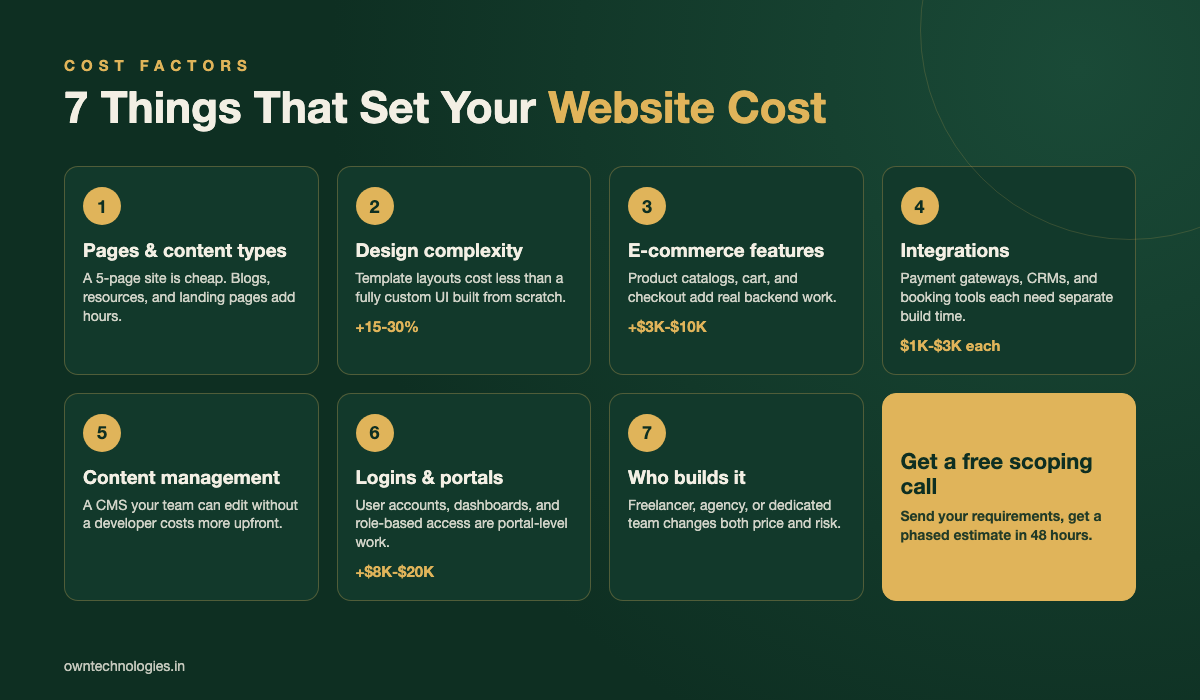
Every quote you receive breaks down into these seven factors. Knowing them lets you cut cost without cutting what your customers actually notice.
1. Number of pages and content types
A 5-page brochure site is the cheapest option. Every additional content type, a blog, a resources library, location pages, or landing pages for ads, adds development and content entry hours.
2. Design complexity
A polished template with your branding is fast to ship. A fully custom UI designed from scratch, with unique layouts, animations, and illustrations, adds roughly 15 to 30 percent to the build.
3. E-commerce functionality
Product catalogs, variants, cart logic, checkout, and payment gateway integration are real backend work. Budget $3,000 to $10,000 on top of a basic site, depending on catalog size and whether you need multi-currency or subscriptions.
4. Third-party integrations
Payment gateways, CRMs, booking tools, and marketing platforms each need a separate integration. Budget $1,000 to $3,000 per integration depending on how well documented the API is. Our custom vs template website guide covers which integrations a template can and cannot handle.
5. Content management needs
A CMS your marketing team can update without calling a developer costs more upfront but saves money every month after launch. A static site is cheaper to build and more expensive to maintain.
6. User accounts, logins, and portals
Anything beyond a public-facing site, customer logins, member dashboards, or a partner portal, moves you into portal territory. This typically adds $8,000 to $20,000 depending on how many roles and permission levels you need.
7. Who builds it
A freelancer is cheapest upfront and riskiest long term. A large US agency is safest on paper and most expensive. A mid-sized development company with a dedicated team, like OwnTechnologies’ website development team, usually lands in the middle on price with real support after launch.
Business, E-commerce, and Portal Website Costs Compared
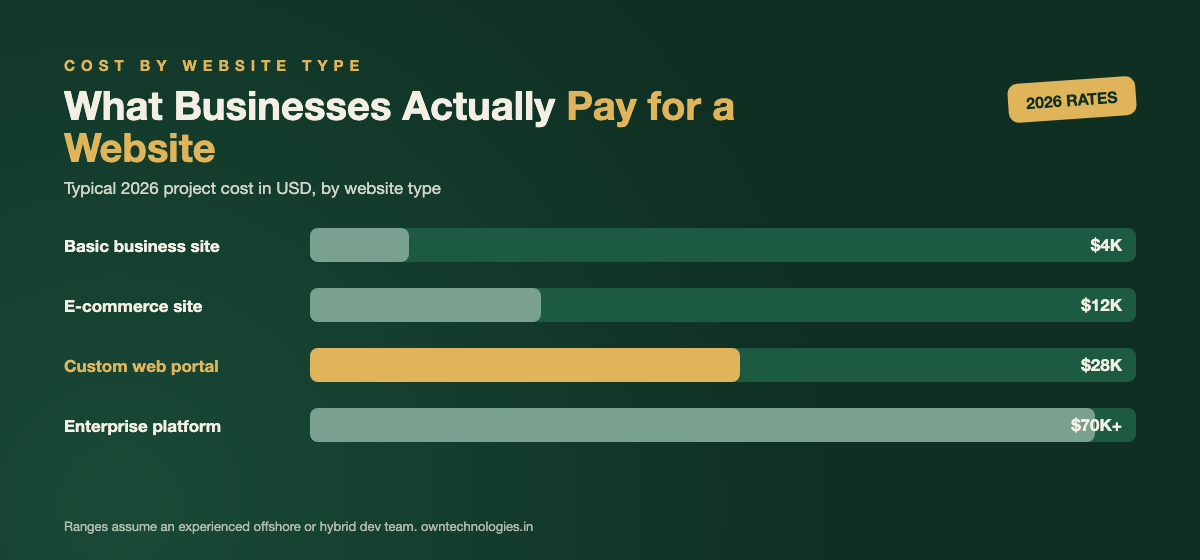
The chart above shows the shape of it: cost climbs fastest once you add logins and workflows, not just more pages. A business website earning its keep needs to be judged on what it is actually for, not just its page count. Our guide on must-have website features lists what belongs on a basic site before you pay for anything more.
If your business needs both a customer-facing site and internal tools such as a CRM, scoping them together often saves money because they can share one database and one login system. Our CRM development team handles that side when projects need it.
Custom Website vs Website Builders: Shopify, WooCommerce, and Wix
Website builders look cheaper on the surface, and for a very simple store or landing page they often are. But the comparison changes once you factor in monthly fees, transaction cuts, and the limits of a template.
| Option | Upfront cost | Ongoing cost | Limitation |
|---|---|---|---|
| Shopify (mid plan) | Low, template-based | ~$1,200 to $3,600 per year plus transaction fees | Design and checkout flow are locked to the platform |
| WooCommerce | Low to moderate, needs WordPress hosting | Hosting, plugin licenses, and maintenance | Performance depends heavily on plugin quality |
| Wix or Squarespace | Very low | ~$200 to $500 per year | Hard to scale past a simple brochure or small store |
| Custom website | $2,500 to $45,000 one time | Hosting plus 10 to 15 percent of build cost per year | Higher upfront investment |
Pricing above is based on the published 2026 plans from Shopify and WooCommerce, and will vary with add-ons and transaction volume. Builders win when you need something live this week and your needs are standard. Custom wins when your business model, checkout flow, or internal workflows do not fit a template, or when you plan to scale past a few hundred orders a month.
Hidden Costs to Ask About Before You Sign
- Hosting and infrastructure: $20 to $300 per month depending on traffic and whether you need a dedicated server. Get this in writing.
- Domain, SSL, and email: Usually small, but often left out of the first quote.
- Stock photography and licensing: Custom photography or premium stock images can add $200 to $1,500.
- Post-launch support: Expect 10 to 15 percent of the build cost per year for updates, security patches, and small changes.
- Content writing: Many quotes assume you supply the copy. Professional copywriting is a separate line item.
How to Cut Website Development Cost Without Cutting Corners
- Start with the pages that convert. Home, services, pricing, and contact cover most buyer journeys. Add resources and blog pages in phase two.
- Bring your own content. Writing your own copy and gathering your own images can save $1,000 to $3,000 in a typical quote.
- Limit integrations to what you use weekly. Every “nice to have” tool is another $1,000 to $3,000 you can defer.
- Use a proven CMS base. Good teams do not rebuild content management from scratch every time. Ask what they reuse.
- Choose a team with experience in your industry. A team that has already built an e-commerce or booking site in your space will not bill you for learning your business.
What a Real Website Project Looks Like at OwnTechnologies
A typical mid-scope engagement runs like this: discovery and a sitemap in week one, a clickable design in week two, then development in weekly sprints with a staging link you can review as it builds. Most business and e-commerce sites go live in 3 to 6 weeks. You can see completed projects in our portfolio.
A website with no traffic is an expensive brochure nobody reads. We usually pair a new build with a technical SEO setup from day one through our SEO services team, so the site is ready to rank the day it launches, not months later.
Frequently Asked Questions
A basic business website with 5 to 10 pages, mobile-responsive design, and contact forms typically costs $2,500 to $6,000 in 2026 when built by an experienced offshore or hybrid development team. Timelines are usually 3 to 4 weeks.
Upfront, no. Website builders cost less to start. Over 3 or more years, a custom site can work out similar or cheaper once you account for platform fees, transaction cuts, and plugins, especially if your store grows past a few hundred orders a month.
A basic business website takes 3 to 4 weeks. An e-commerce site takes 5 to 8 weeks. A custom portal with logins and dashboards takes 10 to 16 weeks or more depending on complexity.
Indian development companies typically charge between 2 lakh and 37 lakh INR ($2,500 to $45,000) for a website depending on scope. The same scope from a US-only or UK-only agency usually costs two to three times more.
Plan for hosting ($20 to $300 per month), a domain and SSL certificate, and an annual support budget of 10 to 15 percent of the original build cost for updates, security patches, and small changes.
Choose custom when you need specific user roles, workflows, or integrations an off-the-shelf tool cannot match. Choose an off-the-shelf tool when your needs are standard and you want to launch within days rather than weeks.
Final Thoughts
A custom website is not automatically the expensive option once you look past the first invoice. For a business planning to grow, add features, or connect internal tools, it is often the option that saves money by year two, and the only one that works exactly the way you need it to.
Want a real number instead of a range? Talk to OwnTechnologies for a free scoping call. Send us what you need your site to do and we will send back a phased estimate within 48 hours, no commitment required.