You run a small clinic, you have about $1,000 to spend on marketing, and two people have given you opposite advice. One says Google Ads will fill your diary next week. The other says SEO is the only thing that lasts. Both are partly right, and choosing wrong usually means spending the whole budget and having nothing to show for it.
This guide gives you a straight answer for where the first $1,000 should go, based on how quickly each channel pays back, what it actually costs, and what has to be in place before either one works.
The short answer
For most small clinics with a working website and a Google Business Profile, the best first $1,000 is a **split, weighted to paid search for the first two months**:
| Where | Amount | Why |
|---|---|---|
| Fix the basics (profile, booking, page speed, call tracking) | $150 to $250 | Without these, both PPC and SEO leak patients |
| Google Ads on high-intent searches | $500 to $600 | Calls and bookings within days, and real data on what patients search |
| Starter SEO (treatment pages and local listings) | $200 to $300 | Starts the compounding work that lowers your cost per patient later |
If your website is broken, slow on mobile or has no clear way to book, do not spend on either channel yet. Fix that first, because every click you buy or earn lands there.
How PPC and SEO really differ for a clinic
| PPC (Google Ads) | SEO | |
|---|---|---|
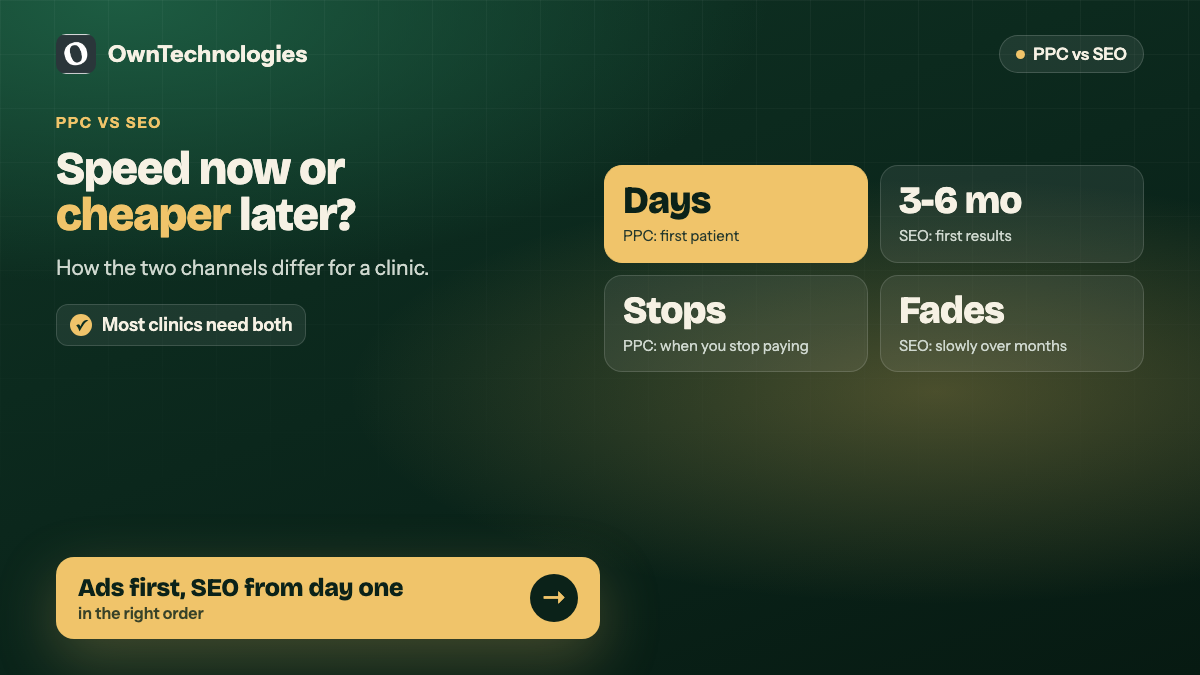
| Time to first patient | Days | Usually 3 to 6 months |
| What you pay for | Every click | Work on the site, content and reviews |
| When you stop paying | Leads stop the same day | Rankings fade slowly over months |
| Best for | Filling the diary now, testing which treatments sell | Lowering cost per patient over time |
| Main risk | Wasted clicks from broad keywords | Slow results, paying for reports instead of work |
Neither is “better”. PPC buys speed; SEO buys a lower cost per patient later. A small clinic usually needs both, in the right order.
Why paid search usually comes first
You get answers in weeks, not months
A month of well-targeted ads tells you which treatments people search for in your area, what a click costs, and how many callers actually book. That data then decides which pages your SEO should build first.
High-intent searches convert
Someone searching “dentist near me open Saturday” or “physiotherapy for back pain [your area]” wants an appointment now. Ads let you appear for exactly those searches while your organic rankings are still weak.
But only with tight targeting
The fastest way to waste $500 is broad match keywords, no negative keywords and ads sent to your homepage. Use phrase and exact match on treatment-plus-location searches, exclude job seekers and “free” or “course” searches, and send each ad to a page about that treatment. Our guide to a dental clinic landing page for Google Ads shows what that page needs.
Healthcare ads also have extra rules on what you can claim and target. Read Google’s healthcare and medicines policy before you launch.
Why you still start SEO on day one
Paid clicks never get cheaper on their own. SEO is what brings your cost per patient down over time, and it is slow, so the clock should start early.
For a small clinic, starter SEO means:
- **Google Business Profile done properly.** Correct categories, services, hours, photos and a steady flow of genuine reviews. For most clinics this drives more calls than the website. See our Google Business Profile guide for clinics.
- **One page per main treatment.** What it is, who it suits, price guidance, the process and a clear booking button.
- **Consistent name, address and phone** on your site and the main local directories.
- **A fast, mobile-friendly site.** Most patients search on their phone.
For dental practices, our local SEO guide for dentists goes deeper.
What to fix before you spend anything
| Check | Why it matters |
|---|---|
| Booking or call button visible on mobile without scrolling | Every paid or organic visit needs a next step |
| Page loads in about 3 seconds on mobile | Slow pages waste the clicks you paid for |
| Call tracking and form tracking set up | Without it you cannot tell which channel works |
| Opening hours and phone number correct everywhere | Wrong details lose patients and hurt local rankings |
| Someone answers calls and messages quickly | Leads go cold within hours |
The last one matters most. Clinics often blame the ads when the real problem is that nobody picked up the phone.
How to measure the first $1,000
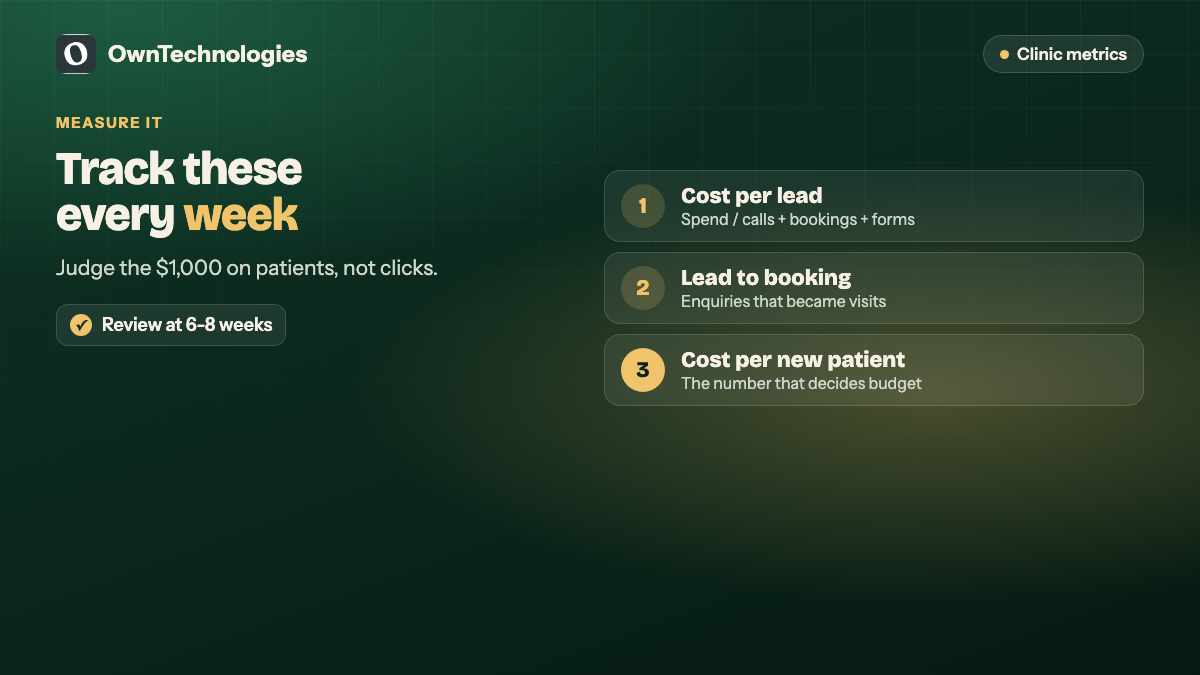
Track three numbers every week:
- **Cost per lead:** total spend divided by calls, bookings and form enquiries.
- **Lead to booking rate:** how many enquiries became appointments.
- **Cost per new patient:** spend divided by booked new patients.
After six to eight weeks, compare the cost per new patient with what a patient is worth to you. If paid search is profitable, keep it and grow it slowly. If it is not, fix the landing page and targeting before adding budget. As SEO starts to bring calls, shift budget gradually from ads to content and reviews.
Five mistakes that waste a clinic’s first budget
- **Sending every ad to the homepage.** Patients searching for one treatment want that treatment’s page, price guidance and a booking button.
- **Running ads around the clock with nobody answering.** Schedule ads for the hours someone can take calls, or reply to messages within minutes.
- **Judging after one week.** A small budget needs four to eight weeks to show a reliable pattern.
- **Paying for SEO reports instead of SEO work.** Ask what pages, fixes and listings were delivered each month, not just how rankings moved.
- **Asking for reviews once.** A steady flow of genuine reviews helps both your profile ranking and the number of people who call.
When SEO first makes more sense
- Your area has very few competitors, so ranking is quick.
- Clicks in your specialty are very expensive and your budget would buy only a handful.
- You already rank on page two for your main treatments, so a push to page one is close.
- Patients book months ahead, so speed matters less than steady visibility.
When PPC only makes more sense
- You have just opened and need patients this month.
- You are launching a new treatment and want to test demand.
- Your diary has gaps you need to fill quickly.
What it costs after the first $1,000
Once you know what works, typical monthly ranges look like this. Ongoing SEO with an experienced agency usually costs $500 to $1,500 a month for a small local business, as our SEO pricing guide explains. Google Ads management often starts around $500 a month plus ad spend. Your ad spend depends on how competitive your area and treatments are.
Frequently Asked Questions
PPC brings patients within days, SEO lowers your cost per patient over months. Most small clinics should start with tightly targeted paid search and begin basic SEO at the same time.
Spend about $150 to $250 fixing the basics, $500 to $600 on Google Ads for high-intent treatment searches, and $200 to $300 on starter SEO such as treatment pages and the Google Business Profile.
Usually three to six months for local treatment searches, longer in competitive cities. Google Business Profile improvements can show results sooner.
It can, if the targeting is tight, each ad goes to a matching treatment page and calls are answered quickly. Broad keywords and homepage traffic waste small budgets fast.
Not always. You need a fast mobile page per main treatment with a clear call or booking button and tracking in place. A full redesign can wait.
Yes. Google restricts some healthcare claims and targeting. Check Google’s healthcare and medicines policy before launching campaigns.
Final Thoughts
For a small clinic, the first $1,000 is about learning fast without wasting money. Fix the basics, buy high-intent clicks to get patients and data now, and start SEO early so your cost per patient falls over time. Measure cost per new patient, not clicks.
Want help spending it well? Our PPC team sets up tightly targeted Google Ads, our SEO team builds the pages and local signals that compound, and our website team fixes the pages patients land on. Book a free consultation and we will tell you honestly where your first $1,000 should go.