Every month your SEO agency sends a report. It is usually a long PDF of charts going up and to the right, a list of tasks completed, and a line about “strong progress”. What it often does not tell you is whether SEO brought you any customers.
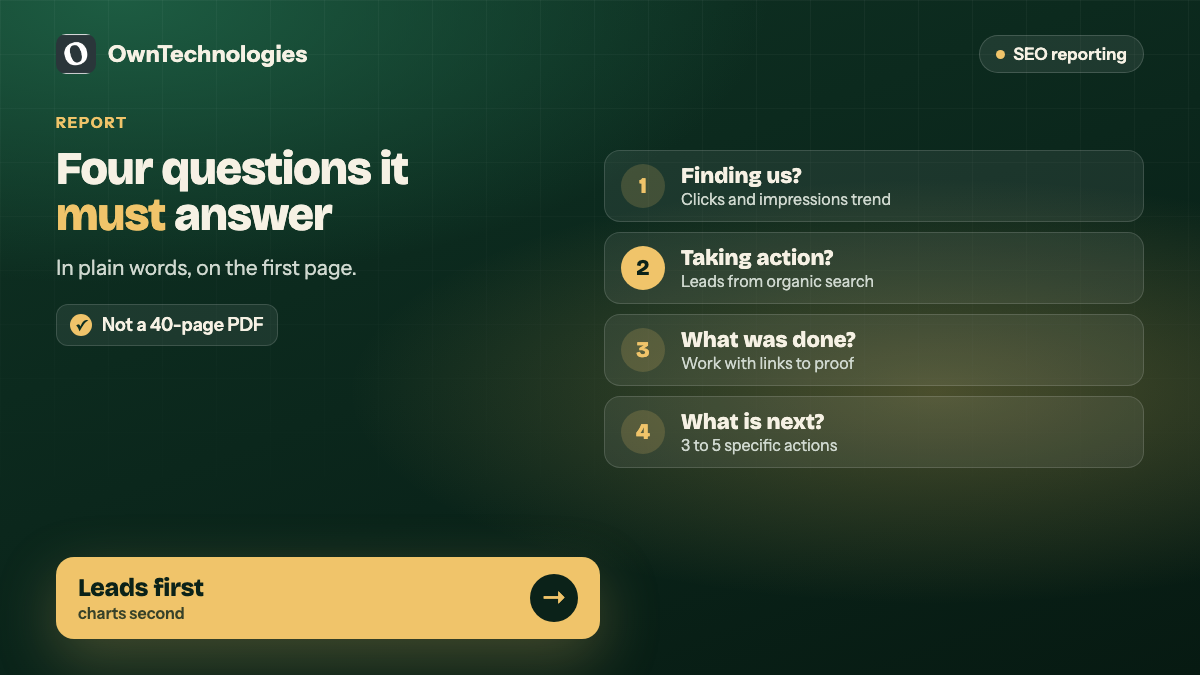
A good monthly SEO report answers four questions in plain language: are more of the right people finding us, are they taking action, what did you do this month, and what will you do next? This guide explains exactly what should be in it, what to ignore, and the red flags that suggest your money is not working.
The one-page summary comes first
Before any charts, a monthly report should open with a short summary a business owner can read in two minutes:
- **The headline result.** For example: “Enquiries from organic search rose from 18 to 24 this month.”
- **What changed and why.** “Two service pages moved onto page one for priority searches after the rewrite in week two.”
- **Problems found.** “The contact form stopped tracking for four days after a plugin update. Fixed on the 14th.”
- **Next month’s plan.** Three to five specific actions, not “continue optimisation”.
If your report does not start with something like this, ask for it. The detail below supports the summary. It should not replace it.
The numbers that actually matter
1. Leads and enquiries from organic search
This is the number that pays for SEO: form submissions, calls, WhatsApp clicks and bookings that came from people who found you through Google. It requires conversion tracking set up properly in your analytics, following Google’s guidance to set up Analytics for a website. If your agency cannot show leads from organic search, that is the first thing to fix.
2. Organic clicks and impressions
From Google Search Console’s Performance report: how often your site appeared in search (impressions) and how often people clicked (clicks). Look at the trend over three months, not one, because a single month can swing with seasons and holidays.
3. Rankings for the searches that bring customers
Not a list of 500 keywords. A short list of 10 to 30 searches that real buyers use, such as “dental implants Dubai Marina” or “CRM development company India”, with positions this month and last month. Rankings for your own brand name or for terms nobody searches do not count.
4. Top landing pages
Which pages brought organic visitors, and which of those produced enquiries. This tells you where to invest next: improving a page that ranks on page two is usually cheaper than creating something new.
5. Technical health
Indexing problems, broken pages, slow pages and mobile issues, with what was fixed. Core Web Vitals give a standard view of page experience; Google explains them on web.dev. A report should list issues found and fixed, not just a health score.
6. Work completed
Pages written or improved, links earned, technical fixes, Google Business Profile updates. Each item should link to the actual page or result, so you can check it exists.
| Report section | What it answers | Where the data comes from |
|---|---|---|
| Summary | Did SEO bring customers this month? | Analyst’s written view |
| Organic leads | How many enquiries came from search | Analytics with conversion tracking |
| Clicks and impressions | Are more people finding us? | Google Search Console |
| Priority rankings | Are we winning the searches that matter? | Rank tracking for a short keyword list |
| Top landing pages | Which pages work, which need help | Analytics and Search Console |
| Technical health | Is anything broken or slow? | Search Console, site audit tools |
| Work done and next plan | What did we pay for, what comes next? | Agency’s task list with links |
What to ignore, or at least question
- **Domain authority or similar third-party scores.** They are tools’ estimates, not Google metrics. Useful for context, never a goal.
- **”Total keywords ranking”.** Ranking at position 87 for thousands of irrelevant terms means nothing.
- **Traffic without context.** A blog post about a celebrity can bring thousands of visits and zero customers.
- **Backlink counts.** Ten relevant links beat a thousand directory listings; see our guide to backlinks for local businesses.
- **Screenshots of rankings checked from the agency’s office.** Rankings vary by location and device. Use a proper tracker for your target area.
Red flags in an SEO report
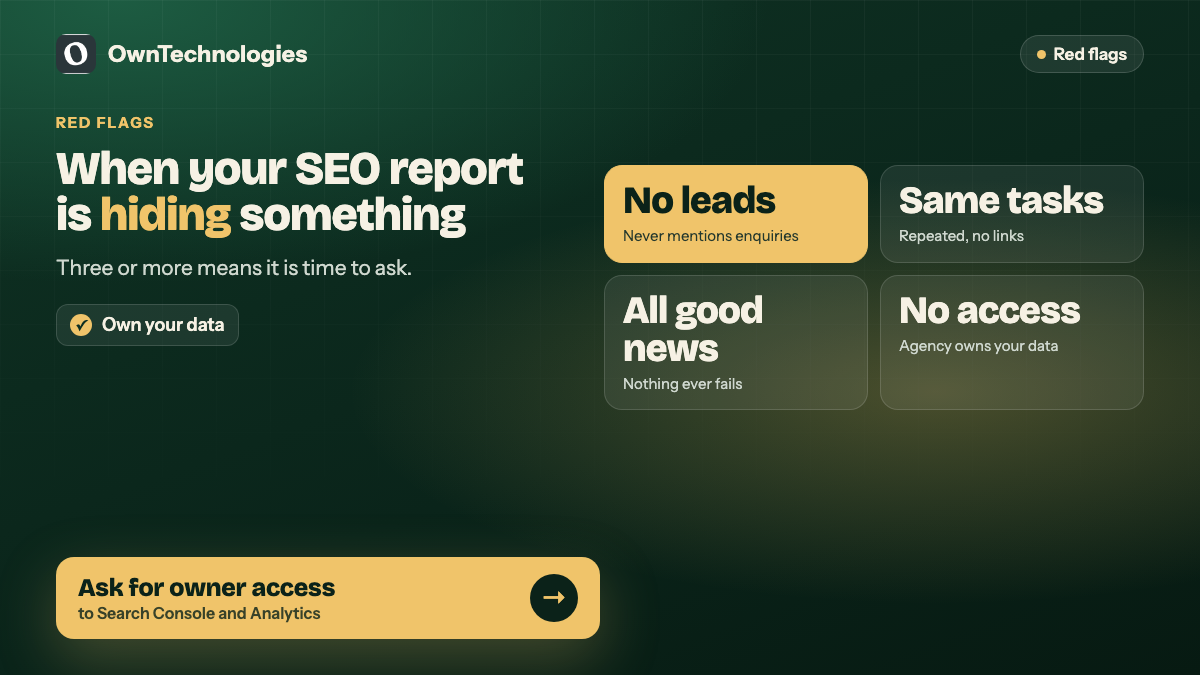
- **No mention of leads or enquiries**, month after month.
- **The same tasks repeated** every month with no links to finished work.
- **Only good news.** Every honest report includes something that went wrong or did not move.
- **Vague next steps** such as “ongoing optimisation” or “content strategy”.
- **Brand-name rankings presented as wins.** You should rank for your own name anyway.
- **No access to your own data.** You should have owner access to Search Console, Analytics and your Google Business Profile, not just the agency.
If you see three or more of these, it is time for a direct conversation, or a second opinion.
For local businesses: add the map pack
If you serve customers in a specific area, your Google Business Profile is often worth as much as your website. A monthly report should include profile views, calls, direction requests and website clicks from the profile, plus reviews gained and your average rating. We cover the profile side in our local SEO for dentists guide, which applies to most local businesses.
How long before the numbers should move
SEO is slow, but not invisible. A reasonable expectation for a small business website:
| Timeframe | What you should see |
|---|---|
| Month 1 | Audit, tracking fixed, technical issues resolved, plan agreed |
| Months 2 to 3 | Impressions rising, some priority pages moving up |
| Months 4 to 6 | More clicks, first page positions for some priority searches, more organic enquiries |
| Months 6 to 12 | Steady growth in organic leads, with clear pages driving them |
If nothing has moved after six months, including impressions, the strategy needs to change.
What SEO reporting should cost
Reporting should be part of an SEO retainer, not a separate charge. Typical retainers for small and mid-size businesses range from about $300 to $1,500 a month, depending on competition and the amount of content and link work. Our SEO services pricing guide breaks down what each level should include.
Five questions to ask on your monthly call
A report is only half the conversation. Use the monthly call to ask:
- **Which pages brought enquiries this month, and why do you think they worked?** Good agencies can explain the cause, not just the number.
- **What did not work, and what will you change?** If the answer is always “nothing”, be suspicious.
- **Which priority search are we closest to winning, and what would get us there?** This focuses effort where it pays.
- **Is anything on the website holding SEO back?** Slow pages, thin service pages and broken forms are common, and often cheaper to fix than more content.
- **What do you need from us?** Photos, reviews, case studies and expert input from your team make content far stronger.
Write the answers down and check them against next month’s report. Over a quarter, you will know whether the work is focused or just busy.
Frequently Asked Questions
A one-page summary, leads from organic search, clicks and impressions from Search Console, rankings for a short list of priority searches, top landing pages, technical health, work completed with links, and next month’s plan.
Leads or enquiries from organic search. Rankings and traffic matter only because they lead to customers.
Monthly is standard, with a short call to walk through it. Look at trends across three months rather than judging a single month.
Yes, always as an owner or admin. Your agency should have user access, not the only access.
Most small business sites see impressions rise within two to three months and more enquiries within four to six months, depending on competition and starting point.
Yes. We offer a free SEO audit that includes a review of your current reporting and what it is missing.
Final Thoughts
A good monthly SEO report tells you, in plain language, whether search brought you customers, what was done, what went wrong and what happens next. Everything else is supporting detail. If your report cannot answer those questions, ask for one that does.
Want a second opinion on your SEO? Our SEO team sends clear monthly reports built around leads, our website development team fixes the technical issues that hold rankings back, and our CRM team makes sure every enquiry is tracked. Ask for a free SEO audit and we will show you what your current report is missing.