Most dental clinics that “tried Google Ads and it did not work” sent their clicks to the homepage. The ads were fine. The page was built for everyone, so it converted almost no one: a slider of the reception area, a welcome message from the founder, twelve services in a grid, and a contact form at the bottom.
A dental landing page for Google Ads has one job: turn a person searching for a specific treatment into a booked appointment. This guide sets out the structure that does that, section by section, plus the Google Ads settings that have to match it.
One treatment, one page
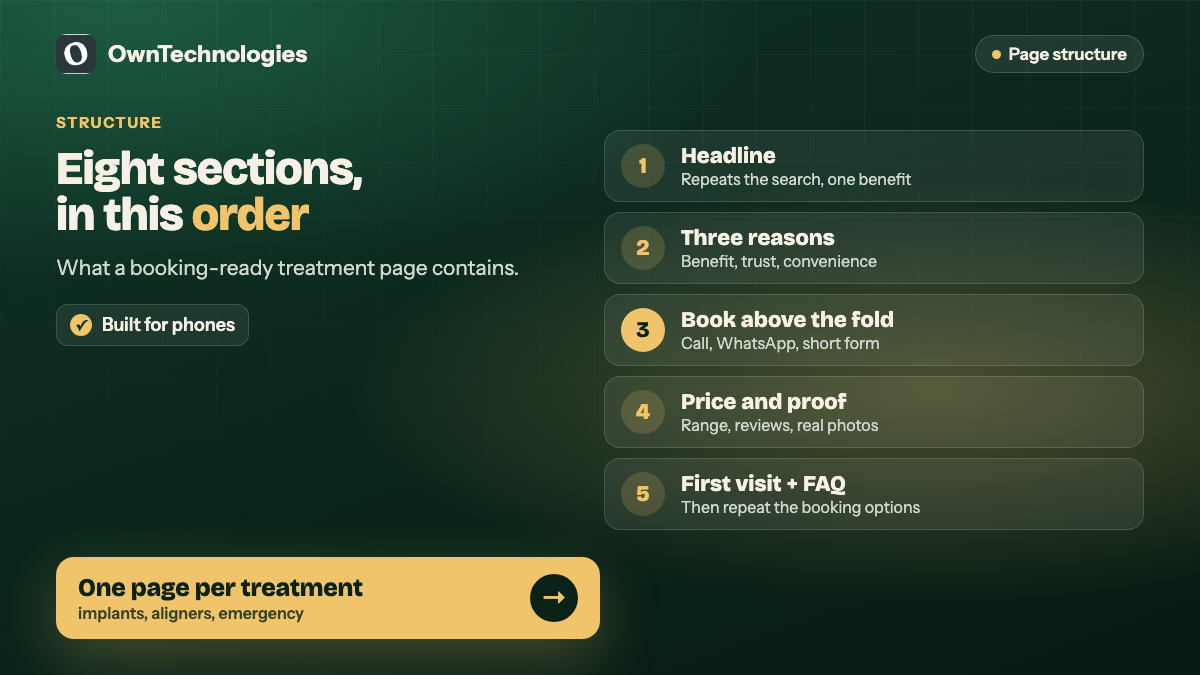
The single most important rule: **build one landing page per treatment you advertise.** Someone searching “emergency dentist near me” wants something very different from someone searching “Invisalign cost”. A single “Dental Services” page cannot speak to both.
Typical pages for a clinic running Google Ads:
- Emergency dental care
- Dental implants
- Clear aligners or braces
- Teeth whitening
- Check-up and cleaning for new patients
- Children’s dentistry
Start with the two or three treatments that bring the most revenue or have the most search demand in your area, and build those first. Each one gets its own ad group, its own ads and its own page.
The page structure, section by section
1. Headline that repeats the search
If the ad group targets “dental implants in Dubai Marina”, the headline says exactly that, with one benefit: “Dental implants in Dubai Marina, with a free consultation and 3D scan”. The visitor should feel they landed in the right place within two seconds.
2. Three reasons, not thirty
Directly under the headline, three short points that answer “why here?”:
- A concrete benefit (same-week appointments, sedation available, payment plans)
- A trust point (years of experience, number of implants placed, specialist qualifications you genuinely hold)
- A convenience point (location, parking, opening hours, languages spoken)
3. The booking action, above the fold
On a phone, the first screen must show a way to book: a short form, a “Call now” button and a WhatsApp button. Many dental patients prefer to call or chat, especially for emergencies, so do not force everyone through a form.
4. Price or price range
Patients compare prices before they call. “Implants from AED 3,500” or “Whitening from $299” filters out people who cannot afford the treatment and reassures those who can. If prices genuinely vary, explain what affects them and offer a free consultation to give an exact quote.
5. Real proof
- Reviews with first names, ideally mentioning the treatment the page is about
- Before-and-after photos, with patient consent and within local rules
- Photos of your actual dentists and clinic, not stock images
- Certifications and memberships that apply to the treatment
6. What happens at the first visit
A short three or four step timeline reduces anxiety: consultation, scan or X-ray, treatment plan and price, then treatment. Fear of the unknown stops many dental bookings.
7. Short FAQ
Four to six questions that people actually ask your reception team: does it hurt, how long does it take, do you accept insurance, can I pay in instalments, what if I have an emergency at night.
8. Repeat the booking action
End with the same form, call and WhatsApp options. Add the address and a map for people ready to visit.
What to leave off a dental landing page
- **The full main menu.** Every link away from the page is a way to leave without booking.
- **Your other eleven treatments.** A small “We also offer” line at the bottom is enough.
- **Long practice history.** One line about experience is plenty here.
- **Sliders and auto-playing video.** They slow the page on mobile data.
- **Pop-ups on arrival.** They frustrate visitors and can affect landing page experience.
Google Ads settings that must match the page
The page and the campaign work together. These settings make the most difference for clinics:
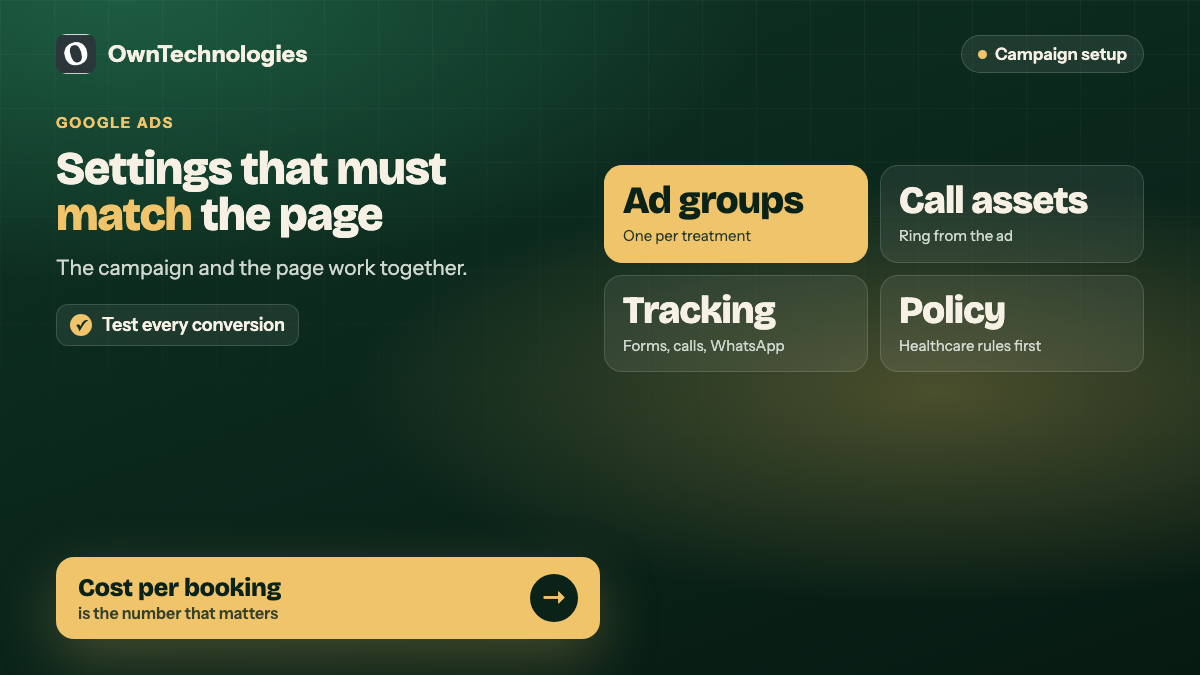
- **Ad groups by treatment**, each pointing to its matching page, with keywords and ads written for that treatment only.
- **Call assets** so mobile searchers can ring the clinic straight from the ad. Google explains the options in its guide to call assets.
- **Location targeting** on the area patients will actually travel from, usually a few kilometres for routine care and wider for implants or orthodontics.
- **Ad schedule** matched to when someone can answer the phone, or a clear WhatsApp option out of hours.
- **Conversion tracking** for form submissions, calls from the ad, calls from the page and WhatsApp clicks. Follow Google’s steps to set up web conversions, then submit a test enquiry to confirm it fires.
- **Policy awareness.** Healthcare advertising has its own rules on claims and certain treatments. Read Google’s healthcare and medicines policy and your local regulator’s advertising guidance before writing ad copy or before-and-after claims.
Speed and mobile
Most dental searches with booking intent happen on phones. Check the page on a real phone over mobile data. Compress images, remove sliders and unnecessary scripts, and keep the booking buttons large and easy to tap. Our landing page conversion checklist covers the 15 checks we run on every page before ads go live.
How to measure whether the page works
| Metric | Why it matters | What to watch |
|---|---|---|
| Conversion rate | Share of clicks that book, call or message | Compare page versions, not industry averages |
| Cost per booked appointment | The number that matters to the clinic | Track bookings, not just form fills |
| Calls answered | Missed calls are lost patients | Check call logs against ad hours |
| No-show rate from ad bookings | Low-quality leads show up here | Send reminders and confirm by phone |
| Treatment value per booking | Implants and aligners justify higher cost per lead | Judge each page against its own treatment value |
Give each change two to four weeks and enough clicks before deciding it worked. Change one thing at a time: the headline, the offer or the form, not all three.
What a dental landing page costs
These are planning ranges for an experienced offshore or hybrid team.
| Option | What you get | Cost | Timeline |
|---|---|---|---|
| One treatment page | Design, copy structure, build, tracking, form, call and WhatsApp | $600 to $1,500 (around 50,000 to 1.25 lakh INR) | 1 to 2 weeks |
| Three treatment pages | Shared design system, three pages, tracking | $1,500 to $3,500 (around 1.25 to 2.9 lakh INR) | 2 to 3 weeks |
| Pages plus Google Ads management | Pages, campaign build, monthly testing and reporting | From $500 a month plus ad spend | Ongoing |
If you also run social ads, see our guide to Meta ads for dental clinics, and for the free side of local visibility, local SEO for dentists.
Frequently Asked Questions
Usually not. A dedicated page for each advertised treatment, with a matching headline and a clear booking action, almost always converts better than a homepage built for every visitor.
A headline that matches the search, three reasons to choose you, call, WhatsApp and form options above the fold, a price or range, real reviews and photos, what happens at the first visit, a short FAQ and the booking options repeated at the end.
One per treatment you advertise. Start with the two or three highest-value or highest-demand treatments, such as implants, aligners and emergency care.
Often yes, with patient consent, but rules vary by country and platform. Check Google’s healthcare advertising policy and your local regulator’s guidance first.
Use call assets for calls from the ad, a tracked number or click-to-call event for calls from the page, and test every conversion with a real enquiry before scaling spend.
In 2026 a single treatment page typically costs $600 to $1,500, and three pages around $1,500 to $3,500, with an experienced offshore or hybrid team.
Final Thoughts
A dental landing page for Google Ads converts when it speaks to one treatment, repeats the search in the headline, makes booking easy on a phone, shows real proof and a price, and tracks every call and message. Build the page before you raise the budget, and build one per treatment.
Want a dental landing page that turns clicks into appointments? Our Google Ads team builds and manages clinic campaigns, our website development team builds fast treatment pages, and our CRM team makes sure every enquiry gets a fast reply. Ask for a free landing page audit and we will show you what to fix first.