Most venue businesses do not lose bookings because their venues are bad. They lose them because enquiries arrive through six channels, sit unanswered for a day, and nobody knows which host was promised which date. A good venue booking platform fixes that before it fixes anything else.
This guide walks through how Urban Venue, a Delhi NCR venue platform we built, handles enquiries from first click to confirmed event. You will see the pages and features that matter, the admin panel behind them, what a venue booking platform costs in 2026, and the mistakes that quietly kill conversions.
What Urban Venue Is and Why Enquiries Were the Hard Part
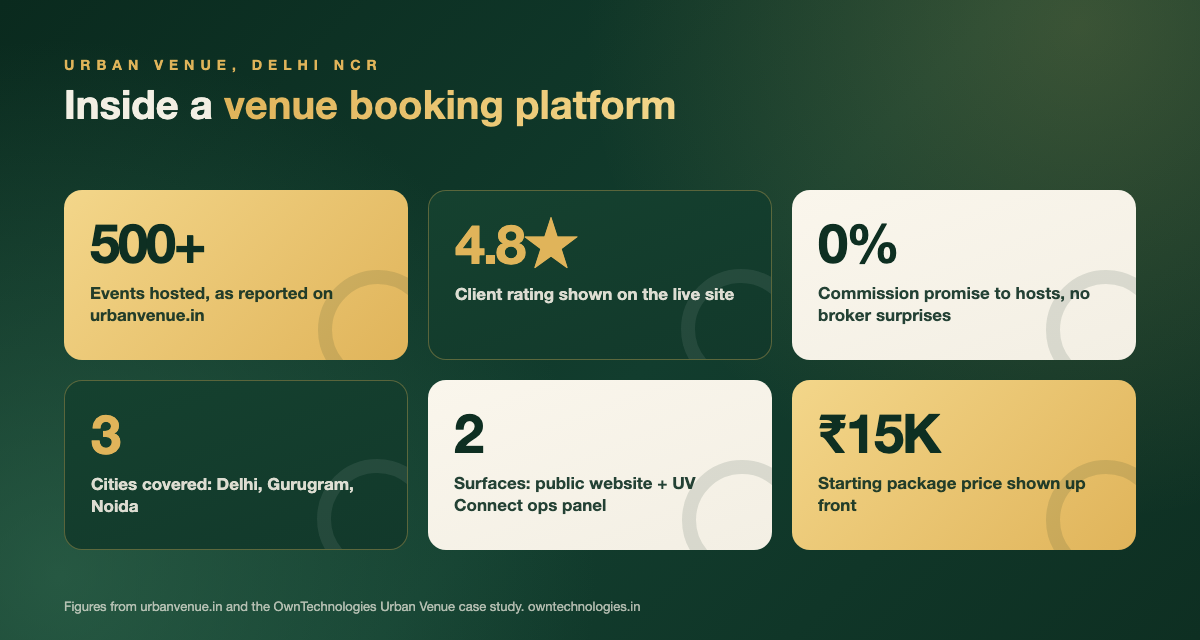
Urban Venue helps people find and book curated celebration venues across Delhi, Gurugram, and Noida: weddings, mehendi and haldi functions, birthdays, pool parties, corporate events, and family gatherings. Its promise to hosts is simple: transparent packages, starting prices shown up front, and no broker or commission surprises.
That promise creates a specific challenge. Event hosts want inspiration and clarity fast: what the venue looks like, how many guests it fits, and what it really costs. They do not want to scroll through hundreds of unvetted listings. At the same time, the business needs tight operational control over bookings and venue partners, and that control cannot live inside a festive, celebration-first website.
So the brief had three parts:
- Help hosts decide quickly with curated venues, occasion types, and honest package cards.
- Capture every enquiry with enough detail that the team can respond with a real answer, not a generic call back.
- Give the ops team a separate workspace to track bookings and coordinate partners without cluttering the public brand.
Two Surfaces, One System: Website Plus Ops Panel
The key design decision was to split the platform into two surfaces that share one brand and one data layer.
| Surface | Who uses it | Main job | Key screens |
|---|---|---|---|
| Public website | Event hosts and guests | Discovery and enquiry capture | Occasion pages, city pages, venue listings, package cards, enquiry forms |
| UV Connect (ops panel) | Urban Venue team | Booking execution and partner coordination | Booking status, partner details, event tracking |
| Venue listing flow | Venue owners | Supply growth | “List your venue” form feeding the ops team |
Keeping these separate matters more than it sounds. When a small team tries to run bookings from the same WordPress dashboard that powers the marketing site, or from a shared spreadsheet, enquiries get lost between tabs. We wrote about this pattern in detail in why businesses are replacing spreadsheets with custom admin panels.
Step 1: Discovery Pages That Match How Hosts Search
Hosts do not search for “venue”. They search for “pool party venue in Gurugram” or “mehendi venue in Delhi”. The Urban Venue site is organised the same way, with two navigation paths:
- By occasion: weddings, pool parties, birthdays, corporate events, family gatherings, pre-wedding shoots, haldi, and mehendi.
- By city: Delhi, Gurugram, and Noida, each with its own venue list.
Each occasion and city page is a landing page in its own right. That helps search rankings, and it means a host who arrives from an Instagram ad for pool parties lands on pool party venues, not a generic homepage. If you are planning a venue site, budget for one well-written page per occasion and per city from day one.
Step 2: Package Cards That Answer Price Before the Call
The fastest way to lose an event host is to hide the price. Urban Venue shows packages as cards, such as haldi and mehendi packages, with a clear starting price. The homepage states that venues start from Rs. 15,000, which sets expectations before anyone fills in a form.
Package cards also make enquiries better. A host who picks a package before enquiring has already told you the occasion, the budget band, and roughly what they expect. Your team can reply with availability and a quote, not a list of questions.
What a good venue package card shows
- Occasion type and a photo of the actual space.
- Guest capacity range.
- Starting price and what is included.
- Extras such as decor, sound, or food tasting.
- A “Check availability” button that pre-fills the enquiry form.
Step 3: Enquiry Forms That Push Toward a Booking
On Urban Venue, the enquiry form sits right in the hero section: name, phone number, and a “Check Available Venues” button. It is short on purpose. The more fields you add at the first touch, the fewer people submit.
The trick is to collect detail in stages. A short form captures the lead. The follow-up, by phone or WhatsApp, collects date, guest count, and budget. Forms further down the site, on package and venue pages, carry context automatically, so the team knows which venue or package the host was looking at.
The site also offers complimentary food tasting and a free consultation for hosts who are not sure where to start. Both work as low-risk next steps that turn a browsing visitor into a real conversation. If most of your hosts prefer to chat, a WhatsApp Business API integration can route those conversations straight into your ops panel.
Step 4: The Ops Panel Where Enquiries Become Events
Once an enquiry comes in, it leaves the public website and moves into UV Connect, the ops panel we built for the Urban Venue team. UV Connect is shaped around two things: booking status and partner coordination.
- Booking status: every enquiry has a clear stage, so nobody has to ask “did anyone call this person back?”
- Partner coordination: venue partner details and event requirements live next to the booking, so the team can execute without chasing information.
- Focus: the panel shows the team what needs doing today, not marketing content.
For most venue businesses, this is where the money is. A beautiful website that sends enquiries into an inbox nobody owns will underperform a plain website backed by a disciplined ops panel. If you already use a CRM that does not fit your booking workflow, a custom CRM or admin panel built around your stages is often the bigger win.
Growing supply with a “List Your Venue” flow
A venue platform is two-sided. Hosts need choice, and venue owners need a reason to join. Urban Venue has a dedicated “List Your Venue” section where property owners share their details and showcase their space. The team then evaluates each venue on ambience, location, guest capacity, and amenities before it goes live.
That curation step is what keeps the “curated and verified” promise believable. It is also a feature you should plan for in version one, even if the review happens manually at first.
Must-Have Features for a Venue Booking Platform
Whether you run a single banquet hall or a multi-city marketplace, these features decide whether enquiries turn into events:
| Feature | Why it matters | Version 1? |
|---|---|---|
| Occasion and city pages | Match search intent and ad campaigns | Yes |
| Package cards with starting prices | Pre-qualify hosts, reduce price anxiety | Yes |
| Short enquiry form with context | More submissions, better leads | Yes |
| Ops panel with booking stages | No lost enquiries, clear ownership | Yes |
| Venue partner onboarding | Grow supply without manual chasing | Yes, simple form |
| Availability calendar | Instant answers on dates | Version 2 for most |
| Online deposits and payments | Lock dates, cut no-shows | Version 2 |
| Venue owner portal | Owners manage their own listings | Version 2 or 3 |
Notice that instant booking and payments are not in version one. For celebration venues, most hosts want to talk before paying a deposit. Starting with enquiry capture plus a strong ops panel gets you to market faster and teaches you what to automate next. Our guide to booking and appointment software for service businesses covers when instant booking does make sense.
Venue Booking Platform Cost in 2026
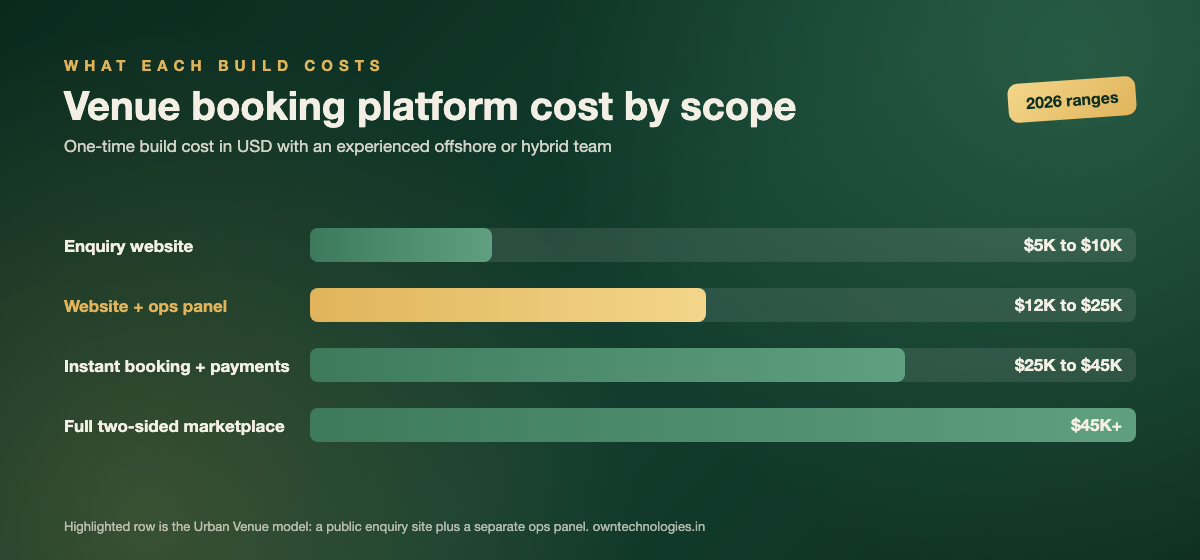
What you pay depends mostly on how much of the booking journey you automate. Here are typical ranges with an experienced offshore or hybrid team.
| Scope | What you get | Cost (USD) | Timeline |
|---|---|---|---|
| Enquiry website | Occasion and city pages, venue listings, package cards, enquiry forms | $5,000 to $10,000 (around 4 to 8.5 lakh INR) | 4 to 6 weeks |
| Website plus ops panel | Everything above plus booking stages, partner records, team roles | $12,000 to $25,000 (around 10 to 21 lakh INR) | 8 to 12 weeks |
| Instant booking and payments | Availability calendars, deposits, confirmations, reminders | $25,000 to $45,000 (around 21 to 38 lakh INR) | 12 to 16 weeks |
| Full two-sided marketplace | Venue owner portal, payouts, reviews, mobile apps | $45,000 and up (around 38 lakh INR and up) | 16 weeks and up |
Ongoing costs to plan for: hosting, SMS or WhatsApp messaging, payment gateway fees if you take deposits, and a small monthly budget for new venue and occasion pages. Venue sites are photo-heavy, so page speed also needs attention. Google’s Core Web Vitals are a good checklist for keeping galleries fast on mobile.
Mistakes That Cost Venue Businesses Bookings
- Hiding prices: “Call for pricing” sends hosts to the venue that shows a starting number.
- Long first forms: ask for name and phone first, collect the rest in the follow-up.
- Enquiries in personal inboxes: if leads live in one person’s phone, they leave when that person is busy or leaves.
- Stock photos: hosts book spaces they can picture themselves in. Use real photos of the actual venue.
- Building a marketplace too early: owner portals and payouts are expensive. Prove demand with enquiries first.
- Mixing brand and back office: the public site should feel like a celebration. The ops tools should feel like a to-do list.
How OwnTechnologies Builds Venue Platforms
For Urban Venue we delivered both surfaces: the consumer website and the UV Connect admin panel. You can see the full breakdown, with screens from the website and CRM, in the Urban Venue case study and the rest of our portfolio.
We have delivered 100+ projects over 8+ years for clients in 15+ countries, including the USA, Canada, UK, UAE, and Australia. Business websites typically take 3 to 6 weeks depending on scope, and if you later want native apps for hosts or venue owners, our mobile app development team can build on the same backend.
Frequently Asked Questions
A venue booking platform is a website or app where event hosts discover venues, compare packages, and send enquiries or bookings, backed by an admin panel where the venue team manages bookings and partners.
In 2026 an enquiry-focused venue website costs about $5,000 to $10,000. A website plus ops panel, like Urban Venue, costs $12,000 to $25,000. Adding instant booking and payments takes it to $25,000 to $45,000, and a full marketplace starts around $45,000.
Not always in version one. Most hosts of weddings and celebrations want to talk before paying a deposit. Start with strong enquiry capture and an ops panel, then add availability calendars and deposits once you know your booking patterns.
The public site needs to feel inspiring and simple for hosts, while the team needs a focused tool for booking stages and partner coordination. Separating them keeps both fast and stops enquiries getting lost in marketing tools.
An enquiry website takes 4 to 6 weeks. A website with an ops panel takes 8 to 12 weeks. Instant booking with payments takes 12 to 16 weeks, and a full two-sided marketplace takes 16 weeks or more.
Final Thoughts
A venue booking platform wins or loses on enquiries. Show hosts real venues and honest starting prices, capture their details with a short form, and hand every lead to an ops panel where someone owns it. Urban Venue’s split between a festive public site and a focused team panel is a model any venue business can copy, whatever its size.
Planning a venue platform or fixing one that leaks enquiries? Talk to OwnTechnologies for a free consultation. We will map your enquiry flow and send back a clear plan with scope, timeline, and cost, no commitment required.