Most website projects do not fail during the build. They fail at the point where nobody wrote down what “finished” means. The agency thinks the scope is one thing, you think it is another, and the disagreement surfaces in month three when the money is already spent.
This is a checklist for the stage before that: what to read, ask and get in writing before you sign with a web development agency in Gurugram or anywhere else. It is written from the contract side, because that is where the expensive surprises actually live.
Why the contract matters more than the portfolio
A portfolio tells you what an agency can build when everything goes well. The contract tells you what happens when it does not: when a dependency is late, when you change your mind in week six, when the developer who knew the code leaves.
Every agency’s work looks similar on a pitch deck. The differences show up in the paperwork. An agency that writes a clear out-of-scope list is telling you it has been burned before and has learned something. An agency whose proposal is two pages of features and a number has not.
The scope document is the real deliverable
Before any price is meaningful, you need a scope document that a stranger could read and understand what is being built.
A usable scope says what each user role can do, which screens exist, what happens on failure, and which integrations are involved. A weak scope says “admin panel”, “booking system”, “payment gateway” and leaves everyone to imagine their own version.
Ask for the scope before the quote. If an agency quotes a fixed price off a one-paragraph brief, it is either padding heavily to cover the unknowns or planning to charge you later for everything it assumed away.
The out-of-scope list is the useful half
Request an explicit list of what is not included. On a serious project this list is often longer than the in-scope list, and that is a good sign, not a bad one.
Typical items that belong on it: data migration from your old system, content and copywriting, stock photography licences, third-party subscription costs, native mobile apps when you asked for a website, SEO work, and any hardware.
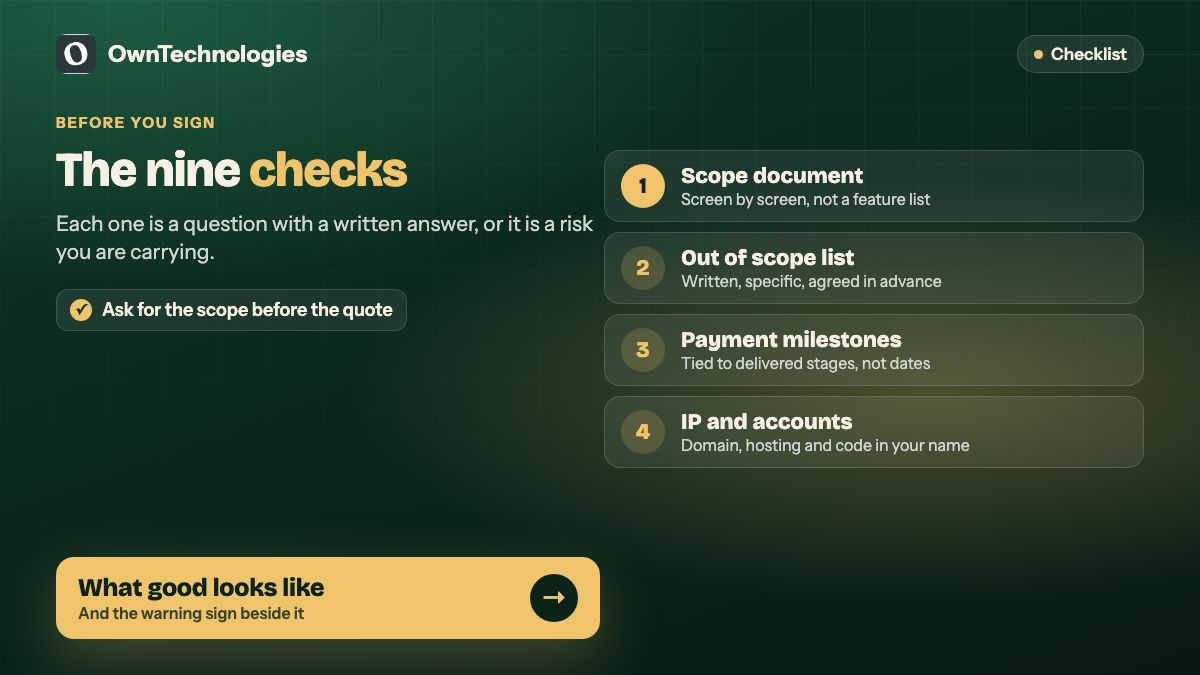
Nine checks before you sign
| Check | What good looks like | Warning sign |
|---|---|---|
| Scope document | Screen by screen, role by role | A feature bullet list |
| Out-of-scope list | Written, specific, agreed | Not provided |
| Payment milestones | Tied to delivered stages | 50 percent upfront, rest on launch |
| Change requests | Named hourly rate in the contract | “We will sort it out” |
| Delivery commitment | A date, with named carve-outs | A vague range |
| IP ownership | Yours on final payment, in writing | Silent, or agency retains |
| Accounts and access | You own domain, hosting, repos | Agency holds everything |
| Support period | Length and what counts as a fault | “We will look after you” |
| Exit terms | What you receive if it ends early | Not addressed |
Payment milestones should match delivery, not the calendar
Avoid structures where most of the money moves before most of the work does. Milestones should attach to things you can see and check: designs approved, a working build you can log into, testing signed off, launch completed.
A reasonable split on a fixed-price website is four or five stages, with the final 20 to 30 percent held until after launch and a support window. If an agency wants 50 percent upfront with the rest on launch, ask what you are paying for in between.
Who owns the code, the accounts and the data
This is the check most businesses skip and most regret.
- Intellectual property in the custom code should transfer to you on final payment, stated in a clause, not implied.
- The domain should be registered in your company’s name from day one, not the agency’s.
- Hosting, analytics, email and payment gateway accounts should be yours, with the agency added as a user you can remove.
- You should be able to request a full export of your data in a standard format at any time, without a fee.
If an agency resists any of these, you are not buying a website. You are renting one. ICANN’s registered name holder guidance explains why the registrant contact, not the administrative one, is the name that actually controls a domain.
What change requests should cost
Scope changes are normal. Pretending they will not happen is what causes disputes.
A healthy contract names an hourly or daily rate for work outside the agreed scope, and says that adding features moves the delivery date in writing. In India that rate commonly sits between $15 and $40 per hour (roughly 1,200 to 3,500 INR), depending on seniority. The number matters less than having one before you need it.
Delivery commitments, and what happens when they slip
Ask what happens if the agency overruns for its own reasons. A fair answer is that the team keeps working at no extra fee until the agreed scope is delivered, with carve-outs for delays caused by you, by change requests, by app store review, or by a third party being unavailable.
Those carve-outs are reasonable. An agency cannot be held to a date while waiting three weeks for your content or for a payment provider to approve an account. What you want is that the risk of its own underestimate sits with the agency, not with you.
Questions worth asking on the first call
- Who exactly will write the code, and are they employees or subcontractors?
- What is your process when we disagree about whether something was in scope?
- Show me a project where the timeline slipped. What happened and what did you change afterwards?
- What do we receive at handover, and can we run the site without you?
- Which parts will we be able to edit ourselves, and which will always need you?
The third question is the most useful one. Every agency has had a project go sideways. The ones worth hiring can describe it plainly.
What this should cost in Gurugram in 2026
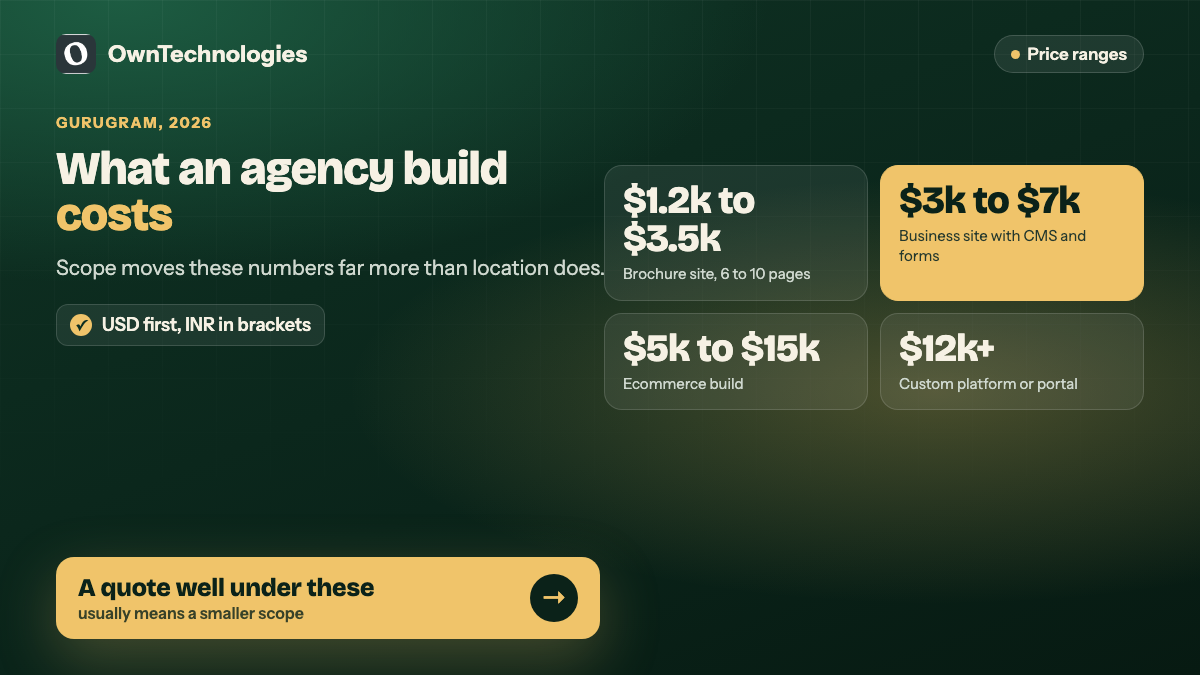
Prices vary more by scope than by postcode, but as a rough guide for an agency build:
| Project | Typical range | Timeline |
|---|---|---|
| Brochure website, 6 to 10 pages | $1,200 to $3,500 (1 to 3 lakh INR) | 3 to 5 weeks |
| Business site with CMS and forms | $3,000 to $7,000 (2.5 to 6 lakh INR) | 4 to 7 weeks |
| Ecommerce build | $5,000 to $15,000 (4 to 12 lakh INR) | 6 to 12 weeks |
| Custom platform or portal | $12,000 upward (10 lakh INR upward) | 12 weeks upward |
A quote well under these ranges usually means the scope is smaller than you think it is. Read the exclusions before you celebrate the number. For a fuller breakdown see our guide to custom website development cost.
Frequently Asked Questions
Location matters less than communication and contract quality. Local helps when you want in-person workshops or your team is non-technical and benefits from face to face sessions. Beyond that, judge on the scope document, the references and the terms rather than the postcode.
Fixed price suits a well-defined scope, which is most brochure and business websites. We cover the trade-off in more depth in freelancer vs agency vs dedicated team. Hourly suits work where the requirements will genuinely evolve, such as an early stage product. The danger is a fixed price on a vague scope, which pushes the risk onto you through change requests.
Between 20 and 30 percent is normal to start work. Anything approaching half the project value before any deliverable is a risk, especially with an agency you have not worked with before.
You should, registered in your company’s name, with you as the registrant contact. Agencies often register it for convenience and it becomes a problem later. Ask for it in your name from the start.
That depends entirely on whether you hold the domain, hosting and code. If you do, another team can take over in days. If the agency holds them, recovery can take weeks and sometimes means rebuilding.
Yes. The size of the project does not change the value of writing down what is included, when payment happens and who owns the result. A two-page agreement is better than none.
Final Thoughts
Choosing a web development agency is mostly an exercise in reading carefully. The portfolio gets you to a shortlist. The scope document, the exclusions and the ownership clauses tell you which one will still be a good decision in month four.
If you are comparing proposals right now and want a second opinion on what is actually in them, get in touch. We are happy to look at a scope you received from someone else and tell you what we think is missing, with no obligation. You can also see how we work on our website development and CRM development pages, or browse the portfolio.