Hiring dedicated developers from India can double your development capacity at a fraction of local cost. It can also turn into three months of missed deadlines if you skip the boring parts: the brief, the trial, the contract, and the first two weeks of onboarding.
This guide is for founders and business owners in the USA, UK, Canada, Australia, and the Gulf who want to hire dedicated developers from India without the usual surprises. You will get the step-by-step process, the checks to run before you sign, a quick look at cost, and the pitfalls we see most often.
What a Dedicated Developer Actually Is
A dedicated developer works only on your project, usually full time, for a monthly fee. They are employed by a development company, which handles salary, equipment, office, HR, and replacements. You direct the daily work, set priorities, and own everything they write.
It sits between a freelancer and a fixed-price project:
| Model | Who manages the work | Best for | Main risk |
|---|---|---|---|
| Freelancer | You | Small, short tasks | Availability and continuity |
| Fixed-price project | The agency | Clear, stable scope | Change requests cost extra |
| Dedicated developer | You, with agency support | Ongoing product work, evolving scope | Needs your time for direction |
| Dedicated team | Agency project manager plus you | Larger products, several roles | Higher monthly commitment |
If you are still choosing between these, our comparison of freelancer vs agency vs dedicated team goes deeper.
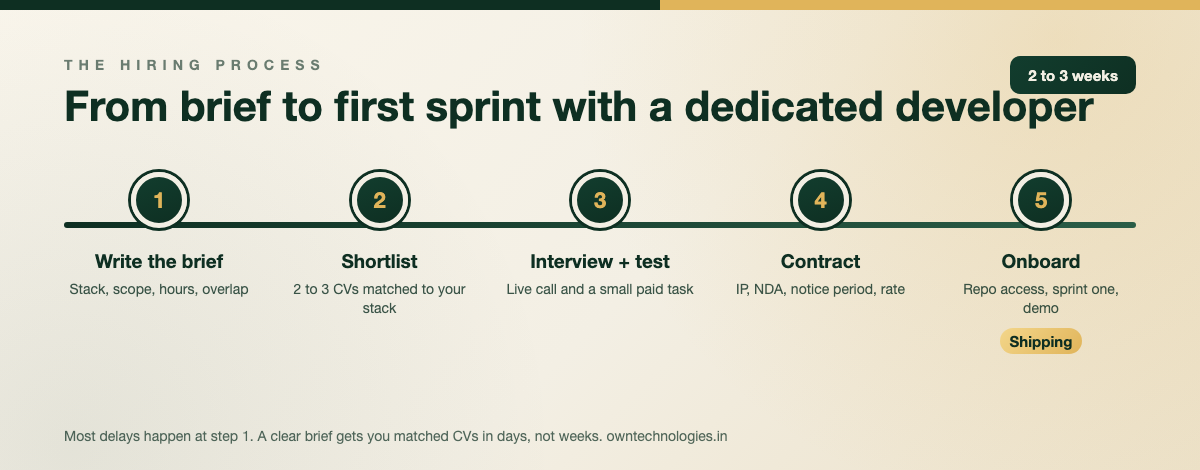
Step 1: Write a One-Page Brief
Most hiring delays start here. “We need a React developer” gets you ten random CVs. A one-page brief gets you two or three that fit. Include:
- The product: what it does and who uses it, in two lines.
- The stack: languages, frameworks, database, hosting. If you do not know, say so.
- The first month: three to five concrete things you want built or fixed.
- Hours and overlap: full time or part time, and which hours in your time zone you need them online.
- Who they report to: you, a CTO, or an existing team lead.
Step 2: Shortlist on Relevant Work, Not Years
Years of experience is a weak signal. A developer with three years building booking apps in your exact stack is a better fit than one with eight years in something unrelated. Ask the company for two or three CVs, each with:
- Projects in a similar domain or stack, with what the developer personally built.
- Links to live products, app store listings, or code samples where contracts allow.
- Their English level for written and spoken communication.
- Availability date and notice period.
Check the stack against current reality too. The Stack Overflow Developer Survey is a useful sanity check on which technologies are widely used and easy to hire for later.
Step 3: Interview, Then a Small Paid Test
A 30 to 45 minute video call tells you about communication. It does not tell you about code. After the call, give the shortlisted developer a small, paid task: a real bug from your backlog or a small feature, scoped to four to eight hours.
What to watch in the test
- Did they ask clarifying questions before starting?
- Did they deliver on time, or warn you early if not?
- Is the code readable, and did they explain what they changed?
- Did they test it, or leave testing to you?
Paying for the test matters. It is fair to the developer, and it gives you a realistic preview of how they work under normal conditions.
Step 4: Get the Contract Right
The contract protects you long after the excitement of hiring fades. Make sure it covers:
| Clause | What to look for |
|---|---|
| IP ownership | All code, designs, and documents belong to you once paid |
| NDA | Covers the developer and the company, not just one |
| Notice period | 15 to 30 days either side is typical |
| Replacement | A free replacement if the developer leaves or is not a fit |
| Working hours | Named overlap hours in your time zone and leave policy |
| Rate and billing | Monthly rate, what counts as overtime, currency, invoice timing |
Step 5: Onboard for Output in Week One
A good company can have a developer ready to start within 48 hours of sign-off. What happens next depends on you. Before day one, prepare:
- Access to your code repository, task board, and staging environment, under accounts you own.
- A short document on how to run the project locally.
- The first sprint: a small, clear set of tasks they can finish in a week.
- A fixed daily check-in time and a weekly demo slot.
The weekly demo is the single most useful habit. Reports can look busy. A working demo cannot hide a problem for long.
What It Costs in 2026
Rates depend on experience and stack. As a rough guide for a full-time dedicated developer from an established Indian company:
| Level | Typical monthly cost (USD) | Good for |
|---|---|---|
| Junior (0 to 2 years) | $2,500 to $4,000 (around 2.1 to 3.3 lakh INR) | Well-defined tasks under a lead |
| Mid-level (3 to 5 years) | $4,000 to $6,500 (around 3.3 to 5.4 lakh INR) | Owning features end to end |
| Senior (6+ years) | $6,500 to $10,000 (around 5.4 to 8.3 lakh INR) | Architecture and leading others |
For hourly and part-time rates by role, see our full breakdown of the cost to hire dedicated developers in India. If you are weighing India against local or nearby teams, read offshore vs nearshore vs in-house development.
Pitfalls That Sink Offshore Hires
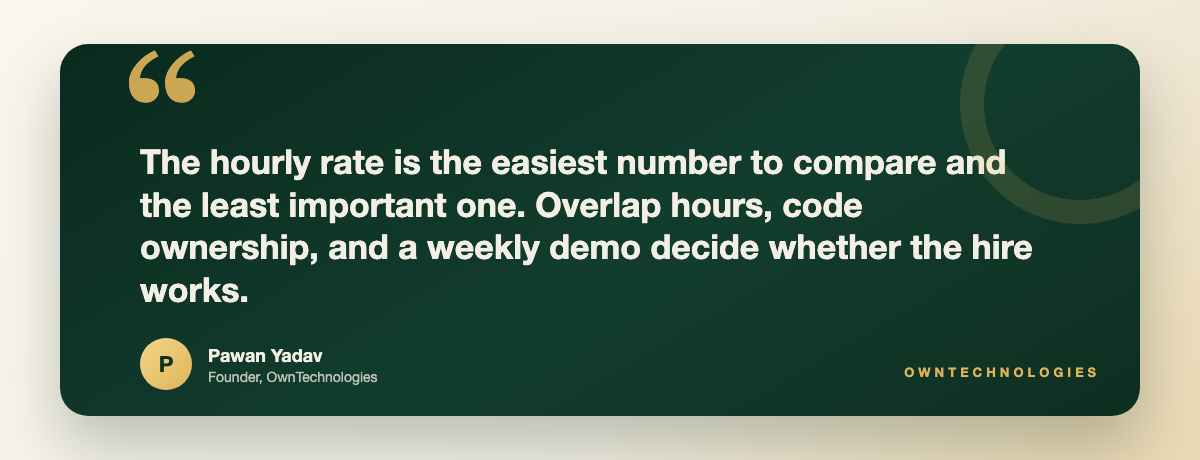
- Choosing on rate alone: the cheapest quote often means a junior developer billed as mid-level. Compare the test task, not the price.
- No time-zone overlap: with zero shared hours, every question costs a day. Agree on at least 3 to 4 overlapping hours.
- Code on their servers: if the repository and hosting are in the vendor’s accounts, you do not really own your product. Keep everything in accounts you control.
- No written scope for month one: vague direction produces vague output, then frustration on both sides.
- Status reports instead of demos: ask to see working software every week.
- One developer, no backup: make sure the company can cover leave and replace the developer without a long gap.
Signs the Hire Is Working After 30 Days
Give any new developer a month before judging them, but know what good looks like by then. You do not need a complex scorecard. Four simple signals tell you most of what you need.
- Shipped work: at least two or three tasks from the first sprints are live or on staging, not just “in progress”.
- Fewer questions, better questions: early questions about setup give way to questions about users and edge cases.
- Early warnings: the developer tells you about delays before the deadline, not after it.
- Readable handover: another developer could pick up their work from the repository and task notes.
If two or more of these are missing after 30 days, raise it with the company directly. A good partner will coach, adjust, or replace the developer quickly, which is exactly what the replacement clause is for.
How OwnTechnologies Works With Dedicated Developers
We offer hourly, part-time, and full-time dedicated developers with onboarding in 48 hours. Our teams build mobile apps, websites and web platforms, and CRMs and admin panels for clients in 15+ countries, including the USA, Canada, UK, UAE, and Australia. Over 8+ years we have delivered 100+ projects, and you can see examples in our portfolio.
Frequently Asked Questions
With a clear brief, most companies share matched CVs within a few days. Interviews and a paid test take about a week, and a good company can onboard the developer within 48 hours of sign-off. Two to three weeks end to end is typical.
In 2026 a full-time dedicated developer from an established Indian company typically costs $2,500 to $4,000 a month for junior level, $4,000 to $6,500 for mid-level, and $6,500 to $10,000 for senior developers.
You should. Make sure the contract assigns all intellectual property to you once invoices are paid, and keep the code repository and hosting in accounts you own from day one.
Agree on 3 to 4 overlapping working hours, hold a short daily check-in, use a shared task board, and schedule a weekly demo of working software. Most Indian companies adjust shifts to overlap with US, UK, or Australian hours.
Choose a company whose contract includes a free replacement and a short notice period of 15 to 30 days. A paid test task before signing also reduces the chance of a poor fit.
Final Thoughts
Hiring dedicated developers from India works best when you treat it like hiring an employee, not buying a service. Write a clear brief, test before you commit, own your code and accounts, agree on overlap hours, and ask for a demo every week. Do those five things and the lower cost becomes a real advantage instead of a hidden risk.
Ready to add a developer to your team? Talk to OwnTechnologies for a free consultation. Send us your brief and we will share matched profiles and a clear monthly quote, no commitment required.