You have three ways to get your app built: hire a freelancer, sign with a full-service agency, or bring on a dedicated team. Each one pitches itself as the safe choice, and each one has a real failure mode that only shows up after you have already paid.
This guide breaks down what freelancers, agencies, and dedicated teams actually cost in 2026, how fast each one ships, and which one fits your app depending on its stage, budget, and how long you plan to keep building on it.
Freelancer vs Agency vs Dedicated Team: The Short Answer
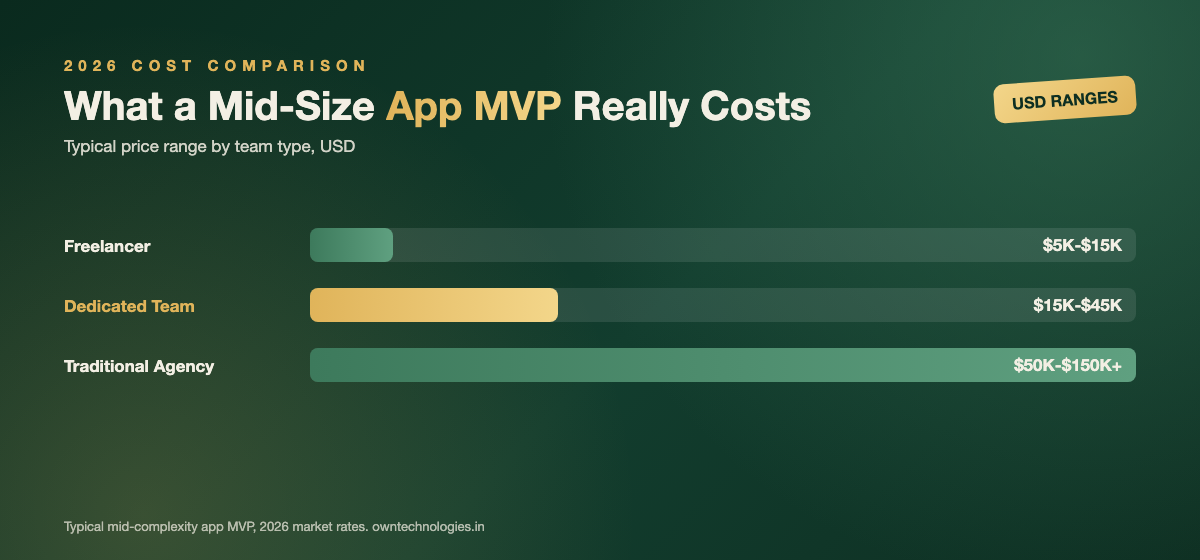
A freelancer is right for a small, well-defined task with a fixed end date. A traditional agency is right when you need one big brand name on the contract and budget is not the constraint. A dedicated team is right for anything you plan to keep improving after launch, which describes most real apps.
| Option | Best for | 2026 cost range (USD) | Typical timeline |
|---|---|---|---|
| Freelancer | A single small feature or a fixed short-term task | $5,000 to $15,000 | 8 to 16 weeks, often delayed |
| Traditional agency | Enterprise brands that need a big name on the contract | $50,000 to $150,000+ | 10 to 20 weeks |
| Dedicated team | MVPs and apps you plan to keep building on | $15,000 to $45,000 | 8 to 14 weeks |
These ranges cover a typical mid-complexity app MVP: user accounts, a handful of core screens, one or two backend integrations, and basic admin. A simpler app costs less in any lane, a complex one costs more.
What Each Model Actually Means
The three terms get used loosely, so here is what you are actually buying with each one.
Freelancer
One person, usually working on your project alongside two or three others at the same time. You get direct access to the developer and the lowest hourly rate, but no backup if they get sick, take another contract, or simply go quiet. Platforms like Upwork and Fiverr make freelancers easy to find but hard to vet.
Traditional agency
A full-service shop with account managers, a sales team, and a bench of developers. You are paying for process, polish, and a brand name you can put in front of a board. The tradeoff is layers: your question goes to an account manager before it reaches the developer, and US or UK agency rates run $100 to $250 an hour.
Dedicated team
A small, fixed group of developers, usually two to five people, who work only on your product for as long as you keep them. You get direct access like a freelancer, continuity like an agency, and a monthly cost that sits between the two. This is the model OwnTechnologies runs for most app development clients: the same people from discovery through post-launch support.
Cost Comparison for 2026
Hourly rate is not the number that matters. Total cost to a working app is, and that includes rework, missed deadlines, and the hours you spend managing whoever you hired.
| Option | Hourly or monthly rate | MVP cost (USD) | MVP cost (INR) |
|---|---|---|---|
| Freelancer (offshore) | $15 to $40 per hour | $5,000 to $15,000 | 4.1 lakh to 12.4 lakh |
| Freelancer (US/UK) | $50 to $100 per hour | $18,000 to $40,000 | 15 lakh to 33 lakh |
| Dedicated team (2 to 3 people) | $2,500 to $6,000 per month | $15,000 to $45,000 | 12.4 lakh to 37 lakh |
| Traditional agency | $100 to $250 per hour | $50,000 to $150,000+ | 41 lakh to 1.24 crore+ |
According to Deloitte’s global outsourcing survey, cost reduction remains the top reason companies bring in outside development help, but teams that outsource for cost alone without a plan for continuity report the highest rate of project restarts. That restart cost rarely shows up in the original quote.
Speed to Launch: Who Gets You Live Faster
A single freelancer looks fast on paper because there is no coordination overhead, but they are almost never working on only your project. Expect your timeline to stretch whenever a bigger client of theirs needs attention first.
A traditional agency is consistent but slow to start. Onboarding, contracts, and a kickoff phase with multiple stakeholders can eat two to four weeks before a single line of code is written.
A dedicated team starts closest to full speed. Because the same two or three people are assigned only to you, there is no queue to wait behind and no ramp-up on a new project every sprint. Most dedicated-team MVPs at OwnTechnologies go from kickoff to a working version in 8 to 14 weeks.
Quality, Reliability, and Long-Term Risk
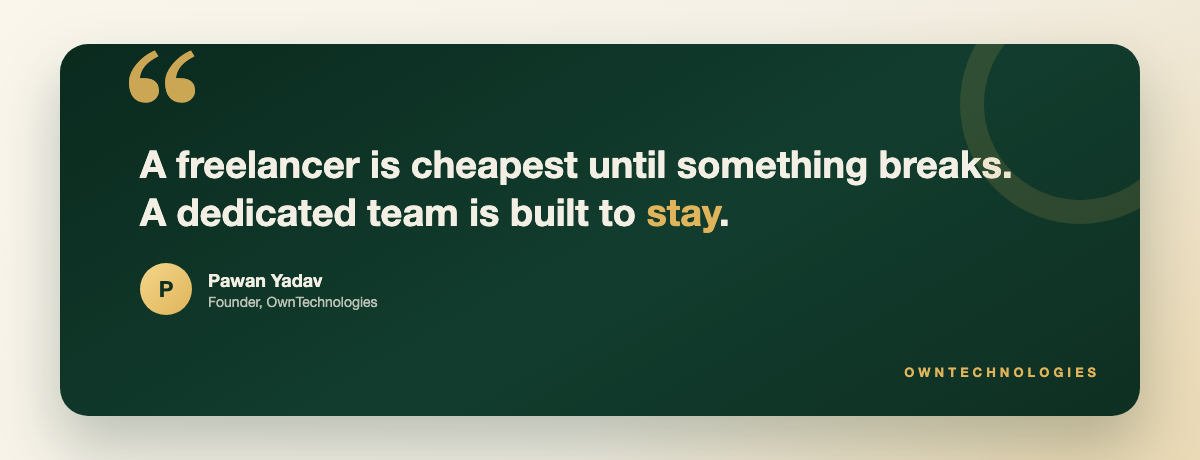
The real risk with a freelancer is not skill, plenty are excellent, it is continuity. If they disappear mid-project you inherit code nobody else has seen, often with little to no documentation. Rebuilding trust and understanding with a replacement can cost more than the original build.
The risk with a traditional agency is different: your project gets staffed by whoever is available that sprint. Ask directly whether the developers on your kickoff call are the ones who will still be writing your code in month three, agencies rotate staff between projects more than they advertise.
A dedicated team removes both risks by design. The same people ship your MVP and stay on for support, so institutional knowledge about your codebase never walks out the door.
Communication, Ownership, and IP
- Freelancer: direct chat with the developer, but confirm source code and repository ownership in writing before work starts, this is often skipped on freelance platforms.
- Agency: communication runs through an account manager, which is useful for non-technical founders but adds a day or two of lag to every decision.
- Dedicated team: direct access to developers plus a single point of contact for planning, and source code ownership transferred to you by default in the contract.
Whichever option you choose, get code and IP ownership in writing before the first invoice. A Statista analysis of IT outsourcing shows the market has grown steadily for a decade, which means more vendors of every size, and more contracts where ownership terms are vague unless you ask.
Which Option Fits Your App
Choose a freelancer when
You need one small, clearly scoped task, such as a bug fix, a single new screen, or a short integration, and you already have a technical person on your side to review the work.
Choose a traditional agency when
Budget genuinely is not a constraint, you need a recognizable name for investor or board credibility, and you are fine with a slower start in exchange for that brand.
Choose a dedicated team when
You are building an MVP or a product you plan to keep improving for years, not months. This is the majority of founders reading this guide, and it is why most of our client work runs on a dedicated-team model from day one.
Red Flags to Watch For in Each Model
- Freelancer: no written contract, no milestone-based payments, reluctance to share past client references.
- Agency: sales team overpromises on the pitch call, then a completely different, more junior team shows up for kickoff.
- Dedicated team: vague about who exactly is on the team, or unwilling to commit to the same developers for the full project.
- Any option: a quote with no phase breakdown, or a vendor who cannot explain what happens to your code if the engagement ends early.
How to Decide: A Quick Checklist
- How long will you need developers? Weeks, hire a freelancer. Months or years, hire a dedicated team.
- How complex is the scope? One feature fits a freelancer. A full product needs a team that covers design, backend, and QA together.
- What is your real budget? Under $20,000, a freelancer or a small dedicated team. Over $80,000 with brand requirements, an agency becomes realistic.
- Do you have technical oversight in-house? No, lean toward a dedicated team with a project manager included rather than an unsupervised freelancer.
- Will you need support after launch? If yes, a dedicated team is the only option built for that by default.
Cost is only one input. Our guide on mobile app development cost in the USA vs India breaks down the same three-way tradeoff purely from a pricing angle, and our piece on offshore vs nearshore vs in-house development covers the same decision from a location and risk lens.
Frequently Asked Questions
Per hour, yes. Over the life of a real app, often no. Freelancer rates are lower, but delays, disappearances, and rebuilding lost context typically close most of the gap once you add up total cost to a working, supported app.
An agency staffs your project from a shared bench and routes communication through an account manager. A dedicated team is a small, fixed group assigned only to you, with direct access to the developers and continuity from build through post-launch support.
A 2 to 3 person dedicated team typically runs $2,500 to $6,000 per month, or $15,000 to $45,000 for a full mid-complexity MVP, roughly 12.4 lakh to 37 lakh INR.
Avoid a freelancer for anything beyond a single small task, especially if you have no technical person in-house to review the work or the project needs to survive past one release.
Yes, but budget time and money for a handover. A new team needs to read, test, and often partially rewrite undocumented code before they can safely build on top of it.
That is the defining feature. A genuine dedicated team is assigned to one client at a time, unlike a freelancer juggling several contracts or an agency developer rotating across accounts.
Final Thoughts
There is no universally right answer between a freelancer, an agency, and a dedicated team, only a right answer for your app’s stage, budget, and how long you plan to keep building. Most founders who plan to iterate for more than a few months end up better served by a dedicated team, since it is the only model built for continuity from the start.
Not sure which fits your project? Talk to OwnTechnologies for a free scoping call. Tell us what you are building and we will tell you honestly whether a small dedicated team or a lighter freelance engagement makes more sense, no pressure either way.