Hiring a software development company in India can save you 50 to 70 percent compared with a US or UK team. It can also cost you six months and your whole budget if you pick the wrong one. The difference is rarely the code. It is how the company scopes, communicates, tests and hands over.
This guide gives you a 12-point checklist, the red flags that show up before you sign, real 2026 price ranges, and the questions to ask on the first call. It is written for founders and business owners in the USA, UK, UAE and India who are hiring, not coding.
Why Businesses Hire a Software Development Company in India
India has one of the largest pools of software engineers in the world, and most mid-size Indian companies already work with overseas clients every day. The reasons buyers come here are practical:
- **Cost:** experienced developers at $25 to $40 per hour instead of $100 to $180 in the US or UK.
- **Range of skills:** one company can usually cover web, mobile, backend, CRM, cloud and QA, so you do not manage five vendors.
- **Time zone:** India is 4.5 hours ahead of the UAE and 9.5 to 10.5 hours ahead of US Eastern time, which means work can move overnight while you sleep, if the company plans handovers well.
- **English-first delivery:** documentation, calls and tickets are in English by default.
The catch is that quality varies more in India than almost anywhere else, because the market ranges from one-person shops to firms with thousands of staff. That is why the checklist below matters more than the hourly rate.
What a Software Development Company in India Costs in 2026
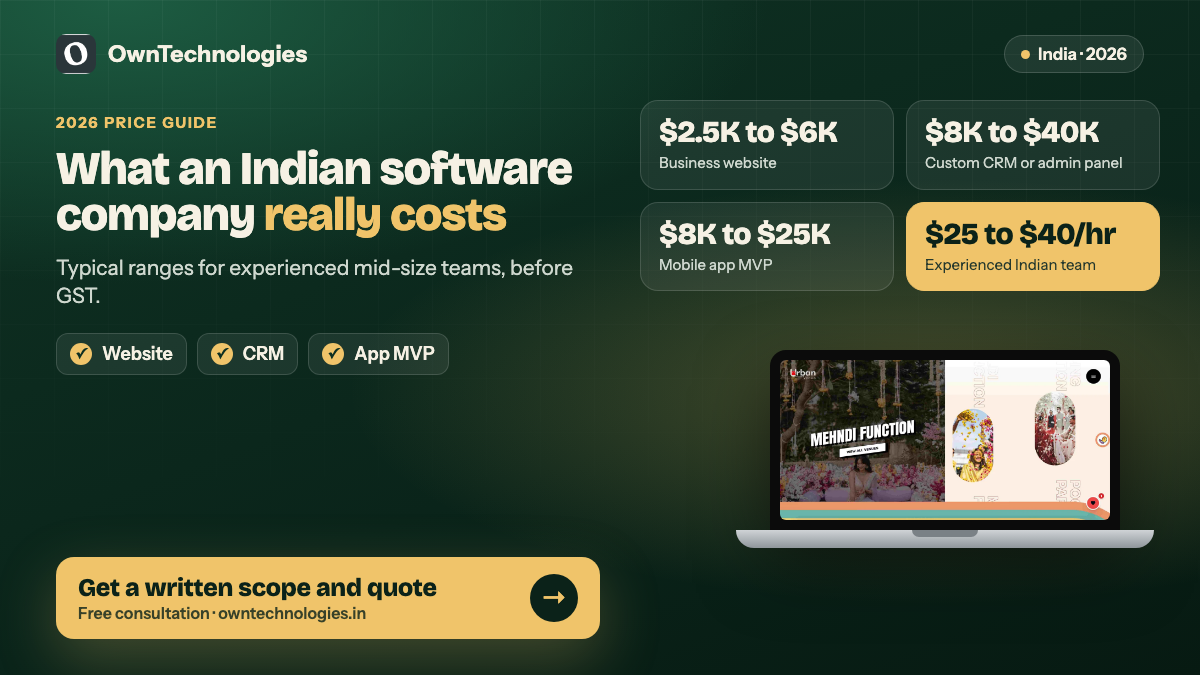
Prices depend on scope, team seniority and how much the company owns (design, QA, project management). These are typical ranges for experienced mid-size Indian teams in 2026:
| Project type | Typical scope | Cost range (USD) | Timeline |
|---|---|---|---|
| Business website | 5 to 10 pages, CMS, forms, SEO-ready | $2,500 to $6,000 (around 2 to 5 lakh INR) | 3 to 6 weeks |
| Custom CRM or admin panel | Leads, pipeline, roles, reports | $8,000 to $40,000 (around 6.7 to 33 lakh INR) | 6 to 14 weeks |
| Mobile app MVP | One core flow, login, admin basics | $8,000 to $25,000 (around 6.7 to 21 lakh INR) | 8 to 14 weeks |
| Web app or SaaS v1 | Multiple user roles, payments, dashboards | $20,000 to $60,000 (around 17 to 50 lakh INR) | 3 to 6 months |
| Dedicated developer | Full-time, works inside your team | $2,500 to $10,000 per month per developer | Ongoing |
If a quote is far below these ranges, ask what is missing. Usually it is testing, design, an admin panel or post-launch support. For deeper breakdowns see our guides on custom CRM development cost and the cost to hire dedicated developers in India.
The 12-Point Checklist for Choosing a Software Company in India
Score every company you talk to against these twelve points. A strong partner clears at least ten.
Proof and track record
- **Live work you can open.** Ask for apps in the stores and websites you can visit, not only screenshots. Check the store listing date, ratings and the last update.
- **Work similar to yours.** A team that has built a booking system or a CRM for an industry like yours will ask better questions in week one.
- **Clients you can speak to.** Ask for one past client contact. A company that has done good work will arrange this without fuss.
- **Independent reviews.** Look for verified reviews on directories such as Clutch or GoodFirms and on the company’s Google Business Profile. A handful of detailed reviews beats dozens of one-liners.
Process and communication
- **A written scope before a price.** Good companies send a feature list, assumptions and exclusions. A price without a scope is a guess.
- **Milestones tied to working software.** Payments should follow demos you can click, not calendar dates.
- **One named project manager.** You need a single person who answers within one working day, plus a weekly demo.
- **Overlap hours stated in writing.** For UAE clients 2 to 4 hours of overlap is easy. For US clients ask exactly which hours the team is online.
Quality and ownership
- **QA is a line item.** Ask who tests, on which devices, and whether automated tests are included. If testing is “done by developers”, expect bugs in production.
- **You own the code and accounts from day one.** The repository, app store accounts, domain and cloud hosting should be in your name. This is the single biggest protection you have.
- **Security and data rules.** If you handle personal data, the company should know India’s Digital Personal Data Protection framework and the rules in your own country, and should sign an NDA before you share details.
- **Support after launch.** Ask for a written support period (30 to 90 days of free bug fixes is common) and a monthly maintenance price after that.
Red Flags to Watch for Before You Sign
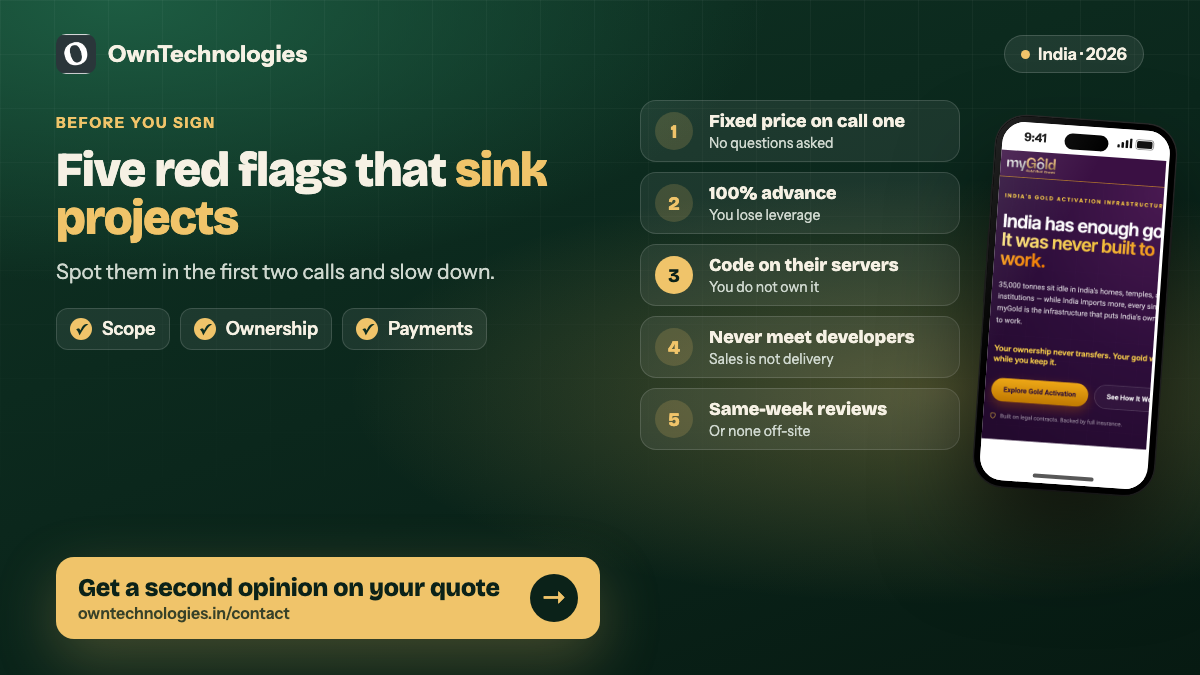
Most bad projects show warning signs in the first two calls. Walk away, or at least slow down, if you see these:
- **A fixed price in the first call** before anyone has asked about your users, integrations or admin needs.
- **”We can do everything”** with no examples in your field. Breadth is fine; zero relevant proof is not.
- **The code stays on their servers** until the final payment, or they refuse to give repository access during the project.
- **100 percent advance payment.** 20 to 30 percent upfront is normal. All of it upfront removes your leverage.
- **No questions about your business.** A good team asks how you make money, who your users are and what success looks like.
- **The person selling is not the person building,** and you never meet the developers or the project manager before signing.
- **Reviews that all sound the same,** posted in the same week, or no reviews anywhere outside the company’s own website.
Project-Based, Dedicated Team or Hourly: Which Model Fits
Indian companies usually offer three ways to work. Picking the right one avoids most budget fights.
| Model | Best for | How you pay | Main risk |
|---|---|---|---|
| Fixed-price project | Clear scope, MVP, website, defined CRM | By milestone | Change requests cost extra |
| Dedicated team | Ongoing product, changing priorities | Monthly per developer | You must manage priorities |
| Hourly / time and material | Small fixes, audits, unclear scope | Weekly or monthly timesheets | Hard to predict the total |
Many buyers start with a small fixed-price phase (a discovery sprint or MVP) and then move to a dedicated team once trust is built. We compare these options in more detail in freelancer vs agency vs dedicated team and offshore vs nearshore vs in-house development.
Questions to Ask on the First Call
Use these on every shortlist call and compare the answers side by side:
- Show me two projects most similar to mine. What went wrong on them and how did you fix it?
- Who exactly will work on my project, and can I meet the lead developer?
- What do you need from me in the first two weeks?
- How do you handle a feature I add halfway through?
- Which hours will you be online in my time zone?
- Who owns the code, the app store accounts and the cloud hosting?
- What does support cost after the free period ends?
A good company answers these clearly and in writing. If the answers turn vague, the project will too.
How Location Inside India Matters (and When It Does Not)
Bengaluru, Hyderabad, Pune, Chennai and Delhi NCR (including Gurugram and Noida) all have strong software companies. For remote projects the city matters far less than the team. It matters when:
- **You plan to visit.** Delhi NCR has direct flights to most Gulf, European and North American hubs, which makes on-site workshops easier.
- **You want local legal comfort.** A registered Indian private limited company gives you a proper contract, invoices and GST compliance.
- **You need specific skills.** Some cities have deeper pools in certain stacks, but any established company can staff common stacks such as React, Node.js, Flutter and Python.
If you are comparing NCR firms specifically, our checklist on contract checks for a Gurugram web agency covers the paperwork side.
Software Company vs Freelancer in India
Freelancers can be excellent for small, clearly defined tasks. For anything with users, payments or ongoing changes, a company is usually safer because:
- someone else can take over if a developer leaves or falls ill
- design, QA and project management are covered by people who do only that
- there is a legal entity to contract with and invoice from
- the company keeps documentation so knowledge is not in one person’s head
The trade-off is cost: a company’s rate includes those safety nets. For an MVP or a business system you will live with for years, that cost is usually worth it.
What a Good First Month Looks Like
You can judge a partner quickly once work starts. In a healthy first month you should see:
- **Week 1:** a kick-off call, a shared task board, access to the repository and a confirmed scope document.
- **Week 2:** clickable designs or wireframes for the main screens and a written list of open questions.
- **Week 3 to 4:** the first working demo on a test link or test build, with a short note on what is done and what is next.
If week four ends with no working software to click through, raise it immediately. Delays rarely fix themselves.
How OwnTechnologies Approaches Software Projects
We are a software development company based in Gurugram, Delhi NCR, with 100+ projects delivered over 8+ years for clients in 15+ countries, including the USA, UK, Canada, UAE, Australia and Norway. Our work covers custom website development (usually delivered in 3 to 6 weeks), mobile app development for iOS and Android, and custom CRM and admin panel development for clients such as CITE, BVT, Urban Venue and Aarogya. You can see the full list on our portfolio.
Every project starts with a written scope, milestones tied to demos, and the code in your own repository from day one.
Frequently Asked Questions
Check live work similar to your project, speak to one past client, read independent reviews, ask for a written scope before a price, and make sure you own the code and accounts from day one. Score each company on the 12-point checklist above.
In 2026 experienced Indian companies typically charge $25 to $40 per hour. A business website costs $2,500 to $6,000, a custom CRM $8,000 to $40,000, an app MVP $8,000 to $25,000 and a web app or SaaS v1 $20,000 to $60,000.
Yes, if you protect yourself: sign an NDA and a contract with an Indian registered company, pay by milestone, keep the repository and accounts in your name, and ask for weekly demos.
A fixed price before any questions, 100 percent advance payment, code kept on the vendor’s servers, no relevant examples, no access to the actual developers, and reviews that only appear on the company’s own website.
A freelancer suits small, well-defined tasks. A company is safer for products with users, payments or ongoing changes, because it covers design, QA, project management and continuity if someone leaves.
A business website takes 3 to 6 weeks, a CRM or admin panel 6 to 14 weeks, an app MVP 8 to 14 weeks, and a larger web app or SaaS first version 3 to 6 months, depending on scope.
Final Thoughts
The best software development company in India for you is the one that proves relevant work, writes the scope down, shows you working software every week and leaves you owning everything. Use the checklist, run the first-call questions, and start with a small paid phase before committing the full budget.
If you would like a second opinion on a quote you already have, or a written scope for your own project, talk to our team. The first consultation is free.