Every hiring plan for a software project eventually hits the same fork: build it in-house, hand it to a nearshore team a few time zones away, or send it offshore where rates are lowest. Most founders pick based on the headline hourly rate and regret it a year later.
This guide breaks down real 2026 cost ranges for offshore, nearshore, and in-house development, the risks each model actually carries, and a simple framework to decide which one fits your project instead of just your budget.
Offshore vs Nearshore vs In-House: The Quick Comparison
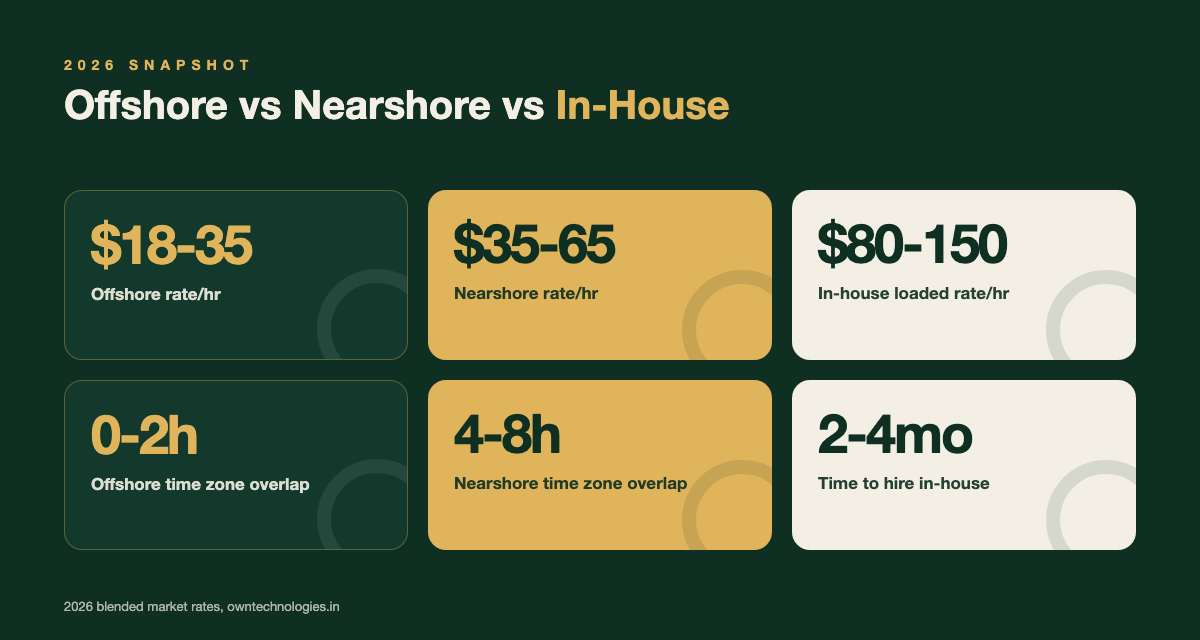
Before the detail, here is how the three models stack up on the things that actually decide a project’s outcome.
| Model | Typical hourly rate (USD) | Time zone overlap with US | Best for |
|---|---|---|---|
| Offshore (India, Southeast Asia) | $18 to $35 | 0 to 2 hours without a shift | Fixed-scope builds, cost-sensitive projects |
| Nearshore (Latin America, Eastern Europe) | $35 to $65 | 4 to 8 hours | Agile teams that need daily overlap |
| In-house (US, UK, Australia) | $80 to $150 loaded cost | Full overlap | Core product teams, sensitive IP |
The gap looks small per hour. It stops looking small once you multiply it across a real project, which is where most budgets get blown.
Rates also swing within each model. A senior offshore developer in a metro hub can cost as much as a junior nearshore developer, and a nearshore team in a smaller city often undercuts one in a capital city by 20 to 30 percent. Always ask for the seniority mix behind a blended rate, not just the number on the quote.
What Each Model Actually Means
Offshore development
Offshore means your development team sits in a country with a large time zone gap, usually India, the Philippines, or Vietnam. You get the lowest hourly rates and access to a huge talent pool, at the cost of little or no live overlap unless the team agrees to shift hours to meet you.
Nearshore development
Nearshore means the team is close enough in time zone to overlap most of the working day, think Latin America for a US client or Eastern Europe for a UK or EU client. Rates sit between offshore and in-house, and daily standups happen without anyone waking up at 6 a.m.
In-house development
In-house means you hire developers as full-time employees in your own country. You get full control, full overlap, and the easiest IP protection, but you carry the salary, benefits, recruiting cost, and the risk of losing months to a bad hire or a resignation.
Real 2026 Cost Comparison for a Mid-Size Project
Take a realistic mid-size build, a custom web app or CRM that needs roughly 1,000 development hours to reach a solid first release. Here is what that project costs under each model, using average 2026 blended rates.
| Model | Avg blended rate | 1,000-hour project cost | Typical time to start |
|---|---|---|---|
| Offshore | $25/hr | $25,000 (around 20.7 lakh INR) | 1 to 3 weeks |
| Nearshore | $50/hr | $50,000 (around 41.5 lakh INR) | 2 to 4 weeks |
| In-house | $100/hr loaded | $100,000 (around 83 lakh INR) | 2 to 4 months to hire |
An in-house hire also keeps drawing a salary after the project ships, whether or not there is enough work to fill their week. Offshore and nearshore teams scale down the moment the sprint backlog does. According to Statista’s outsourcing research, cost reduction remains the top reason companies send development work offshore, but it is rarely the only reason that sticks a year in.
Hidden Costs Nobody Mentions in the Pitch
- Management overhead: Offshore and nearshore teams still need a product owner on your side reviewing work daily. Budget 5 to 10 hours a week of your own time.
- Onboarding and ramp-up: A new offshore team takes 2 to 4 weeks to reach full speed on your codebase, in-house hires take 4 to 8 weeks including recruiting.
- Recruiting and benefits: An in-house hire’s loaded cost is typically 1.25 to 1.4 times their salary once you add benefits, payroll tax, and equipment.
- Attrition and knowledge loss: Losing a developer mid-project costs 2 to 4 weeks of handover time regardless of model, but it hits in-house teams hardest since there is usually no backup on the bench.
- Communication tooling: Time-zone-heavy offshore setups often need async documentation habits your team may not have yet, which slows the first month.
Risk Comparison: Quality Control, IP, and Turnover
| Risk area | Offshore | Nearshore | In-house |
|---|---|---|---|
| Quality control | Depends heavily on vendor process | Easier, daily overlap catches issues fast | Highest, direct oversight |
| IP and data security | Needs a solid NDA and code-ownership clause | Same, plus similar data laws in many regions | Lowest risk, everything stays internal |
| Turnover risk | Vendor absorbs it if the contract says so | Vendor absorbs it, similar to offshore | Falls entirely on you |
| Communication risk | Highest, plan for async handoffs | Low, near real-time collaboration | None |
A Deloitte Global Outsourcing Survey found that vendor relationship management, not cost, is what most often determines whether an outsourcing engagement is judged a success. The lesson holds for offshore and nearshore alike: the contract and the weekly process matter more than the country on the invoice.
Two contract terms matter more than any other clause. First, confirm code and repository ownership transfers to you at every milestone, not only at final payment. Second, ask what happens if your lead developer leaves mid-project, a good vendor has a documented handover process and a bench to draw from, a freelancer or small shop usually does not.
When Each Model Actually Wins
Offshore wins when
The scope is well defined, the budget is tight, and you have (or can hire) a project manager who can run async. Offshore is the strongest fit for a first version of an app, a CRM, or a website where cost per feature matters more than same-hour turnaround. See our breakdown of dedicated developer rates in India for exact numbers by role.
Nearshore wins when
You are running true agile sprints with daily standups, frequent design reviews, or a non-technical founder who needs to jump on a call mid-afternoon. The rate premium over offshore buys back the hours you would otherwise lose to time-zone friction.
In-house wins when
The product is your core IP, security or compliance rules require data to stay on internal systems, or the team is small enough that culture and pace of iteration matter more than hourly cost. Most companies that scale past their MVP end up running a hybrid of a small in-house core team plus an offshore or nearshore team for feature work, similar to how our USA vs India cost comparison plays out for mobile apps.
How to Decide: A 5-Step Framework
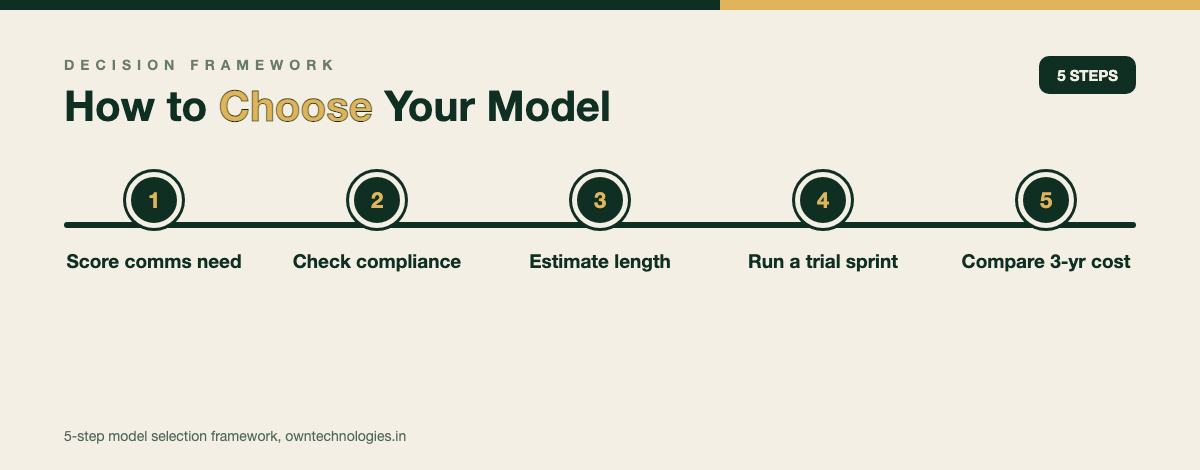
- Score your communication need. Daily standups and design reviews push you toward nearshore or in-house. A fixed spec pushes you toward offshore.
- Check compliance and IP rules. Healthcare, fintech, and government-adjacent projects often have data residency rules that limit offshore options.
- Estimate the real project length. Under 6 months favors offshore or nearshore. Multi-year core product work favors building in-house.
- Run a paid trial sprint. Two weeks of real work with any vendor tells you more about quality than ten reference calls.
- Compare 3-year cost, not hourly rate. Add recruiting, management overhead, and turnover risk before you compare numbers on a rate card.
What a Hybrid Engagement Looks Like at OwnTechnologies
Most clients who come to us are not choosing offshore versus in-house in the abstract, they already have a founder or a small in-house team and need a dedicated offshore or nearshore-priced team to build alongside them. We run discovery in week one, a clickable prototype in week two, then two-week sprints with a working build you can log into after every sprint. Clients including CITE, Urban Venue, and Aarogya run this way today. You can see the results in our portfolio.
If the project is a mobile app, our app development team handles it end to end. If it is a customer-facing site or portal, our website development team scopes it alongside any backend or CRM work so both share one database from day one, the same approach covered in our CRM development guide.
Frequently Asked Questions
Yes, on hourly rate. Offshore development in India or Southeast Asia typically runs $18 to $35 an hour versus $35 to $65 for nearshore teams in Latin America or Eastern Europe. The gap narrows once you add the management time nearshore saves through better time zone overlap.
Communication friction from little or no time zone overlap. It shows up as slower feedback loops and requirements that get misread. A clear written spec, a paid trial sprint, and a project manager on the vendor side reduce this risk significantly.
When the software is your core, defensible product, when compliance rules require data to stay in-country, or when you are past MVP and need daily, same-timezone iteration for years, not months.
Nearshore development for US and European clients typically costs $35 to $65 an hour depending on the country and seniority mix, roughly 2,900 to 5,400 INR at 2026 exchange rates.
Yes, and it is increasingly the norm. A common setup is a small in-house product owner plus an offshore or nearshore team for development, which keeps core decisions internal while controlling build cost.
Final Thoughts
There is no universally right answer between offshore, nearshore, and in-house, only the right answer for your project’s scope, timeline, and how much daily overlap you actually need. Most growing companies land on a hybrid, not a single model, and adjust the mix as the product matures.
Not sure which model fits your project? Talk to OwnTechnologies for a free scoping call. Tell us your timeline and budget and we will tell you honestly which model, or mix, makes sense, no commitment required.