“How much does a React Native app cost?” usually gets answered with a generic app cost table. That misses the point. React Native has its own cost drivers, some that save you real money and some that quietly add it back a year later.
This guide gives you 2026 price ranges for React Native apps, then explains the framework-specific decisions that move your quote up or down: Expo or bare, native modules, over-the-air updates, upgrades and web reuse.
The short answer
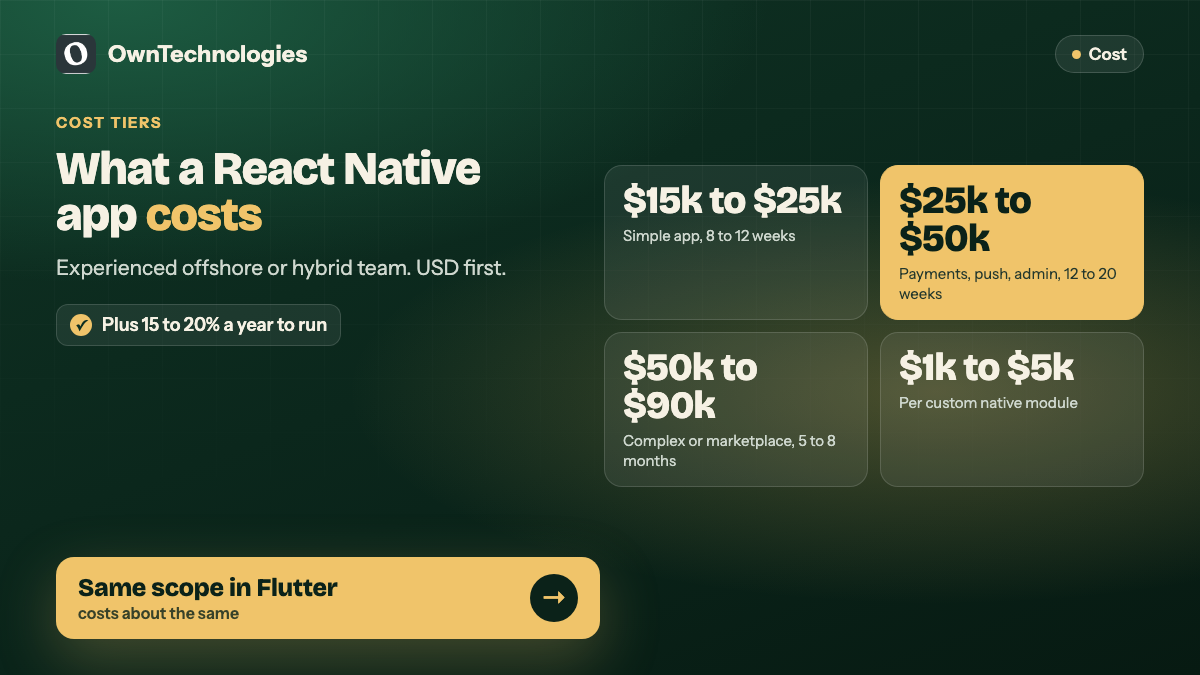
With an experienced offshore or hybrid team, most React Native apps in 2026 cost between $15,000 and $90,000 (around 12.5 to 75 lakh INR). One codebase covers both iPhone and Android, which is where most of the saving against two fully native apps comes from.
| App type | Typical scope | Cost | Timeline |
|---|---|---|---|
| Simple app | Login, 5 to 10 screens, one core flow, basic admin | $15,000 to $25,000 (around 12.5 to 21 lakh INR) | 8 to 12 weeks |
| Mid-complexity app | Payments, push, maps or chat, admin panel, analytics | $25,000 to $50,000 (around 21 to 42 lakh INR) | 12 to 20 weeks |
| Complex app or marketplace | Multiple user roles, real-time features, heavy integrations | $50,000 to $90,000 (around 42 to 75 lakh INR) | 5 to 8 months |
These ranges sit within what we see for cross-platform apps generally. For the full picture of how region changes price, see mobile app development cost: USA vs India.
Where React Native saves money
One codebase, two stores
The biggest saving is obvious: you build and maintain one app instead of two. Business logic, screens and API code are shared between iOS and Android. In practice most of the code is shared, with a small slice of platform-specific work for things like permissions and store requirements.
JavaScript and TypeScript talent
React Native uses the same language and much of the same mental model as React on the web. If you already have a React web app or a React team, developers move between the two easily, and some logic (validation, API clients, state handling) can be shared.
Over-the-air updates
React Native apps can ship many JavaScript-only fixes without a full store release, using services such as EAS Update. A typo, a copy change or a small bug fix can reach users the same day. Store review is still needed for native changes and new permissions, and both Apple and Google have rules about what an update may change, but day-to-day fixes get much cheaper.
Where React Native adds cost back
Native modules
Anything React Native does not do out of the box needs a native module: Bluetooth hardware, certain payment SDKs, background location, specialised camera work. If a well-maintained library exists, it is a day or two of integration. If it does not, someone writes Swift and Kotlin, and that is where quotes jump.
Budget roughly $1,000 to $5,000 per custom native integration, depending on how well documented the SDK is. Ask your developer to list every native dependency before quoting.
Version upgrades
React Native moves quickly. Staying on a supported version means planned upgrades, which the official upgrade guide treats as a normal part of maintaining an app. Skip them for two years and the eventual upgrade becomes a project of its own. Plan for a small upgrade effort once or twice a year rather than one painful jump.
Performance-sensitive screens
Most business apps run perfectly well. Heavy animation, very long lists, real-time video or complex charts need more careful engineering, which adds design and testing time. If your app is mostly forms, lists and dashboards, this rarely matters.
Expo or bare React Native?
This is one of the first decisions your developer makes and it affects cost for the life of the app.
- **Expo (managed workflow with development builds):** faster setup, cloud builds, over-the-air updates and a large set of ready-made modules. For most business apps it is the cheaper route in 2026, and it no longer locks you out of custom native code.
- **Bare React Native:** full control of the native projects from day one. Worth it when you know you need deep native work or an unusual build setup.
Expo’s paid build and update plans are listed on its pricing page; many small apps fit within the free or low tiers. Ask your developer which route they recommend and why, in writing.
React Native vs Flutter vs native: cost in one table
| Approach | Build cost | Best fit |
|---|---|---|
| React Native | $15,000 to $90,000 | Teams with React skills, apps that share logic with a web product |
| Flutter | $15,000 to $90,000 | Pixel-perfect custom UI, consistent look on every device |
| Fully native iOS and Android | $30,000 to $180,000+ | Heavy hardware, graphics or platform-specific features |
| Progressive web app | $6,000 to $18,000 | No store presence needed, content and booking flows |
React Native and Flutter cost about the same for the same scope. The choice should come from your team, your design and your integrations, not from a price difference. If you are still deciding whether you need an app at all, read PWA vs native app: when to choose which.
What drives the quote, in order of impact
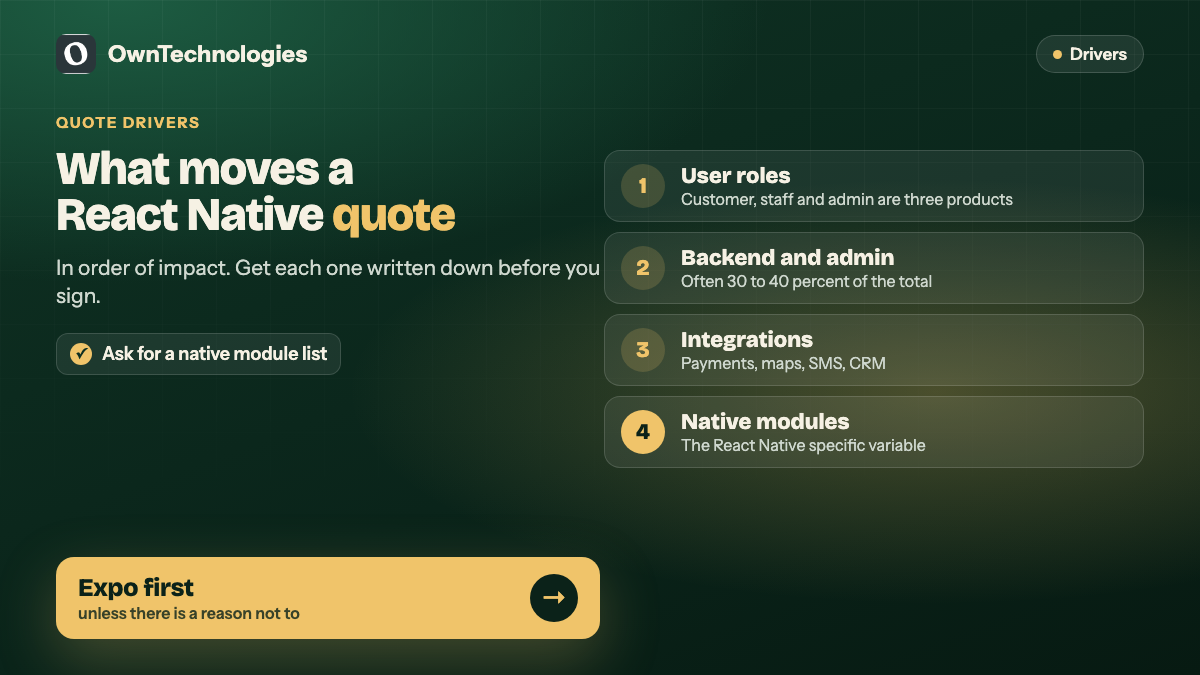
- **Number of user roles.** A customer app plus a staff app plus an admin panel is three products, not one.
- **Backend and admin panel.** Often 30 to 40 percent of the total. React Native only covers the mobile side.
- **Integrations.** Payments, maps, SMS, CRM, accounting. Each one adds testing as well as build time.
- **Native modules.** See above. The single biggest React Native-specific variable.
- **Design depth.** A custom design system costs more than a clean, standard UI.
- **Real-time features.** Chat, live tracking and live updates need extra backend work.
Ongoing costs after launch
| Item | Typical cost |
|---|---|
| Apple Developer Program | $99 a year (Apple) |
| Google Play developer account | $25 once |
| Hosting and backend | $50 to $500 a month, growing with users |
| Build and update service | Free to a few hundred dollars a month, depending on volume |
| Maintenance and upgrades | 15 to 20 percent of the build cost per year |
The maintenance line is the one people forget. It covers OS updates, React Native upgrades, library updates and the small fixes every live app needs.
How to keep a React Native budget under control
- **Write the screen list and user roles down first.** It is the fastest way to get comparable quotes.
- **Ask for a native dependency list** before you sign, with a plan for each item.
- **Start with Expo** unless there is a clear reason not to.
- **Launch an MVP,** then add features users actually ask for. Our MVP cost guide shows what a lean first version includes.
- **Budget for upgrades from day one,** so maintenance is a line item, not a surprise.
More ways to trim scope without hurting the product are in how to reduce mobile app development cost.
Five questions to ask a React Native developer before you sign
- Will you use Expo or bare React Native, and why for this app?
- Which features need native code, and is there a maintained library for each?
- How will you handle over-the-air updates, and what still needs a store release?
- How often will you upgrade React Native, and is that in the maintenance price?
- Who owns the Apple and Google developer accounts, the code repository and the build service?
Clear, specific answers to these five are a good sign. Vague ones usually mean the quote will move later.
Frequently Asked Questions
With an experienced offshore or hybrid team, a simple React Native app costs about $15,000 to $25,000, a mid-complexity app $25,000 to $50,000, and a complex app or marketplace $50,000 to $90,000.
Usually yes. One shared codebase for iOS and Android typically costs well under two separate native apps, especially for business apps built mostly from forms, lists, payments and dashboards.
For the same scope, the cost is about the same. Choose based on your team’s skills, your design needs and the native integrations you require.
A simple app takes 8 to 12 weeks, a mid-complexity app 12 to 20 weeks, and a complex app or marketplace 5 to 8 months, including design and testing.
Custom native modules for hardware or unusual SDKs, regular version upgrades, and performance work on very animation-heavy screens. Ask for these to be listed in the quote.
Partly. Business logic, API clients and validation can often be shared with a React web app. Screens and navigation are usually built separately for mobile.
Final Thoughts
React Native is a strong, cost-effective choice for most business apps in 2026, especially if you already work with React. The real cost differences come from user roles, the backend, integrations and native modules, not from the framework itself. Get those listed before you sign and your quote will hold.
Planning a React Native or Flutter app? Our mobile app development team builds cross-platform apps with the admin panels and CRM integrations behind them, and our web team can share code with your React site. Book a free consultation and we will give you a fixed-scope estimate.