Most doctor appointment app projects go over budget for the same reason: version one tries to be a full hospital platform. Video consults, e-prescriptions, lab reports, pharmacy delivery, insurance claims, all before the first patient has booked a single slot.
This guide is about the opposite approach. It sets out exactly what a doctor appointment app MVP should include, what to deliberately leave out, what it costs in 2026 and how long it takes, so you can launch, learn and then grow.
Who this MVP is for
The scope below fits three common starting points:
- **A single clinic or doctor group** that wants patients to book, reschedule and get reminders without phoning reception.
- **A multi-specialty clinic** that needs booking across several doctors, each with their own schedule.
- **A startup** testing a doctor-booking marketplace in one city before raising money for a wider launch.
If you need video consultations, insurance billing or hospital system integration from day one, you are building a larger healthcare platform. Our healthcare app development guide covers those tiers and their costs.
The MVP scope: what to build first
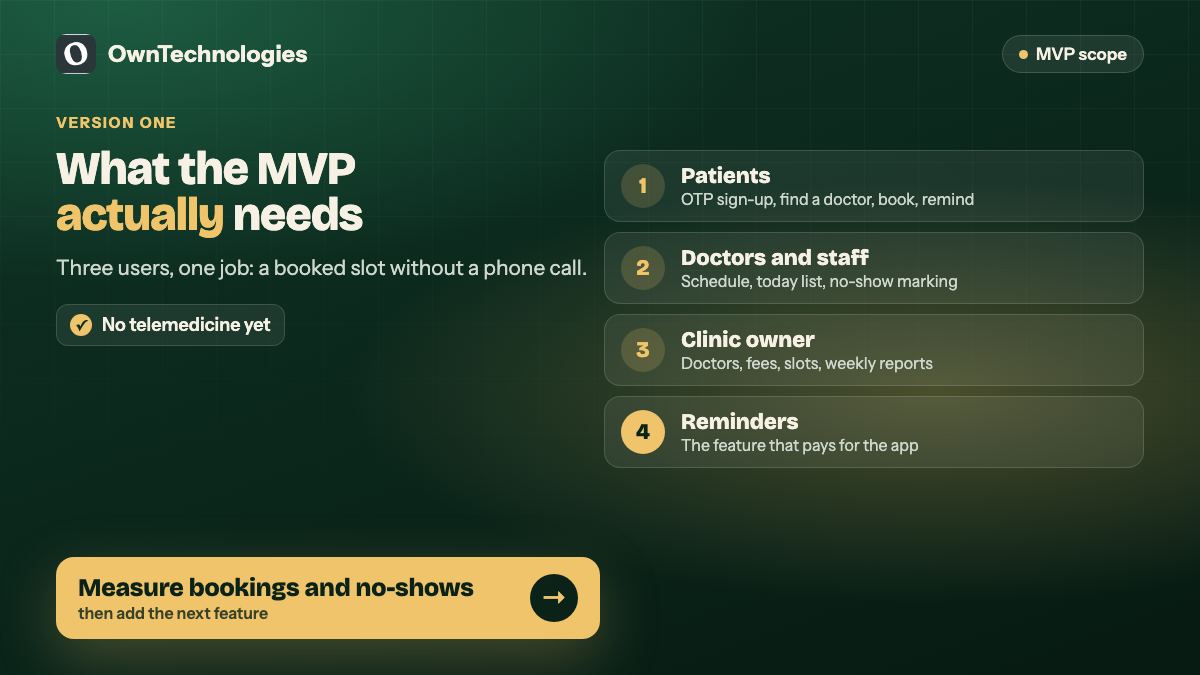
For patients
- **Sign up with a phone number and OTP.** No passwords to forget.
- **Find a doctor** by specialty, name or location, with a short profile, fees and languages spoken.
- **See real availability** and book a slot in under a minute.
- **Reschedule or cancel** inside the app, within the clinic’s rules.
- **Reminders** by push notification and SMS or WhatsApp the day before and an hour before.
- **My appointments,** past and upcoming, with clinic address and directions.
For doctors and clinic staff
- **Weekly schedule and leave,** set by the doctor or reception.
- **Today’s appointment list** with patient name, reason for visit and status.
- **Mark arrived, completed or no-show.**
- **Block or add slots** for emergencies and walk-ins.
For the clinic owner (admin panel)
- **Manage doctors, specialties, fees and slot lengths.**
- **Booking and no-show reports** by doctor and by week.
- **Patient list** with visit history.
That is the whole MVP. It solves the problem patients actually have (getting an appointment without a phone call) and the problem clinics actually have (empty slots and no-shows).
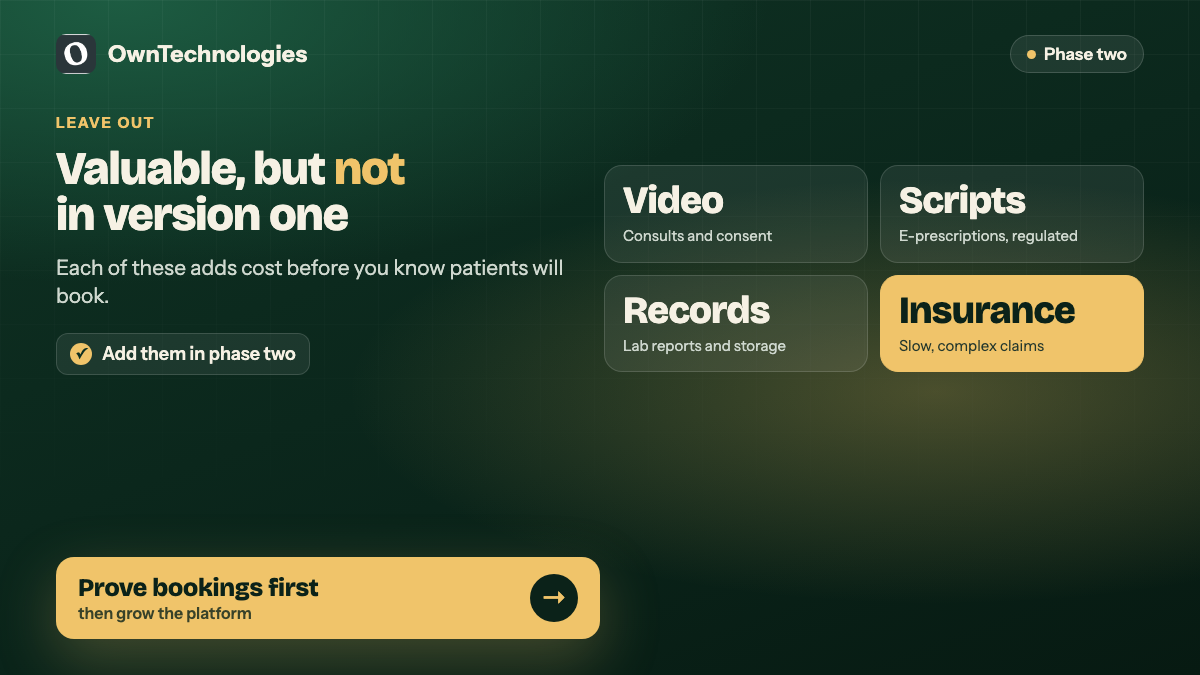
What to leave out of version one
| Feature | Why it can wait | When to add it |
|---|---|---|
| Video consultations | Adds video infrastructure, extra compliance and consent work | When patients ask for remote follow-ups |
| E-prescriptions | Regulated, varies by country, needs doctor workflows | After booking is stable and doctors use the app daily |
| Online payments | Many clinics collect at the desk at first | When no-shows justify a deposit |
| Lab reports and records | Sensitive data, storage and access controls | Phase two, with a proper security review |
| Insurance and claims | Complex integrations, slow approvals | Much later, if ever |
| Ratings and reviews | Needs moderation and enough volume to be useful | After a few hundred visits |
| Pharmacy delivery | A separate business with its own logistics | Only with a partner |
Each of these is valuable. None of them is needed to prove that patients will book through your app.
What a doctor appointment app MVP costs in 2026
These ranges assume one cross-platform app for iOS and Android, a web admin panel and an experienced offshore or hybrid team.
| Scope | What it includes | Cost | Timeline |
|---|---|---|---|
| Single clinic MVP | Patient app, doctor schedule, reminders, admin panel | $15,000 to $25,000 (around 12.5 to 21 lakh INR) | 8 to 12 weeks |
| Multi-doctor clinic MVP | Above plus multiple schedules, specialties, reports | $20,000 to $35,000 (around 17 to 29 lakh INR) | 10 to 14 weeks |
| Doctor marketplace MVP | Many clinics, doctor onboarding, search by location, clinic dashboards | $30,000 to $60,000 (around 25 to 50 lakh INR) | 14 to 20 weeks |
A fuller booking app with patient intake forms and secure messaging typically lands in the $25,000 to $45,000 range we describe in our healthcare guide. For how MVP budgets compare across industries, see our MVP development cost guide.
Ongoing costs
- Hosting and backend: $50 to $300 a month at MVP scale
- SMS or WhatsApp reminders: priced per message, often the largest running cost for a busy clinic
- App store accounts: $99 a year for Apple, $25 once for Google Play
- Maintenance: 15 to 20 percent of the build cost per year
How long it takes, step by step
- **Discovery, 1 to 2 weeks.** Specialties, slot rules, cancellation policy, reminder timing and who manages schedules.
- **Design, 2 weeks.** Every patient, doctor and admin screen approved before code.
- **Build, 5 to 10 weeks.** Booking engine and schedules first, then reminders, then reports.
- **Testing, 1 to 2 weeks.** Real reception staff booking real test patients.
- **Store review and launch, 1 to 2 weeks.** Health-related apps can take longer to review, so plan for it.
Privacy and compliance, even for an MVP
An appointment app stores names, phone numbers and the reason for each visit. That is health-related data, so a few things are not optional even in version one:
- **Collect only what booking needs.** A reason for visit, not a full medical history.
- **Encrypt data** in transit and at rest, and restrict staff access by role.
- **Clear consent** at sign-up, with a privacy policy in plain language.
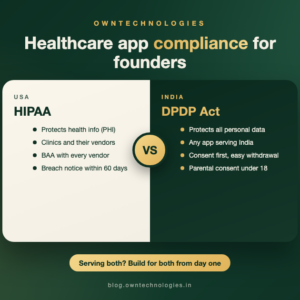
- **Know your rules.** In India the DPDP Act applies, and the national digital health mission, ABDM, sets standards worth following if you plan to link health records later. In the US, HIPAA applies once you handle protected health information on behalf of a provider.
We cover both frameworks in our HIPAA and DPDP compliance guide.
Build or buy?
For a single doctor, an off-the-shelf booking tool at a monthly fee is often the right answer. A custom app starts to make sense when:
- You run several clinics or doctors with different rules
- You want your own brand in the app stores, not a platform’s
- You plan to add services such as follow-up programmes or packages
- You are building a marketplace, which is the product itself
We compare the two routes in detail in booking and appointment software for service businesses.
What to measure in the first 90 days
An MVP only earns its name if it tells you what to build next. Track a handful of numbers from week one:
- **Bookings through the app** as a share of all appointments. This is the headline number.
- **No-show rate,** before and after reminders. If it falls, the app is already paying for itself.
- **Time from opening the app to a confirmed slot.** Over a minute usually means too many steps.
- **Reschedules and cancellations done in the app** rather than by phone.
- **Which specialties and time slots fill first,** so you know where to add doctors or hours.
- **What patients ask reception for** that the app cannot do yet. That list is your phase two roadmap.
Review these with the clinic team once a month. The features worth adding next are almost always obvious from the numbers.
Mistakes that blow up the budget
- **Building telemedicine first.** Video is expensive and most patients still want an in-person visit booked quickly.
- **No admin panel.** If reception cannot change a schedule without a developer, the app goes stale in a week.
- **Ignoring no-shows.** Reminders are the feature that pays for the app. Build them well.
- **Too many specialties at launch.** Start with the ones that already have demand.
- **Unclear slot rules.** Decide slot length, buffers and cancellation windows before design starts.
Frequently Asked Questions
In 2026 a single-clinic MVP costs about $15,000 to $25,000, a multi-doctor clinic MVP $20,000 to $35,000, and a doctor marketplace MVP $30,000 to $60,000, with an experienced offshore or hybrid team.
A focused MVP takes 8 to 14 weeks from discovery to launch, plus time for app store review. A marketplace MVP usually takes 14 to 20 weeks.
OTP sign-up, doctor search, real-time availability and booking, rescheduling, reminders, a doctor schedule and appointment list, and an admin panel with basic reports.
Usually not. Video adds cost and compliance work. Launch booking first, then add video when patients ask for remote follow-ups.
Not always. Many clinics collect at the desk at first. Add deposits or prepayment when no-shows become a real cost.
Yes. A cross-platform framework such as Flutter or React Native builds both from one codebase, which keeps the MVP budget down.
Final Thoughts
The best doctor appointment app MVP does one thing extremely well: it gets a patient from “I need to see a doctor” to a confirmed slot and a reminder, without a phone call. Build that, measure bookings and no-shows, then add video, payments and records in the order your patients ask for them.
Planning a doctor or clinic booking app? Our app development team builds cross-platform healthcare apps, our CRM team builds the admin panels behind them, and our website team builds the site patients find first. Our healthcare work includes Aarogya Global. Book a free consultation and we will scope your MVP with you.