Most EdTech founders start with the same question: should we build a custom app or launch faster on an existing LMS? Then the second question hits: what is this actually going to cost.
This guide breaks down the features an education app actually needs, compares custom builds against white-label and SaaS LMS options, covers the compliance rules for student data, and gives you real 2026 price ranges so you can plan a budget before your first app development call.
Education App Development Cost in 2026: The Short Answer
Most education apps cost between $15,000 and $120,000 (roughly 12.5 lakh to 1 crore INR), depending on whether you need live classes, offline video, and a full learning management system behind it, or a simpler course-delivery app for a single tutor or school.
| App type | Typical scope | 2026 cost range (USD) | Timeline |
|---|---|---|---|
| Course delivery app | Video lessons, quizzes, progress tracking, single instructor or school | $15,000 to $30,000 | 6 to 8 weeks |
| LMS-backed learning app | Multiple courses, student and teacher roles, assignments, certificates | $30,000 to $60,000 | 10 to 14 weeks |
| Live class platform | Everything above plus live video, whiteboards, attendance, parent dashboard | $55,000 to $90,000 | 3 to 4 months |
| Enterprise EdTech platform | Multi-school, custom curriculum tools, analytics, integrations with school ERPs | $90,000+ | 5 months+ |
These figures assume an experienced offshore or hybrid development team. A US-only or UK-only agency typically quotes 2 to 3 times more for the same scope.
The 7 Features Every Education App Needs
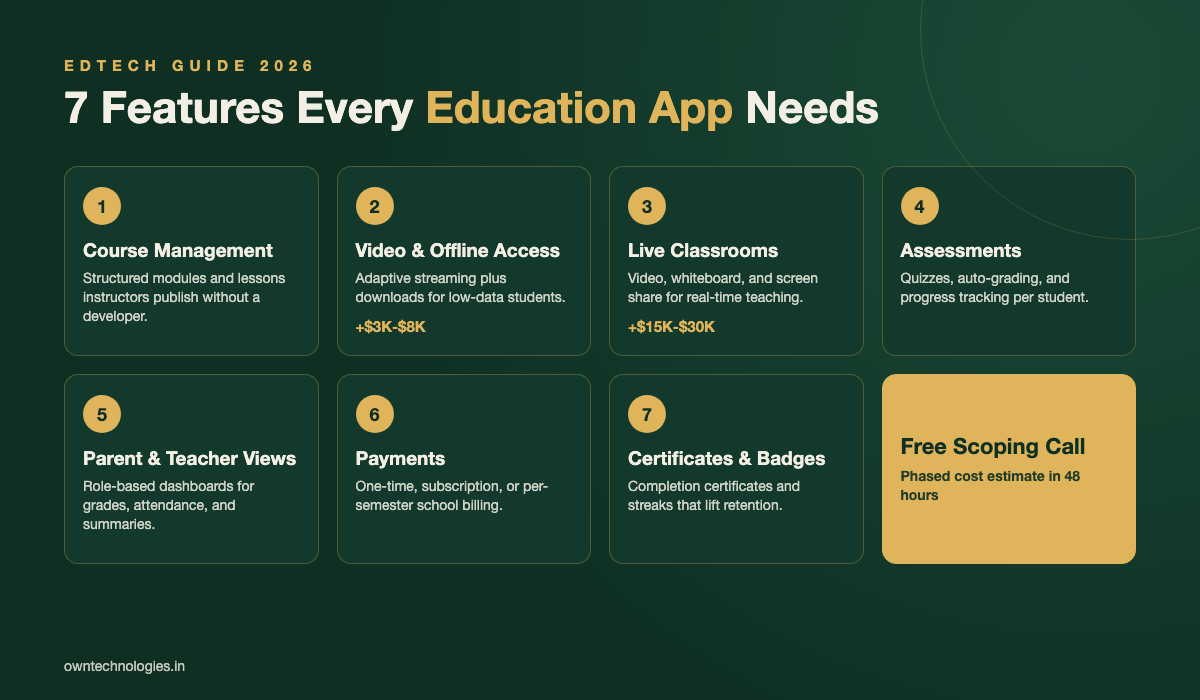
A course-hosting app and a real EdTech platform look similar on the surface. The difference is in these seven pieces.
1. Course and content management
A structured way to organize modules, lessons, and resources so instructors can publish without a developer. Budget this as your baseline, it is included in almost every quote.
2. Video streaming and offline access
Adaptive streaming so video does not stall on slow connections, plus downloadable lessons for students with limited data. This is one of the most requested features by parents in Tier 2 and Tier 3 markets and typically adds $3,000 to $8,000.
3. Live classes and virtual classrooms
Live video, a shared whiteboard, screen sharing, and hand-raise or chat for questions. This is the single biggest cost driver on the list, usually $15,000 to $30,000 depending on how many concurrent students you need to support.
4. Assessments and progress tracking
Quizzes, assignments, auto-grading for objective questions, and a dashboard showing each student where they stand. Parents and school admins use this more than any other screen in the app.
5. Parent and teacher dashboards
Separate role-based views: students see lessons and grades, teachers see class performance and attendance, parents see a summary. Role-based access adds roughly 10 to 15 percent to the build, the same pattern we cover in our guide on mobile app development cost.
6. Payments and subscriptions
One-time course purchases, monthly subscriptions, or per-semester school billing, plus refund handling. Budget $2,000 to $5,000 depending on how many payment gateways and currencies you support.
7. Certificates and gamification
Auto-generated completion certificates, badges, streaks, and leaderboards. Not essential for launch, but it is the feature most linked to student retention in course-based apps, so most clients add it in phase two.
Custom App vs White-Label LMS vs SaaS Platform
Before you scope a custom build, it is worth knowing what you are comparing it against. There are three real paths.
| Option | Best for | Year 1 cost (1,000 students) | Control over branding and features |
|---|---|---|---|
| SaaS platform (Teachable, Thinkific style) | Solo instructors, quick launch | ~$3,000 to $10,000 | Low, shared platform rules |
| White-label LMS (Moodle-based) | Schools needing standard LMS features fast | ~$10,000 to $25,000 | Medium, limited customization |
| Custom education app | Platforms with a distinct model or live classes at scale | $30,000 to $90,000 build | Full, built around your workflow |
SaaS and white-label LMS options win when you need to launch in weeks and your model matches what the platform already supports. Custom wins once you have a unique teaching model, need live classes at real scale, or are already paying for three tools that should be one platform. Our own work scaling a Delhi-based EdTech company is a case in point, they had outgrown a template LMS within a year of launch.
Compliance: What EdTech Apps Cannot Skip
Education apps handle data from minors, which puts them under stricter rules than most consumer apps. Get this right before launch, not after a complaint.
- COPPA (US): If your users include children under 13, you need verifiable parental consent before collecting personal data. See the FTC’s COPPA rule for the exact requirements.
- FERPA (US): If schools share student education records with your app, those records are protected. The US Department of Education’s student privacy office publishes the current guidance.
- Data minimization: Collect only what the app needs to function. Do not ask for a child’s location or contacts unless a feature genuinely requires it.
- Content moderation: Any discussion forum, chat, or comment feature needs profanity filters and a reporting flow before you launch it to minors.
- Regional variants: GDPR for EU users, India’s DPDP Act for Indian users. Ask your development team which apply before, not after, you sign contracts with schools in those regions.
How to Reduce Education App Development Cost
- Launch with recorded courses before live classes. Live video is the most expensive feature. Prove demand with recorded content first.
- Use existing video infrastructure. Building your own video pipeline from scratch rarely makes sense below 50,000 users. Use a proven streaming service underneath your app.
- Start with one role, add the rest in phase two. A student-only MVP validates the core experience before you build teacher and parent dashboards.
- Reuse a proven admin panel base. Login, user management, and permissions should not be rebuilt from scratch for every EdTech project.
- Pick a team that has shipped an LMS before. A team new to course structures and grading logic will bill you for the learning curve.
What a Real Education App Project Looks Like
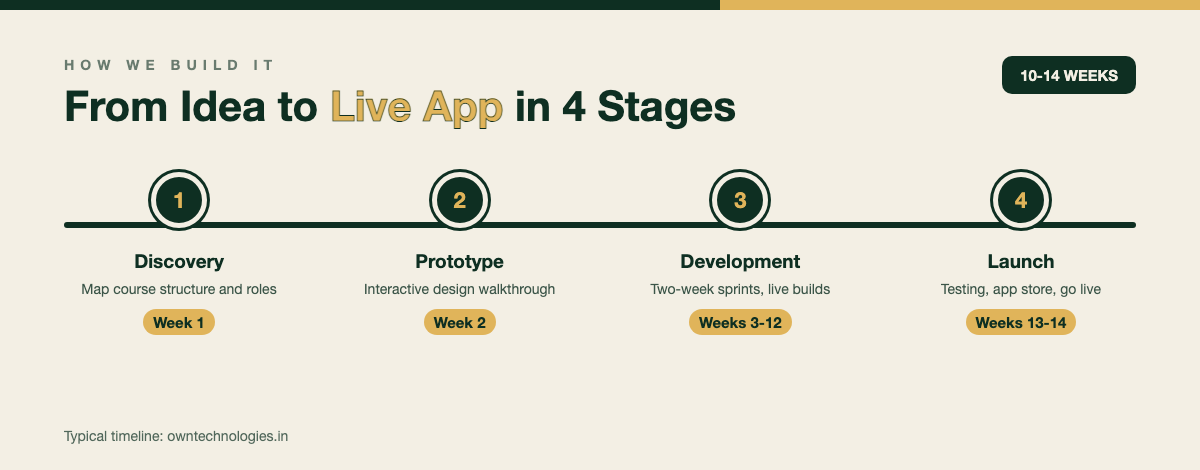
A typical mid-scope engagement at OwnTechnologies starts with one week mapping your course structure and user roles, a clickable prototype in week two, then two-week development sprints with a working build you can log into after each one. If your app needs a companion admin portal for school staff, we usually scope that alongside the student and teacher apps so they share one database and one login system. You can browse similar builds in our portfolio. For teams still scoping requirements, our free requirements document template is a useful starting point before the first call.
The EdTech market itself keeps growing steadily, which is one reason schools and training companies keep moving off generic tools. Statista’s e-learning research tracks this shift in more detail if you want the wider market picture before you pitch this internally.
Frequently Asked Questions
Most education apps cost between $15,000 and $120,000 in 2026. A simple course delivery app for one instructor starts around $15,000, while a live class platform with parent dashboards and teacher tools runs $55,000 to $90,000 or more.
Use a white-label LMS like Moodle if your needs match standard course delivery and you want to launch fast. Build custom once you have a distinct teaching model, need live classes at real scale, or your school has outgrown a template platform’s limits.
In the US, COPPA requires verifiable parental consent for users under 13, and FERPA protects student education records shared by schools. Apps with EU or Indian users also need to check GDPR and the DPDP Act respectively.
A course delivery app takes 6 to 8 weeks. An LMS-backed app with student, teacher, and parent roles takes 10 to 14 weeks. A live class platform typically takes 3 to 4 months.
Yes, in most projects. Live classrooms with video, whiteboards, and screen sharing typically add $15,000 to $30,000 depending on how many concurrent students the platform needs to support.
Indian development companies typically charge between 12.5 lakh and 1 crore INR ($15,000 to $120,000) depending on scope. The same scope from a US-only or UK-only agency usually costs two to three times more.
Final Thoughts
An education app is not just a video player with a login screen. The real cost lives in live classes, role-based dashboards, and compliance for young users, and skipping any of them shows up as complaints and refunds later. Scope in phases, start with the roles and features your students will use daily, and add the rest once they are actually using it.
Want a real number instead of a range? Talk to OwnTechnologies for a free scoping call. Send us your course structure and target users and we will send back a phased estimate within 48 hours, no commitment required.