Building a fintech app is not like building a regular business app. One missed compliance requirement can freeze your launch, and one security gap can end your company before it starts. Yet most founders get quotes without ever learning what actually drives fintech development cost.
This guide covers real 2026 price ranges for fintech app development, the compliance and security work that separates it from a normal app build, and how to plan a launch that regulators and banks will actually approve.
Fintech App Development Cost in 2026: The Short Answer
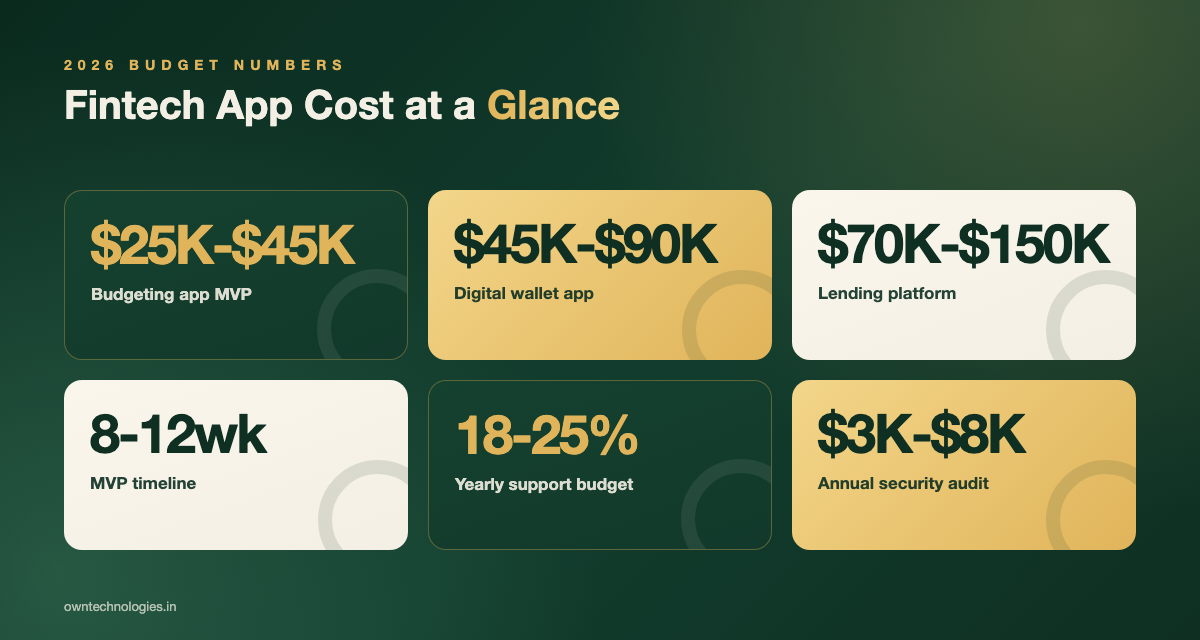
Most fintech startups pay between $25,000 and $150,000 (roughly 21 lakh to 1.25 crore INR) to build and launch a first version. The range is wide because a simple budgeting app with no money movement costs a fraction of a lending or payments platform that has to handle KYC, bank integrations, and audit trails from day one.
| Fintech app type | Typical scope | 2026 cost range (USD) | Timeline |
|---|---|---|---|
| Personal finance or budgeting app | Account linking, spend tracking, basic insights, no direct money movement | $25,000 to $45,000 | 8 to 12 weeks |
| Digital wallet or payments app | KYC, card or bank linking, send and receive money, transaction history | $45,000 to $90,000 | 3 to 5 months |
| Lending or BNPL platform | Credit scoring integration, underwriting rules, repayment schedules, collections | $70,000 to $130,000 | 4 to 7 months |
| Investment or trading platform | Real-time market data, portfolio management, brokerage or custodian integration | $100,000 to $150,000+ | 6 months+ |
These ranges assume an experienced offshore or hybrid development team working alongside your compliance counsel. A US-only fintech-specialist agency will typically quote 2 to 3 times higher for the same scope.
What Makes Fintech App Development Different
A normal business app fails quietly if something breaks. A fintech app that mishandles a compliance requirement can get you fined, blocked from app stores, or shut out by your banking partner. Three things separate fintech builds from everything else.
- Regulatory exposure from day one. Even an MVP handling real money needs to consider KYC, AML, and data protection rules before the first user signs up, not after.
- Third-party dependencies you do not control. Banking APIs, card networks, and identity verification vendors each have their own approval process and uptime that becomes part of your product.
- Security is not optional polish. A data breach in fintech is an existential risk, not a bad review. Encryption, access controls, and audit logging have to be built in, not added later.
What Actually Drives the Cost of a Fintech App
Every quote you receive is really a sum of these seven factors. Understanding them lets you scope a launch you can actually afford.
1. KYC and identity verification
Verifying who a user is before they move money is non-negotiable. Integrating a KYC provider for ID scanning, liveness checks, and sanctions screening typically adds $5,000 to $15,000, plus a per-verification fee from the vendor.
2. Banking and payment integrations
Connecting to bank accounts, card networks, or a payments processor like Stripe or a regional equivalent is the core of most fintech apps. Budget $8,000 to $25,000 depending on how many rails you support and how well documented the APIs are.
3. Compliance and audit trail
Every money-moving action needs to be logged, timestamped, and reportable. Building this correctly from the start, rather than retrofitting it before an audit, typically costs $5,000 to $12,000.
4. Security architecture
End-to-end encryption, tokenized card data, role-based access, and regular penetration testing add $6,000 to $18,000 depending on scope. See the PCI Security Standards Council requirements if your app touches card data directly, and Stripe’s security documentation for a practical reference on how a major payments provider structures this.
5. Credit or underwriting logic
Lending and BNPL products need scoring rules, repayment logic, and collections workflows. This is usually the single most expensive feature set, often $15,000 to $35,000 depending on how much is rules-based versus model-driven.
6. Multi-platform and offline resilience
Fintech users expect the app to work reliably on iOS, Android, and web, with graceful handling when connectivity drops mid-transaction. Building this properly across platforms adds 20 to 30 percent versus a single-platform app. Our guide on mobile app development cost breaks down platform-by-platform pricing.
7. Who builds it
A generalist freelancer without fintech experience will underestimate compliance work and cost you in rework. A team that has shipped regulated products before, like OwnTechnologies’ app development team, scopes compliance and security correctly from the first estimate instead of discovering it mid-build.
Fintech App Cost by Launch Stage
Most fintech founders do not need every feature on day one. Scoping by stage keeps the first check smaller and lets real user data guide what to build next.
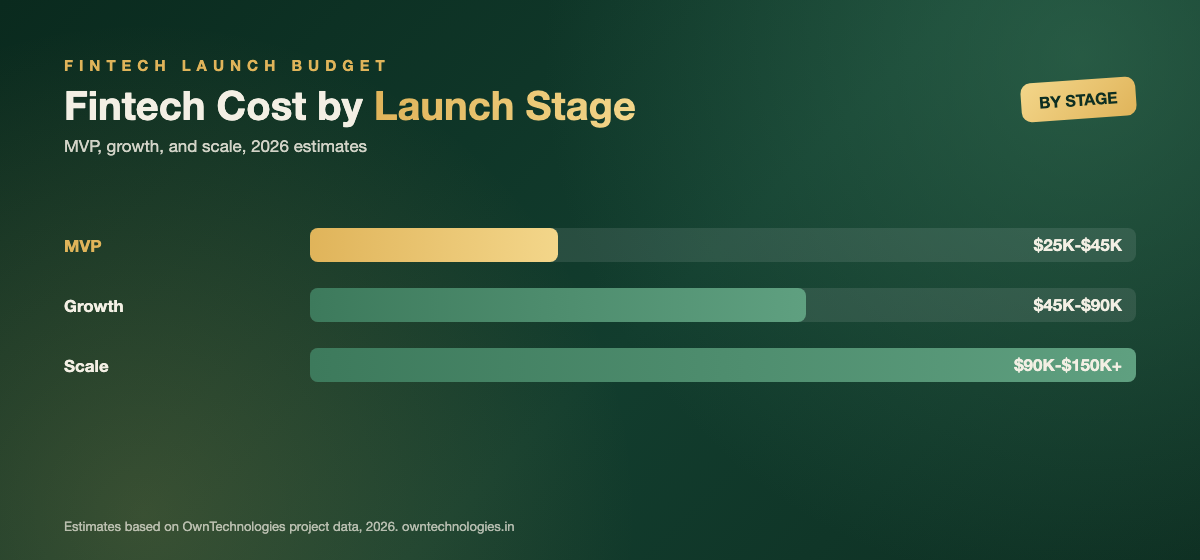
| Stage | What it includes | Cost (USD) |
|---|---|---|
| MVP | Core money flow, KYC, one banking integration, basic compliance logging | $25,000 to $45,000 |
| Growth | Multiple integrations, richer reporting, fraud rules, customer support tools | $45,000 to $90,000 |
| Scale | Credit or investment logic, multi-region compliance, advanced analytics | $90,000 to $150,000+ |
Hidden Costs to Ask About Before You Sign
- Per-transaction and per-verification fees: KYC providers, payment processors, and credit bureaus all charge per use, separate from your build cost. These scale with your user base.
- Licensing and legal counsel: Money transmitter licenses or banking-as-a-service partnerships involve legal fees that are not part of a development quote.
- Penetration testing and audits: Budget $3,000 to $8,000 per year for third-party security audits, which banking partners will often require.
- Post-launch support: Expect 18 to 25 percent of build cost per year, higher than typical apps because of ongoing compliance and security patching.
- Data residency requirements: Some regions require financial data to be hosted locally, which affects your infrastructure choices and cost.
How to Scope a Fintech MVP Without Cutting Corners on Compliance
- Pick one core money flow and do it right. A wallet that only sends and receives money reliably beats a wallet that half-supports five features.
- Use established KYC and payment vendors, do not build your own. Building custom identity verification or payment rails is rarely worth it below significant scale.
- Build the audit trail from the first sprint. Retrofitting compliance logging after launch is far more expensive than including it from the start.
- Talk to your banking partner or processor early. Their approval requirements should shape your build, not surprise you after it is finished.
- Choose a team that has shipped a regulated product. Fintech mistakes are expensive to fix after launch. Experience here pays for itself.
What a Real Fintech App Project Looks Like
A typical fintech MVP at OwnTechnologies starts with a two-week discovery phase mapping the money flow, compliance requirements, and vendor choices before a line of code is written. Development runs in two-week sprints with a working build you can test after every sprint, so compliance gaps surface early rather than at final review. You can see how we approach regulated products in our portfolio.
If your fintech product also needs an internal ops dashboard for support and compliance teams, we usually scope that alongside the consumer app so both share one data layer. Our CRM and admin panel team handles that side. Building a healthcare or other regulated product instead? Our healthcare app development guide covers a similar compliance-first approach for HIPAA.
Frequently Asked Questions
Most fintech startups pay $25,000 to $45,000 for a personal finance or budgeting app with no direct money movement, $45,000 to $90,000 for a digital wallet or payments app, and $70,000 to $150,000 or more for lending or investment platforms.
It depends on what your app does. Apps that only track or display financial data typically do not need a license. Apps that move money directly usually need either a money transmitter license or a partnership with a licensed bank or banking-as-a-service provider.
A focused fintech MVP with one core money flow, KYC, and one banking integration typically takes 8 to 12 weeks. Lending or investment platforms with more complex logic take 4 to 7 months.
At minimum, plan for KYC and identity verification, an audit trail for every transaction, data encryption in transit and at rest, and sanctions screening. Requirements grow with the type of product, especially for lending and investment apps.
Usually yes for the banking and compliance infrastructure. Most fintech startups build their own user experience and business logic on top of an established KYC and payments provider rather than building identity verification or payment rails from scratch.
Plan for per-transaction and per-verification fees from vendors, annual security audits at $3,000 to $8,000, and a support budget of 18 to 25 percent of the original build cost per year for compliance and security patching.
Final Thoughts
Fintech app development costs more than a typical app because it has to, not because of padding. Compliance and security are the product, not features bolted onto it. Scope a focused MVP around one core money flow, lean on established KYC and payment vendors, and choose a team that has shipped a regulated product before.
Planning a fintech launch and need a real number? Talk to OwnTechnologies for a free scoping call. Send us your product idea and we will send back a phased estimate within 48 hours, no commitment required.