A clinic owner asks three developers for a quote on a patient app and gets three answers that do not agree on price, timeline, or what “HIPAA compliant” even means. That gap is where most healthcare app projects go wrong before a single screen is designed.
This guide breaks down what a healthcare app actually costs in 2026, what HIPAA compliance really requires, which features clinics need versus which ones are nice to have, and how to pick a development partner who has done this before.
Healthcare App Development Cost in 2026: The Short Answer
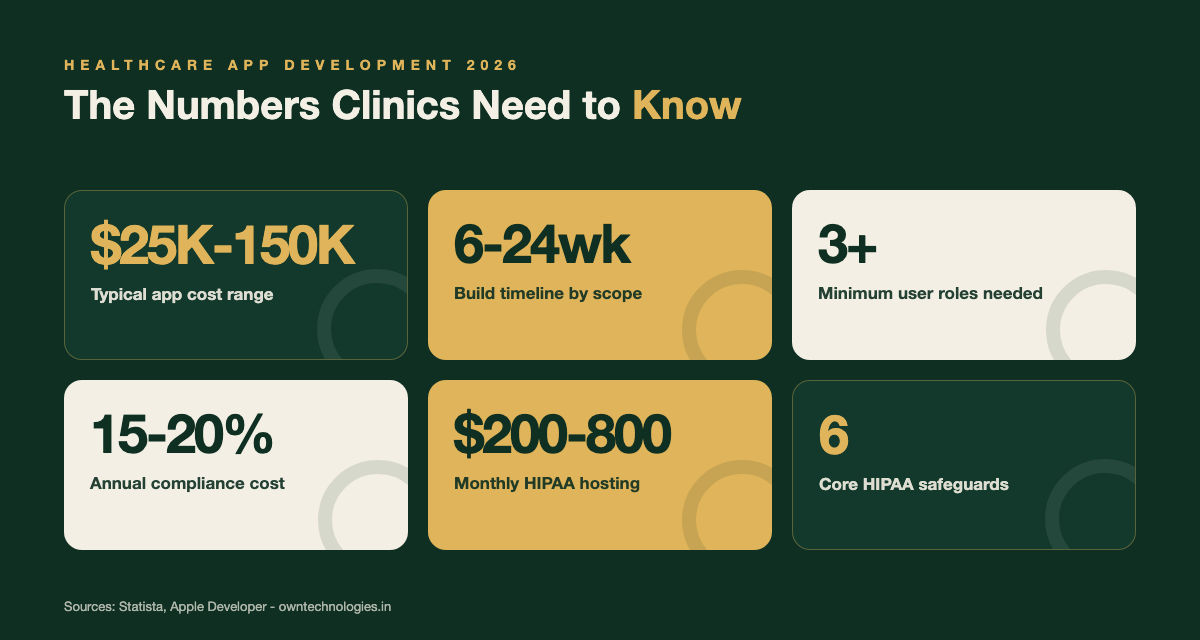
Most clinics and small healthcare businesses pay between $25,000 and $150,000 (roughly 20 lakh to 1.25 crore INR) for a HIPAA-compliant app. The range is wide because a simple appointment booking app and a full telemedicine platform with video consults and EHR integration are completely different builds priced on the same page by inexperienced vendors.
| App type | Typical scope | 2026 cost range (USD) | Timeline |
|---|---|---|---|
| Appointment and booking app | Scheduling, reminders, patient intake forms, basic messaging | $25,000 to $45,000 | 6 to 10 weeks |
| Patient portal | Above plus secure records access, prescription refill requests, billing | $45,000 to $80,000 | 10 to 16 weeks |
| Telemedicine app | Video consults, e-prescriptions, patient history, provider dashboard | $70,000 to $130,000 | 4 to 6 months |
| EHR-integrated platform | Everything above plus two-way sync with an existing EHR/EMR system | $130,000+ | 6 months+ |
These figures assume an experienced offshore or hybrid team that has built HIPAA-compliant software before. A team building its first healthcare app will quote lower and then discover the compliance work mid-project, which is how budgets blow up. Our guide on why software projects go over budget covers this pattern in more detail.
Types of Healthcare Apps Clinics Actually Build
“Healthcare app” covers a wide range of products. Knowing which category you need before the first call saves weeks of scope confusion.
Patient-facing apps
Booking, reminders, secure messaging with staff, bill payment, and access to lab results or visit summaries. This is the most common first project for a clinic or small practice.
Telemedicine platforms
Video consultations, virtual waiting rooms, e-prescriptions, and post-visit follow-up. Demand grew sharply after 2020 and has stayed high. According to Statista, the global mHealth market continues to expand year over year as more care moves to remote and hybrid delivery.
Provider and staff apps
Internal tools for scheduling, charting, task handoffs between shifts, and dashboards for clinic owners to see occupancy and revenue at a glance.
Remote monitoring apps
Connect to wearables or home devices to track vitals like blood pressure, glucose, or heart rate and alert staff when a reading falls outside a safe range. These need the most careful data-security design of any category here.
HIPAA Compliance: What It Actually Requires
“HIPAA compliant” is not a feature you add at the end. It is a set of technical, administrative, and physical safeguards that shape how the app is built from day one. If you serve US patients and touch protected health information (PHI), these apply to you.
- Encryption in transit and at rest: All PHI must be encrypted, both while moving between the app and server and while stored in the database.
- Access controls and audit logs: Every user needs a unique login, role-based permissions, and a record of who viewed or changed what and when.
- Business Associate Agreement (BAA): Your hosting provider, development company, and any third-party service that touches PHI must sign a BAA with your practice.
- Automatic logoff and session timeouts: Devices left unattended must lock the app after a set period of inactivity.
- Data backup and disaster recovery: A documented plan to restore PHI if a server fails or data is lost.
- Breach notification readiness: A process to detect and report a breach within the legally required window.
None of this is optional and none of it can be bolted on after launch. A development team that has not built HIPAA-compliant software before will usually discover these requirements halfway through the project, which is the single biggest cause of healthcare app budgets doubling.
What Actually Drives the Cost of a Healthcare App
1. HIPAA-compliant hosting and infrastructure
You need a hosting provider willing to sign a BAA, such as AWS or Google Cloud on their compliant tiers, plus proper network segmentation. This adds setup cost and roughly $200 to $800 per month in hosting versus a standard app.
2. EHR or EMR integration
Syncing with systems like Epic, Athenahealth, or a smaller regional EHR usually means working with the HL7 FHIR standard. Budget $8,000 to $25,000 per integration depending on how open the EHR vendor’s API is.
3. Video and telemedicine infrastructure
HIPAA-compliant video calling is not the same as a generic video SDK. You need a provider that signs a BAA and encrypts streams end to end. This typically adds $10,000 to $20,000 to development plus per-minute usage costs.
4. User roles and permissions
A clinic app usually needs at least three roles (patient, provider, front desk), each seeing different data. Role-based access control adds 10 to 15 percent to the build, the same pattern we cover in our custom CRM cost guide.
5. Device and wearable integration
Pulling readings from a blood pressure cuff, glucose monitor, or fitness tracker means one integration per device type, generally $3,000 to $8,000 each depending on the manufacturer’s SDK quality.
6. App store review for health apps
Apple and Google apply extra scrutiny to apps handling health data, and rejections for missing privacy disclosures or unclear data-use explanations are common on the first submission. See Apple’s App Store Review Guidelines for the specific health and medical data requirements. Budget an extra 1 to 2 weeks for review cycles.
7. Ongoing compliance maintenance
HIPAA is not a one-time checkbox. Annual risk assessments, security patching, and access log reviews typically run 15 to 20 percent of the build cost per year, slightly higher than a non-healthcare app because of audit requirements.
Must-Have Features for a HIPAA-Compliant Clinic App
- Secure patient login with multi-factor authentication, not just a password.
- Appointment scheduling with automated reminders by SMS or email.
- Secure messaging between patient and provider, encrypted end to end.
- Records access for visit summaries, lab results, and prescriptions.
- Consent and intake forms completed digitally before the visit.
- Audit trail showing every access to a patient record.
- Role-based dashboards for providers, front desk, and administrators.
Healthcare App vs Generic Booking App: Why Compliance Changes the Build
A salon or restaurant booking app and a clinic booking app can look identical on screen and cost completely different amounts. The difference is not the calendar UI, it is everything underneath it.
| Requirement | Generic booking app | Healthcare booking app |
|---|---|---|
| Data encryption | Standard HTTPS | Encryption at rest and in transit, mandatory |
| Hosting | Any cloud provider | BAA-signed HIPAA-eligible hosting only |
| Access logs | Optional | Required, retained for audits |
| Third-party tools | Any SMS or email service | Only BAA-covered vendors |
| Typical cost | $8,000 to $20,000 | $25,000 to $80,000 |
This is why a general-purpose booking app template almost never works for a clinic without a rebuild. If you are still deciding between the two paths for a non-medical business, our mobile app development cost guide covers the standard, non-regulated pricing for comparison.
Common Mistakes Clinics Make When Building Their First App
- Choosing a vendor with no HIPAA track record. Ask for a reference project, not just a verbal promise.
- Skipping the Business Associate Agreement. Without a signed BAA with every vendor touching PHI, you are exposed regardless of how the app is built.
- Treating compliance as a launch-day task. Encryption, access controls, and audit logging must be designed in from the first sprint.
- Underestimating EHR integration time. Vendor API access and approval can take weeks before development even starts.
- No plan for ongoing maintenance. A HIPAA-compliant app needs yearly risk assessments, not just bug fixes.
What a Real Healthcare App Project Looks Like
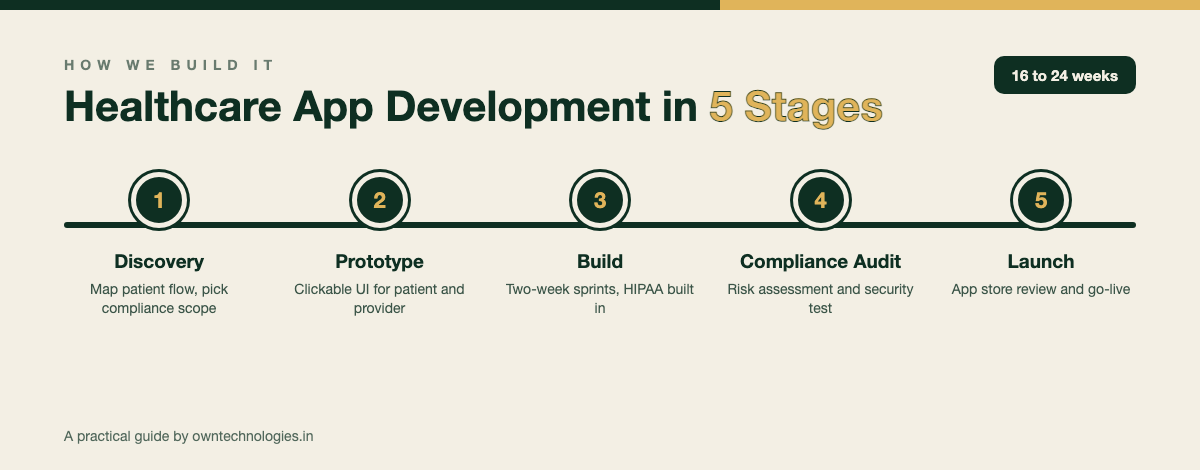
A typical mid-scope engagement starts with a discovery phase to map patient flow and identify which systems need to connect, followed by a clickable prototype, then development in two-week sprints with a HIPAA risk assessment built into the plan rather than added at the end. OwnTechnologies built a custom platform for a healthcare startup in Delhi covering patient records and CRM in one system. You can read that healthcare startup case study for a real example of scope and outcome.
If your app needs to connect to a CRM for patient follow-up and billing, our CRM development team usually scopes both together so records and communication sit in one place.
Choosing a Development Partner for a Healthcare App
- Have they built a HIPAA-compliant app before? Ask to see one, not just hear about it.
- Will they sign a Business Associate Agreement directly with your practice?
- Do they have experience with your specific EHR or are they learning on your project?
- What is included in year-one support, and does it cover the annual risk assessment?
- Do you own the source code and database outright after final payment?
A mid-sized development company with a dedicated healthcare team, like OwnTechnologies’ app development team, usually gives you a realistic middle ground between an inexperienced freelancer and an enterprise agency priced for hospital systems.
Frequently Asked Questions
Most clinics pay $25,000 to $150,000 in 2026 depending on scope. A basic appointment app starts around $25,000, while a telemedicine platform with video consults and EHR integration can exceed $130,000.
Encryption in transit and at rest, role-based access controls, audit logging, automatic session timeouts, a documented backup and disaster recovery plan, and signed Business Associate Agreements with every vendor that touches patient data.
A basic booking or patient portal app takes 6 to 16 weeks. A telemedicine platform with video and e-prescriptions takes 4 to 6 months. Adding EHR integration typically adds 6 or more months.
Yes, if the developer or their hosting provider will access or store protected health information at any point. Without a signed BAA, your practice carries the full compliance risk regardless of how well the app is built.
Most modern EHR systems support integration through the HL7 FHIR standard. Cost and timeline depend heavily on how open the specific EHR vendor’s API is, typically $8,000 to $25,000 per integration.
Plan for HIPAA-eligible hosting ($200 to $800 per month), annual risk assessments, security patching, and general support at 15 to 20 percent of the original build cost per year.
Final Thoughts
A healthcare app is not just a regular app with extra paperwork. Compliance shapes the architecture from day one, and skipping that step early is the most expensive mistake a clinic can make. The clinics that get the best result treat HIPAA as part of the build, not a checkbox after launch, and choose a team that has done this work before.
Ready to scope your project properly? Talk to OwnTechnologies for a free consultation. Tell us about your patient flow and compliance needs and we will send back a phased estimate within 48 hours, no commitment required.