Most ecommerce budgets stop at the launch invoice. Then the monthly charges start: platform fees, apps, payment fees, email tools, security updates, and the developer you call when checkout breaks on a Saturday. Six months in, many owners realise they never budgeted for actually running the store.
This guide breaks down ecommerce website running costs line by line for 2026: what you pay monthly and yearly, how it changes by store size and platform, which costs are worth it, and how to cut the rest without hurting sales. If you need the build cost instead, start with our ecommerce website development cost guide.
Ecommerce Running Costs: The Short Answer
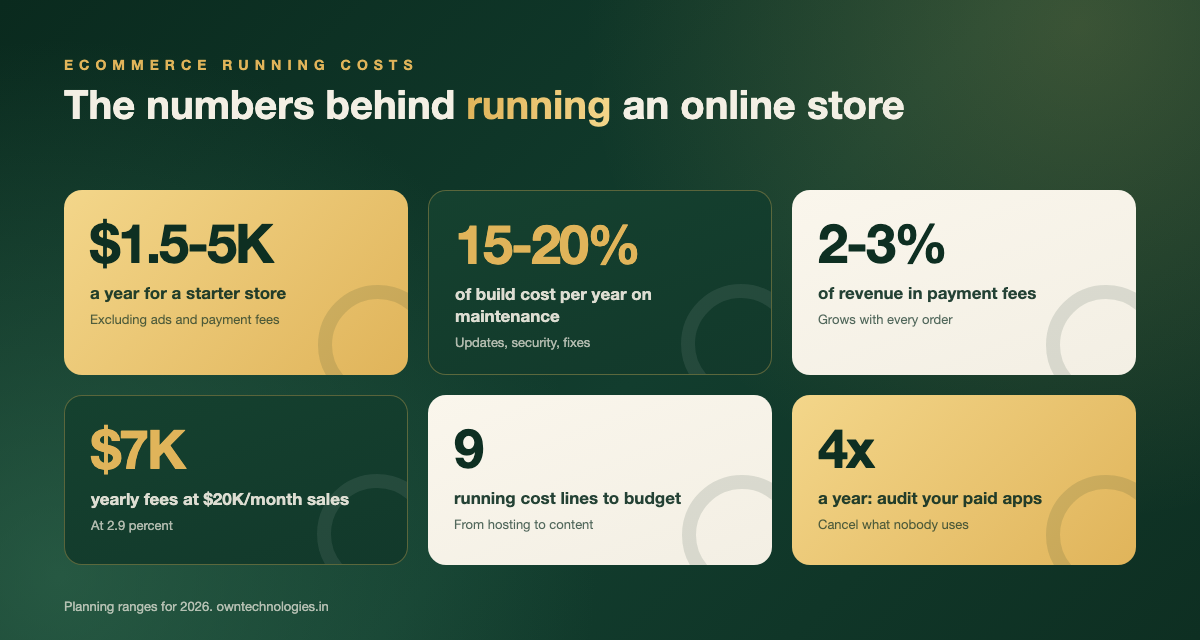
Leaving out advertising and the cost of the products themselves, a small online store typically spends $1,500 to $5,000 a year (around 1.2 to 4 lakh INR) to stay online, secure, and working. A growing store with more apps and regular development spends $6,000 to $20,000 a year (around 5 to 16.5 lakh INR). A custom ecommerce platform usually costs $25,000 to $80,000 a year (around 20 to 66 lakh INR) to host, maintain, and improve. Payment processing fees come on top and scale with revenue.
The 9 Running Costs Every Online Store Has
Every store, whatever the platform, pays some version of these nine costs. The ranges below are typical for small to mid-size stores selling to the US, UK, or India.
| Cost | What it covers | Typical monthly cost |
|---|---|---|
| Platform or hosting | Shopify plan, or managed hosting for WooCommerce or a custom store | $30 to $400 |
| Domain and SSL | Domain renewal; SSL is often free with hosting | $1 to $10 |
| Apps and plugins | Reviews, subscriptions, search, filters, upsells, backups | $20 to $300 |
| Payment processing | Card and wallet fees on every order | Around 2 to 3 percent of revenue |
| Shipping tools | Label printing, rate calculation, tracking pages | $0 to $100 |
| Email and SMS marketing | Abandoned cart, newsletters, order updates | $20 to $300 |
| Maintenance and security | Updates, bug fixes, monitoring, small changes | $100 to $1,500 |
| Content and photography | New product photos, descriptions, banners | $50 to $800 |
| SEO and analytics | Technical SEO, content, reporting tools | $0 to $1,500 |
Platform and Hosting Costs
This is the line most people know about, and usually not the biggest one.
Shopify
Hosting, security, and updates are bundled into the monthly plan. Check current plan prices on the Shopify pricing page, since they vary by country and billing cycle. The catch is that most real stores add several paid apps on top.
WooCommerce
WooCommerce has no platform fee, but it needs good managed hosting, typically $50 to $150 a month for a store with real traffic. You also own updates and security, which means either your time or a maintenance plan.
Custom platform
Cloud hosting for a custom store usually runs $100 to $1,000 a month depending on traffic, images, and search. You pay no per-app fees, but you do pay a team to keep it updated.
Payment Processing: The Cost That Grows With You
Payment fees are the one cost that rises with every sale. Standard online card pricing is roughly 2.9 percent plus 30 cents per transaction in the US on Stripe’s published pricing, and around 2 percent for most domestic payments on Razorpay in India. International cards, currency conversion, and some wallets cost more.
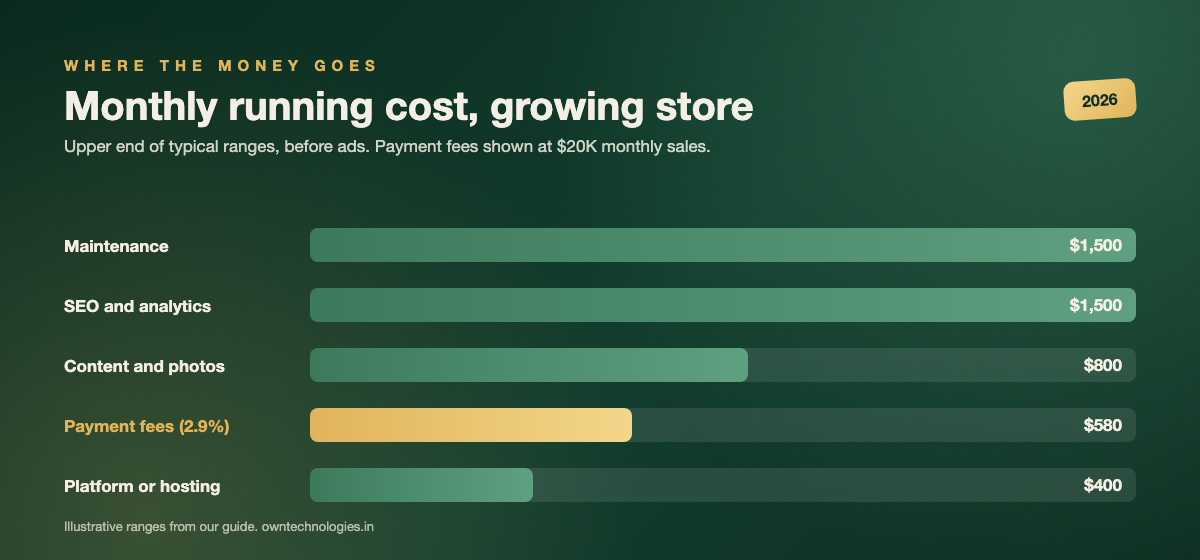
At $20,000 a month in sales, a 2.9 percent fee is about $580 a month, or roughly $7,000 a year, often more than hosting and apps combined. Once you pass a steady volume, ask your provider about custom pricing, and check whether your platform adds its own transaction fee when you use an outside gateway.
Apps, Plugins and Subscriptions
Apps are where running costs quietly creep. Each one is only $10 to $50 a month, but stores regularly end up with ten or more.
- Audit every quarter: list every paid app, what it does, and whether anyone used it last month.
- Watch for overlap: two apps doing upsells or two doing reviews is common after a redesign.
- Check speed: each script-heavy app slows pages, which costs conversions. Our guide on how website speed affects SEO and conversions explains why.
- Replace, do not stack: when you are paying for five apps to bend the platform, a small custom feature is often cheaper within a year.
Maintenance, Security and Updates
Plan an annual maintenance budget of roughly 15 to 20 percent of what the store cost to build. That covers platform and plugin updates, security patches, uptime and backup monitoring, bug fixes, and small improvements such as a new shipping rule or a seasonal landing page.
| Maintenance option | Monthly cost | Best for |
|---|---|---|
| Do it yourself | Your time | Very small Shopify stores with few apps |
| Freelancer on call | $100 to $400 | Simple stores with occasional changes |
| Agency maintenance plan | $300 to $1,500 | WooCommerce and growing stores that need response times |
| Dedicated developer | $1,500 to $4,000 | Custom platforms and stores shipping features every month |
Skipping maintenance does not save money, it defers it. Outdated plugins are a common way stores get hacked, and a broken checkout for a single weekend can cost more than a year of maintenance.
Marketing Tools, SEO and Content
These are optional on paper and essential in practice. Abandoned cart emails alone usually pay for the email tool. Budget for:
- Email and SMS marketing, priced by list size
- Product photography for new ranges
- Technical SEO and category page content, which brings free traffic that compounds
- Analytics and heatmap tools to find where shoppers drop off
Our SEO services team starts with a free SEO audit so you can see what is worth fixing before you commit a monthly budget.
Yearly Budget by Store Size
Putting it together, here is what a realistic yearly running budget looks like, excluding advertising and payment fees.
| Store type | Typical setup | Yearly running cost |
|---|---|---|
| Starter store | Shopify or WooCommerce, under 100 products, 3 to 5 apps | $1,500 to $5,000 (around 1.2 to 4 lakh INR) |
| Growing store | 100 to 2,000 products, 8 to 15 apps, maintenance plan, email marketing | $6,000 to $20,000 (around 5 to 16.5 lakh INR) |
| Established store | Multiple markets, integrations with ERP or warehouse, monthly feature work | $20,000 to $50,000 (around 16.5 to 41 lakh INR) |
| Custom platform | Own codebase, cloud hosting, dedicated developer or team | $25,000 to $80,000 (around 20 to 66 lakh INR) |
How to Reduce Ecommerce Running Costs
- Cancel unused apps after a quarterly audit.
- Pay annually for tools you are sure to keep; many offer a discount.
- Negotiate payment fees once your monthly volume is steady.
- Fix speed and SEO so free traffic does more of the work paid ads do today.
- Bundle maintenance with one team instead of paying several freelancers ad hoc.
- Replace app stacks with one custom feature when the combined fees pass what the feature would cost to build.
If your store feels slow, dated, or held together with apps, compare the numbers in our website redesign cost guide before deciding whether to fix or rebuild.
How OwnTechnologies Helps Online Stores
We have delivered 100+ projects over 8+ years for clients in 15+ countries, including ordering and booking platforms you can see in our portfolio. Our website development team builds and maintains Shopify, WooCommerce, and custom stores, and when app fees start to outgrow the store, our CRM and admin panel development service can move orders, customers, and inventory into one system you own.
Frequently Asked Questions
A small online store typically spends $125 to $420 a month on hosting or platform fees, apps, email tools, and basic maintenance, which is $1,500 to $5,000 a year. Payment processing fees and advertising come on top.
After advertising, payment processing is usually the largest running cost because it grows with revenue. At around 2 to 3 percent per order, a store selling $20,000 a month pays roughly $500 to $600 a month in fees.
Budget roughly 15 to 20 percent of the original build cost per year for maintenance. That covers updates, security patches, backups, monitoring, bug fixes, and small improvements.
WooCommerce has no platform fee but needs managed hosting and hands-on maintenance, while Shopify bundles hosting and security into the plan. Total running cost often ends up similar once paid apps and maintenance time are included.
A custom platform makes sense when app and platform fees keep rising, when your workflows do not fit standard platforms, or when you need deep integration with ERP, warehouse, or B2B pricing. It usually costs $25,000 to $80,000 a year to run.
Final Thoughts
The launch invoice is the smallest number you will see for your online store over three years. Budget for platform, apps, payment fees, maintenance, and marketing from day one, audit them every quarter, and the store stays profitable instead of slowly leaking money through subscriptions nobody remembers signing up for.
Want a clear picture of what your store should cost to run? Book a free consultation with OwnTechnologies and we will review your platform, apps, and maintenance setup and show you where the savings are.