A five person sales team does not have a CRM problem. It has a “who is following up with Priya” problem. Those sound the same and they are not, which is why so many small teams buy a CRM, use it for three weeks and quietly go back to the spreadsheet.
This is about what a lead management system actually has to do for a team of three to fifteen people, what you can safely ignore, and when a subscription stops being the cheaper option.
The four failures that mean you have outgrown the spreadsheet
You do not need a system because you have leads. You need one when these start happening:
- **Two people contact the same lead.** Embarrassing once, expensive when it keeps happening.
- **Nobody can answer “how many deals are open right now” without opening a file.** If the answer takes more than ten seconds, you cannot manage the week.
- **The real record lives in WhatsApp.** Half the history of a deal is in a thread on one person’s phone, and it leaves when they do.
- **Monday reports are made by hand.** Someone spends an hour assembling what the system should have produced in a second.
One of these is annoying. Three of them is costing you deals you will never know about, which is the part that makes it hard to justify fixing until it is expensive.
What a small team actually needs
Strip out everything a 200 person sales org needs and this is what is left.
| Capability | Why it matters at this size | Skip for now |
|---|---|---|
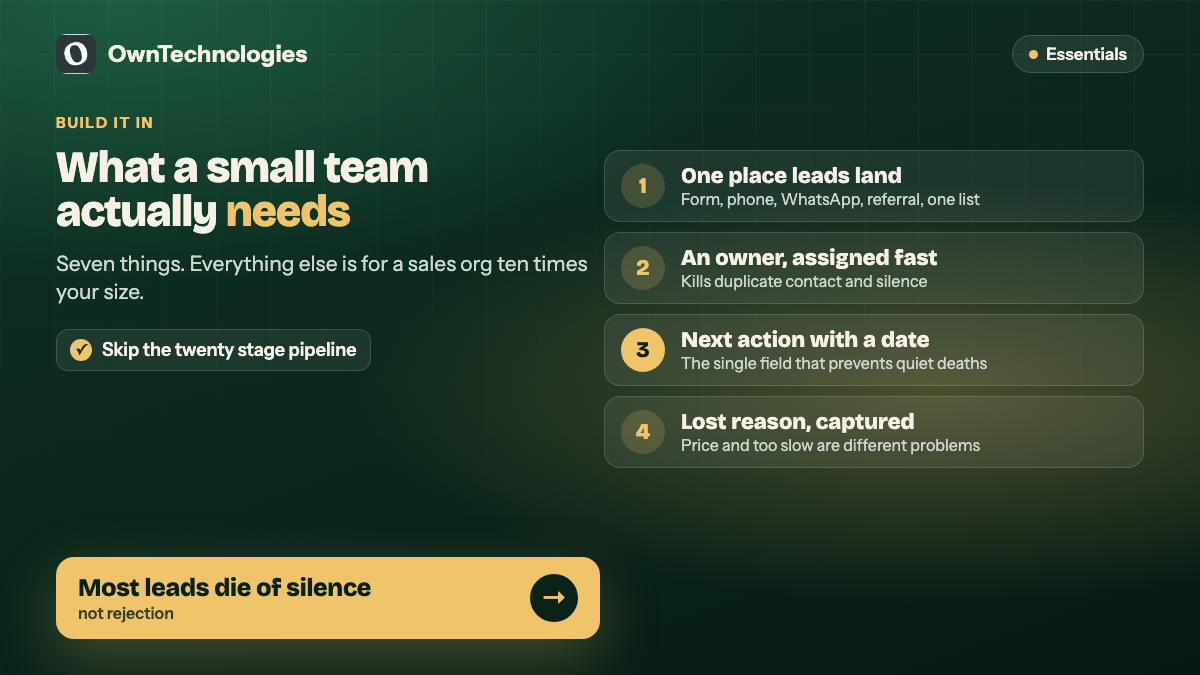
| One place every lead lands | Web form, phone, WhatsApp, referral, all in one list | Multi-channel attribution modelling |
| Owner on every lead, assigned fast | Kills duplicate contact and silence | Complex territory rules |
| Next action with a date | The single field that prevents leads going quiet | Task dependency chains |
| Simple stage pipeline | New, contacted, qualified, proposal, won, lost | Twenty stage custom workflows |
| Activity log per lead | So the history survives a person leaving | Call recording and transcription |
| One dashboard | Open deals, value, stalled leads | Forecasting models |
| Lost reason, captured | The most useful data you are not collecting | Win probability scoring |
That last row is the one most teams skip and most regret. “Lost” with no reason teaches you nothing. “Lost, price” versus “lost, too slow to respond” are two entirely different problems with two entirely different fixes, and only one of them is about your pricing. Response time is worth measuring on its own. The Harvard Business Review study of online sales leads found firms that responded within an hour were far more likely to qualify a lead than those that waited longer, and that most companies were nowhere near that. It is an old finding that has aged well, and it is a management problem a system can actually solve, because the system is the only thing that knows when the lead arrived.
The one field that does most of the work
If you take one thing from this: every open lead needs a next action and a date, and the dashboard needs to show you everything where that date has passed.
Almost every lead that dies quietly dies because nobody decided what happens next. Not because the follow-up was bad, but because there was no follow-up scheduled and nothing in the system ever raised its hand. A list of leads is a record. A list of overdue next actions is a to-do list, and a sales team will work a to-do list. The distinction sounds like semantics until you watch the same team ignore one and clear the other.
Off the shelf or custom
For most teams under about fifteen people, start with an off the shelf tool. The honest reasons to build instead are narrower than vendors or agencies will tell you.
Buy when
- Your sales process is recognisably standard
- You want it running this month
- Per-user pricing at your headcount is comfortable
- You can live with the tool’s idea of a pipeline
Build when
- **Your qualification logic is the business.** If deciding whether a lead is good involves rules a dropdown cannot express, that logic is worth owning.
- **The lead has to meet operations.** Where a won deal has to become a job, a booking or a delivery, and that handover is where things currently break.
- **Per-user cost has quietly passed the build.** At twenty plus seats on a mid-tier plan, three years of subscription often exceeds a focused build. We ran that arithmetic properly in custom CRM cost versus off the shelf, and the crossover is earlier than most teams expect.
- **WhatsApp is genuinely your sales channel.** Most tools treat it as a bolt-on. In a lot of Indian and Gulf businesses it is the primary channel, and that changes the design. We covered the practical patterns in WhatsApp integration for websites.
Rough numbers
| Option | Cost | Setup time |
|---|---|---|
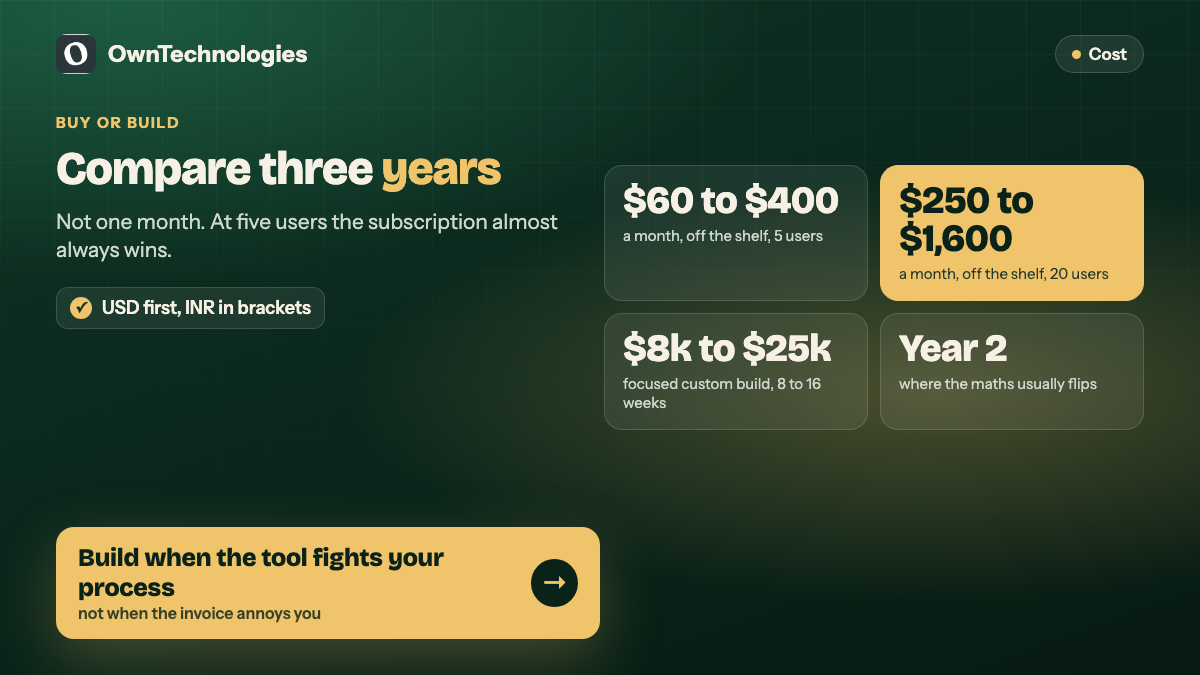
| Off the shelf, 5 users | $60 to $400 a month (5,000 to 33,000 INR) | Days |
| Off the shelf, 20 users | $250 to $1,600 a month (20,000 to 1.3 lakh INR) | Weeks, with configuration |
| Focused custom build | $8,000 to $25,000 (6.5 to 20 lakh INR) | 8 to 16 weeks |
Compare three years, not one month. At five users the subscription almost always wins. At twenty or more, with a process the tool fights, the maths usually flips by year two.
What to do in the first two weeks
Whatever you choose, the rollout decides whether it survives.
- Put in only the fields you will actually use. Every optional field is a reason someone does not update a record.
- Import open leads only. Do not migrate three years of dead ones, you are importing noise.
- Make one person responsible for the data being true, not just for using it. Shared responsibility for data quality reliably means nobody’s responsibility, and the decay is slow enough that nobody notices until the dashboard is lying.
- Run the Monday meeting from the dashboard. If the meeting still runs off a spreadsheet, the system is already dead and everyone knows it.
- Give it one quarter before adding anything. Most teams add complexity to fix an adoption problem, which makes it worse.
Point four is the real test, and it is the cheapest one to get right. A sales system is adopted the moment it becomes the thing the boss looks at, and not one day earlier.
Frequently Asked Questions
Around three, if they share leads. Below that the cost is coordination, not volume, and a well structured shared sheet is honestly fine. The trigger is shared ownership of leads rather than headcount.
Until two people contact the same person, or someone leaves and takes the history with them. Both are survivable once. The problem is that neither shows up in your numbers, so you only find out when a deal you expected does not close.
Next action with a date, and a view that shows everything overdue. Most leads die from silence rather than rejection, and silence is the only failure the system can catch for you.
Usually not at first. Build when your qualification logic is genuinely unusual, when a won deal has to become an operational job, or when per-seat pricing at your headcount has passed what a focused build would cost over three years.
Eight to sixteen weeks for a focused one covering capture, assignment, pipeline, activity history and a dashboard. Longer once you add quoting, invoicing or a customer portal.
Reduce the fields, and run the weekly meeting off the dashboard. Adoption is a management decision far more than a software one.
Final Thoughts
A lead management system for a small team is not a smaller version of enterprise software. It is a different thing: one list, a clear owner, a next action with a date, and a dashboard the person running the team actually opens on a Monday.
If you are deciding between a subscription and a build, tell us how your team sells and we will give you an honest answer, including when the answer is to stay on the tool you already pay for. You can also see our CRM development and website development work, or browse the portfolio.