Shopify, WooCommerce, or a fully custom build? Every answer online gives you a different number because nobody separates the platform fee from the actual development work.
This guide breaks down real 2026 costs for all three routes, shows what drives the price up or down, and gives you a 3-year total so you can compare like for like instead of guessing.
E-commerce Website Development Cost in 2026: The Short Answer
Most businesses spend between $2,000 and $80,000 (roughly 1.6 lakh to 65 lakh INR) building an online store, depending entirely on which route they choose. Shopify and WooCommerce are the fast, lower-cost options. A fully custom platform costs far more but removes every platform limit.
| Platform | Best for | Build cost (USD) | Ongoing monthly cost |
|---|---|---|---|
| Shopify | Fast launch, standard catalog, non-technical owners | $2,000 to $6,000 | $89 to $700 (plan + apps) |
| WooCommerce | Content-heavy sites, full design control, WordPress users | $3,000 to $15,000 | $70 to $250 (hosting + plugins) |
| Custom platform | Marketplaces, B2B pricing, unique checkout logic | $15,000 to $80,000+ | 15 to 20% of build cost per year |
These ranges assume an experienced team handling design, setup, and integrations, not a do-it-yourself build. A US-only agency typically quotes 2 to 3 times higher for the same scope.
Shopify vs WooCommerce vs Custom: How They Actually Compare
Cost is only half the decision. Here is how the three options compare on the things that matter after launch.
| Factor | Shopify | WooCommerce | Custom |
|---|---|---|---|
| Time to launch | 2 to 4 weeks | 4 to 8 weeks | 3 to 6 months |
| Platform fees | Monthly, unavoidable | None, hosting only | None |
| Transaction fees | Yes unless Shopify Payments | Depends on gateway | Depends on gateway |
| Design flexibility | Limited to theme structure | High | Unlimited |
| Scales past 10,000 SKUs | Needs Shopify Plus | Needs server tuning | Built for it |
| Code ownership | No, you rent the platform | Yes | Yes |
Shopify wins on speed and support. WooCommerce wins on control without giving up affordability. Custom wins only when your business logic does not fit a standard store, such as tiered B2B pricing, a multi-vendor marketplace, or a checkout tied into your own inventory system.
What Actually Drives E-commerce Website Cost Up or Down
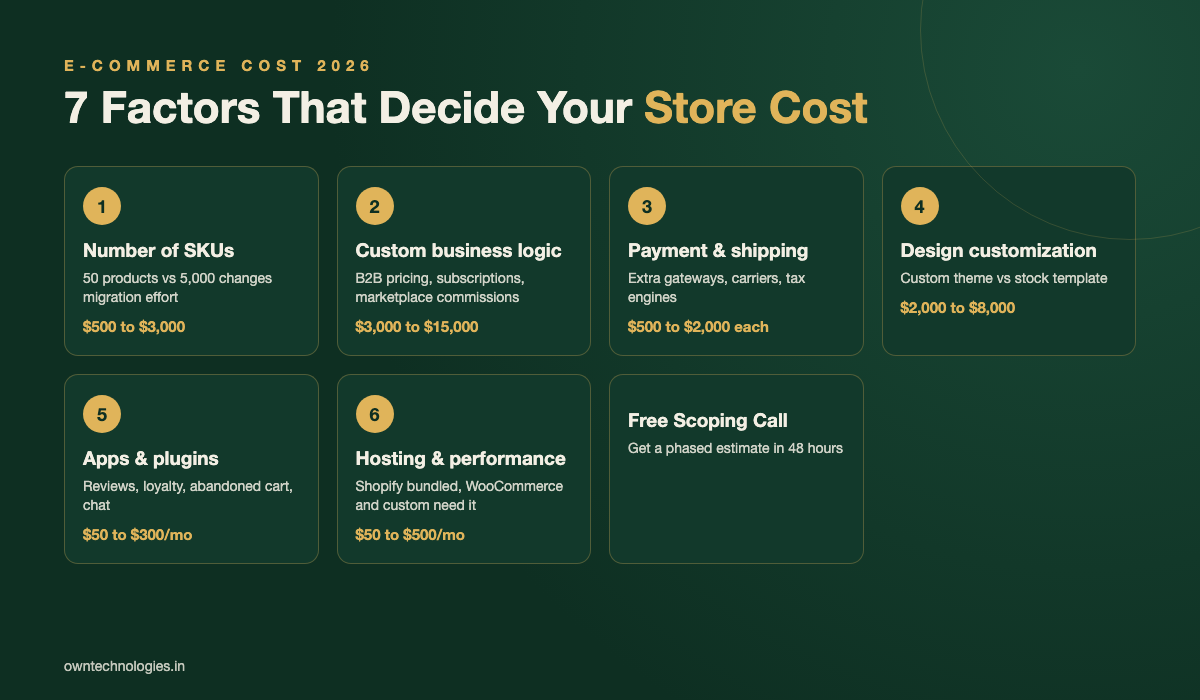
Every quote you receive is a sum of these seven factors, regardless of which platform you pick.
1. Number of products (SKUs)
Uploading 50 products by hand takes a day. Migrating 5,000 SKUs with variants, images, and categories from an old system needs scripted data import, which adds $500 to $3,000 depending on how messy the source data is.
2. Custom business logic
Standard “add to cart and checkout” is included everywhere. Tiered B2B pricing, subscription billing, multi-vendor commissions, or quote-based checkout are custom work and typically add $3,000 to $15,000.
3. Payment and shipping integrations
One payment gateway and one shipping carrier is usually included. Every extra gateway, carrier, or tax engine (Avalara, TaxJar) is a separate integration, budget $500 to $2,000 each.
4. Design and theme customization
A pre-built theme with your logo and colors is the cheapest path. A fully custom design built from scratch adds $2,000 to $8,000 on Shopify or WooCommerce, and is simply part of the base cost on a custom platform.
5. Third-party apps and plugins
Reviews, loyalty points, abandoned cart recovery, and live chat are usually paid apps stacking $50 to $300 a month on Shopify or WooCommerce. On a custom build these are one-time features instead of recurring fees.
6. Performance and hosting
Shopify hosting is bundled into the plan. WooCommerce needs managed WordPress hosting built for e-commerce traffic, $50 to $150 a month. A custom platform needs its own server and CDN, typically $100 to $500 a month at moderate traffic. See our guide on custom website development cost for the wider picture.
7. Who builds it
A freelancer is cheapest but riskiest for anything past a basic store. A large US agency is safest on paper and most expensive. A mid-sized team like OwnTechnologies’ website development team usually lands in the middle on price with a real support commitment after launch.
Shopify Store Cost Breakdown
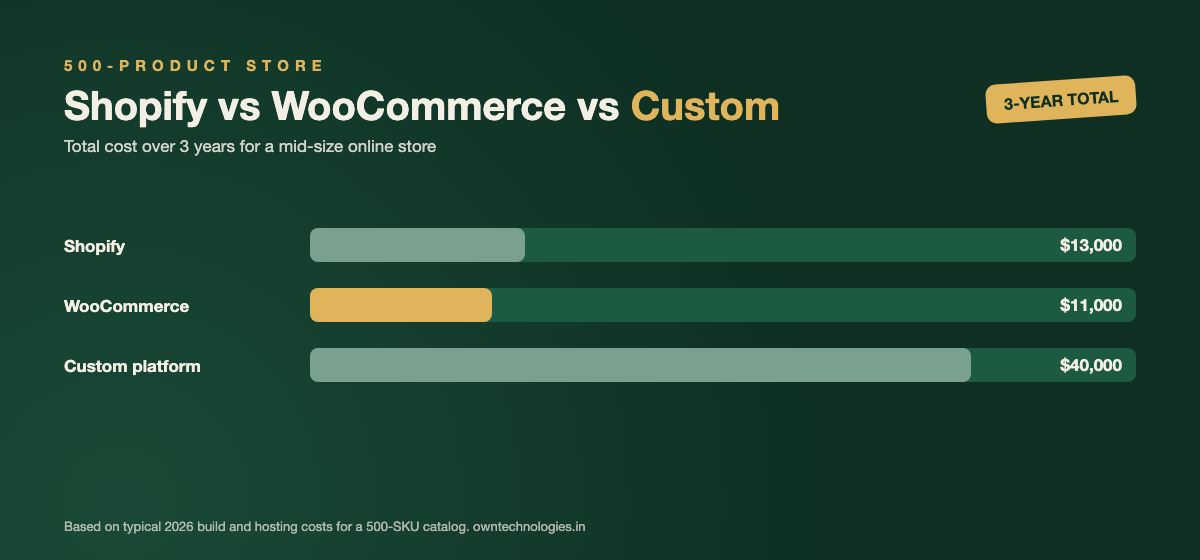
A Shopify store with a customized theme, 500 products, one payment gateway, and 3 to 4 apps typically costs $2,000 to $6,000 to set up, plus $89 to $399 a month for the Shopify plan itself. Add $50 to $300 a month in app subscriptions. Official pricing is published on the Shopify pricing page. Over 3 years, a mid-size store lands around $13,000 (roughly 10.6 lakh INR) all in.
WooCommerce Store Cost Breakdown
WooCommerce itself is free, but the build is not. A comparable 500-product store with custom design, payment setup, and shipping rules costs $3,000 to $15,000 to build, plus $50 to $150 a month for managed hosting and $20 to $100 a month for premium plugins. Plugin pricing is listed on the WooCommerce pricing page. Over 3 years, the same mid-size store lands around $11,000 (roughly 9 lakh INR), slightly cheaper than Shopify because there is no platform fee.
Custom E-commerce Platform Cost Breakdown
A custom platform for the same 500-product catalog, with no unusual business logic, is overkill and will cost more without adding value. Custom starts making financial sense once you need B2B tiered pricing, a marketplace with multiple vendors, or checkout logic tied into your own ERP or inventory system. Expect $15,000 to $80,000 to build and 15 to 20% of that per year in support. Over 3 years for a mid-complexity custom store, budget around $40,000 (roughly 33 lakh INR), which only pays off once you are past the scale or complexity Shopify and WooCommerce were built to handle.
Hidden Costs to Ask About Before You Sign
- Transaction fees: Shopify charges extra unless you use Shopify Payments. Confirm the actual rate for your country.
- App and plugin stacking: Five small apps at $20 to $50 a month each quietly becomes a $150 to $250 monthly bill.
- Data migration: Moving products, orders, and customer history from an old store is billed separately and often underquoted.
- Post-launch support: Budget 15 to 20% of the build cost per year for updates, security patches, and small changes.
- Theme and plugin lock-in: Some premium themes and apps stop working if you cancel the subscription, taking store sections down with them.
Which Option Should You Choose
- Under 1,000 products, standard checkout, need to launch fast: choose Shopify.
- Want full design control and no recurring platform fee, comfortable with WordPress: choose WooCommerce.
- B2B pricing, marketplace, subscriptions, or checkout logic tied to your own systems: choose custom.
- Not sure yet: start on WooCommerce or Shopify, and migrate to custom once you hit a wall the platform cannot solve. Rebuilding later costs less than over-building now.
- Budget under $5,000: Shopify or WooCommerce are your only realistic options this year.
What a Real E-commerce Project Looks Like
A typical mid-scope engagement at OwnTechnologies starts with a short discovery call to map your catalog, payment needs, and shipping rules, followed by a clickable design preview before any development starts. Shopify and WooCommerce builds usually go live in 3 to 6 weeks. You can see examples of past work in our portfolio.
Once the store is live, most clients also want traffic. Our SEO and digital marketing team handles that side so the store is not just built, it is found. If your catalog or workflow starts outgrowing Shopify or WooCommerce, that is usually the point to talk to us about a custom build instead of a bigger app subscription.
Frequently Asked Questions
WooCommerce is usually cheaper over 3 years because it has no monthly platform fee, only hosting. Shopify can still be the better choice if you value bundled hosting, security, and support over the lowest possible cost.
A custom e-commerce platform typically costs $15,000 to $80,000 depending on complexity, plus 15 to 20% of that per year in support. It only makes financial sense once your business logic goes beyond what Shopify or WooCommerce can handle.
Yes. Products, customers, and order history can be migrated, though the process takes time and careful planning for larger catalogs. Many businesses start on Shopify or WooCommerce and move to custom once they outgrow the platform.
WooCommerce itself does not charge transaction fees. Whatever payment gateway you connect, such as Stripe or PayPal, charges its own standard processing fee, which is separate from the platform.
Shopify stores typically launch in 2 to 4 weeks, WooCommerce in 4 to 8 weeks, and a fully custom platform in 3 to 6 months depending on scope.
Indian development teams typically charge 1.6 lakh to 65 lakh INR ($2,000 to $80,000) depending on the platform and complexity, with Shopify and WooCommerce builds at the lower end and custom platforms at the higher end.
Final Thoughts
There is no single right answer between Shopify, WooCommerce, and custom, only the right answer for your catalog size, budget, and how unusual your business logic is. Most stores should start on Shopify or WooCommerce and only move to custom once a platform limit is actually costing them sales. For a wider look at what shapes your total site budget, see our guide on choosing an e-commerce development partner.
Want a real number instead of a range? Talk to OwnTechnologies for a free scoping call. Tell us your product count and business model and we will send back a phased estimate within 48 hours, no commitment required.