Most web development agencies switch on Google Ads, bid on “web development company”, and watch the budget disappear in nine days. The traffic is real. The enquiries are students, job seekers, and other agencies looking for white label partners.
The problem is almost never the budget. It is the keyword list. A handful of phrases on that list carry genuine buying intent and the rest carry curiosity. This guide separates them, shows what the clicks cost, and sets out a starting budget you can judge honestly in 30 days.
Why Agency Google Ads Accounts Burn Money
Three things go wrong, usually at the same time.
The head term is too broad. “Web development” and “website development company” attract everybody who has ever typed those words, including people studying the subject. You pay the same for all of them.
The match type is too loose. Broad match hands Google permission to decide what your ad is about. On a niche like development services, that decision is often wrong and always expensive.
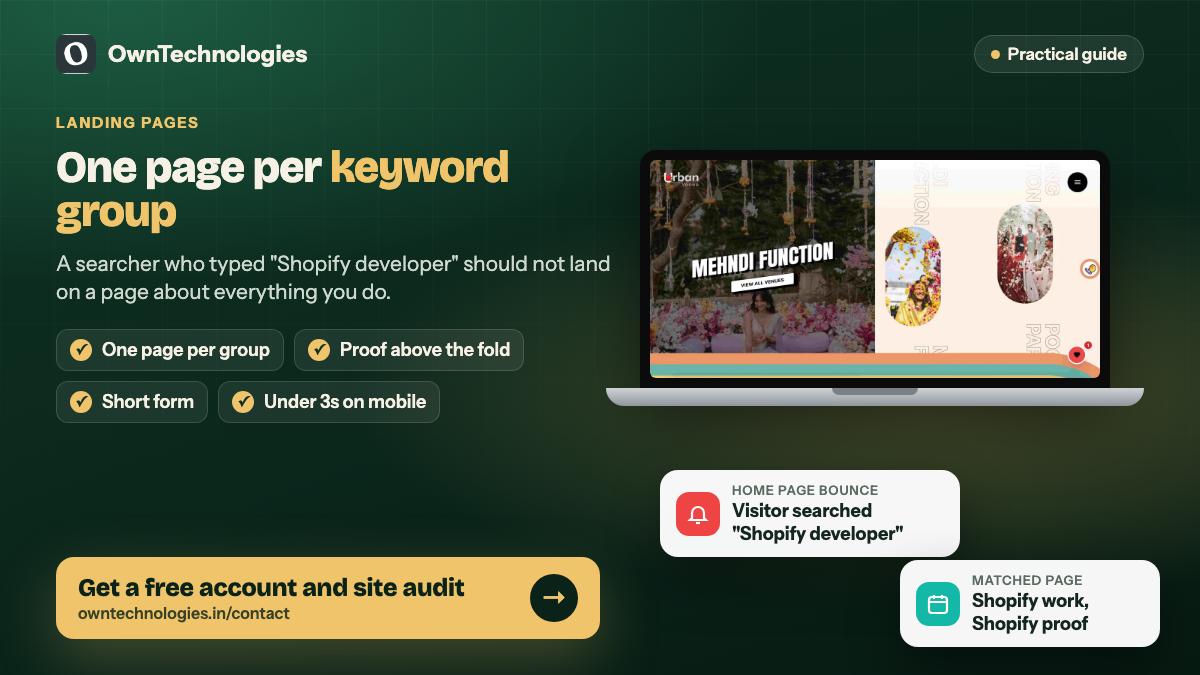
The landing page is the home page. A visitor searching for “Shopify developer” lands on a page that says you do mobile apps, CRMs, SEO, and video. They leave.
Fix the keyword list first. It is the cheapest of the three to change.
The Four Keyword Groups That Convert
Not all commercial intent is equal. These four groups, in this order, are where agency enquiries come from.
1. Service plus location
Someone typing “web development company in Dubai” or “website designer Toronto” has a project and a geography. Volume is lower than the head term. Intent is far higher, and competition is local rather than global.
Build one ad group per city you genuinely serve. Not twenty cities you would like to serve.
2. Platform and technology
“Shopify developer”, “WordPress developer for hire”, “React Native app developer”, “Laravel development company”. These people already know what they want built. They are comparing suppliers, not deciding whether to buy.
These convert well because the searcher has self qualified. If you cannot deliver on that platform, do not bid on it.
3. Replacement and migration
“Migrate WooCommerce to Shopify”, “redesign WordPress website”, “replace Wix with custom site”. A migration search means an existing site, an existing budget line, and a specific frustration.
This group is small and tends to be the cheapest route to a real conversation.
4. Problem and outcome
“Website loading slow fix”, “ecommerce site not converting”, “need booking system on website”. The searcher describes a symptom rather than a service. Fewer agencies bid here, so the cost per click is usually lower than the head terms.
| Keyword group | Buying intent | Typical competition | Worth bidding |
|---|---|---|---|
| Head terms (“web development”) | Low | Very high | No, not at the start |
| Service plus city | High | Medium | Yes, first |
| Platform and technology | High | Medium to high | Yes |
| Replacement and migration | Very high | Low | Yes, highest priority |
| Problem and outcome | Medium to high | Low | Yes, cheap tests |
| Careers, courses, tutorials | None | Low | Never |
The Negative Keyword List You Need on Day One
Negatives matter more than keywords in this niche. Add these before you spend a rupee or a dollar.
- Jobs, careers, hiring, vacancy, internship, resume, salary
- Course, tutorial, learn, training, certification, syllabus, bootcamp
- Free, cheap, template, clone script, nulled
- Freelancer, part time, work from home
- Meaning, definition, what is, examples, roadmap
- White label, reseller, partnership, guest post, backlink
Then check your search terms report every week for the first month. The report shows what people actually typed, which is never quite what you bid on. Each junk term you find becomes a new negative.
Match Types Decide How Much Control You Keep
Google explains the three match types in its own match types documentation. For a service business with a small budget, the practical reading is simple.
Use phrase match for your core terms. It keeps the meaning intact while allowing sensible variations.
Use exact match for the handful of terms you know convert, and bid higher on those.
Avoid broad match until you have 30 or more conversions in the account and a negative list that has been through real search term data. Broad match without that history spends your budget teaching Google what you do.
What These Clicks Actually Cost
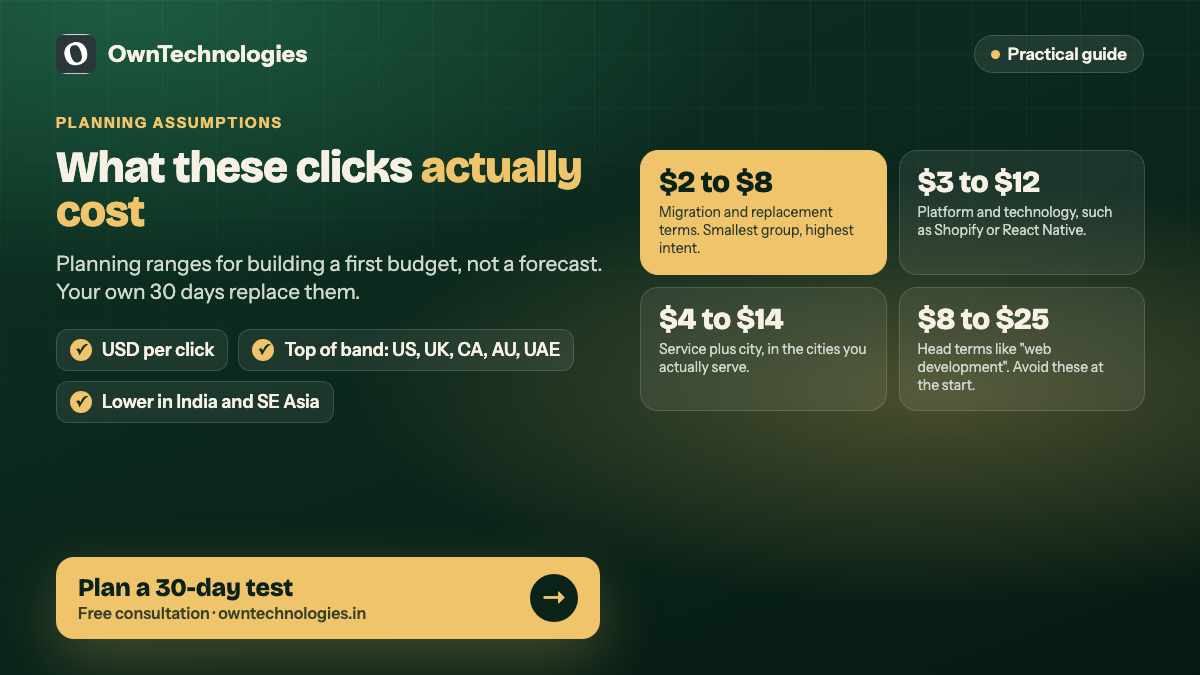
Development keywords are expensive because the lifetime value of a client is high and everyone knows it. Treat the figures below as planning assumptions for building a budget, not as a forecast. Your real numbers come from your own account after 30 days.
| Keyword group | Planning CPC range (USD) | Planning CPC range (INR) |
|---|---|---|
| Head terms | $8 to $25 | 650 to 2,100 |
| Service plus city | $4 to $14 | 330 to 1,200 |
| Platform and technology | $3 to $12 | 250 to 1,000 |
| Migration and replacement | $2 to $8 | 165 to 670 |
| Problem and outcome | $1 to $5 | 85 to 420 |
Ranges vary widely by country. Clicks in the USA, Canada, UK, Australia and the UAE sit at the top of these bands. India and South East Asia sit well below them.
Landing Pages Decide Your Cost Per Lead
A keyword gets you the click. The page decides whether you paid for anything.
One page per keyword group. Someone who searched “Shopify developer” should land on a page about Shopify work, with Shopify examples, and a form that asks about their store.
Keep the form short. Name, email, one line about the project. Every extra field costs you submissions, and you can qualify on the call.
Put the proof above the fold. Named clients, a result, a timeline. Our own [portfolio page](https://owntechnologies.in/portfolio/) is structured this way because the first question every buyer has is whether you have built something like theirs before.
Load the page in under three seconds on mobile. Google’s Quality Score factors landing page experience into what you pay per click, so a slow page costs you twice. We wrote a short list of [website speed fixes](https://blog.owntechnologies.in/website-speed-quick-fixes/) that covers the common causes.
A Starting Budget You Can Judge
Start at $30 to $50 a day (around 2,500 to 4,200 INR). Below that, you do not gather enough data in a month to make a decision.
Split it this way for the first 30 days:
- 50 percent on service plus city, in your two strongest cities
- 30 percent on platform and technology, on platforms you genuinely deliver
- 20 percent on migration and problem terms, as cheap tests
Change one thing per week. Week one, launch and watch search terms. Week two, cut the ad groups with clicks and no enquiries. Week three, rewrite the weakest landing page. Week four, judge the account.
The number that matters at day 30 is cost per qualified enquiry, not cost per click and not cost per form fill.
Track Qualified Enquiries, Not Form Fills
Most agency accounts count every form submission as a conversion, which is how an account full of job applications can look profitable.
Set up conversion tracking so that a lead only counts once it is qualified. In practice this means importing a status from your CRM back into Google Ads, so the platform optimises toward real enquiries. Google supports this through offline conversion imports.
If your CRM cannot do that yet, the fallback is simple: tag each enquiry manually for the first month and compare it against the search term that produced it. It is tedious and it is worth it. This is one of the reasons we build [custom CRM systems](https://owntechnologies.in/crm-development/) with lead source captured from day one rather than bolted on later.
Mistakes That Cost Agencies the Most
- Bidding on the head term first because it has the biggest search volume
- Sending every ad to the home page
- Leaving location targeting on “presence or interest”, which shows your ads to people merely reading about your city
- Running search and display in the same campaign, so display impressions hide the search performance
- Judging week one. Google needs roughly two weeks of data before the account stabilises
- Pausing everything after a bad fortnight instead of cutting the one ad group that caused it
How We Approach Paid Search
We run paid search alongside [SEO](https://owntechnologies.in/digital-marketing/seo-services) rather than instead of it, because ads buy you data in weeks that SEO takes months to produce. Our breakdown of SEO pricing in 2026 covers what that longer game costs. The keywords that convert in a Google Ads account are the ones worth writing content for.
For agencies and service businesses we start with a free audit of the existing account and site, map the keyword groups above to real landing pages, and give a 30 day plan with a number to judge it on. If the landing pages need building, that is [website development](https://owntechnologies.in/website-development/) work and we quote it separately so the ad budget is never quietly funding a site build.
Frequently Asked Questions
Start between $900 and $1,500 a month (roughly 75,000 to 125,000 INR) for a single country. Below that you will not collect enough clicks in 30 days to tell a working keyword group from an unlucky one.
You can, and it is legal in most markets, but it is rarely the best use of a small budget. Competitor terms convert poorly for service businesses because the searcher already has a supplier in mind. Spend that money on migration keywords instead.
Expect clicks in days and enquiries within two to four weeks. The account usually needs about 30 days before the data is stable enough to make budget decisions on.
They answer different questions. Ads tell you within a month which keywords produce enquiries. SEO turns those same keywords into traffic you do not pay for, over six to twelve months. Run ads to find the keywords, then write content for the winners.
Because “web development company” is also what a job seeker types. The fix is the negative keyword list, not a smaller budget. Add jobs, careers, salary, internship and resume as negatives on day one.
In the USA, UK, Canada and Australia, agencies commonly plan around $80 to $250 per qualified enquiry. In India and South East Asia the planning range is far lower. Use your own first 30 days to replace these assumptions with real numbers.
Final Thoughts
Google Ads works for development agencies, but not on the keywords most agencies start with. The head term is the most expensive way to reach the least qualified audience in the market. Migration, platform and city terms are cheaper, smaller, and full of people who already have a project.
Build the negative list first, keep match types tight, send each group to its own page, and judge the account on qualified enquiries at day 30.
If you want a second pair of eyes on an account that is not producing, we offer a free audit of your Google Ads account and landing pages. [Get in touch](https://owntechnologies.in/contact/) and tell us what you are spending and what you are getting back, and we will tell you plainly whether the problem is the keywords, the pages, or the offer.