When someone searches “dentist near me”, Google shows three clinics on a map before any website link. Those three spots, the Map Pack, take most of the calls. If your clinic is not in them, you are invisible to patients who are ready to book today.
This guide gives dental practice owners a practical 90-day plan to rank in the Map Pack: what Google actually looks at, what to fix in week one, how to get more reviews without breaking rules, and what local SEO for dentists costs if you hand it to someone else.
How Google Decides Which Dentists Show in the Map Pack
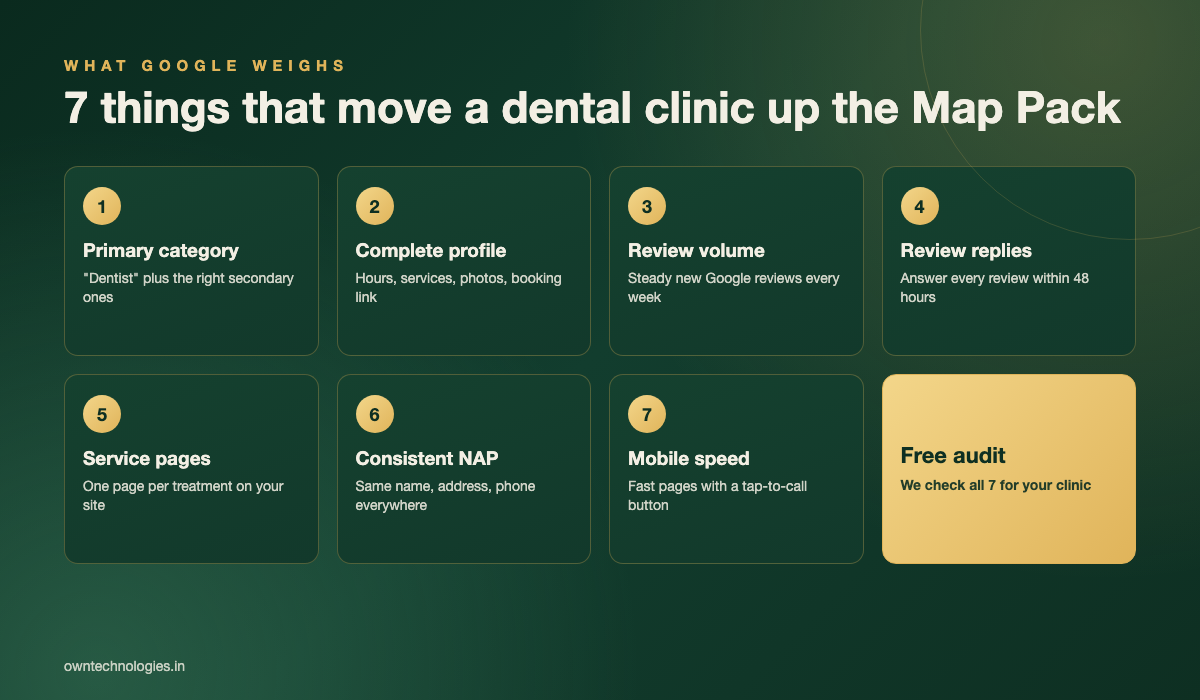
Google says local results are based mainly on three things: relevance, distance, and prominence. You can read the official explanation in Google’s guide on how to improve your local ranking. In plain terms:
- Relevance: how well your profile and website match what the patient searched, for example “emergency dentist” or “Invisalign”.
- Distance: how close your clinic is to the searcher. You cannot change this, which is why the other two matter so much.
- Prominence: how well known and trusted your clinic is online, shown through reviews, ratings, links, and mentions across the web.
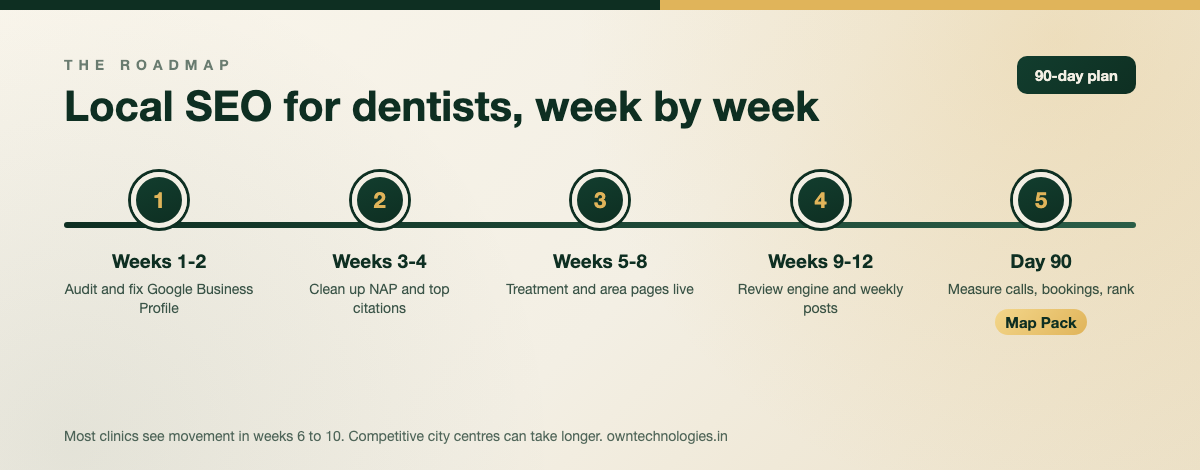
Everything in the 90-day plan below pushes relevance or prominence. Here is the full plan at a glance.
| Phase | Focus | Key tasks | What improves |
|---|---|---|---|
| Days 1 to 14 | Google Business Profile | Categories, services, hours, photos, booking link | Relevance |
| Days 15 to 30 | Consistency | Name, address, phone cleanup, top directory listings | Prominence and trust |
| Days 31 to 60 | Website | Treatment pages, area pages, mobile speed, schema | Relevance |
| Days 61 to 90 | Reviews and activity | Review requests, replies, weekly posts, tracking | Prominence |
Days 1 to 14: Fix Your Google Business Profile
Your Google Business Profile is the single biggest lever for local SEO for dentists. Most clinics we audit have it half filled in. Start here:
- Primary category: set it to “Dentist”. Add secondary categories only if you really offer them, such as “Cosmetic dentist”, “Pediatric dentist”, or “Emergency dental service”.
- Services: list every treatment by name: implants, root canal, teeth whitening, clear aligners, crowns, and so on. Add a one-line description to each.
- Hours: keep regular and holiday hours accurate. A patient who drives to a closed clinic leaves a bad review.
- Photos: real photos of your reception, treatment rooms, team, and building exterior. Add a few new ones every month.
- Booking link and phone: link straight to your online booking page, not your homepage.
- Description: say who you are, where you are, and what you are known for in plain language. Do not stuff keywords.
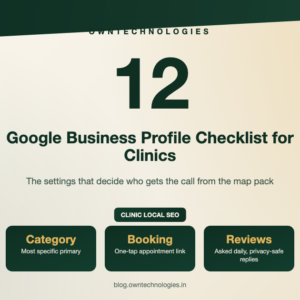
We covered every field in detail in our Google Business Profile checklist for clinics. If you only do one thing this month, work through that list.
Days 15 to 30: Make Your Details Match Everywhere
Google cross-checks your clinic’s name, address, and phone number (often called NAP) across the web. If your old address is still on a directory, or your phone number differs between your website and your profile, Google trusts all of them a little less.
- Write down your exact clinic name, address format, and main phone number. Use that exact version everywhere.
- Update your website footer and contact page to match your Google profile.
- Fix or claim listings on the major directories in your country, plus dental and health directories patients actually use.
- Update your social profiles, insurance provider listings, and any association memberships.
- Remove or merge duplicate Google profiles, which often exist when a clinic has moved or changed names.
This is dull work, but it compounds. A clean, consistent footprint makes every review and every page you add later count for more.
Days 31 to 60: Build Treatment and Area Pages
Your Google profile links to your website, and Google reads that website to judge relevance. A single “Services” page listing twelve treatments cannot rank for any of them. Patients search for specific treatments, so you need specific pages.
What each treatment page should include
- What the treatment is and who it is for, in plain language.
- What happens at the appointment, how long it takes, and recovery time.
- A starting price or range, if you are comfortable sharing it.
- Your dentist’s name and qualifications for that treatment.
- Real before and after photos, with patient consent.
- A booking button and a tap-to-call button, visible on mobile.
Area pages, done honestly
If you draw patients from several nearby neighbourhoods, one page per area can help, but only if each page is genuinely useful: directions, parking, nearby landmarks, and which treatments people from that area usually come in for. Copy-paste pages with only the suburb name changed can do more harm than good.
Add LocalBusiness structured data (the Dentist type) to your site so Google reads your hours, address, and contact details correctly. And check speed: most dental searches happen on phones, and a slow site loses the patient before the page loads. Our guide on how website speed affects SEO and conversions explains what to fix first.
Days 61 to 90: Build a Review Engine
Reviews are the most visible part of prominence. Patients compare star ratings and review counts in the Map Pack before they click anything. The goal is not a burst of fifty reviews in one week. It is a steady flow of genuine reviews every week.
- Ask at the right moment: right after a good appointment, at the front desk, when the patient is happiest.
- Make it one tap: send your Google review link by SMS or WhatsApp the same day. A QR code at reception helps too.
- Ask everyone: do not filter only happy patients. Google’s policies discourage selective requests, and a mix of reviews looks more trustworthy.
- Never pay or discount for reviews: it breaks Google’s rules and can get reviews removed or the profile suspended.
- Reply to every review within 48 hours: thank positive reviewers and answer negative ones calmly, without sharing any patient details.
Alongside reviews, publish a Google post every week: a new treatment, a team member, a seasonal offer, or opening hours for a holiday. Activity signals that the clinic is open and engaged.
How to Track Whether It Is Working
Rankings move around depending on where the searcher stands, so do not judge progress by one search from your own desk. Track these numbers monthly instead:
| Metric | Where to find it | What good looks like by day 90 |
|---|---|---|
| Calls from Google profile | Business Profile performance | Steady month-on-month growth |
| Website clicks and direction requests | Business Profile performance | Rising with review count |
| Searches you appear for | Business Profile performance | Treatment terms, not just your clinic name |
| New Google reviews | Your profile | A few new reviews every week |
| Online bookings from Google | Booking system or UTM links | Tracked separately from other channels |
Most clinics that follow the plan see movement between weeks 6 and 10. Clinics in dense city centres with many competitors can take longer, which is why consistency beats one big push.
Local SEO for Dentists: DIY vs Agency Cost
You can do most of this plan in-house if someone on your team has a few hours a week. If not, here is what outside help usually costs in 2026.
| Option | What you get | Typical monthly cost (USD) |
|---|---|---|
| DIY | Your team follows the 90-day plan | Staff time only, 3 to 5 hours a week |
| One-time setup | Profile, citations, and schema fixed once | $500 to $1,500 one-time (around 42,000 to 1.25 lakh INR) |
| Local SEO retainer | Ongoing posts, reviews system, pages, reporting | $400 to $1,200 a month (around 33,000 to 1 lakh INR) |
| Local SEO plus new website | Retainer plus treatment pages and booking built in | Retainer plus $3,000 to $10,000 one-time for the site |
For a wider view of agency pricing, see our breakdown of SEO services pricing in 2026.
Mistakes That Keep Dental Clinics Out of the Map Pack
- Keyword stuffing the clinic name: adding “Best Dentist Implants City” to your business name breaks Google’s guidelines and risks suspension.
- Using a virtual office address: your profile must use the address where you see patients.
- Ignoring negative reviews: an unanswered one-star review costs more than a calm, professional reply.
- Linking the profile to the homepage: link to a booking page or a page that matches the main category.
- A website that only works on desktop: most dental searches are on mobile. If booking breaks on a phone, rankings do not matter.
- Stopping after month two: local SEO compounds. Clinics that stop posting and asking for reviews slowly slip back.
How OwnTechnologies Helps Dental Clinics
Our SEO team runs local SEO for clinics, starting with a free SEO audit of your Google profile and website. When the website itself is the problem, we build fast, mobile-first clinic websites with treatment pages and online booking in 3 to 6 weeks depending on scope. For multi-location practices, a custom CRM can automate review requests and recall reminders for every patient.
We have delivered 100+ projects over 8+ years for clients in 15+ countries, including the USA, Canada, UK, UAE, and Australia. You can see our healthcare and clinic work in our portfolio.
Frequently Asked Questions
Most dental clinics see movement in the Map Pack between weeks 6 and 10 when they fix their Google Business Profile, clean up listings, add treatment pages, and collect reviews steadily. Busy city centres with many competitors can take longer.
A complete, accurate Google Business Profile with the right primary category, full services list, real photos, and a steady flow of genuine reviews. Google ranks local results on relevance, distance, and prominence, and the profile affects the first and last.
There is no fixed number. What matters is having more recent, genuine reviews than nearby competitors and adding new ones every week. Replying to every review also helps patients trust the clinic.
A one-time profile and listings setup usually costs $500 to $1,500. An ongoing local SEO retainer for a dental clinic typically costs $400 to $1,200 a month in 2026. Clinics with a team member who has a few hours a week can do much of it themselves.
A profile alone can rank, but a fast website with one page per treatment makes it much easier. Google reads the website linked from your profile to judge relevance, and patients check it before booking.
Final Thoughts
Ranking a dental clinic in the Map Pack is not a trick. It is 90 days of steady work: a complete Google profile, consistent details everywhere, one page per treatment, and a weekly habit of asking for and replying to reviews. Clinics that keep the habit going after day 90 usually keep the calls coming too.
Want to know where your clinic stands today? Contact OwnTechnologies for a free local SEO audit. We will check your Google profile, listings, and website, and send back a clear list of fixes, no commitment required.