Every founder hits the same fork in the road. Build a stripped-down version first, or spend six months building the whole thing and launch once. Get it wrong and you either run out of runway building features nobody asked for, or you ship something so thin that users bounce in the first week.
This guide breaks down exactly what separates an MVP from a full product, what each actually costs in 2026, and how to decide which one your business needs before you write a single line of code.
MVP vs Full Product: The Quick Answer
An MVP (minimum viable product) is the smallest version of your idea that solves one real problem well enough that a stranger would pay for it or keep using it. A full product is the complete vision: every feature, every user role, every integration you have planned, built and polished before anyone outside your team sees it.
Most businesses should start with an MVP. It costs less, ships faster, and tells you within weeks whether the idea works before you spend the budget for the full build. The exceptions are covered further down, because there are real cases where an MVP is the wrong call.
What Actually Counts as an MVP in 2026
An MVP is not a prototype and it is not a cheap version of your app. It is a real, working product with one core loop done properly. The term comes from the lean startup method, and the original idea still holds up: build the smallest thing that lets you test a real assumption with real users, then decide what to build next based on what they actually do.
Read the original thinking on this in Harvard Business Review’s piece on why the lean startup approach changed how products get built, and Y Combinator’s own explainer on what an MVP is and is not.
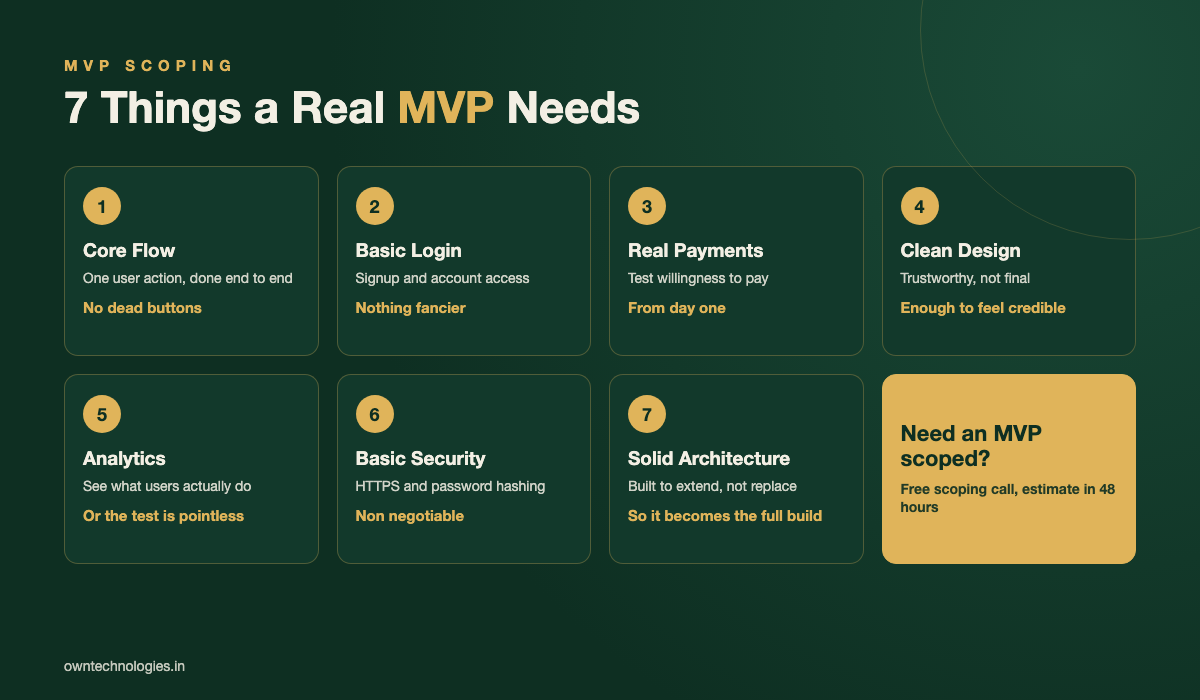
A working MVP includes
- One core user flow that actually works end to end, no dead buttons
- Basic account creation and login
- Payment or booking if that is the core action (you cannot test willingness to pay without it)
- Enough design to look trustworthy, not a finished design system
- Basic analytics so you can see what users actually do
What “Full Product” Really Means (and Why It Costs More)
A full product is what you build once you know the core idea works. It includes every user role you eventually need, admin dashboards, reporting, third-party integrations, offline support, multi-language, push notifications, and the polish that turns a working app into a professional one. None of this is wasted money, it is just money spent before you have proof the core idea earns it.
The jump in cost between MVP and full product is rarely linear. Adding the last 20 percent of features (role-based permissions, deep integrations, edge case handling) often takes 50 to 60 percent of the total build time, because that is where the genuinely hard engineering lives.
MVP vs Full Product: Cost and Timeline by Project Type
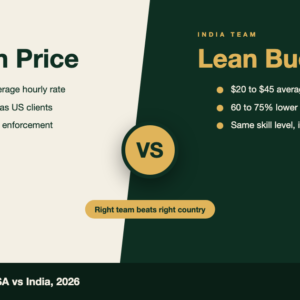
These 2026 ranges assume an experienced offshore or hybrid development team. A US-only agency typically quotes 2 to 3 times higher for the same scope.
| Project type | MVP cost (USD) | MVP timeline | Full product cost (USD) | Full timeline |
|---|---|---|---|---|
| Simple app, 1 to 2 core features | $8,000 to $18,000 | 6 to 10 weeks | $25,000 to $50,000 | 4 to 6 months |
| Marketplace or booking platform | $20,000 to $40,000 | 10 to 14 weeks | $60,000 to $120,000 | 6 to 9 months |
| SaaS platform | $25,000 to $50,000 | 12 to 16 weeks | $80,000 to $200,000+ | 8 to 12 months |
| Enterprise or multi-role platform | $40,000 to $70,000 | 14 to 18 weeks | $150,000 to $300,000+ | 10 to 14 months |
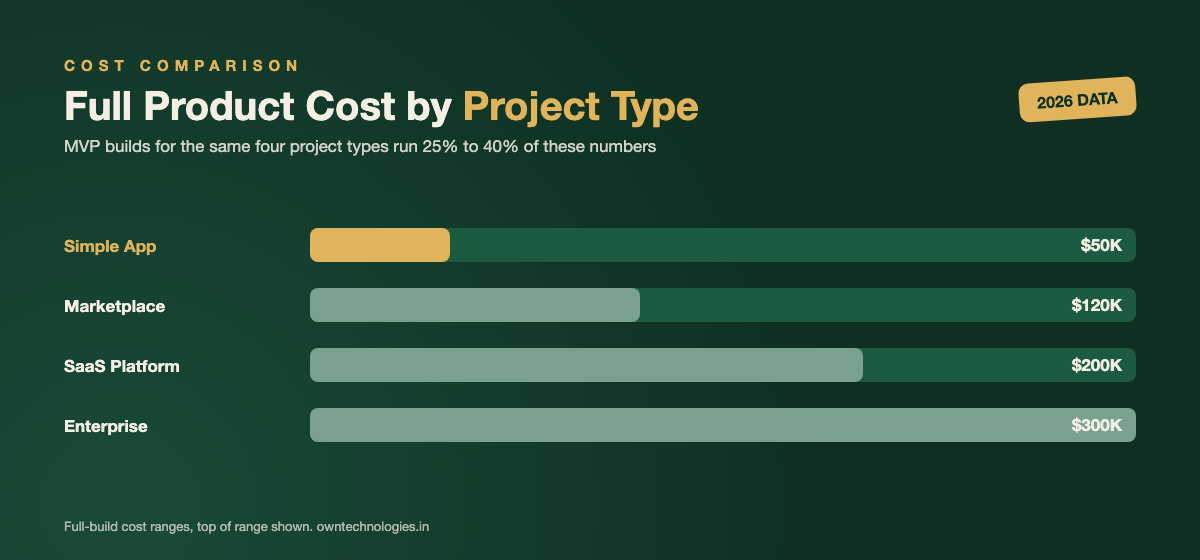
An MVP for a small business app runs $8,000 to $18,000 (roughly 6.5 lakh to 15 lakh INR). The same app built out fully can run $25,000 to $50,000 (around 20 lakh to 41 lakh INR) or more once every role, integration, and edge case is handled. For a full breakdown of what changes the number, see our guide on mobile app development and the related post on build vs buy vs customize.
When an MVP Is the Right Call
Build an MVP first when any of these are true for you.
- You have not validated that people will actually pay for this
- Your budget cannot cover the full build without outside funding
- You are entering a market with competitors already live, and speed to market matters more than feature depth
- You expect the product to change significantly once real users touch it
- This is your first product in this space and you do not yet have full clarity on what users need
Most first-time founders and most businesses testing a new product line fall into this group. The MVP is not a lesser version of the product, it is the fastest honest way to find out if the product should exist at all.
When You Should Skip the MVP and Build the Full Product
An MVP is not always the right move. Skip straight to a fuller build when any of these apply.
You are replacing an internal tool your team already depends on
If you are rebuilding an internal system your staff uses every day, such as an ERP or a dispatch tool, a thin MVP can actually slow the business down. You already know the requirements because your team lives them daily. Scope the real thing.
You operate in a regulated industry
Healthcare, fintech, and insurance products often need compliance, audit trails, and security controls from day one. Shipping a bare-bones MVP without these can create legal exposure that costs more to fix later than to build correctly the first time.
You already have proof the demand exists
If you already have a waitlist, an existing customer base moving from a competitor, or a signed enterprise contract, you have already done the validation an MVP is meant to provide. Build for the scale you already have lined up.
What to Cut From Your MVP (and What to Never Cut)
The skill in scoping an MVP is knowing which corners are safe to cut and which will quietly kill the test.
- Cut multi-language support. Launch in one language, add more once you know which markets stick.
- Cut advanced reporting and dashboards. A simple export is enough at MVP stage.
- Cut every integration except the one users cannot work without. Every extra integration is $1,000 to $3,000 you can defer.
- Never cut the core action. If the app is a booking app, booking has to actually work, not be a “coming soon” screen.
- Never cut basic security. Password hashing, HTTPS, and data protection are not optional even in week one.
- Never cut analytics. Without it you cannot tell if the MVP worked, which defeats the entire point of building one.
The Real Risk: Shipping an MVP That Cannot Scale
The most common mistake is not overbuilding, it is building an MVP so cheaply that the full product cannot be built on top of it later. A rushed MVP built on shortcuts (no proper database structure, no separation between frontend and backend, hardcoded logic instead of configurable settings) often gets thrown away entirely once it succeeds, wasting the original spend.
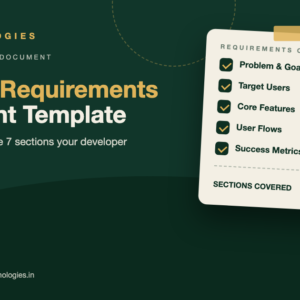
A well-scoped MVP uses fewer features but the same solid architecture you would use for the full product. That way, when the MVP proves the idea, your team extends it instead of rebuilding it from zero. Ask any development partner directly whether their MVP architecture is meant to be extended or replaced. Write your answer into the app requirements document before the first sprint. Our free app requirements document template covers exactly what to specify at this stage.
How OwnTechnologies Scopes MVP vs Full Build Projects
A typical MVP engagement at OwnTechnologies starts with a one-week discovery call to map your core user flow, followed by a clickable prototype in week two, then development in two-week sprints with a working build you can log into after every sprint. Clients including CITE, Urban Venue, and Aarogya started with a scoped MVP before expanding into their full platform. You can see more examples in our portfolio.
If your MVP needs a CRM or admin backend behind it, we usually scope both together on one shared database from the start, since retrofitting that later costs more than planning for it. Our CRM development and website development teams handle that side without duplicating work.
Frequently Asked Questions
An MVP typically costs $8,000 to $50,000 depending on project type, while the full product for the same idea usually runs $25,000 to $300,000 or more. The gap exists because the last set of features, integrations, and edge cases takes disproportionately more engineering time than the core flow.
Most MVPs take 6 to 16 weeks depending on complexity. A simple app with one core feature can ship in 6 to 10 weeks, while an MVP for a marketplace or SaaS platform usually takes 12 to 16 weeks.
Most should, but not all. Skip the MVP stage if you are replacing a system your team already depends on daily, operate in a regulated industry needing compliance from day one, or already have proven demand such as a signed contract or existing customer base.
A well-architected MVP can be extended into the full product without a rebuild. Problems only happen when the MVP is built on shortcuts like hardcoded logic or a poor database structure purely to save time, which usually forces a full rewrite once the idea succeeds.
Never cut the core action the app exists for, basic security such as password hashing and HTTPS, or analytics. Cutting any of these either breaks the test the MVP is meant to run or creates risk you cannot see until it is too late.
Indian development companies typically charge 6.5 lakh to 40 lakh INR ($8,000 to $50,000) for an MVP depending on scope and complexity. The same scope from a US-only agency usually costs two to three times more.
Final Thoughts
Building an MVP first is the right call for most businesses because it turns a guess into a tested decision before the real money gets spent. The exception is when you already have proof the demand exists, or when the product needs to be trustworthy and compliant from the first day it goes live. Either way, the architecture decisions you make on day one decide whether your MVP becomes your full product or gets thrown away and rebuilt.
Not sure which one your idea needs? Talk to OwnTechnologies for a free scoping call. Send us your idea and we will tell you honestly whether it needs an MVP or the full build, with a phased estimate back within 48 hours.