You have heard that other clinics get new patients from Facebook and Instagram, so you boosted a post, spent a few hundred dollars, and got likes from people who live two cities away. Not one booking.
Meta ads for dental clinics do work, but only when the budget, the offer, and the follow-up are planned together. This guide gives you a realistic starter budget, what to expect in the first 90 days, the campaign setup that suits a local clinic, and a 30-day test plan you can run without an agency.
Do Meta Ads Work for Dental Clinics?
Yes, for the right treatments. Meta ads (Facebook and Instagram) are strongest when you want to reach local people who are not searching yet: someone who has been meaning to fix a chipped tooth, try aligners, or whiten before a wedding. Your ad puts a clear, low-risk next step in front of them at the right moment.
They are weaker for urgent needs. A person with toothache searches Google and calls the first clinic with good reviews. That is why most clinics get the best results when Meta ads sit next to a solid Google profile and local SEO, not instead of them.
Treatments that usually suit Meta ads:
- Teeth whitening and smile makeovers
- Clear aligners and orthodontic consultations
- Dental implants (higher value, longer decision time)
- New patient check-up and cleaning offers
- Children’s dentistry and family plans
Starter Budget: How Much to Spend in the First 30 Days
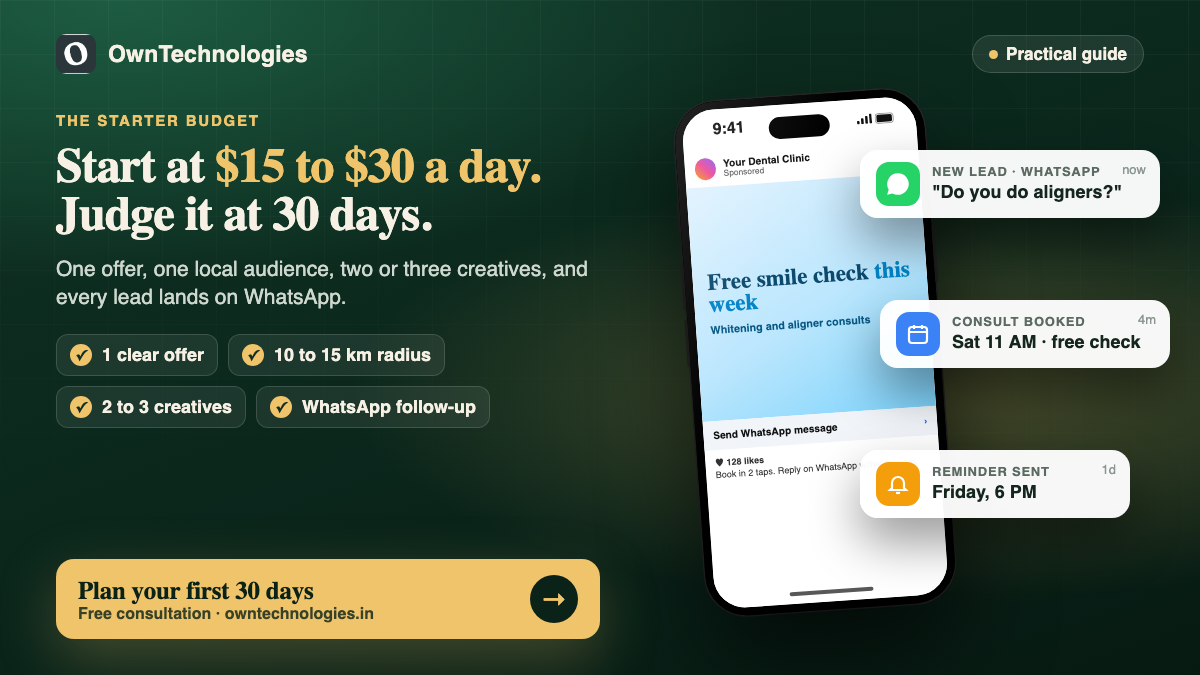
For a single clinic, a sensible starter budget is $15 to $30 a day, or roughly $450 to $900 for the first month (around 37,000 to 75,000 INR). That is enough for Meta’s system to find the people most likely to respond, and small enough that a bad month will not hurt.
Spending less than $10 a day usually means the ads never get past the learning stage, so you cannot tell whether the idea failed or just did not get enough reach. Spending more than $50 a day in month one usually means paying to learn lessons a smaller test would have taught you.
| Market | Starter daily budget | First month | Planning cost per lead |
|---|---|---|---|
| USA, UK, Canada, Australia | $20 to $40 | $600 to $1,200 (50,000 to 1 lakh INR) | $20 to $60 |
| UAE and Gulf | $15 to $30 | $450 to $900 (37,000 to 75,000 INR) | $10 to $35 |
| India (metro cities) | $6 to $12 | $180 to $360 (15,000 to 30,000 INR) | $2 to $8 |
Treat the last column as a planning assumption, not a promise. Your real number depends on your city, your offer, how many clinics nearby are advertising, and how good your creative is. The point of month one is to find your own number.
What to expect month by month
- **Month 1:** learning. Expect enquiries, some poor-quality leads, and one or two creatives that clearly beat the rest. Judge it on booked consultations, not likes.
- **Month 2:** focus. Cut the weak ads, tighten the offer, fix follow-up. Cost per booking usually improves here.
- **Month 3:** decide. If one offer brings booked consults at a cost you are happy with, increase the budget by 20 to 30 percent at a time.
Which Campaign Objective Should a Clinic Use?
Meta asks you to choose an ad objective before anything else. For clinics, three setups are worth testing:
| Setup | How it works | Best for | Watch out for |
|---|---|---|---|
| Click to WhatsApp | Ad opens a WhatsApp chat with your clinic | Clinics that reply fast and like to talk first | Needs someone to reply within minutes |
| Instant form (lead ad) | Patient fills a short form without leaving Instagram | Volume, offers, first tests | More low-intent leads, call them quickly |
| Traffic to booking page | Ad sends people to your website booking page | Clinics with a fast, clear booking page | A slow page wastes most of the spend |
If you are unsure, start with click-to-WhatsApp ads. Patients in most markets already use WhatsApp daily, the conversation feels personal, and you can qualify the lead before offering a slot. Instant form lead ads are a good second test when you want more volume.
Offers That Get Patients to Message You
The offer does more work than the targeting. A vague “Book your appointment today” competes with every other clinic. A specific, low-risk first step gives people a reason to message now.
- A free smile check or aligner suitability consult, limited to this month
- A fixed-price new patient check-up and cleaning
- Whitening at a clear price with a booking deadline
- A free implant consultation with a 3D scan, if you offer it
- A family check-up slot on weekends
Keep prices honest and the terms simple. If the offer needs a paragraph of conditions, it is the wrong offer for an ad.
Targeting: Keep It Local and Let Meta Do the Rest
Most clinic patients come from within 10 to 15 km, or 15 to 25 minutes’ drive. Set a radius around the clinic, choose an age range that fits the treatment (for example 25 to 55 for aligners and whitening), and leave the rest broad.
Since 2022, Meta has removed many detailed targeting options linked to health topics, so you cannot target people “interested in dental care” the way you could years ago. That is fine. The creative and the offer now do the targeting: an ad about aligners attracts people who care about aligners.
If you have an existing patient list, you can upload it as a custom audience to exclude current patients from new-patient offers, as long as you have consent to use their details.
Ad Creative and Copy That Passes Meta Review
Healthcare ads get rejected more than most. Meta’s Advertising Standards do not allow ads that assert or imply personal attributes, and they restrict images that promise unrealistic results.
- **Avoid:** “Embarrassed by your crooked teeth?” or “Are your teeth stained?” These imply something about the viewer.
- **Use instead:** “Straighter teeth with clear aligners. Free suitability check this month.”
- Avoid dramatic before-and-after photos as the main image. Show your clinic, your team, a calm patient, or a simple text design.
- Short videos of the dentist explaining the offer in 15 to 20 seconds often beat polished graphics, because they build trust.
Run two or three creatives per offer at the start. Meta will push more budget to the one that works, and you learn what your patients respond to.
The Follow-Up Problem: Where Clinic Ad Budgets Leak
Most failed clinic campaigns do not fail in the ad. They fail after the patient messages. A lead who waits three hours for a reply has usually messaged two other clinics by then.
- Reply to every new message within 5 minutes during opening hours
- Offer two specific slots (“Saturday 11 AM or 4 PM?”) instead of “When suits you?”
- Send a reminder the day before, by WhatsApp, to cut no-shows
- Log every lead with its source, so you know which ad produced which booking
If your front desk cannot keep up, this is where software helps. A simple clinic CRM can capture leads from forms and WhatsApp in one list, assign them to staff, and send automatic reminders. We cover the website side of this in our guide to WhatsApp integration for websites.
Your booking page matters as much as the ad
If you send traffic to your website, the page has to load fast on a phone, repeat the offer from the ad, show real photos and reviews, and make booking a two-tap job. A slow page or a generic homepage quietly burns your ad budget.
A good clinic landing page has one offer, one form or WhatsApp button, your address and opening hours, and nothing that pulls attention away. If your current site cannot do that, a focused clinic website or landing page is often a better first investment than a bigger ad budget.
A 30-Day Test Plan for Your First Campaign
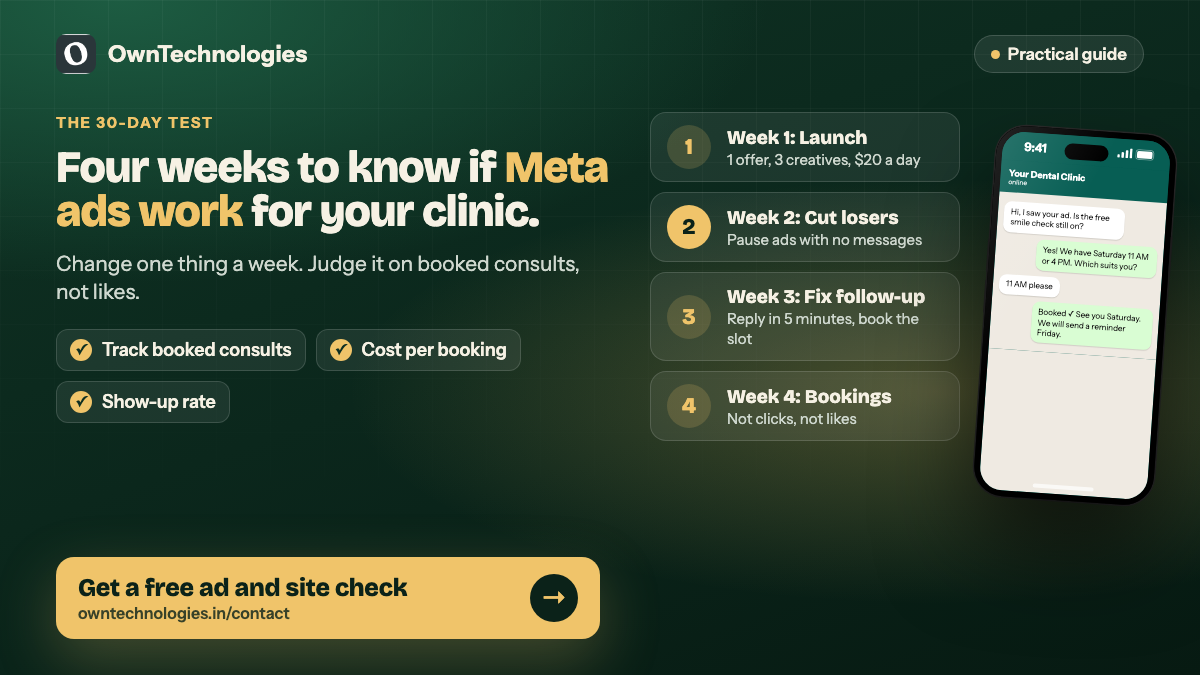
- **Week 1, launch:** one offer, one radius, two or three creatives, $15 to $30 a day. Set up the Meta pixel or conversions tracking if you use a booking page.
- **Week 2, cut the losers:** pause any ad that has spent two to three times your target cost per lead with no messages.
- **Week 3, fix follow-up:** check reply times, how many leads were offered a slot, and how many booked. Fix the weakest step.
- **Week 4, count bookings:** compare booked consultations and new patients against spend. Decide to scale, change the offer, or stop.
Change one thing at a time. If you change the offer, the audience, and the creative in the same week, you will not know what made the difference.
The Numbers to Track (and the Ones to Ignore)
Likes, reach, and clicks feel good but do not pay salaries. Track these four instead, in a simple sheet or your CRM:
- **Cost per lead:** ad spend divided by messages or form fills
- **Cost per booked consultation:** ad spend divided by appointments booked
- **Show-up rate:** how many booked patients actually came in
- **Cost per new patient:** ad spend divided by patients who started treatment
The last number is the one that matters. A $40 lead for implants can be a great deal, while a $10 lead for a free check-up that never shows up is not.
Meta Ads vs Google Ads vs Local SEO for Dentists
Meta ads create demand: they reach people who were not searching yet. Google Ads and local SEO capture demand: they reach people searching “dentist near me” right now. Most clinics need both, in a sensible order.
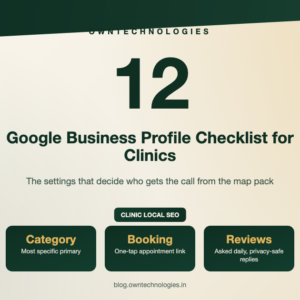
If your Google Business Profile is weak, fix that first with our Google Business Profile checklist for clinics, because every Meta lead will look you up before booking. Then run Meta ads for elective treatments, and grow organic search over time with SEO services that compound month after month.
Frequently Asked Questions
A single clinic can start with $15 to $30 a day, roughly $450 to $900 for the first month (around 37,000 to 75,000 INR). In India, $6 to $12 a day is a reasonable start in metro cities. Judge the result on booked consultations after 30 days before increasing the budget.
They do different jobs. Google ads reach people actively searching for a dentist, which suits urgent care. Facebook and Instagram ads reach local people who are not searching yet, which suits elective treatments like aligners, whitening, and implants. Most clinics do best with a strong Google profile plus Meta ads for elective offers.
The most common reasons are copy that implies something about the viewer, such as asking whether their teeth are stained, and images that promise unrealistic results, such as dramatic before-and-after photos. Rewrite the copy to describe the treatment and offer, and use clinic, team, or simple text images instead.
Most clinics see enquiries in the first week, but it usually takes 30 days to know whether an offer works and 60 to 90 days to settle on a profitable setup. Fast replies to leads matter as much as the ad itself.
Start with click-to-WhatsApp if your team can reply within minutes, because conversations convert well and feel personal. Instant lead forms bring more volume but more low-intent leads, so call them quickly. Test both and keep the one with the lower cost per booked consultation.
Final Thoughts
Meta ads for dental clinics are not a magic switch, and they are not a waste of money either. A small, honest starter budget, one clear offer, local targeting, compliant creative, and fast WhatsApp follow-up will tell you within 30 days whether paid social can bring your clinic new patients.
Want a second pair of eyes before you spend? Book a free consultation with OwnTechnologies. We will review your booking page, your Google profile, and your lead follow-up, and tell you what to fix before you put money into ads. You can see the websites and systems we have built in our portfolio.