Quick answer
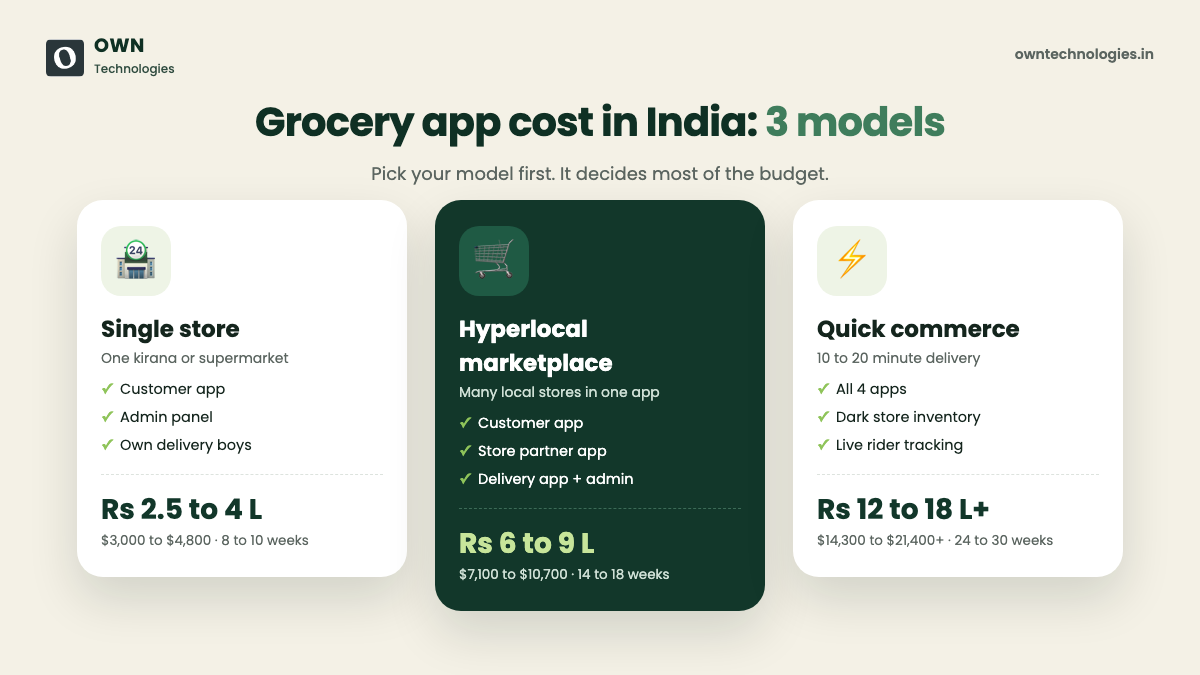
A grocery delivery app in India costs about $3,000 to $4,800 (Rs 2.5 to 4 lakh) for one store with its own delivery, $7,100 to $10,700 (Rs 6 to 9 lakh) for a multi-store hyperlocal marketplace, and $14,300 to $21,400 (Rs 12 to 18 lakh) or more for a 10-minute quick commerce setup with dark stores. Timelines run from 8 weeks to about 7 months.
Planning a grocery delivery app and getting quotes that range from Rs 50,000 to Rs 50 lakh? That gap is real, and it is not about the agency. It comes from how many apps you actually need and how your stock and riders work.
This guide breaks down grocery delivery app development cost in India for 2026 in plain numbers: the 3 build models, the 4 apps inside every grocery business, the monthly running costs nobody quotes upfront, and how to launch for less without cutting what customers notice.
Grocery delivery app development cost in India: 3 models
Most grocery apps fall into one of three models. Pick yours first, because it decides 70 to 80 percent of the cost.
| Model | Who it suits | Apps you need | Cost (2026) | Timeline |
|---|---|---|---|---|
| Single store ordering | One kirana, supermarket or organic store with its own delivery boys | Customer app + admin panel | $3,000 to $4,800 (Rs 2.5 to 4 lakh) | 8 to 10 weeks |
| Hyperlocal marketplace | Many local stores listed in one app, like a city level grocery platform | Customer app + store partner app + delivery app + admin | $7,100 to $10,700 (Rs 6 to 9 lakh) | 14 to 18 weeks |
| Quick commerce (10 to 20 minutes) | Dark stores you own, tight delivery promise | All 4 apps + dark store inventory + rider assignment + live tracking | $14,300 to $21,400+ (Rs 12 to 18 lakh+) | 24 to 30 weeks |
Ranges assume a professional Indian team building with Flutter or React Native for Android and iOS, plus a web admin panel. USD figures use about Rs 84 to the dollar.
Key takeaway
If you run one store, do not pay for a marketplace. If you want 10-minute delivery, do not expect a single-store budget to cover it. The model is the price.
The 4 apps inside every grocery business
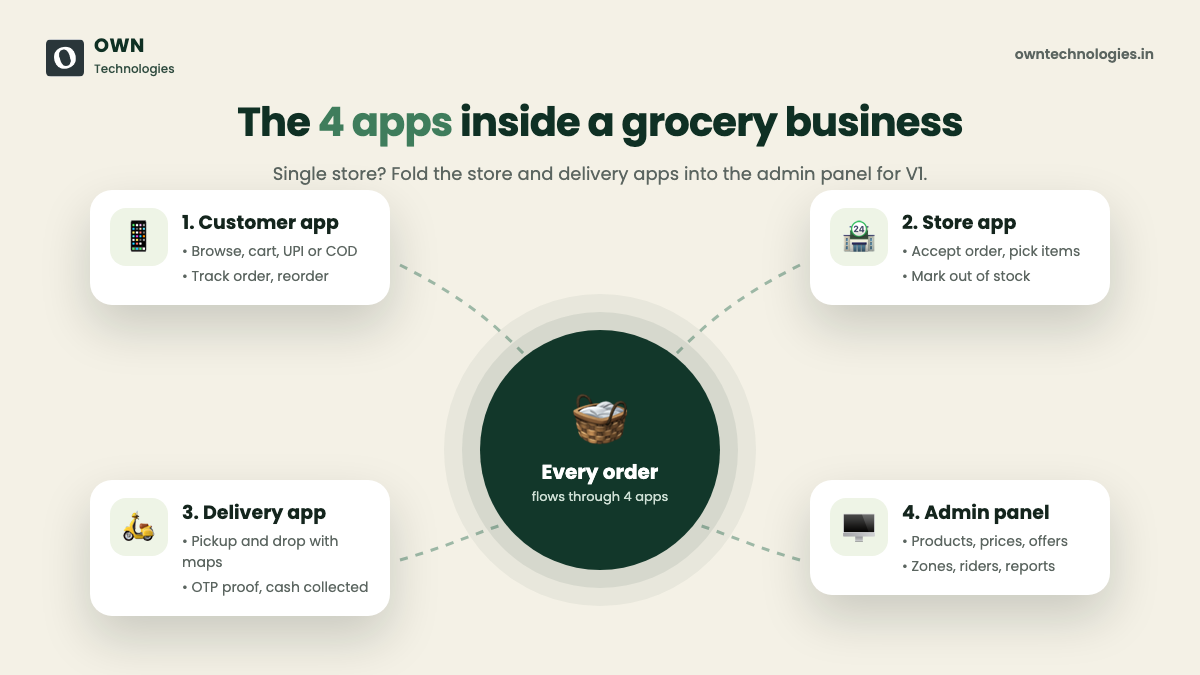
A “grocery app” is usually four products that talk to each other. Knowing them helps you read any quote line by line.
1. Customer app
- Search, categories and product pages with weight options (500 g, 1 kg)
- Cart, coupons, saved addresses with map pin
- Delivery slot or express delivery choice
- UPI, cards, wallets and cash on delivery
- Order tracking and reorder in one tap
2. Store or dark store app
- Accept or reject orders, mark items out of stock
- Picking list sorted by shelf, with substitutions
- Daily sales and stock view
3. Delivery partner app
- New order alerts, accept and navigate with maps
- Pickup and delivery proof (OTP or photo)
- Cash collected, trips and earnings for the day
4. Admin panel
- Products, prices, offers and banners
- Stores, riders, delivery zones and charges
- Orders, refunds, customers and reports
For a single store, apps 2 and 3 are often folded into the admin panel to save money. That one decision can cut 30 to 40 percent of the build. Our guide on what to include in admin panel version 1 shows how to keep it lean.
Features Indian grocery customers expect on day one
Indian shoppers compare every grocery app with the big platforms they already use. These basics decide whether they order a second time:
- **UPI checkout in two taps,** plus cash on delivery for new customers who do not trust a new app yet
- **Search that understands local names,** so “atta”, “dahi” and “bhindi” find the right products
- **Clear delivery time and charges before payment,** with a minimum order value shown upfront
- **Substitution choice** when an item runs out: call me, replace it, or refund it
- **Order updates on WhatsApp or SMS,** because many customers do not open the app until the doorbell rings
None of these are expensive to build. Missing them is what costs you repeat orders.
What pushes the cost up (feature by feature)
Each of these features is useful. Each also adds weeks. Use this list to decide what goes in version 1.
| Feature | Adds roughly | Needed in V1? |
|---|---|---|
| Live rider tracking on a map | 2 to 3 weeks | Only for express delivery |
| Delivery slots with capacity limits | 1 to 2 weeks | Yes if you deliver in slots |
| Multi-store inventory sync | 3 to 4 weeks | Only for marketplaces |
| POS or billing software integration | 2 to 4 weeks | Only if stock lives in your POS |
| Subscriptions (daily milk, weekly veggies) | 2 weeks | Strong for repeat orders |
| Wallet and cashback | 1 to 2 weeks | Can wait |
| Referral program | 1 week | Can wait |
| Hindi or regional language | 1 to 2 weeks | Yes in tier 2 and 3 cities |
Tip
Subscriptions for milk, bread and vegetables are the cheapest way to get daily repeat orders. If your store already has regular customers, build this before wallets or referrals.
Monthly running costs after launch
Development is a one-time cost. These keep running every month, so budget them before you launch.
- **Payment gateway fees:** most Indian gateways charge a percentage per successful payment. For example, Razorpay’s standard pricing lists 2% on domestic transactions, plus GST.
- **Maps and location:** address pins, distance and routing use map APIs that bill per request after a free monthly allowance. Check the Google Maps Platform pricing page for current rates.
- **Cloud hosting and database:** small apps start low and grow with orders and images.
- **SMS OTP and notifications:** login OTPs and order SMS are charged per message.
- **App store accounts:** Google Play charges a one-time US$25 registration fee, and Apple charges a yearly developer program membership.
- **Maintenance and updates:** bug fixes, OS updates and small changes. We break this down in app maintenance cost in India and the UAE.
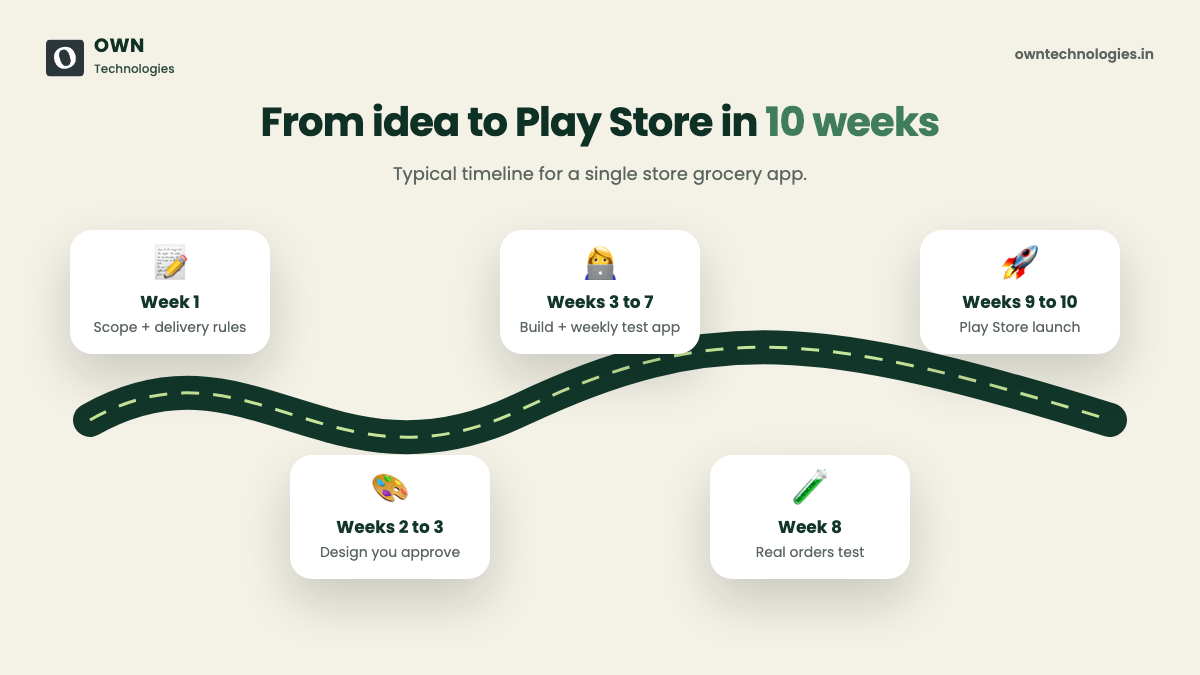
Timeline: what happens week by week
Here is how a single store grocery app usually moves from idea to Play Store.
- **Week 1:** scope, screens list and delivery rules (zones, slots, minimum order).
- **Weeks 2 to 3:** design of customer app and admin panel, approved by you.
- **Weeks 3 to 7:** build, with a test build on your phone every week.
- **Week 8:** testing with real products, real addresses and real payments.
- **Weeks 9 to 10:** store submission, launch and first fixes.
Marketplaces and quick commerce follow the same steps, just with more apps in parallel. For a detailed plan, see our MVP app in 8 weeks guide.
5 ways to cut grocery app cost without hurting customers
- **Start with one city zone.** Delivery rules, charges and riders are easier to get right in one area first.
- **Use a cross-platform framework.** One Flutter or React Native codebase serves Android and iOS, instead of paying for two separate apps.
- **Launch on Android first if your buyers are mostly Android users,** then add iOS from the same codebase.
- **Fold the store and rider apps into the admin panel** for version 1 if you run a single store.
- **Import your product list from Excel** instead of typing 2,000 items by hand. Ask your developer to build a bulk upload on day one.
Key takeaway
Cutting features customers never see (complex reports, wallets, referrals) is safe. Cutting search, checkout speed or delivery updates is not. Those are what make people order again.
App or website first?
If most of your customers already order on WhatsApp or by phone, a fast ordering website with UPI checkout can be a smart first step. It is cheaper, needs no app store approval, and you can add the app later using the same backend. Our e-commerce website development cost guide compares the website route.
Move to an app when customers order every week, because an app on their home screen, with push notifications and one-tap reorder, keeps them coming back.
Real example: doorstep ordering for an FMCG brand
We built the website for CleanSip Water, a packaged water brand that takes doorstep orders. The lesson carries over to groceries: make reordering a two-tap job and show delivery timing clearly. Read the CleanSip doorstep ordering case study.
How to choose a grocery app development company in India
Ask these 6 questions before you sign:
- Can you show live apps on the Play Store or App Store that you built?
- Is the admin panel included in the quote, and what can it do?
- Who owns the source code and the app store accounts after launch?
- Which payment gateway and map provider will you use, and who pays those bills?
- How many test builds will I see before launch?
- What does a monthly support plan cover, and what does it cost?
At OwnTechnologies, we have shipped 100+ projects over 8+ years, including apps with 10M+ downloads. See our portfolio, or explore our website development and CRM development services if you also need ordering on the web or a customer database.
Frequently Asked Questions
A single store grocery app costs about $3,000 to $4,800 (Rs 2.5 to 4 lakh). A multi-store hyperlocal marketplace costs about $7,100 to $10,700 (Rs 6 to 9 lakh). A 10-minute quick commerce setup with dark stores starts around $14,300 (Rs 12 lakh) and can go above $21,400 (Rs 18 lakh).
A single store app takes about 8 to 10 weeks. A marketplace with store and delivery apps takes 14 to 18 weeks. A quick commerce system with dark stores and live tracking takes about 24 to 30 weeks.
You can build the same core idea, but not the same scale on day one. Start with one zone, a customer app, a picker view and rider assignment, then add live tracking, multiple dark stores and advanced inventory once orders grow.
For a single store, no. Store and delivery tasks can live in the admin panel for version 1. For a marketplace or quick commerce, separate store and delivery apps save time for every order.
Both work well. Each gives you Android and iOS from one codebase, which lowers cost. Choose the team with more live apps like yours rather than the framework alone.
Expect payment gateway fees per transaction, maps and SMS charges per request, cloud hosting, app store accounts and a maintenance plan for updates and fixes.
Final Thoughts
Grocery delivery app development cost in India depends mainly on one choice: single store, marketplace or quick commerce. Pick the model that fits how you deliver today, launch lean in one zone, and grow features with real order data.
Want a fixed quote for your grocery app? Share your store count, delivery area and must-have features, and we will send a clear plan with cost and timeline. Book a free consultation with OwnTechnologies.