You are a founder in Dubai or Abu Dhabi with an app idea, a budget, and two quotes on your desk. One agency says Flutter. The other says React Native. Both say their choice is “faster and cheaper”. You cannot read code, so how do you decide?
This guide compares Flutter and React Native for UAE startups in 2026, in plain business terms: cost in AED, Arabic and right-to-left support, UAE payments and UAE PASS, hiring, updates, and the cases where neither is the right answer. You will finish with a simple scorecard you can use in your next vendor call.
The short answer
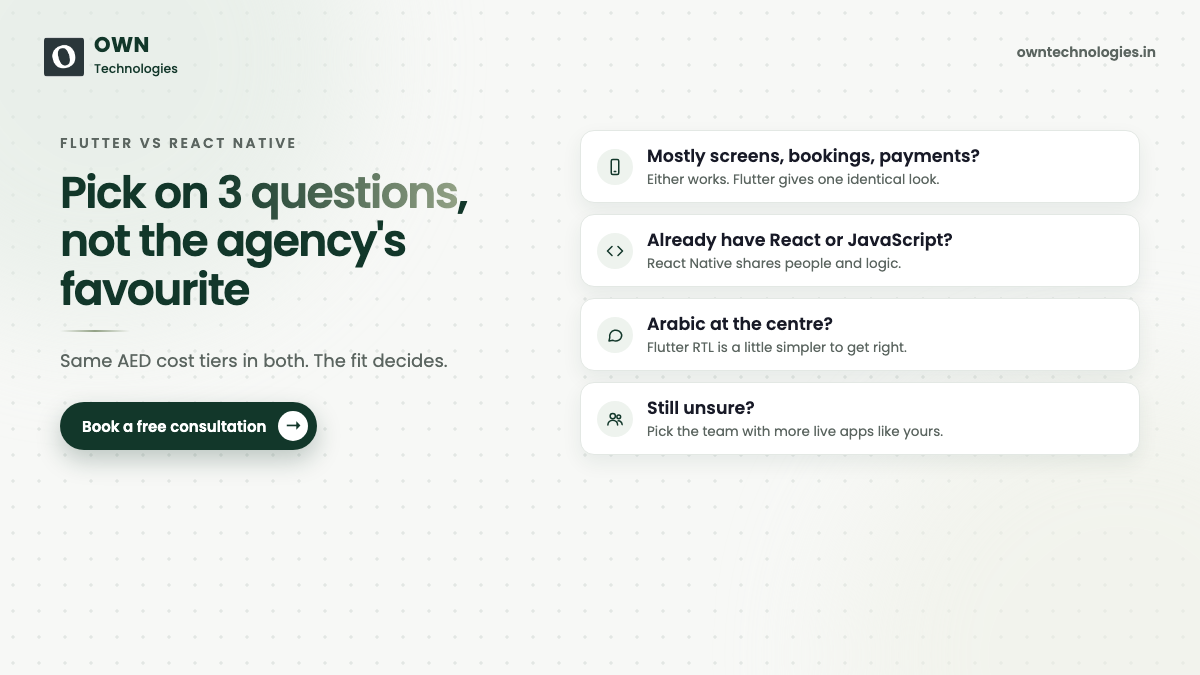
For most UAE startup apps, both frameworks will do the job, and the build cost is close. The choice should come from three questions, not from the agency’s favourite tool:
- **Is your app mostly screens, forms, bookings and payments?** Either works. Flutter often gets a polished, identical look on iPhone and Android with less effort.
- **Do you already have a web product built in React, or a JavaScript team?** React Native usually wins, because you can share people, skills and some code.
- **Does Arabic sit at the centre of the product, not as an afterthought?** Flutter’s built-in right-to-left handling is a little simpler to get right across every screen. React Native can do it well too, but it needs more care in testing.
If none of these points clearly one way, pick the team that has shipped more apps like yours, in the framework they know best. A strong team in either framework beats a weak team in the “right” one.
What Flutter and React Native actually are
Both are cross-platform frameworks. You build one app, and it runs on iPhone and Android. That is why both are cheaper than building two fully native apps.
| Flutter | React Native | |
|---|---|---|
| Made by | Meta | |
| Language | Dart | JavaScript or TypeScript |
| How screens are drawn | Flutter draws every pixel with its own rendering engine | Uses the phone’s real native buttons, lists and text fields |
| Look across devices | Same look on iPhone and Android by default | Looks closer to each platform’s own style |
| Web sharing | Can also build web and desktop, less common for marketing sites | Shares skills and logic with React web apps |
| Over-the-air updates | No official built-in option | Expo offers over-the-air updates for JavaScript changes |
The practical meaning for a business owner: Flutter gives your designer more control over every pixel. React Native gives you a bigger pool of JavaScript developers and an easier path if you already run a React website or dashboard.
React Native also changed a lot under the hood. Since version 0.76 in late 2024, its New Architecture is switched on by default, which removed many of the old performance complaints. You can read the details on the official React Native release post. If someone tells you React Native is “slow” based on articles from 2020, ask for something newer.
Cost in the UAE: Flutter vs React Native
This is the question most founders care about first, and the honest answer is that the framework is not the main driver of price. Scope is. Here are the planning ranges we use for UAE projects, the same ones in our full guide to mobile app development cost in Dubai.
| Tier | What you get | Flutter | React Native |
|---|---|---|---|
| MVP | Core flow, login, payments or bookings, simple admin, both stores | AED 25,000 to 50,000 | AED 25,000 to 50,000 |
| Growth app | Several features, full admin panel, integrations, Arabic and English | AED 60,000 to 150,000 | AED 60,000 to 150,000 |
| Enterprise | Multiple roles, real-time features, compliance, AI features | AED 180,000 to 400,000 | AED 180,000 to 400,000 |
| Two fully native apps (for comparison) | Separate iPhone and Android codebases | Up to about 2 times the cross-platform price | Same |
The ranges are the same on purpose. In our experience, a quote that is 30 or 40 percent cheaper “because of Flutter” or “because of React Native” usually has less scope hidden inside it: no admin panel, Android only, or no Arabic.
Where each framework can save you money
- **Flutter saves money** when the design is custom and must look identical on both platforms. There is less “it looks different on Samsung” rework.
- **React Native saves money** when you already have React developers, or when the app and a web dashboard share business logic such as pricing rules or validation.
- **Both save money** compared with native when the app is mostly data, bookings, chat and payments.
Where each can add cost back
- **Flutter** can add cost when you need a native SDK that has no maintained Flutter package. Someone has to write a bridge.
- **React Native** can add cost when the app depends on many third-party libraries that fall behind new versions. Upgrades then take longer.
For a deeper breakdown of React Native pricing in USD, see our post on React Native app development cost.
Arabic and right-to-left support
In the UAE, Arabic is not a nice-to-have for many apps. Government-facing services, family and healthcare apps, and many retail brands need full Arabic, with the whole layout mirrored from right to left.
Flutter and Arabic
Flutter has right-to-left layout built into its core widgets. When the app language is Arabic, rows, padding, icons that show direction and text alignment flip automatically if the developers use the direction-aware settings. Translations are handled through Flutter’s official localization tools, described in the Flutter internationalization guide.
React Native and Arabic
React Native supports right-to-left through a module called I18nManager. It works, but switching direction usually needs the app to reload, and some third-party components do not mirror properly. That means more screen-by-screen testing in Arabic.
What actually breaks in Arabic apps
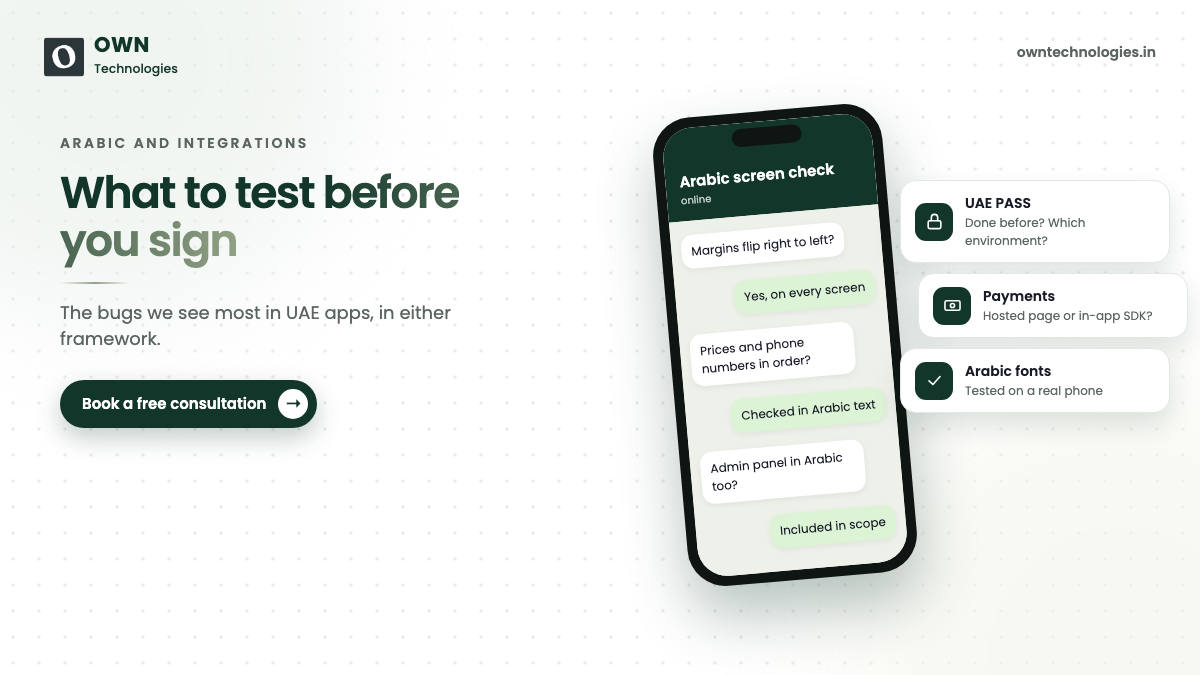
In both frameworks, the bugs we see most are the same:
- Hard-coded “left” and “right” margins that do not flip
- Numbers, prices and phone numbers that display in the wrong order inside Arabic sentences
- Arabic fonts that look fine in Figma but cut off at the top or bottom on a real phone
- An admin panel that is English only, so your Arabic content team cannot work
We cover these in detail in our Arabic mobile app development guide for the UAE. Whichever framework you pick, ask the agency to show you an Arabic screen from a past app before you sign.
UAE payments, UAE PASS and local integrations
UAE apps rarely live alone. They need a payment gateway, sometimes UAE PASS sign-in, WhatsApp, maps and SMS. Here is how the two frameworks compare on the common ones.
| Integration | Flutter | React Native | What to ask the agency |
|---|---|---|---|
| Apple Pay and Google Pay | Supported through payment SDKs | Supported through payment SDKs | Which gateway, and has it been tested on a live merchant account? |
| Stripe | Community-maintained package | Official Stripe React Native SDK | Who maintains the package you will use? |
| Local gateways (for example Network International, Telr, Checkout.com) | Often through the web checkout or a custom bridge | Often through the web checkout or a custom bridge | Hosted page or in-app SDK? Who handles 3-D Secure? |
| UAE PASS sign-in | Native SDK plus a bridge, or a browser-based login | Native SDK plus a bridge, or a browser-based login | Have you integrated UAE PASS before, and in which environment? |
| Maps, push, analytics | Mature official or widely used packages | Mature official or widely used packages | Usually no difference |
The pattern is clear: for local UAE services, the framework matters less than whether the team has done that exact integration before. A payment bridge written once is cheap. A payment bridge written for the first time, on your budget, is not.
Performance: does it matter for your app?
For booking apps, e-commerce, loyalty, delivery tracking, real estate listings and most marketplaces, users will not feel a difference between a well-built Flutter app and a well-built React Native app.
Performance becomes a real decision factor only in a few cases:
- **Heavy animation or custom graphics**, such as an interactive property viewer or a game-like loyalty screen. Flutter usually has the edge here because it controls every pixel.
- **Very long, complex lists with live updates**, such as a trading or live-odds screen. Both can do it, but the team’s skill matters more than the framework.
- **Bluetooth, sensors, background location or AR**, such as a fleet tracker or a smart-home controller. Here you may need native code in either framework, and sometimes fully native is the better call.
If your app is in the first group of everyday business apps, do not let performance be the reason you choose. Choose on cost, team and Arabic.
Hiring and the long-term team
Your first version is maybe a third of the money you will spend on the app over three years. The rest is updates, new features and fixes. So ask who will maintain it.
React Native hiring
JavaScript is one of the most widely used programming languages in the world, so React Native talent is easier to find in Dubai, India and remotely. If you later bring development in-house, a React web developer can learn React Native quickly.
Flutter hiring
Dart is used almost only for Flutter, so the pool is smaller. The upside is that Flutter developers tend to be focused mobile specialists. Many UAE startups work with an offshore Flutter team in India for the build and support, which keeps the monthly cost lower than a Dubai in-house hire.
Maintenance cost is the same rule for both
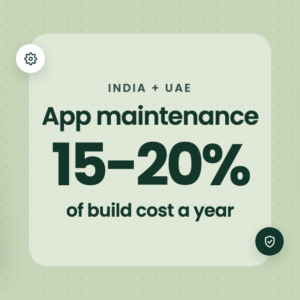
Plan 15 to 20 percent of the build cost per year for maintenance in either framework. That covers new iOS and Android versions, library updates, small fixes and security patches. A AED 60,000 app should have roughly AED 9,000 to 12,000 a year set aside.
Updates after launch
Every app needs updates. The difference is how fast you can push small fixes.
- **React Native with Expo** can send over-the-air updates for JavaScript changes, so a text fix or small logic fix can reach users without a full store review, within Apple and Google’s rules.
- **Flutter** has no official over-the-air update feature. Most fixes go through a normal store release, which on Apple usually takes from a few hours to a couple of days.
For most startups this is a convenience, not a deal-breaker. It matters more for apps that change prices, menus or promotions often, though that content should come from your backend anyway, not be built into the app.
When to choose Flutter, React Native or neither
| Choose Flutter when | Choose React Native when | Choose neither (go native) when |
|---|---|---|
| You want one custom design that looks identical on iPhone and Android | You already have a React web app or a JavaScript team | The app depends on Bluetooth, background sensors or AR |
| Arabic and English are both core, from day one | You want to share logic between app and web dashboard | You need brand-new iOS or Android features on launch day |
| The app is screens, bookings, payments and content | You want over-the-air fixes through Expo | You already have a large native team and codebase |
| You plan to hire an offshore mobile specialist team | You plan to hire in-house developers later | Performance is the product, for example a game |
And one more option many founders skip: if you do not need the app stores yet, a progressive web app can test the idea for much less. We compared that route in our post on PWA vs native apps.
A 6-question scorecard for your vendor call
Give each answer 1 point for the framework it favours. It takes ten minutes and cuts through most of the sales talk.
- Do we already have React or JavaScript developers, in-house or on retainer? (Yes: React Native)
- Is the design custom, with animations, and must it look the same on every phone? (Yes: Flutter)
- Is Arabic a launch requirement on every screen? (Yes: Flutter, slightly)
- Will the app share business rules with a web dashboard we are also building? (Yes: React Native)
- Do we need native-only hardware features? (Yes: consider native)
- Which framework has this agency shipped more live UAE or GCC apps in? (Give that framework 2 points)
Then ask to see two live apps in the winning framework, one of them in Arabic, and ask who owns the code and the store accounts. It should be you, in writing.
Where OwnTechnologies fits
We build cross-platform apps in both Flutter and React Native, as well as native iOS and Android, for clients in the UAE, India and 15+ countries. Over 8+ years and 100+ projects, we often recommend Flutter for new UAE business apps, mainly because of the consistent design and simpler Arabic layout, and we switch to React Native when a client already has a React product or team.
If you want a second opinion on a quote you already have, or a written scope with both options priced, see our mobile app development services, our guide to Flutter app development in Dubai, or browse the portfolio. If your project also needs a marketing site, our website development team can build it alongside the app.
Frequently Asked Questions
For most Dubai startup apps, both work and cost about the same. Choose Flutter for a custom design that looks identical on both platforms and for simpler Arabic layout. Choose React Native if you already have React or JavaScript developers or a React web product.
Not in a meaningful way. An MVP in either framework typically costs AED 25,000 to 50,000 and a growth app AED 60,000 to 150,000. If one quote is much cheaper, check what scope has been left out, such as the admin panel, Arabic or one of the platforms.
Both can build a good Arabic app. Flutter has right-to-left layout built into its core widgets, which makes full mirroring a little simpler. React Native uses I18nManager, which works but usually needs an app reload to switch direction and more testing of third-party components.
Yes. UAE PASS and most local gateways can be integrated in both, usually through a native SDK with a bridge or a hosted web flow. What matters most is whether the team has done that exact integration before.
Plan 15 to 20 percent of the build cost per year in either framework. For a AED 60,000 app, that is roughly AED 9,000 to 12,000 a year for OS updates, library upgrades, fixes and security patches.
Only if your app depends on Bluetooth, background sensors, AR, advanced graphics or brand-new platform features, or if you already have native teams. Two native apps can cost up to about 2 times a cross-platform build.
Final Thoughts
Flutter vs React Native is a smaller decision than most sales calls make it sound. In the UAE, the bigger wins come from getting the scope right, planning Arabic from day one, choosing a team that has done your payment and login integrations before, and owning your code. Use the scorecard, ask for live apps, and let the framework follow.
Want a fixed-price scope for your app in Flutter or React Native, with Arabic and UAE payments included? Talk to our team for a free consultation, or call +91 9311228839.