Most quiz apps look the same in a store search: a question, four answers and a timer. Yet a few of them reach millions of installs while most stop at a few thousand. Trivia Master, the quiz game listed as Quiz App in our mobile portfolio, shows 10M+ downloads on Google Play, with a 4.3 rating from about 114,000 reviews.
This case study looks at what is visible in that product, why those choices matter, and what a founder in India should plan and budget to build a quiz app in 2026. We stick to public facts here. We do not publish private revenue or retention numbers, and where we give an opinion about why something works, we say so.
Trivia Master at a glance
| App | Trivia Master – Word Quiz Game |
| Publisher on Google Play | Topy Games |
| Downloads | 10M+ on Google Play |
| Rating | 4.3 from about 114K reviews (November 2026) |
| Content | 50,000+ questions, per the store listing |
| Topics | Science, history, geography, movies, music, art, sports, nature and culture |
| Ways to play | Adjustable difficulty, offline play, challenge friends |
| How it earns | Ads and in-app purchases |
You can check these figures yourself on the Google Play listing.
Why a simple format is harder than it looks
A quiz looks like a weekend project. Show a question, check the answer, add to the score. That part really is simple, and it is exactly why the category is crowded.
The hard part is everything around the question: having enough content that it does not repeat, keeping the difficulty fair, making the game work on a weak connection, and earning money without driving players away. These are product decisions more than code problems, and they are where quiz apps win or lose.
Five product choices visible in the app
1. A question bank large enough to stay fresh
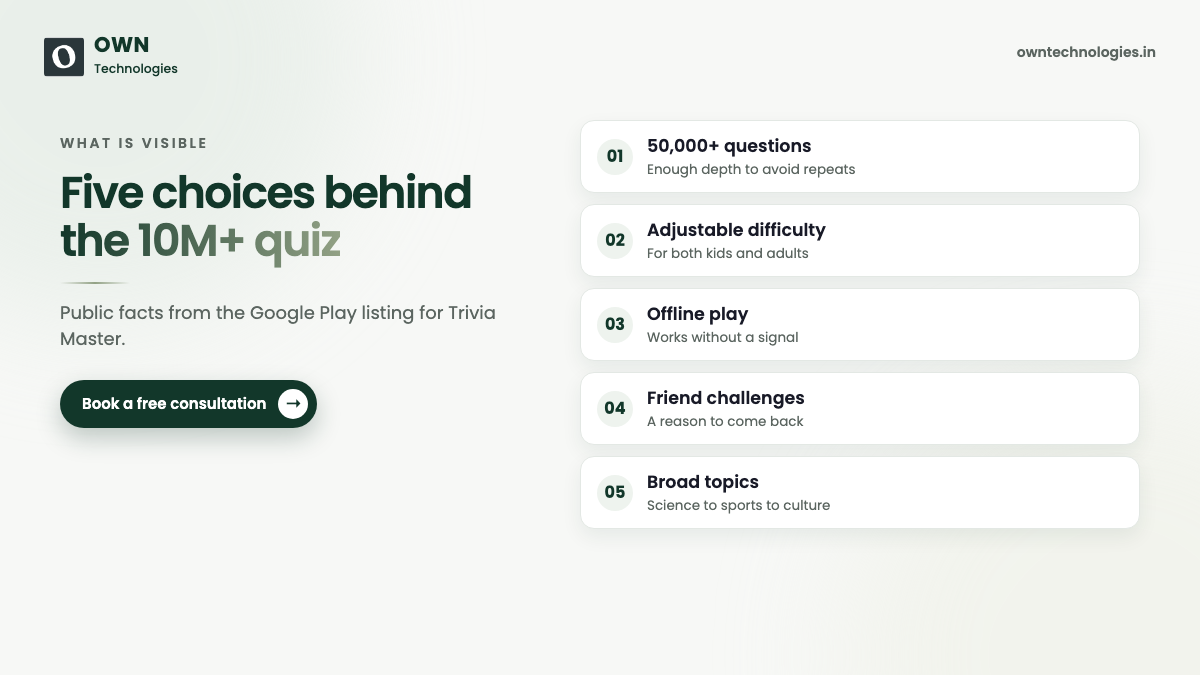
The listing promises more than 50,000 questions. Repetition is what ends a quiz game. Once a player starts seeing the same questions, the score stops meaning anything and the reason to return is gone.
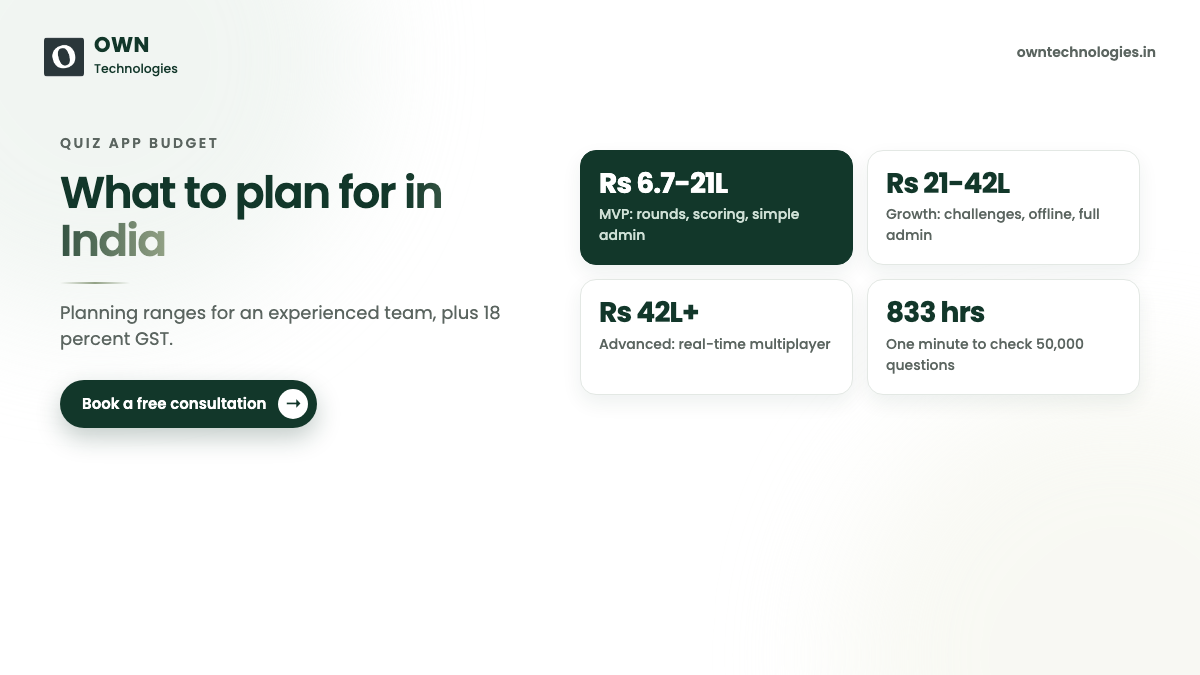
A bank this size is also a real production job. If someone spent just one minute checking each question for accuracy, 50,000 questions would take about 833 hours of review. That is why content needs its own budget line and its own tools, and why you cannot treat it as something to sort out the week before launch.
2. Difficulty that fits the player
The app offers adjustable difficulty for both kids and adults. This matters because a quiz only feels good when the player gets some answers right and has to work for others. Too easy is boring. Too hard feels unfair, and an unfair game gets uninstalled.
In our view this is the most underrated feature in the category, because it widens the audience. The same app can suit a child, a parent and a trivia fan without three separate products.
3. Offline play
Offline play removes the most common reason a casual game does not get opened: no signal, or a data pack the player wants to save. A quiz is well suited to this because a batch of questions can be stored on the phone and played anywhere.
For founders in India this is worth noting. A game that opens instantly on the metro or in a low-signal area gets more sessions than one that shows a loading spinner.
4. Reasons to come back and to compete
The listing describes challenging friends and comparing results, along with a millionaire-style challenge. A pure solo quiz has no natural reason for tomorrow’s session. Competition supplies one, and a friend’s score is more motivating than a number on your own screen.
Sharing also gives the app a free way to spread, because every challenge sent to a friend is an invitation to install.
5. Breadth of topics
Science, history, geography, movies, music, art, sports, nature and culture give very different people a reason to try the app. Broad topics also help in store search, since people look for many kinds of quiz and trivia game.
What any quiz app has to get right underneath
If you are planning a similar product, budget for these areas from the start.
A content pipeline and admin panel
Questions need writing, fact-checking, tagging by topic and difficulty, and correcting when a player reports an error. Without an admin panel, every change means a developer and possibly an app update. With one, your content team can add and fix questions on the same day.
Plan for a “report this question” button as well. Players will find mistakes faster than any review team, and a wrong answer marked as correct damages trust quickly.
Offline storage and sync
Offline play means storing question packs on the phone, recording progress while offline, and syncing it later without losing a score or letting anyone cheat easily. Keep the first download small and fetch further packs when the player is on a connection.
Monetisation that respects the session
Trivia Master uses both ads and in-app purchases, which is a common model for free games. A natural place for an ad is between rounds, not in the middle of a question. Rewarded ads, where a player chooses to watch in return for a hint or an extra life, tend to feel fairer because the player is in control.
As a simple way to plan, work out your revenue per thousand sessions, then test ad frequency against how often people return. More ads can raise revenue today and lower it next month if players leave. Measure both before you decide.
Store rules for kids
If your app targets children or appeals to them, extra rules apply. Google Play’s Families policies cover data collection and advertising in these apps. Decide your target age before you integrate ads or analytics, because changing it later can mean replacing both.
Performance on budget phones
India’s Android market includes many low-cost devices. Test on those, keep animations light, and keep the app size small. A quiz has no excuse for being heavy, and every extra megabyte loses people who are on limited data.
What founders can take from this
You do not need to build a trivia game for these lessons to apply.
- **Treat content as a product.** Education, test preparation and language apps live or die on content quality, not on screens.
- **Fit the difficulty to the person.** Any learning or game product feels better when it adapts to the user.
- **Work offline where you can.** Your users are not always on good Wi-Fi.
- **Build in a reason to return.** Streaks, challenges and friends give tomorrow’s session a purpose.
- **Plan how you earn before you build.** Ads, purchases and subscriptions each change the design.
Common mistakes in quiz app first versions
- **Launching with too few questions.** A few hundred questions can run out within days for an active player.
- **No difficulty tags.** If questions are not tagged from day one, re-tagging thousands of them later is slow and expensive.
- **Ads too early and too often.** An ad before the first question is the fastest way to lose a new player.
- **Answer data sitting in the app with no checks.** Leaderboards are easy to cheat if scores are only stored on the phone.
- **No analytics on where people drop off.** Track the rounds played in a first session and which questions people quit on.
- **Copying a famous TV format too closely.** Names, logos and show formats can belong to someone else, so get advice before you use them.
What it costs to build a quiz app in India (2026)
These are the planning ranges we use for apps built by an experienced Indian team. A quiz app usually sits in the lower half of each range unless it adds real-time multiplayer. Your exact price depends on screens, user roles and integrations.
| Version | What it usually includes | Typical cost |
|---|---|---|
| MVP | Questions by topic and difficulty, scoring, login, simple admin, Android and iOS, store launch | Rs 6.7 lakh to 21 lakh |
| Growth app | Friend challenges, leaderboards, ads and purchases, offline packs, full admin panel | Rs 21 lakh to 42 lakh |
| Advanced platform | Real-time multiplayer, live events, tournaments and heavy analytics | Rs 42 lakh and up |
Add 18 percent GST. Budget separately for writing and checking questions, servers, app store fees and yearly maintenance of about 15 to 20 percent of the build cost.
How we would plan a similar app today
- **Define the core game, 1 week.** Topics, round length, difficulty rules and how the app earns. You get a written scope.
- **Prepare the first content set.** Enough checked and tagged questions that an active player does not see repeats in the first weeks.
- **Design and test the round, 2 to 3 weeks.** A clickable prototype of one complete round, tried with real players.
- **Build in milestones.** A working build every week, starting with the core round, then the admin panel, offline packs and challenges.
- **Soft launch.** Release to a small audience, watch first-session numbers and crash reports, and tune ad frequency before spending on installs.
If you are comparing teams, read our guide to [picking a mobile app development company in India](https://blog.owntechnologies.in/best-mobile-app-development-company-india/). For another high-download product in our portfolio, see the [Tender case study](https://blog.owntechnologies.in/tender-app-case-study/). If your quiz is really a learning product, our guide to [education app development](https://blog.owntechnologies.in/education-app-development/) covers tests, courses and fees.
Frequently Asked Questions
A focused quiz MVP usually costs Rs 6.7 lakh to 21 lakh. Adding friend challenges, leaderboards, offline packs and a full admin panel usually takes it to Rs 21 lakh to 42 lakh, plus 18 percent GST and the cost of writing and checking questions.
Enough that an active player does not see repeats in the first few weeks. That can mean several thousand checked questions for a broad trivia game. Trivia Master’s listing shows more than 50,000, built up as the product grew.
Mainly through ads between rounds, rewarded ads for hints or extra lives, and in-app purchases. Trivia Master’s Google Play listing shows both ads and in-app purchases.
Yes. Question packs can be stored on the phone and progress synced later. Keep the first download small and let players fetch more packs when they are connected.
A focused first version typically takes 2 to 4 months from scope to store launch. Real-time multiplayer and live events add more time.
Yes. Google Play’s Families policies cover data collection and advertising in apps for children, so decide your target age before you add ads or analytics.
Final Thoughts
A quiz app does not stand out because of its question screen. Every quiz app has one. It stands out through the depth of its content, difficulty that fits the player, a game that works anywhere, and a reason to come back tomorrow. Those are the decisions to get right before anyone writes code.
Planning a quiz, learning or casual game app? Our mobile app development team in Gurugram will review your idea and send a written scope with a cost range in INR. Book a free consultation to get started.