Most fintech founders in India pick their app development company the same way they would pick one for a food delivery app: portfolio, price, a friendly call. Then the first KYC vendor rejects the integration, the payment partner asks for an audit report, and the timeline doubles.
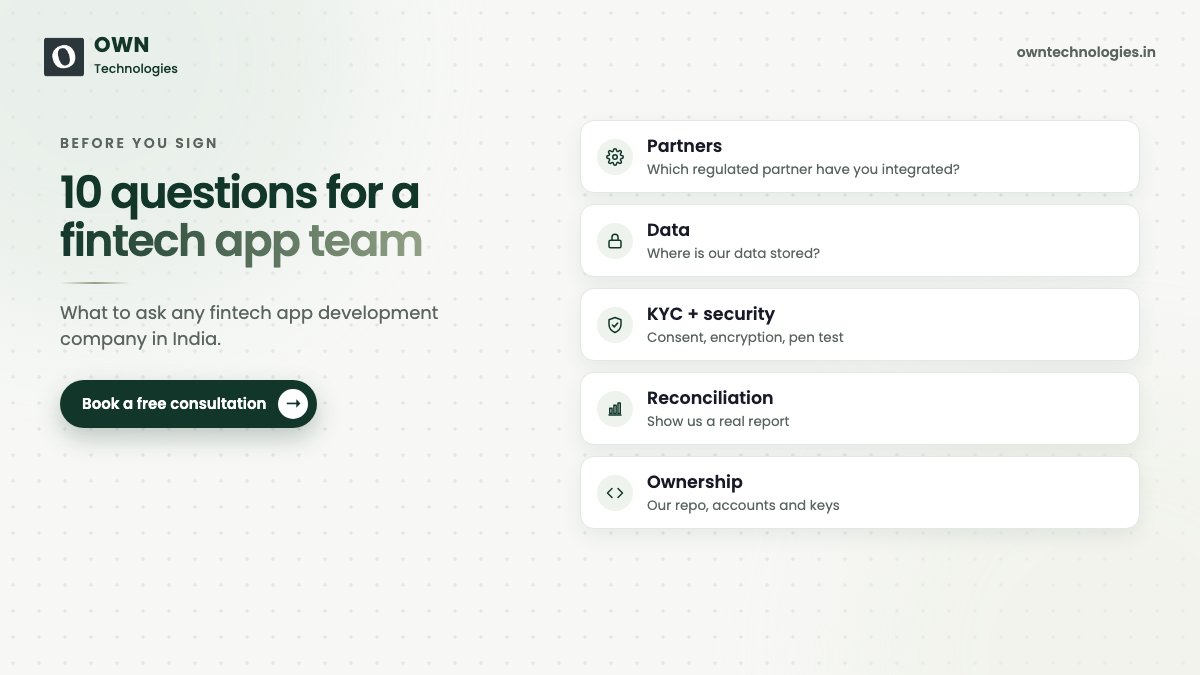
A fintech build is judged by your bank partner, your payment aggregator and, sooner or later, a regulator. This guide gives you 10 questions to ask any fintech app development company in India before you sign, what a good answer sounds like, and what the work should cost.
Why Hiring for Fintech Is Different From Hiring for Any Other App
A normal app can ship with bugs and fix them next sprint. A fintech app that loses a transaction, shows a stale price or leaks a PAN number has a much bigger problem, because money and identity data are involved.
Three things change when money moves through your app:
- Someone else signs off. Your bank, NBFC or payment aggregator partner will review your security before they switch you on in production.
- The rules are written down. RBI directions, the DPDP Act 2023 and CERT-In reporting rules apply to how you store and protect data.
- Every number must reconcile. The money in your ledger, your partner’s ledger and the user’s screen must agree at the end of every day.
So the question is not only “can this team build a good app?” It is “has this team built something that a bank partner and an auditor accepted?” The 10 questions below test exactly that.
Question 1: Which Regulated Partner Have You Integrated With?
Most fintech startups in India do not hold their own licence at the start. They work through a licensed partner: a bank, an NBFC, a payment aggregator or a custodian. The integration with that partner is the core of the build.
Ask the company to name the type of partner they have integrated with before (payment gateway, KYC provider, bullion custodian, lending partner) and what broke the first time. A team that has done it will tell you about sandbox limits, webhook retries and callback failures without being asked.
Weak answer: “We can integrate any API.”
Good answer: “On our last build the partner’s sandbox behaved differently from production, so we built a retry queue and a daily reconciliation report before launch.”
Question 2: Where Will Our Data Be Stored?
RBI’s 2018 direction on storage of payment system data requires payment data to be stored only in India. If your app touches payments, your servers, backups and logs need to sit in an Indian region of your cloud provider.
Ask which cloud region they will use, where backups go, and whether any third-party tool (analytics, crash reporting, support chat) sends payment data outside India. Many teams get the main database right and then pipe full transaction payloads into a foreign logging tool.
Question 3: How Do You Handle KYC and Personal Data?
Fintech apps collect PAN, Aadhaar-linked details, bank account numbers and selfies. Under the Digital Personal Data Protection Act, 2023, you need clear consent, a stated purpose and a way to handle deletion requests.
A good team will explain:
- Which KYC provider they suggest and why (cost per check, success rates you can test in their sandbox)
- How documents are encrypted at rest and who on your team can view them
- How consent is recorded, with a timestamp, for each purpose
- What happens to KYC data when a user closes the account
Question 4: What Is Your Security Testing Process?
Your partner will ask for a security test report before go-live. Ask the company whether they run a third-party penetration test or only internal checks, and who fixes the findings.
Budget for it separately. In our planning ranges, an external security audit costs $3,000 to $8,000 (around 2.5 to 6.6 lakh INR) per year, and banks often ask for it again after major releases.
Also ask how they would meet the CERT-In directions of April 2022, which require reporting certain cyber incidents within 6 hours of noticing them. That means logs you can actually search and a named person who gets the alert.
Question 5: How Do You Build Reconciliation?
This is the question that separates fintech teams from general app teams. Reconciliation means checking, every day, that what your app says happened matches what your partner says happened.
On the BKS MyGold build, the hard part was not the payment button. Grams bought, grams sold, grams leased and grams in transit had to agree every day across the app, the admin console and the partner records. That is why we tell every fintech founder to design the admin console for reconciliation from day one, not after launch.
Ask to see a sample reconciliation report or admin screen from a past project. If they have never built one, you will be paying for them to learn.
Question 6: What Happens When a Partner API Goes Down?
Every partner API fails at some point. Payments time out, KYC checks hang, price feeds go stale. What matters is what your user sees.
Ask for their failure plan:
- Payment started but no callback: does the app show “processing” and check again, or does it let the user pay twice?
- Live price feed drops: does the app show a stale price or a clear “pricing unavailable” message?
- KYC provider slow: can the user save progress and come back?
On a gold platform, a stale price is worse than a visible pause, because users act on it. A team that has run a live money product will have strong opinions here.
Question 7: Who Owns the Code, Accounts and Keys?
Your partner agreements, app store accounts, cloud account and API keys should all be in your company’s name from day one. If the agency holds them, switching teams later becomes very hard.
Ask for this in writing:
- Source code in a repository your company owns
- Apple, Google Play and cloud accounts registered to your company
- Production keys stored in a secrets manager you control
- A handover document before the final payment
Question 8: Can You Show a Fintech or Trust-Heavy Product You Built?
Portfolios full of restaurant apps do not tell you much. Look for products where users trusted the app with money, identity or health data.
For example, we built the website, iOS and Android apps for BKS MyGold, India’s gold activation platform. The apps let users buy and sell MMTC-PAMP 24K digital gold, lease gold to earn extra gold weight, run SIPs from as little as Rs 10 a day, gift gold and give temple daan. The design challenge was making insurance, legal documentation and live pricing visible without scaring first-time savers. You can read the full story in our MyGold case study.
Ask any company you shortlist for one product like this, and ask what they would do differently today.
Question 9: How Will You Phase the Build?
Good fintech teams do not build everything in one go. They pick one money flow, make it safe, and grow from there. Ask for a phase plan with costs.
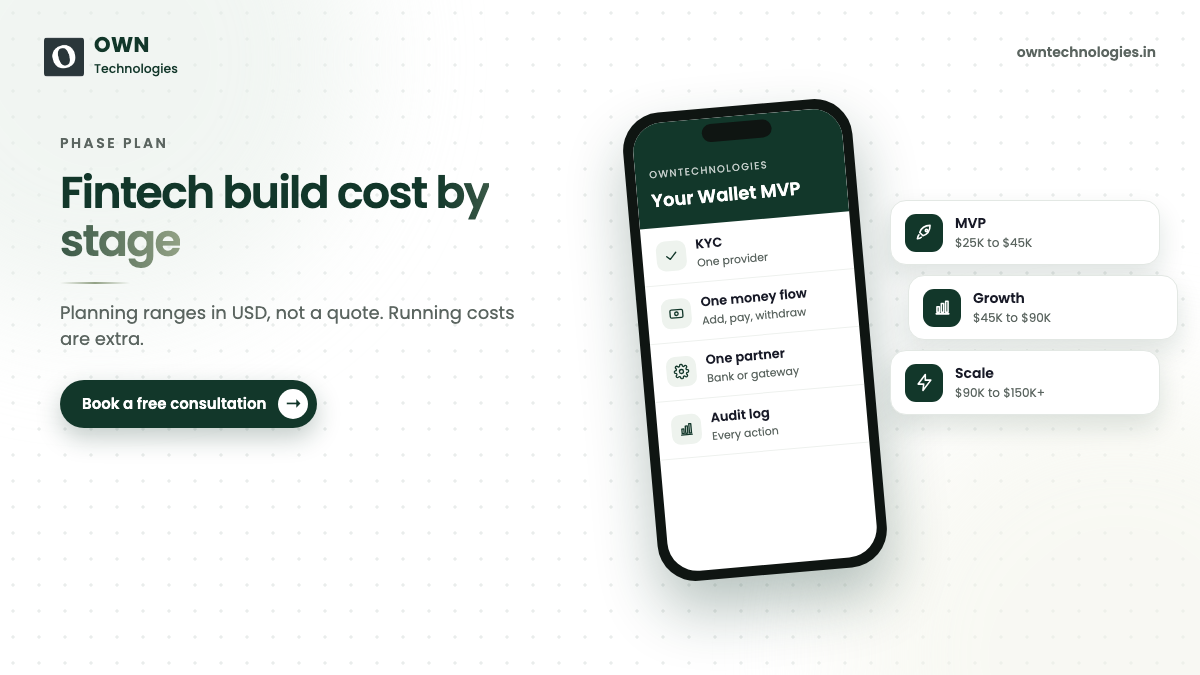
These are the planning ranges we use for fintech builds. They match the ranges in our fintech app development guide, and they are not a quote for any specific project.
| Stage | What it includes | Cost (USD) | Cost (INR, approx.) |
|---|---|---|---|
| MVP | One core money flow, KYC, one partner integration, basic audit logs | $25,000 to $45,000 | 21 to 37 lakh |
| Growth | More integrations, reporting, fraud rules, support tools | $45,000 to $90,000 | 37 to 75 lakh |
| Scale | Credit or investment logic, multi-region rules, advanced analytics | $90,000 to $150,000+ | 75 lakh to 1.25 crore+ |
Running costs are separate: per-check KYC fees, gateway percentages, cloud hosting, security audits and yearly support of around 18 to 25 percent of the build cost. Ask every company to list these, so your first-year budget is real.
Question 10: What Does Support Look Like After Launch?
A fintech app is never finished. Partner APIs change, app store rules change, and RBI issues new directions. Ask:
- What response time do you commit to for a payment or login outage?
- Who monitors the app on weekends and festival days, when transaction volume peaks?
- How do you handle partner API version changes?
- Is support a fixed monthly fee or billed by the hour?
Get the answers in the contract, not only on a call.
A Quick Scorecard for Your Shortlist
Use this table when you compare two or three companies side by side.
| Check | What a good answer includes | Red flag |
|---|---|---|
| Partner integrations | Names the partner type and what broke | “We can integrate any API” |
| Data location | Indian cloud region, backups and logs too | Only talks about the main database |
| KYC and consent | Encryption, access control, consent log | No mention of DPDP |
| Security testing | Third-party test, fix plan, CERT-In plan | Internal testing only |
| Reconciliation | Shows a real report or admin screen | Has never built one |
| Failure handling | Clear plan per partner outage | “The API is reliable” |
| Ownership | Your accounts, your repo, your keys | Agency holds the accounts |
| Phasing | Phase plan with costs and running costs | One big fixed price, no phases |
If a company scores well on six or more of these, it is worth a paid discovery phase. If it scores below four, keep looking.
For a wider checklist that covers any app, not only fintech, see our guide on how to choose a mobile app development company in India. For the rules themselves, our fintech compliance checklist for India and GCC goes deeper.
Frequently Asked Questions
In our planning ranges, a fintech MVP with one money flow, KYC and one partner integration costs $25,000 to $45,000 (around 21 to 37 lakh INR). Growth-stage builds run $45,000 to $90,000. Running costs such as KYC fees, gateway charges and security audits are extra.
Not always. Many startups launch through a licensed partner such as a bank, NBFC or payment aggregator. Whether you need your own licence depends on what your app does with money, so take legal advice before you design the product.
A focused fintech MVP with one core money flow, KYC and one partner integration typically takes 8 to 12 weeks to build. Wallets and payments apps take 3 to 5 months, and lending or investment platforms 4 to 7 months. Partner onboarding and review can add weeks, so start that process early.
If your app handles payment data, RBI’s 2018 direction requires that data to be stored only in India. Check your backups, logs and third-party tools too, not only your main database.
Ask for one live product where users trusted the app with money or identity data, a sample reconciliation report or admin screen, and a phase plan with build and running costs.
Final Thoughts
The right fintech app development company in India is the one that can answer these 10 questions with stories from real builds, not promises. Partner integration, data location, reconciliation and failure handling decide whether your launch goes smoothly or stalls in review.
Shortlist two or three teams, run them through the scorecard, and pay for a short discovery phase with the best one before you commit to the full build.
If you are planning a fintech, wallet, investment or gold product, talk to our team. We have delivered 100+ projects over 8+ years, including the BKS MyGold apps, and we will give you a written phase plan with real costs. See our mobile app development services, our CRM and admin console work and the full portfolio.