Most CRM guides are written for a sales team that lives in email. Indian sales teams do not. Leads arrive from IndiaMART, JustDial, Meta lead forms and a website form, the follow-up happens on WhatsApp, the quotation goes out as a PDF, and the invoice is raised in Tally. A CRM that does not fit that chain gets ignored within a month.
This guide is for owners in India who are about to hire a CRM development company. It covers what an India-first CRM has to do, when extending Zoho or HubSpot is enough, when a custom build is worth it, what each route costs, and the questions to ask a CRM development company in India before you sign.
Why a CRM Built for Email Fails an Indian Sales Team
Most packaged CRMs were designed around an inbox: a lead fills a form, a rep sends an email, the reply is logged. In India the same journey looks different, and each step breaks a different assumption.
- **The lead is not on your website.** A large share of B2B enquiries for manufacturers, traders and service firms comes through marketplaces such as IndiaMART and JustDial, or Meta lead forms, not your own site.
- **The conversation is on WhatsApp.** Reps reply from their personal phones, so the history sits in a chat that the business does not own and the manager cannot see.
- **The money is in Tally.** The CRM says “won”, but the invoice, GST and payment status live in the accounting system. Nobody trusts the CRM’s revenue figure.
- **Half the team is in the field.** Site visits, demos and collections happen on Android phones with patchy data, not at a desk.
When a CRM ignores these four facts, the team keeps working in WhatsApp and Excel, and the CRM becomes a place where the manager types notes after a weekly call. That is the real cost of a bad fit, and it is why choosing the right CRM development company in India matters more than choosing the right software brand.
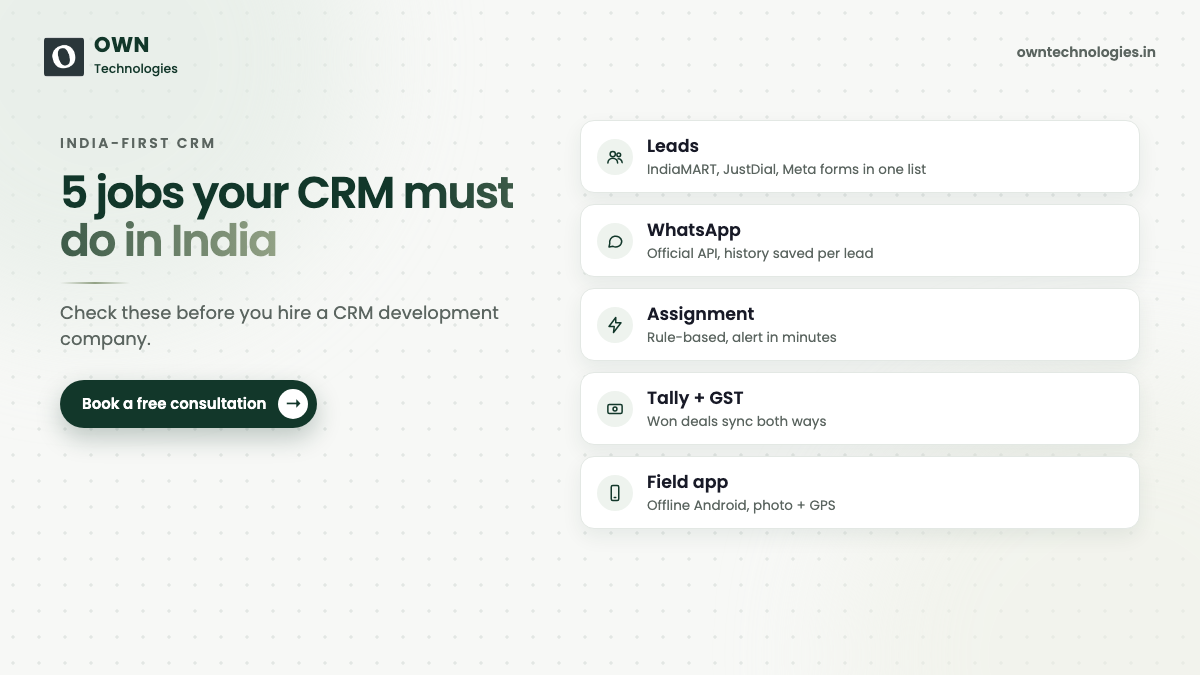
The Five Things an India-First CRM Has to Do
Before you compare vendors, write down whether your CRM must do these five jobs. If you need three or more, you are no longer buying a standard CRM.
1. Pull leads from every source into one list
IndiaMART, JustDial, Meta lead forms, Google Ads forms, your website and walk-ins should land in one lead list within minutes, tagged by source. IndiaMART offers a lead pull API for paid sellers, and Meta sends lead form entries by webhook, so this can be automatic. A good CRM also removes duplicates, because the same buyer often enquires on two platforms in the same week.
2. Run follow-ups on WhatsApp, not just log them
The CRM should send WhatsApp messages through the official WhatsApp Business Platform: an approved template for the first touch, then free-form replies inside the 24-hour customer service window. Every message is saved against the lead, so when a rep leaves, the history stays. Meta has charged per message by category since 1 July 2025, so the CRM should show how many template messages each campaign uses. Our WhatsApp Business API integration guide covers the setup in detail.
3. Assign leads by rule, fast
Round robin, by city, by product or by language. The first rep to call usually wins in India, so the CRM should alert the assigned rep on their phone and escalate to the manager if nobody responds in a set time, for example 15 minutes.
4. Talk to Tally and GST
When a deal is won, the CRM should push the customer, items and amounts to Tally so accounts can raise the invoice without retyping. TallyPrime supports JSON, XML and ODBC integration, so two-way sync of invoices and payment status is a normal build task, not a research project. If your turnover is above Rs 5 crore, e-invoicing applies, and the invoice number from the IRP should flow back into the CRM.
5. Work on a cheap Android phone in the field
Field reps need a mobile app that works offline, captures photos and GPS at a visit, and syncs when the signal returns. A desktop CRM opened in a phone browser is not the same thing.
Option A: Extend Zoho or HubSpot
For many Indian teams the right answer is not a custom CRM at all. It is a packaged CRM plus a few custom connectors built by a development partner.
This works when your process is a standard funnel (enquiry, quote, follow-up, won or lost), you have fewer than about 30 users, and the gaps are mostly integrations: IndiaMART into Zoho, WhatsApp inside HubSpot, a Tally sync for won deals.
A development company can build these connectors in a few weeks. You keep the vendor’s reporting, mobile app and updates, and you pay for the gap only. We compared the two platforms in depth in Custom CRM vs Zoho vs HubSpot.
**Watch out for:** per-user price rises as you grow, WhatsApp add-ons billed on top of Meta’s own message charges, and custom fields that stop working smoothly once you need approvals, multi-step quotes or dealer hierarchies.
Option B: Build a Custom CRM
A custom CRM makes sense when the process itself is the product: dealer networks with their own logins, multi-level approvals on discounts, bookings and site visits, field teams of 40 or more, or pricing rules that no packaged tool supports.
You own the code and the data, you pay no per-user fee, and the screens match how your team works. The trade-offs are a longer start (two to four months for a first version), an annual support budget, and the need for a partner who will still be around in year three.
Cost of Each Route in India (2026)
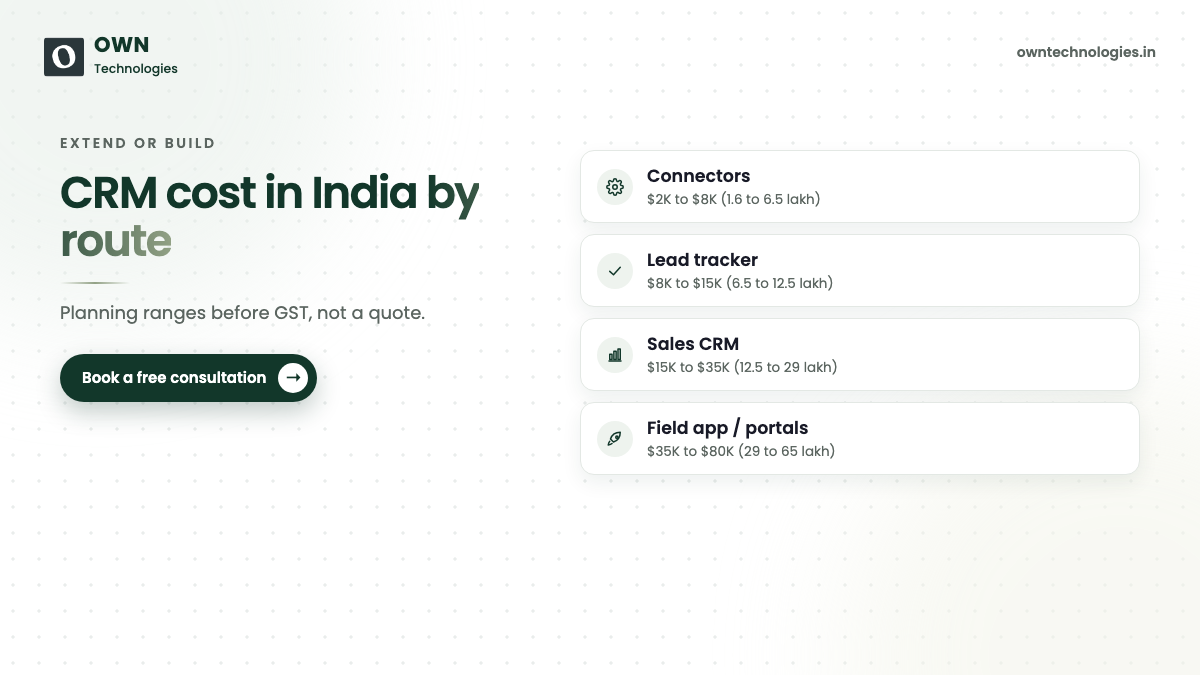
These ranges match our CRM software cost in India guide, where the three-year math is worked out by team size. They are planning ranges before 18 percent GST, not a quote.
| Route | What you get | Build cost | Time to go live |
|---|---|---|---|
| Packaged CRM, no custom work | Standard pipeline, vendor mobile app | Subscription only | 1 to 3 weeks |
| Packaged CRM plus connectors | IndiaMART, WhatsApp or Tally sync added | $2,000 to $8,000 (1.6 to 6.5 lakh INR) | 3 to 6 weeks |
| Custom lead tracker | Leads, pipeline, notes, 1 to 2 roles | $8,000 to $15,000 (6.5 to 12.5 lakh INR) | 4 to 6 weeks |
| Custom sales and operations CRM | Multi-source capture, WhatsApp, assignment, reports | $15,000 to $35,000 (12.5 to 29 lakh INR) | 2 to 4 months |
| Custom CRM with field app or portals | All of the above plus offline Android app or dealer portal | $35,000 to $80,000 (29 to 65 lakh INR) | 4 to 7 months |
After launch, plan 15 to 20 percent of the build cost per year for support and changes, plus hosting of $50 to $500 a month. WhatsApp message charges are paid to Meta on top, whichever route you choose.
A 2-Minute Test: Extend or Build?
Answer yes or no to each line.
- More than 30 people will use the CRM every day.
- Dealers, franchisees or customers need their own login.
- Discounts or quotes need approval from someone other than the rep.
- Field staff log visits, photos or collections away from Wi-Fi.
- Your pricing changes by customer, region or quantity in ways a price list cannot hold.
- You need the CRM and Tally to agree on every invoice and payment, both ways.
Zero to two yes answers: extend a packaged CRM. Three or four: get quotes for both routes and compare three-year cost. Five or six: a custom CRM will almost certainly fit better and cost less over time.
Questions to Ask a CRM Development Company in India
Price is the easiest thing to compare and the least useful. These questions tell you more.
- **”Show me a CRM you built that pulls leads from a marketplace or Meta lead forms.”** Ask to see the lead list with sources, not a slide.
- **”How do you send WhatsApp messages: the official Business Platform or an unofficial tool?”** Unofficial tools risk your number being banned. Only the official route is safe for a business.
- **”How will won deals reach Tally?”** A vague answer here means a spreadsheet export every Friday.
- **”Who owns the code, the server and the WhatsApp Business account?”** All three should be in your company’s name from day one.
- **”What happens offline on the field app?”** Ask them to switch a test phone to airplane mode during the demo.
- **”Can we start with a 6 to 8 week first version?”** A good partner will cut scope to get you live, then add the rest.
For a longer checklist, see 9 checks before you sign with a CRM development company.
Red Flags in a CRM Proposal
- One fixed number with no breakdown by module or phase.
- No mention of data migration from your current Excel sheets or CRM.
- WhatsApp “integration” that means a click-to-chat link, not message history inside the CRM.
- No support or warranty period after launch.
- The source code stays with the agency, or you only get a hosted login.
Data Protection: What Indian CRMs Must Handle Now
A CRM is a database of names, phone numbers and conversations, so the Digital Personal Data Protection framework applies to it. In practice that means recording consent for WhatsApp marketing messages, letting a person ask for their data to be deleted, limiting which staff see phone numbers, and keeping an access log. Ask your CRM development company how each of these is handled before the build starts, because adding them later is slower and more expensive.
How We Approach CRM Projects at OwnTechnologies
At OwnTechnologies we have built CRMs for clients such as Aarogya, IGNTI and Urban Venue across 100+ projects over 8+ years. Our CRM development service usually starts with a one-week discovery: we map every lead source, every WhatsApp step and every handoff to accounts, then tell you honestly whether extending your current tool is enough. If you need field staff on mobile, our mobile app development team builds the Android and iOS apps on the same backend, and if your lead forms need fixing first, our website development team can rebuild them to feed the CRM.
Frequently Asked Questions
Adding connectors such as IndiaMART, WhatsApp or Tally to Zoho or HubSpot usually costs $2,000 to $8,000 (about 1.6 to 6.5 lakh INR). A custom sales CRM costs $15,000 to $35,000 (about 12.5 to 29 lakh INR), and one with a field app or dealer portal $35,000 to $80,000 (about 29 to 65 lakh INR), before GST.
Yes, through the official WhatsApp Business Platform. The first message to a lead uses an approved template, and replies inside the 24-hour customer service window can be free-form. Meta charges per message by category, so plan that cost separately from the CRM build.
Yes. TallyPrime supports JSON, XML and ODBC integration, so a CRM can push won deals to Tally and pull back invoice and payment status. Ask your developer for two-way sync, not a one-way export.
If you have fewer than about 30 users and a standard sales funnel, use Zoho or another packaged CRM and add connectors for the gaps. If you need dealer logins, approvals, offline field work or complex pricing, a custom CRM usually fits better and costs less over three years.
A basic lead tracker takes 4 to 6 weeks. A sales and operations CRM with WhatsApp and multi-source lead capture takes 2 to 4 months. Adding a field app or dealer portal takes it to 4 to 7 months.
Final Thoughts
The best CRM development company in India for your business is the one that starts with your lead sources, your WhatsApp habits and your Tally setup, not with a feature list. Map those three first, run the six-question test above, and you will know within a day whether you need connectors or a custom build.
If you want a second opinion on your current setup, book a free consultation with OwnTechnologies. We will map your lead flow and tell you which route fits, with a written estimate for both.