“Can you build our app in two months?” is a question every app company in India hears. The honest answer is yes, for the right MVP, and no, for a full product with every feature on the wish list.
This guide shows what a realistic 8-week MVP looks like, week by week: what gets decided, what gets built, what you need to provide, and what usually pushes the date back. It also covers the Google Play testing rule that catches many first-time founders out. For budgets, read our guide to [MVP development costs in 2026](https://blog.owntechnologies.in/mvp-development-cost-2026/).
The short answer
A simple app MVP, meaning login, one core flow, payments if needed and a basic admin panel, can usually be built in 6 to 10 weeks by an experienced team. In India that typically costs around Rs 6.7 lakh to Rs 15 lakh ($8,000 to $18,000) plus 18 percent GST.
Eight weeks works when three things are true:
- The MVP solves one problem for one type of user.
- You can answer questions and approve designs within a day or two.
- Your content, logins and accounts are ready before they are needed.
Marketplaces, AI products and apps with many user roles usually need 10 to 16 weeks.
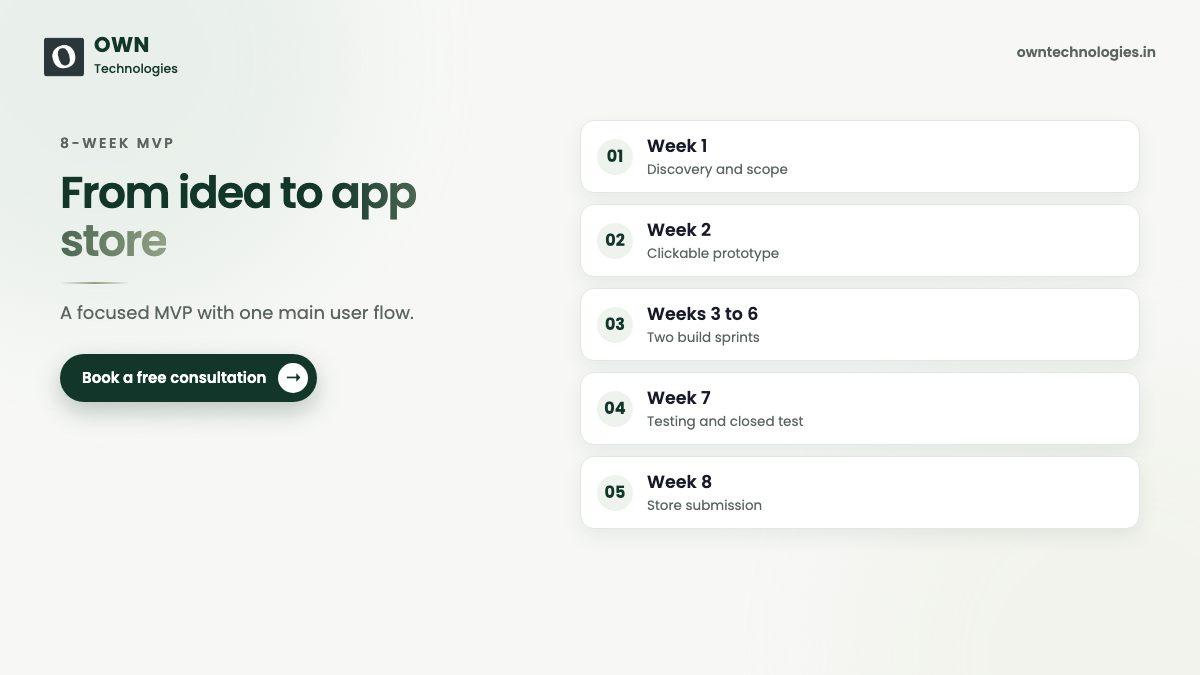
The 8-week plan at a glance
| Week | Focus | What you get | What you provide |
|---|---|---|---|
| 1 | Discovery | One-page scope, user flow, feature list for version 1 | Answers, examples, any existing material |
| 2 | Design | Clickable prototype of the main screens | Feedback, brand assets, 5 to 10 people to show it to |
| 3 | Build sprint 1 | Login, core screens, database set up | Developer accounts, payment gateway application |
| 4 | Build sprint 1 | First working build on your phone | Testing and quick feedback |
| 5 | Build sprint 2 | Main feature complete, payments working | Real content, prices, terms |
| 6 | Build sprint 2 | Admin panel, notifications, second build | Testing and a list of fixes |
| 7 | Testing | Bug fixes, closed testing on Google Play | Your testers, final copy |
| 8 | Launch | Store listing, submission, release | Approval to go live |
Week 1: discovery
This is the most important week, and the one most often rushed. The goal is to agree on one problem, one main user flow and what success looks like after launch.
By the end of the week you should have:
- **A one-page scope** listing what is in version 1, and just as important, what is not.
- **The main user flow,** step by step, from opening the app to completing the core action.
- **A success measure,** such as 100 bookings in the first month or 50 paying users.
If you already have a written requirements document, this week goes faster. Our [app requirements document template](https://blog.owntechnologies.in/app-requirements-document-template/) shows what to include.
Week 2: design and a clickable prototype
Designers turn the flow into screens you can click through on your phone. Show this prototype to five to ten real potential customers before any code is written. It is far cheaper to change a screen now than after it has been built.
Keep the design simple. An MVP needs to be clear and trustworthy, not award-winning. A clean layout using your brand colours is enough.
Weeks 3 and 4: the first build sprint
Development starts with the foundations: user accounts, the main screens and the database. By the end of week 4 you should be able to install a working build on your own phone and log in.
Two jobs on your side cannot wait:
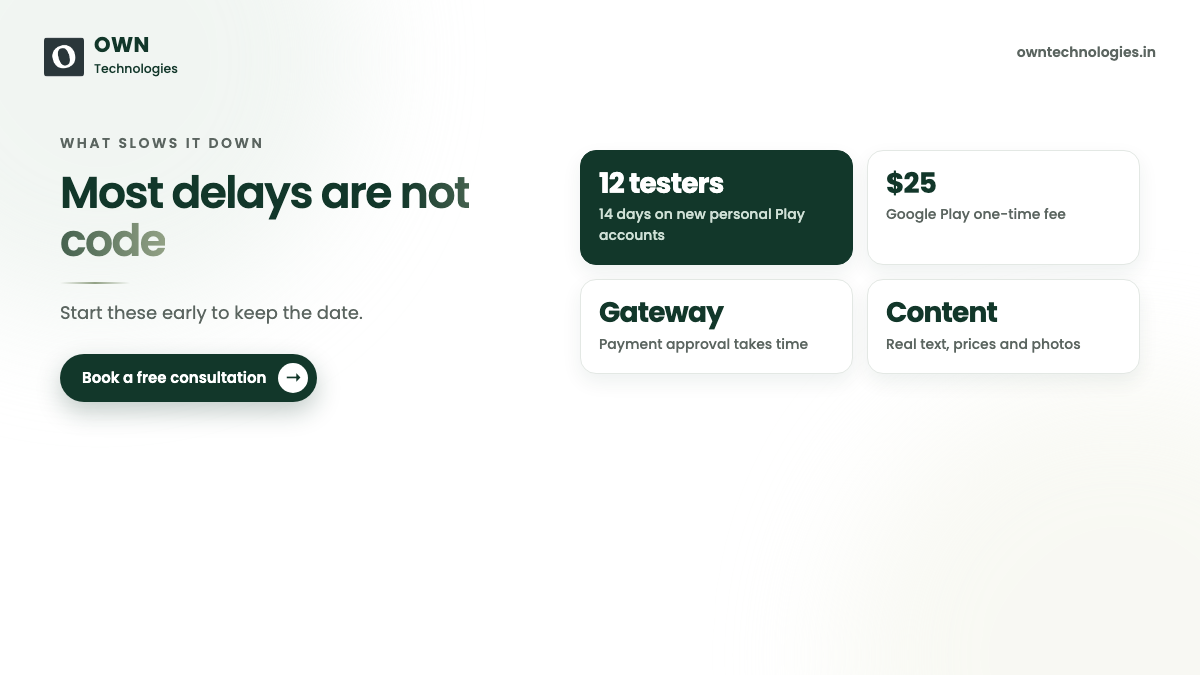
- **Developer accounts.** Google Play charges a one-time registration fee of $25. The Apple Developer Program is a yearly membership. Verification can take days, so register in week 1 or 2, in your company’s name.
- **Payment gateway approval.** If your app takes payments, apply to your payment gateway early. Business verification can take time, and the app cannot go live with real payments until it is approved.
Weeks 5 and 6: the second build sprint
The core feature gets finished: bookings, orders, lessons or whatever your app exists to do. Payments are connected, and the admin panel is built so your team can manage users, content and orders without calling a developer.
You will get a second build to test at the end of week 6. This is when real content matters. Placeholder text hides problems that real prices, real photos and real descriptions reveal. For what to include in the back office, see our guide to [admin panels for version 1](https://blog.owntechnologies.in/admin-panel-development-version-1/).
Week 7: testing, and the Google Play rule
This week is for fixing bugs, testing on several real phones and preparing the store listings.
There is one rule many founders learn too late. Google Play says that new personal developer accounts must run a closed test with at least 12 testers, opted in continuously for at least 14 days, before they can publish to production.
Two ways to stay on schedule:
- **Use an organisation account** in your company’s name, which is not covered by this personal-account rule. You will need your business documents ready.
- **Start the closed test early,** around week 5, if you are using a personal account, so the 14 days are complete by launch week.
Week 8: launch
The app is submitted with its store listing: name, description, screenshots, privacy policy and contact details. Store review usually takes from a few hours to a few days, so do not plan a big announcement for the same morning.
Our [app store launch checklist](https://blog.owntechnologies.in/app-store-launch-checklist/) covers everything the stores ask for.
Android first, or both at once?
In India, Android dominates. Statcounter puts Android at about 95 percent of mobile operating system share in October 2026, with iOS at about 5 percent.
| Approach | Best for | Trade-off |
|---|---|---|
| Android first | Mass-market consumer apps in India | iPhone users wait for version 2 |
| Both with one codebase (Flutter or React Native) | Most MVPs that need both stores | Slightly more testing time |
| Web app first | Business tools used mainly on laptops | No app store presence at launch |
For most Indian MVPs, a cross-platform build gives you both stores with one codebase, so the extra cost is mainly testing, not a second app.
What pushes an 8-week MVP to 12 weeks
- **Scope creep.** “Can we just add chat?” in week 5 can cost two weeks.
- **Slow feedback.** If approvals take a week, the project loses a week.
- **Missing content.** Developers cannot finish screens without real text and images.
- **Late accounts.** Developer and payment gateway verification take time.
- **Unclear rules.** Refund policies, cancellation windows and user roles need decisions, not guesses.
- **Too many roles.** Each extra user type, such as admin, vendor, delivery partner and customer, adds screens and testing.
What should wait for version 2
Leave these out of an 8-week MVP unless they are the core of your idea:
- In-app chat between users
- Advanced analytics dashboards
- Multiple languages
- Loyalty points and referral schemes
- AI features, unless AI is the product itself (see our guide to [AI app development costs in India](https://blog.owntechnologies.in/ai-app-development-cost-india/))
Our guide to [MVP vs full product](https://blog.owntechnologies.in/mvp-vs-full-product/) explains how to decide what to build first.
Questions to ask before you sign
- Will I see a working build on my phone every sprint?
- Who owns the code, the design files and the store accounts?
- What exactly is in version 1, in writing?
- What happens if I want to add a feature mid-project?
- Who handles Google Play closed testing and store submission?
- What support do I get in the first month after launch?
Frequently Asked Questions
Yes, for a focused MVP with one main user flow, quick feedback from the founder and content ready on time. Marketplaces, AI products and apps with many user roles usually take 10 to 16 weeks.
A simple app MVP usually costs around Rs 6.7 lakh to Rs 15 lakh ($8,000 to $18,000) plus 18 percent GST. More complex MVPs can cost Rs 20 lakh or more.
Google Play requires new personal developer accounts to run a closed test with at least 12 testers for at least 14 days before production. An organisation account in your company’s name is not covered by this personal-account rule.
Android has about 95 percent of mobile share in India according to Statcounter, so Android first suits mass-market apps. A cross-platform build lets you launch on both stores with one codebase.
A clear idea of the one problem you solve, examples of apps you like, your brand assets, developer accounts in your company’s name and, if needed, a payment gateway application.
Final Thoughts
Eight weeks is enough for a real, launchable MVP if you keep it to one problem, make decisions quickly and start the slow admin jobs early. Most delays come from scope and paperwork, not code. Plan for those, and you can be in your customers’ hands in two months.
Planning an MVP? Our app development team in Gurugram will review your idea and send a written week-by-week plan with a cost range in INR. If you need a web version or landing page too, see our website development service and our portfolio. Book a free consultation to get started.