Launching an app feels like the finish line. In practice it is the start of a yearly bill that many founders in India and the UAE do not plan for. Phones update, app store rules change, servers need care, and users find bugs that testing missed.
This guide explains what app maintenance costs in India and the UAE in 2026, what a yearly plan should cover, the store rules that force updates, and how to budget so your app keeps working.
The short answer
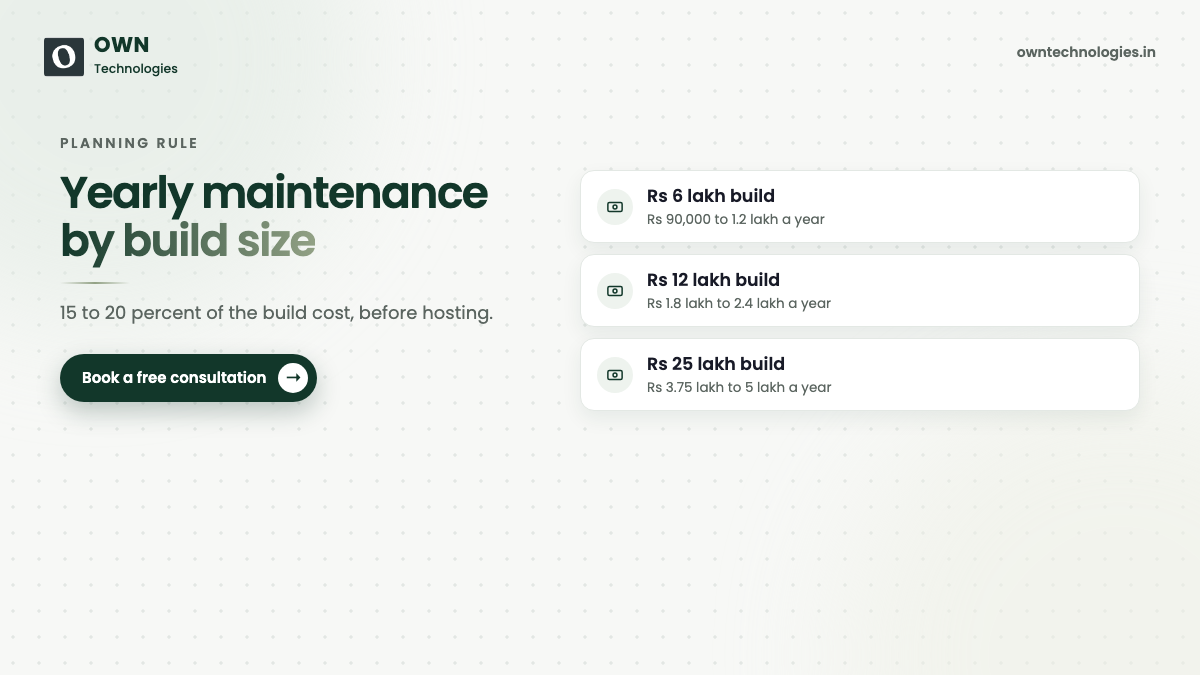
A common planning rule is to budget about 15 to 20 percent of the original build cost every year for maintenance. That covers bug fixes, operating system updates, security patches, small improvements and keeping the app compliant with store rules.
| App build cost | Yearly maintenance at 15 to 20 percent | Roughly per month |
|---|---|---|
| Rs 6 lakh (about AED 26,000) | Rs 90,000 to 1.2 lakh | Rs 7,500 to 10,000 |
| Rs 12 lakh (about AED 52,000) | Rs 1.8 lakh to 2.4 lakh | Rs 15,000 to 20,000 |
| Rs 25 lakh (about AED 109,000) | Rs 3.75 lakh to 5 lakh | Rs 31,000 to 42,000 |
Hosting, third-party services and new features are usually extra. Rupee to dirham conversions here use about Rs 23 per AED.
Why apps need maintenance at all
Phones and operating systems change every year
Apple releases a new iOS every year and Google releases a new Android version every year. Each one can break layouts, permissions or features that worked before.
Google Play forces updates
Google Play’s target API level requirements say that from 31 August 2026, new apps and app updates must target Android 16 (API level 36) or higher. Existing apps that fall behind stop being available to new users on newer Android versions. In plain terms: if your Android app is not updated, fewer people can find and install it.
Apple charges a yearly fee
The Apple Developer Program costs $99 a year. If the membership lapses, your app can disappear from the App Store. Google Play has a one-time registration fee instead.
Security does not stand still
Libraries and frameworks release security fixes. An app that is never updated keeps old vulnerabilities, which matters even more if you store customer or payment data.
What a yearly maintenance plan should cover
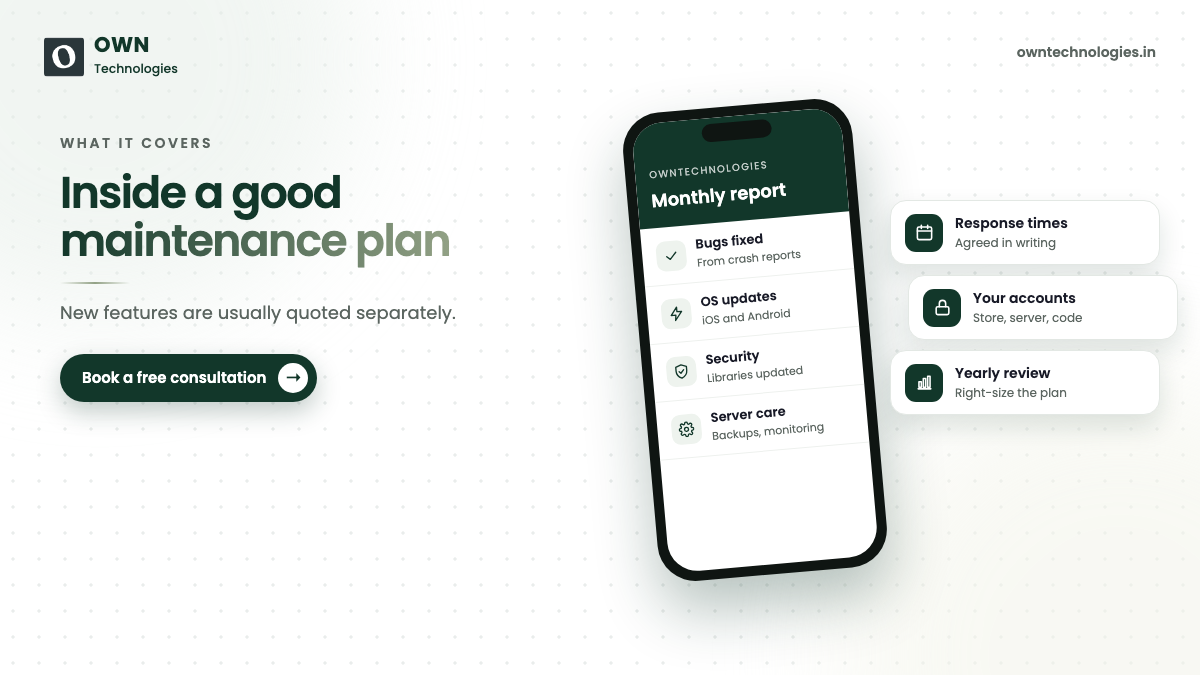
- **Bug fixes:** problems reported by users or found in crash reports.
- **OS and device updates:** testing on new iOS and Android versions, and fixing what breaks.
- **Store compliance:** target API updates, privacy forms, new policy requirements.
- **Security updates:** framework and library updates, dependency checks.
- **Server and database care:** monitoring, backups, scaling when traffic grows.
- **Small improvements:** text changes, minor UI tweaks, small feature requests.
- **Monthly report:** what was fixed, what was updated, and what needs attention next.
New features, a redesign or new user roles are usually outside maintenance and quoted separately.
India vs UAE: what changes in cost
| Factor | Team in India | Team in the UAE |
|---|---|---|
| Hourly or monthly rate | Lower | Higher, because salaries and office costs are higher |
| Working hours | The UAE is 1.5 hours behind India, so the day overlaps well | Local hours |
| On-site visits | Rare, usually online | Easier |
| Data hosting | Can host in the UAE if needed | Usually local |
For healthcare or other regulated apps in the UAE, data may need to stay in the country, and that affects hosting choices, not who maintains the code. Our guide to [healthcare app development in the UAE](https://blog.owntechnologies.in/healthcare-app-development-uae/) covers those rules.
The hidden running costs
| Item | What it is | Typical range |
|---|---|---|
| Cloud hosting | Servers, database, file storage | From a few thousand rupees a month for small apps |
| Push notifications and SMS | OTP codes, alerts | Pay per message |
| Maps, payments, email | Third-party services | Usage based |
| App store fees | Apple yearly, Google one-time | $99 a year for Apple |
| Monitoring and crash reporting | Tools that show what breaks | Free tiers to paid plans |
Set usage alerts on every paid service, so a sudden spike does not become a large bill.
Signs your current app is under-maintained
- Crash reports nobody reads.
- The Android app has not been updated in over a year.
- Users complain that the app looks broken on new phones.
- Nobody knows the login for the app store accounts or the server.
- Every small change takes weeks because the original developer has gone.
If two or more of these sound familiar, start with an audit before planning new features.
How to budget without overpaying
- **Separate maintenance from new features.** Maintenance keeps the app working. Features grow it. Budget both, but separately.
- **Agree response times.** For example, critical bugs within one working day, minor bugs within a week.
- **Ask for a monthly report.** You should know what you paid for.
- **Keep accounts in your company’s name.** App store, server, domain and code repository.
- **Review once a year.** If the app is stable, the plan can be smaller. If it is growing fast, it may need more.
For ways to keep the original build lean, see our guide to [reducing mobile app development cost](https://blog.owntechnologies.in/reduce-mobile-app-development-cost/). For launch requirements, see our [app store launch checklist](https://blog.owntechnologies.in/app-store-launch-checklist/).
Choosing the right level of plan
Not every app needs the same plan. Match the plan to how much the app matters to your revenue.
| Plan level | Good for | Usually includes |
|---|---|---|
| Basic | Simple apps with few users | Bug fixes, OS and store updates, monthly check |
| Standard | Apps customers use every week | Everything in Basic, plus security updates, server monitoring and small changes |
| Growth | Apps that drive revenue daily | Everything in Standard, plus faster response times, performance tuning and a set number of hours for new features |
Start with the level that matches today’s usage, and review it after six months.
Who should maintain your app?
- **The original developer** knows the code best, so this is usually the fastest option, if they are still available and responsive.
- **A new team** can take over, but budget two to four weeks for a handover: reading the code, setting up access and documenting what exists.
- **An in-house developer** makes sense once the app is central to your business and changes every week.
Whichever you choose, ask for written documentation of how to build, deploy and access the app. Without it, every future change gets slower and more expensive.
Frequently Asked Questions
A common planning rule is 15 to 20 percent of the original build cost per year. For an app that cost Rs 12 lakh to build, that is roughly Rs 1.8 lakh to 2.4 lakh a year, before hosting and third-party services.
Usually yes, because local salaries and office costs are higher. Many UAE businesses use a remote team in India for maintenance and keep hosting in the UAE where data rules require it.
Google Play requires apps to target recent Android versions. From 31 August 2026, new apps and updates must target Android 16. Apps that fall behind become unavailable to new users on newer Android versions.
Bug fixes, operating system updates, store compliance, security updates, server care, small improvements and a monthly report. New features are usually quoted separately.
Yes. The Apple Developer Program costs $99 a year, and your app needs an active membership to stay on the App Store.
Final Thoughts
An app is never finished. Plan for maintenance from the first budget, keep every account in your company’s name, and ask for a simple monthly report. A well-maintained app keeps its users. A forgotten one slowly loses them.
Need a maintenance plan for your app? Our app development team in Gurugram maintains iOS and Android apps for businesses in India and the UAE. See our work in the portfolio, or ask for a free review of your current app. Book a free consultation to get started.