If you run a business in Dubai and need software built, you have three real options: hire developers in the UAE, sign with a software company in Dubai, or work with an offshore team in India. Each one can work. Each one can also go badly wrong if you pick it for the wrong reason.
We are an Indian team that builds software for UAE businesses, so we have an obvious interest in this question. That is why this comparison tries to be honest about where a Dubai-based team is the better choice, and where an offshore team in India saves you money without adding risk.
The short answer
| In-house hire in Dubai | Software company in Dubai | Offshore team in India | |
|---|---|---|---|
| Cost | Salary plus visa, insurance and gratuity | Highest per project | Lowest per project |
| Speed to start | Slow: hiring takes months | Fast | Fast |
| Skills | One person’s skill set | Full team | Full team |
| Time zone | Same | Same | 1.5 hours behind GST |
| In-person meetings | Easy | Easy | Video calls, occasional visits |
| Best for | Long-term product owned in-house | Regulated or on-site projects | Websites, apps, CRMs and portals with clear scope |
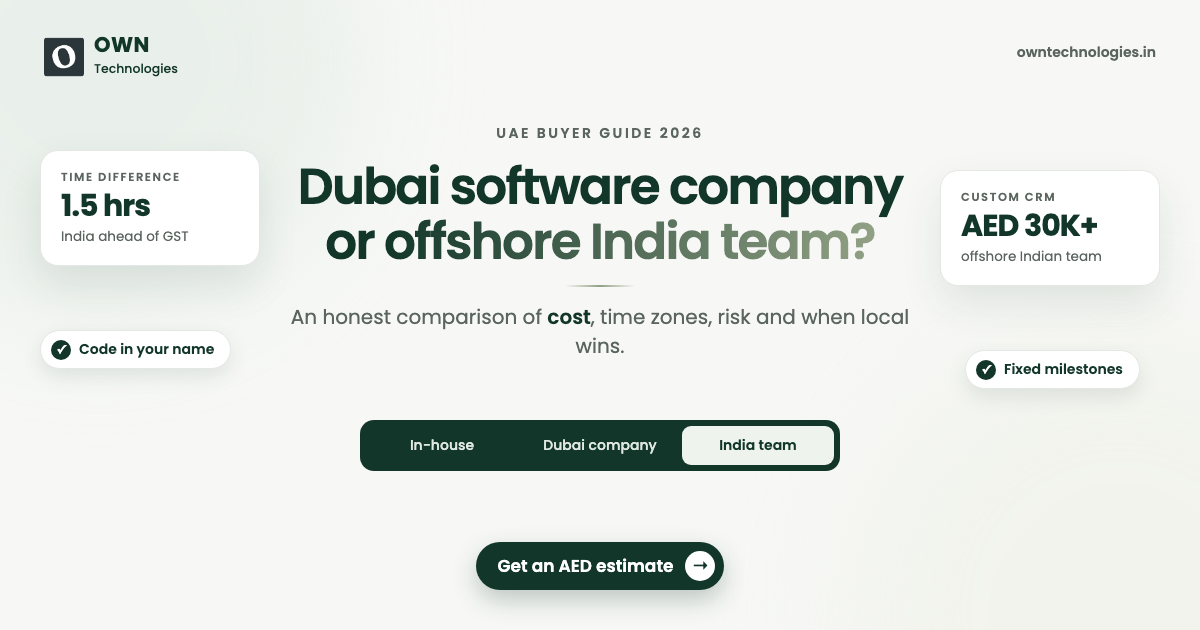
For most small and mid-size UAE businesses building a website, an app, a CRM or an internal tool, an offshore team in India with fixed milestones gives the best value. For projects that need on-site work, local data hosting or a local legal entity on the contract, a Dubai company is often worth the premium.
What hiring a developer in Dubai really costs
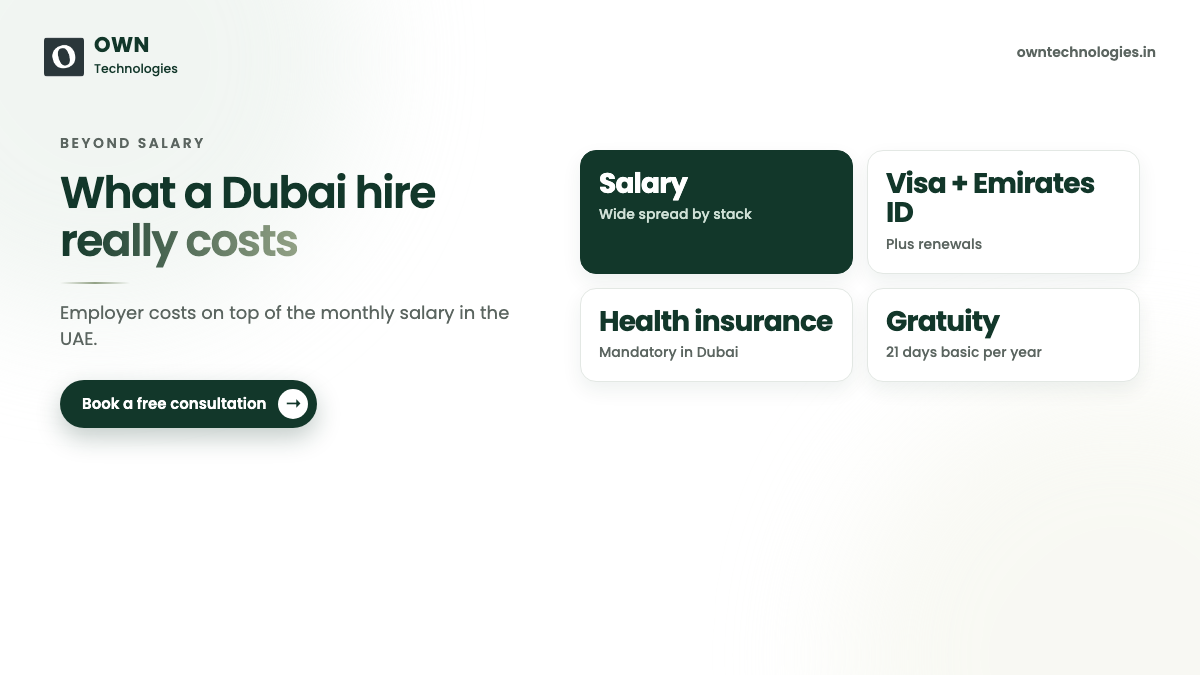
Salary is only the starting point. Public job-board data shows a wide spread. Indeed lists the average Senior Software Engineer salary in the UAE at about AED 9,457 a month, while recruiter blogs put experienced backend developers in Dubai at AED 12,000 to 28,000 a month. The real figure depends heavily on the stack and seniority.
On top of salary, a UAE employer pays for:
- **Visa and Emirates ID** for every foreign hire, plus renewals.
- **Health insurance.** In Dubai, employers must provide health insurance for their employees.
- **End-of-service gratuity.** Under UAE labour law (Federal Decree-Law No. 33 of 2021), full-time employees earn 21 days of basic salary for each of the first five years of service, and 30 days for each year after that.
- **Recruitment time and fees,** often one to three months before a new hire writes useful code.
- **Equipment, software licences and office space.**
And one developer is rarely enough. A real product usually needs a designer, a backend developer, a mobile or frontend developer and someone to test. Hiring all four in Dubai is a serious monthly commitment before your product earns anything.
What a software company in Dubai offers
A Dubai software company gives you a full team without the hiring burden, and the people you meet are in the same city. That matters for:
- **On-site work,** such as workshops with your staff, hardware set-up or training in your office.
- **Regulated sectors.** Health data in the UAE is covered by Federal Law No. 2 of 2019, which generally requires health data to be stored inside the country. Government and some financial projects also prefer or require a UAE-registered supplier.
- **Contracts under UAE law** with a local entity, if your procurement team insists on it.
The trade-off is price. A Dubai company’s rates have to cover Dubai salaries, visas and office rent, and many of them also subcontract part of the build to offshore teams. Ask directly where the developers on your project actually sit.
What an offshore team in India offers
India has one of the largest pools of experienced developers in the world, and the time zone is close to the UAE. Gulf Standard Time is UTC+4 and India Standard Time is UTC+5:30, so an Indian team is only one and a half hours ahead of Dubai. A 9 AM start in Dubai is 10:30 AM in India, which means almost your whole working day overlaps.
The main advantages are:
- **Lower cost per project,** because the team’s own costs are lower.
- **A full team from day one:** design, development, testing and project management.
- **Fast start,** usually within one to two weeks of signing.
- **Easy scaling,** adding or removing people as the project changes.
The risks are real too: unclear scope, weak communication, and code or accounts held in the vendor’s name. Every one of these can be prevented in the contract, which we cover below.
Typical costs with an offshore Indian team (2026, AED)
These are the ranges we quote UAE businesses. They exclude VAT where applicable and third-party costs such as hosting and app store fees.
| Project | What it includes | Typical cost | Timeline |
|---|---|---|---|
| Business website | 5 to 10 pages, CMS, forms, English and Arabic, SEO-ready | AED 9,000 to 22,000 | 3 to 6 weeks |
| Custom CRM or admin panel | Leads or orders, pipeline, roles, reports | AED 30,000 to 145,000 | 6 to 14 weeks |
| Web app or SaaS first version | Multiple user roles, payments, dashboards | AED 75,000 to 220,000 | 3 to 6 months |
| Mobile app MVP | One core flow, login, admin, Android and iOS | AED 25,000 to 50,000 | 2 to 4 months |
For a detailed breakdown of app pricing in AED, read our guide to [mobile app development cost in Dubai](https://blog.owntechnologies.in/mobile-app-development-cost-dubai/).
When to choose a Dubai company instead
We would point you to a UAE-based company when:
- Your project handles health data or other data that must stay inside the UAE, and your hosting plan cannot meet that from abroad.
- Your buyer is a government entity that requires a UAE-registered supplier.
- The work is mostly on-site: hardware, installations or daily in-person training.
- Your team will only work with someone they can meet in person every week.
If none of these apply, you are mainly paying for proximity. That is a fair choice, but it should be a conscious one.
How to make an offshore team work: 7 rules
- **Write the scope before you sign.** A short document listing screens, user roles and integrations. If the vendor will not write it with you, walk away.
- **Pay by milestone, not by month.** Each payment should be tied to something you can see and test.
- **See working software every week** on a test link, not just status reports.
- **Keep everything in your name:** domain, hosting, app store accounts, source code repository and analytics. Give the vendor access, not ownership.
- **Put IP assignment in the contract,** so the code belongs to your company once paid for.
- **Agree a daily overlap window** and one named project contact who answers in your working hours.
- **Plan for the UAE calendar.** The UAE weekend is Saturday and Sunday, and working hours change during Ramadan. A good offshore team adjusts to both.
For a step-by-step hiring process, see our guide on [how to hire dedicated developers in India](https://blog.owntechnologies.in/hire-dedicated-developers-india-process/).
What a good week with an offshore team looks like
- **Monday:** a 20-minute call in your morning to agree the week’s goals.
- **Daily:** a short written update in Slack, WhatsApp or email: done, next, blocked.
- **Midweek:** quick questions answered within your working hours, not the next day.
- **Friday:** a new build on the test link, with a short list of what changed.
- **End of each milestone:** a demo, your feedback, and sign-off before the next payment.
If your current vendor cannot keep this rhythm, the problem is the process, not the country.
The hybrid option many UAE businesses use
You do not have to choose only one model. A common and effective setup is:
- **A product owner in Dubai,** either you or one employee, who knows the business and makes decisions.
- **An offshore team in India** that designs, builds, tests and maintains the software.
- **A local partner only where needed,** for example a UAE hosting provider for regulated data.
This keeps decisions close to your customers and the expensive build work where it costs less.
Questions to ask any software company, local or offshore
- Where exactly are the people who will build my project, and can I meet them on a video call?
- Who is my single point of contact, and what hours do they work in GST?
- Can I see two similar projects you have delivered, with live links?
- How do you handle a change in scope halfway through?
- Whose name will the code repository, servers and app store accounts be in?
- What does support cost after launch, and what does it cover?
Frequently Asked Questions
Usually yes. An experienced Indian team costs less per project because its own salaries and overheads are lower, and the time difference with the UAE is only 1.5 hours.
India is 1 hour 30 minutes ahead of Dubai. Gulf Standard Time is UTC+4 and India Standard Time is UTC+5:30, so most of the working day overlaps.
When your project must store data inside the UAE, when a government buyer requires a UAE-registered supplier, or when most of the work happens on-site.
Keep the repository, servers and accounts in your company’s name, put IP assignment in the contract, and pay by milestone against working software you can test.
With an experienced Indian team, a custom CRM or admin panel typically costs AED 30,000 to 145,000, depending on users, workflows and integrations.
No. We are CodeAndClick Pvt Ltd (OwnTechnologies), a registered company in Gurugram, India. We work with UAE clients remotely, invoice in AED or USD, and say so up front.
Final Thoughts
The right choice depends on what you are building, not on where the vendor is. If your project needs local data hosting, a UAE-registered supplier or daily on-site work, pay for a Dubai company. For most websites, apps, CRMs and portals, an offshore team in India with a written scope, milestone payments and everything in your name gives you the same quality for much less.
Want a second opinion on your project? Our team builds custom CRMs and business software and mobile apps for UAE businesses, with AED estimates and fixed milestones. Book a free consultation to get your estimate.