Search “CRM development company” and you will get hundreds of agencies claiming the same three things: experienced team, on-time delivery, client satisfaction. None of that tells you who will actually own your code, answer the phone after launch, or quietly pad your invoice with integrations you never asked for.
This guide gives you 9 specific checks to run before you sign, the red flags that mean you should walk away, and what a CRM development company should actually cost in 2026.
Why the Wrong CRM Development Company Costs More Than the Build
A bad hire on a CRM project rarely shows up as a bad first quote. It shows up six months later, when the agency that built your lead pipeline cannot add a feature without “re-scoping,” will not hand over the source code, or has quietly moved your point of contact to someone new. By then you have paid once for the build and are about to pay again to fix or rebuild it.
The checks below are not about finding the cheapest quote. They are about finding the company that will still take your call in year two.
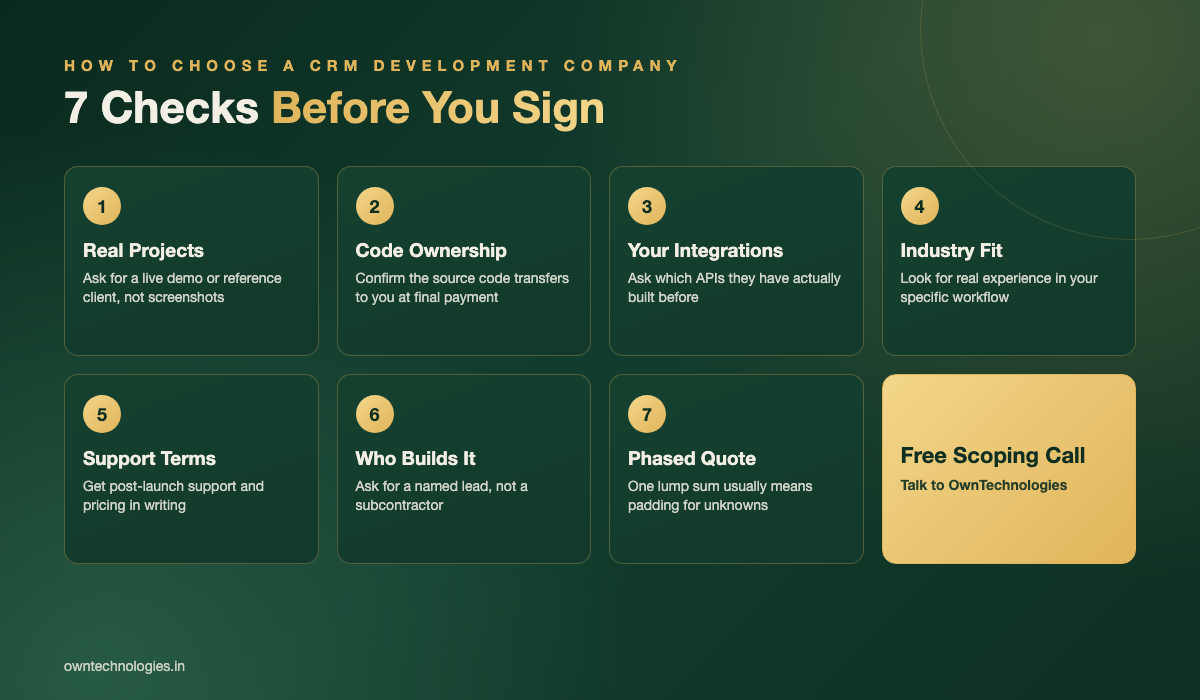
The 9 Checks Before You Sign a CRM Development Contract
Run through these before you sign anything. Most agencies will answer the first few readily. How they respond to the harder ones tells you more than their pitch deck.
1. Ask to see CRM projects they have actually shipped
Not screenshots on a website. Ask for a live login, a walkthrough call, or a reference client you can email directly. A company that has built real CRMs will offer this without hesitation, because they have nothing to hide in how the product actually behaves.
2. Confirm who owns the source code
This should be a single sentence in the contract: full source code, database, and repository access transfer to you on final payment. Some vendors keep the code on their own servers and charge a monthly fee to keep it running. Get this in writing before you pay a deposit.
3. Check how they handle the integrations you actually need
If your leads come from Facebook Ads, WhatsApp, or a call-tracking tool, ask the agency to name the exact API they will use and whether they have built that integration before. A vague “yes, we can do that” for every integration you mention is a warning sign, not a strength.
4. Look for real experience in your industry
A real estate CRM needs site-visit scheduling and broker commission tracking. A healthcare CRM needs patient record handling done right. A company that has already solved your industry’s specific workflow will not bill you for the time it takes to learn it from scratch.
5. Get post-launch support terms in writing
Ask exactly what happens the week after launch. Is there a warranty period for bug fixes? What is the hourly rate for small changes after that? Is there a retainer option? Vague answers here usually mean the relationship ends the day the invoice is paid.
6. Understand who actually builds it
Some agencies sell the project, then quietly pass it to a subcontractor you never meet. Ask who your day-to-day developer or project lead will be, and whether that person stays on the project through launch. A named, dedicated team is worth more than a big logo on the website.
7. Ask about their discovery process
A company that jumps straight to a fixed quote without asking how your leads move today is guessing. A proper discovery call, followed by a written scope or a clickable prototype, means the quote you get is based on your actual process, not a generic template.
8. Check reviews beyond the agency’s own website
Testimonials on an agency’s homepage are curated. Look for independent reviews, ask for a client you can call directly, or check how the company’s team talks about past projects on LinkedIn. Consistency across sources matters more than any single five-star quote.
9. Get a phased quote, not a single number
A single lump-sum number for a multi-month CRM build usually means someone is padding for the unknowns. A phased quote, discovery, MVP, phase two features, shows you exactly what you are paying for at each stage and gives you an exit point if the relationship is not working.
CRM Development Company vs Freelancer vs In-House Team
Before you shortlist companies, decide which path actually fits your situation. Each option trades cost, speed, and risk differently.
| Option | Best for | Typical cost | Main risk |
|---|---|---|---|
| Freelancer | Very small, simple CRMs with a tight budget | $3,000 to $12,000 | No backup if they disappear mid-project |
| CRM development company | Most businesses needing a real, supported product | $8,000 to $80,000 | Vendor quality varies widely, vet carefully |
| In-house team | Companies building CRM as a core, ongoing product | $120,000+ per year in salaries | Slow to hire, expensive to scale up or down |
Most businesses under 50 employees land on a CRM development company, since it gives the accountability of a team without the fixed cost of full-time hires. Our full breakdown of the offshore vs nearshore vs in-house decision covers the trade-offs in more depth if you are weighing this for more than just your CRM.
Red Flags That Mean You Should Walk Away
- No written scope document. If the agreement is a verbal promise or a one-line email, there is nothing to hold them to later.
- Reluctance to discuss code ownership. Any hesitation here means they plan to keep leverage over you after launch.
- Pressure to sign within 24 hours. A rushed decision on a multi-month, multi-thousand-dollar project is rarely in your favor.
- No named project lead. If nobody can tell you who is actually building your CRM, you have no accountability.
- Price far below every other quote. Usually means corners will be cut on testing, security, or support, not that you found a bargain.
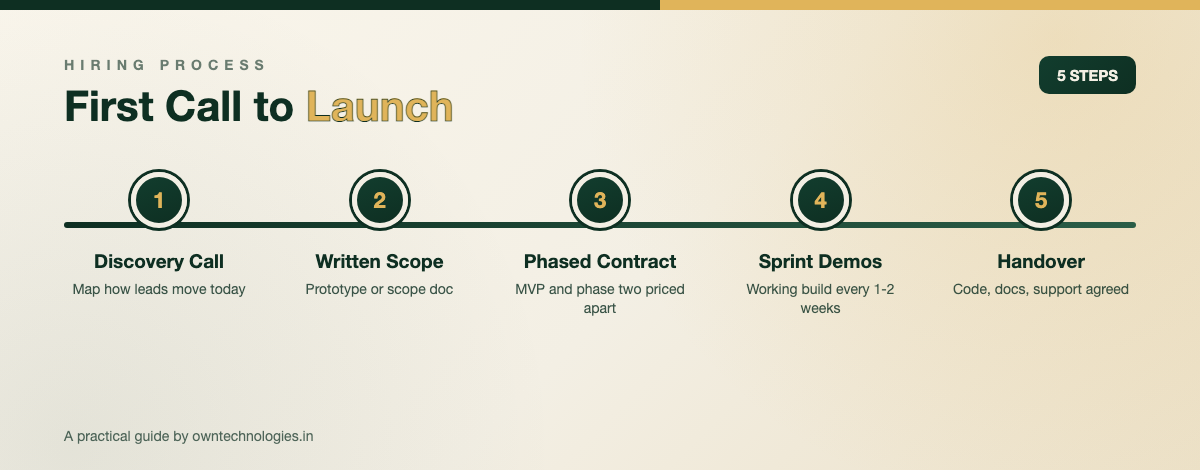
What a Good CRM Development Company’s Process Looks Like
- Discovery call. They ask how leads move through your business today, before quoting anything.
- Written scope or prototype. You see a document or a clickable mockup before development starts, not just a quote.
- Phased contract. Discovery, MVP, and phase two are priced and timed separately, with a natural exit point after each.
- Sprint demos. You log into a working version every one to two weeks, not just at the very end.
- Handover and support terms. Source code, documentation, and a clear post-launch support plan are agreed before final payment.
This is close to how our own CRM development team runs projects: one week of discovery, a clickable prototype in week two, then two-week sprints with a working build you can log into after every sprint.
Questions to Ask on the First Call
- Can you show me a CRM you built for a business similar to mine?
- Who will be my day-to-day contact, and do they stay on the project through launch?
- What happens if I need a mobile app for the sales team later? Our app development guide has more on scoping that separately.
- What is included in the price, and what counts as a change request?
- What is your support plan for the first 90 days after launch?
- Do I own the source code and database from day one, or only on final payment?
What This Should Cost in 2026
Most businesses pay $8,000 to $80,000 (roughly 6.5 lakh to 65 lakh INR) for a custom CRM, depending on scope. A basic lead tracker sits at the low end, while an industry-specific platform with integrations and reporting sits at the top. Our full custom CRM development cost guide breaks down exactly what drives that range. If you are also weighing a CRM development company against a SaaS subscription, our custom CRM vs Zoho vs HubSpot comparison walks through the three-year math, alongside published pricing from HubSpot.
CRM adoption keeps growing across small and mid-size businesses as more teams move off spreadsheets, per Statista’s CRM market data, which is exactly why vetting who builds yours matters more than ever.
Frequently Asked Questions
Ask for a live demo of a real project, a reference client you can contact directly, and written terms on source code ownership. A legitimate company will not hesitate on any of these three.
Most businesses pay $8,000 to $80,000 (roughly 6.5 lakh to 65 lakh INR) depending on scope, from a basic lead tracker to a full industry-specific platform with integrations and reporting.
A freelancer can work for a very small, simple build on a tight budget, but carries the risk of no backup if they become unavailable. A CRM development company costs more but gives you a team, a process, and accountability after launch.
A written scope or prototype, a phased pricing structure, a named project lead, source code ownership terms, and a clear post-launch support plan. Verbal promises are not enough for a multi-month project.
Budget one to two weeks to shortlist and vet a company, then 4 to 14 weeks for development depending on scope, based on the checks in this guide.
Final Thoughts
Choosing a CRM development company is really a bet on a relationship that lasts years, not a single project. Run the 9 checks, watch for the red flags, and insist on a phased, written process. The right partner will welcome every one of these questions, because they answer them the same way for every client.
Ready to run these checks against a real quote? Talk to OwnTechnologies for a free scoping call. Tell us how your leads move today and we will send back a phased estimate within 48 hours, no commitment required.