Every growing business eventually hits the same wall: your spreadsheets stop working, your off-the-shelf tools feel limiting, and someone in a meeting asks, “Should we just build our own software?”
That one question can quietly cost a company lakhs — or crores — if answered wrong.
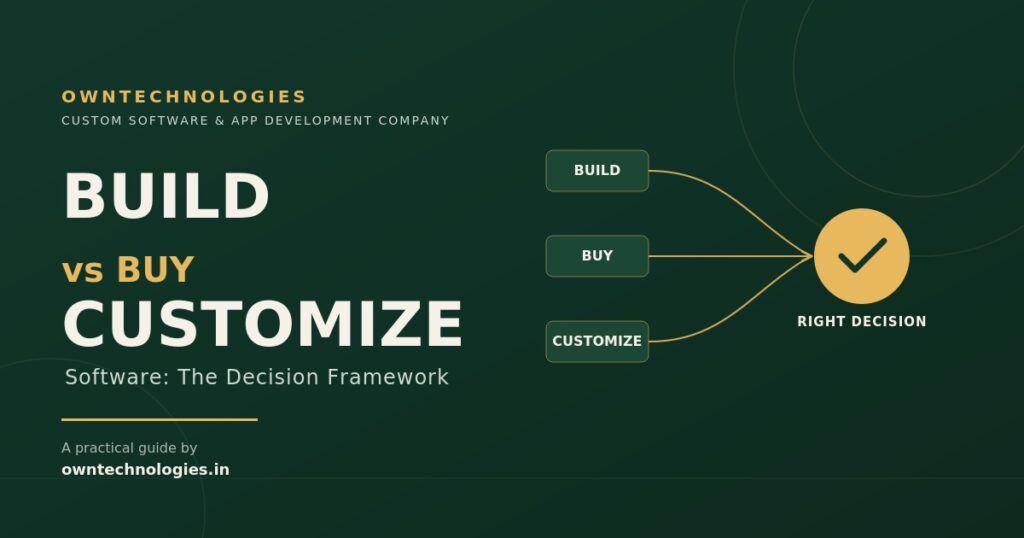
The truth is, there’s no universal right answer. Build vs Buy vs Customize isn’t a technology decision first; it’s a business decision that happens to involve technology. This guide gives you a practical, easy-to-follow framework — used by CTOs, founders, and IT heads — to make that call with confidence, along with real cost factors most people ignore.
Why This Decision Matters More Than Ever
In 2026, software isn’t a “nice to have” — it’s the operating system of your business. But options have exploded:
- Thousands of SaaS tools exist for almost every function
- No-code/low-code platforms let you “build” without engineers
- Custom software development has become faster and more affordable with modern frameworks and AI-assisted engineering
More choice means more chances to choose wrong. A rushed decision here leads to wasted budgets, missed deadlines, tool fatigue, and systems that don’t scale with the business.
What Do “Build,” “Buy,” and “Customize” Actually Mean?
Before jumping into the framework, let’s define each option clearly — this is where most teams get confused.
1. Build (Custom Software Development)
Creating a solution from scratch, tailored entirely to your workflows, data, and goals. You own the code, the roadmap, and the future.
2. Buy (Off-the-Shelf / SaaS)
Subscribing to an existing product (like a CRM, HRMS, or accounting tool) that solves a common, well-defined problem shared by many businesses.
3. Customize (Configure or Extend)
Taking an existing platform (open-source or licensed) and modifying it — through configuration, plugins, or custom modules — to fit your specific needs without building everything from zero.
The Hidden Costs Nobody Talks About
Most comparisons stop at “license fee vs development cost.” That’s incomplete. Here’s what actually drives the total cost of ownership:
| Cost Factor | Build | Buy | Customize |
|---|---|---|---|
| Upfront cost | High | Low | Medium |
| Time to launch | Long (months) | Fast (days/weeks) | Moderate (weeks/months) |
| Ongoing maintenance | You own it fully | Vendor handles it | Shared responsibility |
| Flexibility | Unlimited | Limited to vendor roadmap | High, within platform limits |
| Data ownership | Full control | Depends on vendor terms | Usually full control |
| Scalability | Built for your exact scale | May hit plan/user limits | Good, if platform scales well |
| Vendor lock-in risk | None | High | Medium |
| Long-term cost (3–5 yrs) | Can be lower if used long-term | Recurring subscription adds up | Balanced |
The 7-Factor Decision Framework
Use these seven questions to score each option honestly. This is the core of the framework — keep it simple, keep it factual.
1. Is This a Core Differentiator or a Support Function?
If the software touches your unique competitive advantage (e.g., a logistics company’s route-optimization engine), lean toward Build or Customize. If it’s a support function everyone needs (e.g., email, payroll), lean toward Buy.
2. How Unique Are Your Workflows?
Standard workflows shared across industries → Buy. Workflows specific to your business model → Build or Customize.
3. What’s Your Timeline?
Need it live next month? Buy or Customize an existing platform. Have 4–6+ months and long-term ROI in mind? Build becomes viable.
4. What’s Your Budget Reality — Not Just Today, But Over 3–5 Years?
SaaS subscriptions feel cheap monthly but compound over years, especially per-user pricing. Custom software has a bigger upfront cost but can be cheaper long-term if usage scales.
5. How Much Control Do You Need Over Data and Security?
Regulated industries (finance, healthcare, government) often need Build or Customize for full data control and compliance flexibility.
6. Do You Have (or Can You Access) Engineering Capacity?
Building without the right technical partner leads to abandoned projects. This is where partnering with an experienced development company — not just hiring one developer — changes the outcome.
7. How Fast Does This Space Change?
If the market/tools in this category evolve fast, a rigid custom build can become outdated. If it’s stable, customization or building is safer long-term.
Quick Scoring Model (Use This in Your Next Meeting)
Score each factor from 1–5 for Build, Buy, and Customize based on the questions above, then total them.
- 20–25 points → Strong fit
- 13–19 points → Viable, evaluate trade-offs
- Below 13 → Not the right path
This simple exercise turns a gut-feeling debate into a data-backed decision your leadership team can actually agree on.
When to Choose Build
- Your business model depends on a unique process no existing tool replicates
- You have long-term scale plans (3+ years)
- Data ownership and security are non-negotiable
- You’re willing to invest in a dedicated development partner
Best for: Fintech platforms, proprietary logistics systems, AI-driven products, industry-specific ERPs.
When to Choose Buy
- The need is common and well-solved (email marketing, basic accounting, ticketing)
- Speed matters more than customization
- You want predictable monthly costs with no maintenance burden
Best for: Startups validating an idea, small teams, standard back-office functions.
When to Choose Customize
- An existing platform covers 70–80% of your needs
- You need specific workflows, integrations, or branding on top of a proven base
- You want a faster path than full custom build, with more flexibility than off-the-shelf
Best for: Mid-size businesses scaling operations, companies with niche compliance or workflow needs.
Common Mistakes Businesses Make
- Choosing “Buy” purely on price — then discovering the tool can’t scale with the team.
- Choosing “Build” without a clear technical partner — leading to delays, budget overruns, and half-finished products.
- Ignoring integration needs — a great tool that doesn’t connect to your existing stack creates more manual work, not less.
- Skipping a pilot phase — jumping straight to full rollout without testing assumptions.
- Not revisiting the decision — what was “Buy” at 10 employees may need to become “Build” or “Customize” at 200 employees.
Why This Decision Needs the Right Technology Partner
A framework helps you think clearly — but execution is where most projects actually succeed or fail. Whether you decide to build a custom platform, customize an existing system, or need help evaluating the right SaaS fit, the difference between success and a stalled project usually comes down to who builds it with you.
OwnTechnologies works with businesses at exactly this decision point — helping teams evaluate build vs buy vs customize options honestly, and then delivering whichever path makes the most business sense:
- Custom Software Development — scalable, secure applications built around your exact workflows
- Product Customization & Integration — extending existing platforms without reinventing the wheel
- Technical Consulting — an outside, experienced perspective before you commit budget and time
- End-to-End Engineering — from architecture and UI/UX to deployment and long-term support
If you’re stuck between building, buying, or customizing software for your business, a short conversation with a team that’s navigated this decision hundreds of times can save months of trial and error. Visit owntechnologies.in to talk through your specific use case.
Frequently Asked Questions
Is building custom software always more expensive than buying?
Not always. SaaS subscriptions look cheaper short-term but often cost more over 3–5 years, especially with per-user pricing as your team grows. Custom software has a higher upfront cost but can be more economical long-term.
Can I switch from Buy to Build later?
Yes, and many businesses do exactly this. Start with an off-the-shelf tool to validate the need, then move to a custom solution once workflows and requirements are proven.
Is customization a safe middle ground?
Usually, yes — if the base platform is stable and well-supported. It reduces build time while still giving you flexibility that off-the-shelf tools don’t offer.
How do I know if my workflow is “unique enough” to justify building?
Ask: would a competitor use this exact process to win in the market? If yes, it’s likely a differentiator worth building. If it’s a standard operational task, buying is usually smarter.
Who should be involved in this decision?
Not just IT. Include finance (for total cost of ownership), operations (for workflow fit), and leadership (for long-term strategy) — this decision affects the whole business, not just the tech stack.
Final Thoughts
There’s no single “best” choice between Build, Buy, and Customize — only the choice that’s best for your specific business, timeline, and growth stage. Use the 7-factor framework and scoring model above to move the decision from opinion to evidence.
And when you’re ready to act on that decision — whether it’s a full custom build, a smart customization, or expert guidance on the right tools — OwnTechnologies is ready to help you build it right, the first time.
Have a project in mind? Get in touch with OwnTechnologies for a free consultation on your build vs buy vs customize decision.
Tags: build vs buy software custom software development software decision framework SaaS vs custom software IT strategy enterprise software digital transformation OwnTechnologies software consulting product engineering