Most logistics businesses start with a mix of spreadsheets, WhatsApp groups, and phone calls to move orders. It works until you cross 10 to 15 vehicles, and then dispatch delays, missed pickups, and “where is my order” calls start eating your margins.
This guide breaks down what logistics software actually does, what dispatch, tracking, and fleet systems each handle, what a custom build costs in 2026, and how to decide between off the shelf tools and a platform built for your exact workflow.
Logistics Software Development in 2026: The Short Answer
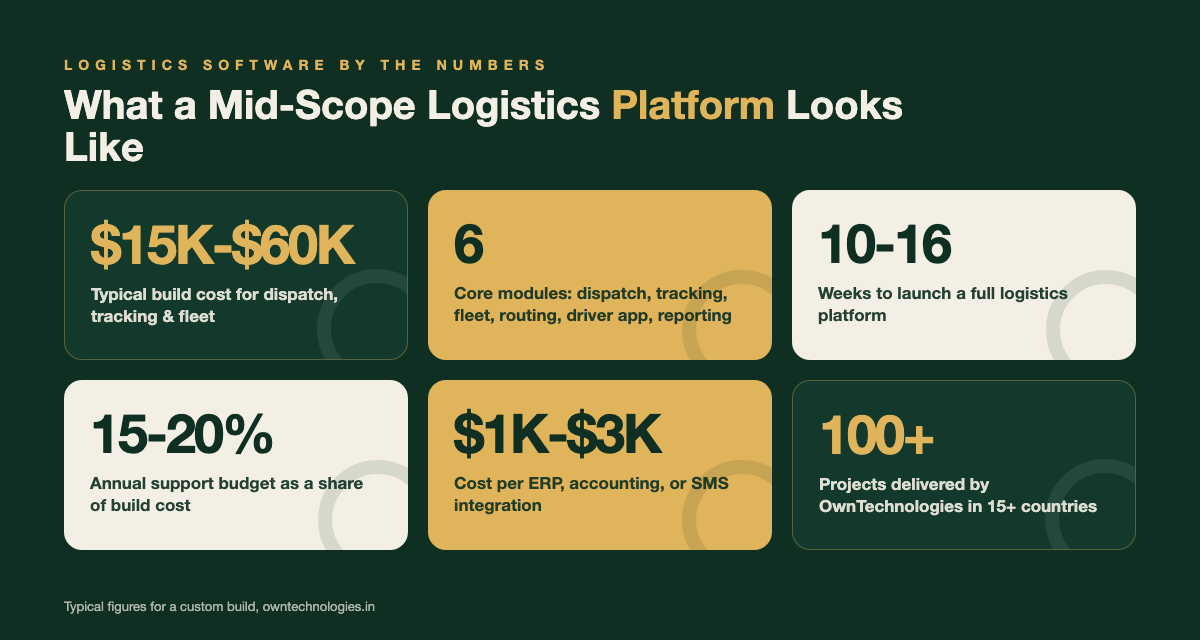
A custom logistics platform with dispatch, live tracking, and fleet management typically costs $15,000 to $60,000 (roughly 12.5 lakh to 50 lakh INR) and takes 10 to 16 weeks to build. The final number depends on how many modules you need, how many third-party systems it has to talk to, and whether you need a dedicated driver app or a mobile-responsive web view is enough.
Off the shelf tools like Samsara or Verizon Connect can get a fleet tracking a truck within days, but they charge per vehicle every month and rarely match how your dispatch team actually assigns jobs. Custom software costs more up front and pays that back once you are running more than a handful of vehicles or vans.
What Is Logistics Software and Who Actually Needs It
Logistics software is the umbrella term for any system that plans, tracks, and manages the movement of goods, vehicles, or field teams. In practice it splits into three connected pieces: dispatch (who does what job), tracking (where is it right now), and fleet management (is the vehicle and driver available, licensed, and roadworthy).
You need this beyond a spreadsheet if you run delivery, courier, trucking, field service, waste collection, or last-mile fleets with more than about 8 to 10 vehicles or 15 daily jobs. Below that, a lightweight tool or even a shared spreadsheet can still work.
Core Modules Every Dispatch, Tracking, and Fleet Platform Needs
Every logistics platform we have built at OwnTechnologies breaks down into the same core pieces. Skipping one usually means duct-taping a spreadsheet back in later.
1. Dispatch and order assignment
Orders come in from a web form, a call center, or an API, and the system assigns them to the nearest available driver or vehicle automatically, or gives a dispatcher a live board to assign manually. Rules-based auto-assignment (by zone, capacity, or driver skill) is what actually saves labor hours.
2. Real-time GPS tracking
Live location updates every 10 to 30 seconds, geofencing for pickup and drop zones, and an ETA that updates as traffic changes. This is also what feeds the customer-facing tracking link most businesses now expect to offer.
3. Fleet and vehicle management
Vehicle documents, insurance and permit expiry alerts, fuel and mileage logs, and maintenance schedules. Skipping this module is the most common reason logistics companies get surprised by a vehicle going off the road mid-route.
4. Route optimization
Multi-stop route planning that accounts for time windows, vehicle capacity, and traffic, usually built on Google Maps Platform or Mapbox routing APIs. Even basic route optimization tends to cut daily mileage and, in turn, fuel spend.
5. Driver app and proof of delivery
A simple Android or iOS app for drivers to accept jobs, navigate, and capture a signature or photo at drop-off. See our guide on hiring dedicated developers if you are weighing building this with an in-house hire versus a development partner.
6. Reporting and analytics dashboard
On-time delivery rate, cost per delivery, driver performance, and fleet utilization in one dashboard the owner or operations manager can check without asking dispatch for a manual report.
Off the Shelf vs Custom Logistics Software
Tools like Samsara and Verizon Connect are genuinely good at vehicle telematics and are the right call if all you need is GPS tracking on a small fleet. They start to strain once your dispatch logic, customer notifications, or billing workflow is not something the vendor’s settings screen covers.
| Factor | Off the shelf (Samsara, Verizon Connect, etc.) | Custom built |
|---|---|---|
| Setup time | Days to 2 weeks | 10 to 16 weeks |
| Upfront cost | Low, per-vehicle subscription | $15,000 to $60,000 one-time |
| 3-year cost at 30 vehicles | $25,000 to $45,000+ | $15,000 to $60,000 build + support |
| Custom dispatch rules | Limited to vendor settings | Built exactly to your workflow |
| Branding and customer tracking page | Rarely available | Fully white-labeled |
| Ownership of data and code | Vendor owns the platform | You own it outright |
Custom usually wins once you are running 20 or more vehicles, need dispatch logic specific to your business (zone-based, skill-based, or shift-based assignment), or want a branded tracking experience your customers see. Under that scale, an off the shelf tool is often the faster, cheaper choice.
What Logistics Software Costs in 2026
| Platform scope | What is included | Cost range (USD) | Timeline |
|---|---|---|---|
| Basic dispatch and tracking | Order intake, manual dispatch board, live GPS map | $8,000 to $18,000 | 6 to 8 weeks |
| Dispatch, tracking and driver app | Above plus auto-assignment, driver app, proof of delivery | $18,000 to $35,000 | 10 to 12 weeks |
| Full logistics platform | Above plus fleet management, route optimization, customer portal | $35,000 to $60,000 | 14 to 16 weeks |
| Enterprise TMS | Multi-branch, ERP or accounting integration, advanced analytics | $60,000+ | 5 months+ |
These ranges assume an offshore or hybrid development team. Learn more about our custom platform development process if dispatch and fleet management need to share a database with your existing sales or ops CRM, which is common for logistics companies that also manage client accounts.
How Dispatch, Tracking, and Fleet Management Work Together
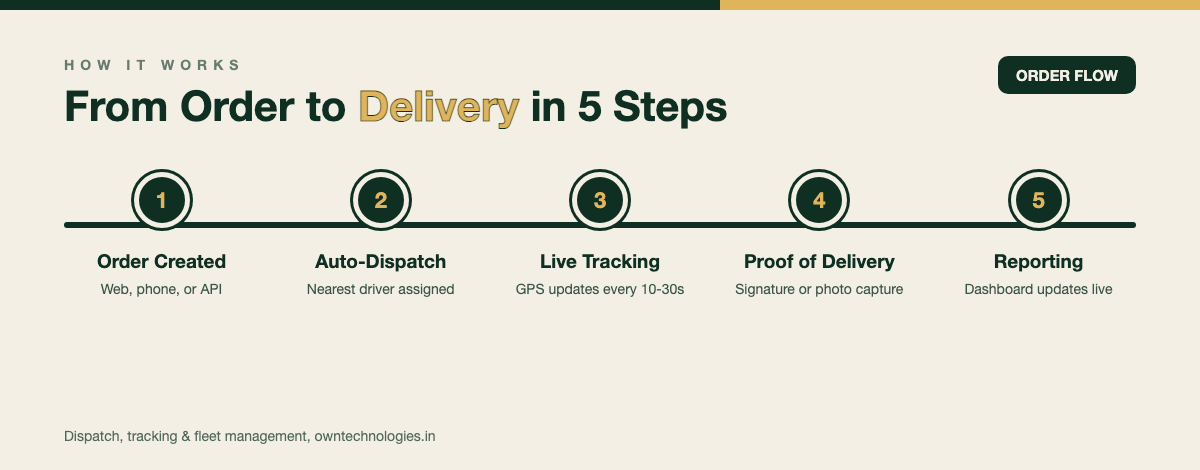
The three systems are not separate products, they are one pipeline. An order enters through dispatch, gets tracked in real time from pickup to drop, and every trip feeds fleet management data back so the next assignment is smarter than the last.
- Order created: placed through a web form, phone, or an API from your existing systems.
- Auto-dispatch: the platform assigns the nearest available driver or vehicle based on your rules.
- Live tracking: GPS updates and an ETA are visible to both dispatch and the customer.
- Proof of delivery: the driver captures a signature or photo on the app to close the job.
- Reporting loop: delivery time, fuel use, and driver performance roll into the dashboard automatically.
Integrations Your Logistics Software Will Actually Need
Most logistics platforms are not standalone, they need to talk to systems you already run. Budget $1,000 to $3,000 per integration depending on how well documented the third-party API is.
- Accounting or ERP: QuickBooks, Tally, or SAP for invoicing completed jobs automatically.
- SMS and WhatsApp: automated pickup and delivery notifications to customers.
- Payment gateways: for cash-on-delivery reconciliation or prepaid logistics services.
- Mapping and routing: Google Maps Platform or Mapbox for live traffic and multi-stop routing.
- E-commerce platforms: Shopify or WooCommerce webhooks if orders originate from an online store.
Common Mistakes Businesses Make When Building Logistics Software
We have scoped enough logistics projects to see the same mistakes repeat across industries.
- Building fleet management before dispatch is stable. Get order assignment right first, fleet data can layer on after launch.
- Skipping the driver app in phase one. Dispatchers calling drivers for updates defeats the purpose of building tracking at all.
- No offline mode for drivers. Delivery routes cross dead zones. A driver app that fails without signal will get abandoned within a week.
- Ignoring proof of delivery. Disputes over “it was never delivered” are expensive without a timestamped signature or photo.
- Treating route optimization as optional. Even a basic routing engine tends to pay for itself in reduced mileage within a few months.
How to Choose a Logistics Software Development Partner
- Ask to see a live GPS tracking demo, not just screenshots. Map rendering and update speed vary a lot between teams.
- Check they have built dispatch logic before, not just a generic admin panel with a map plugin.
- Confirm driver app offline handling is part of the original scope, not an add-on you discover you need later.
- Ask how they handle route optimization, since a real routing engine is different from a straight-line map pin.
- Get a phased proposal. Dispatch and tracking first, fleet management and reporting in phase two.
- Confirm source code ownership is transferred to you at final payment, in writing.
What a Real Logistics Software Project Looks Like
A typical logistics build at OwnTechnologies starts with a week of discovery mapping your current dispatch process, a clickable prototype in week two, then development in two-week sprints with a working version you can test after every sprint. We have delivered over 100 projects for clients across 15+ countries including the USA, Canada, UK, UAE, and Australia. You can see examples of platform builds like this in our portfolio.
If your logistics platform needs the same cost discipline as a CRM build, our custom CRM development cost guide covers the same seven cost drivers in more depth, most of which apply directly to dispatch and fleet software too.
Frequently Asked Questions
A custom logistics platform with dispatch, tracking, and a driver app typically costs $15,000 to $60,000 (roughly 12.5 lakh to 50 lakh INR) depending on scope. A basic dispatch and tracking build starts around $8,000.
Dispatch software assigns and tracks individual orders or jobs to drivers. Fleet management handles the vehicles themselves, documents, maintenance schedules, and fuel logs. Most logistics platforms include both as connected modules.
A basic dispatch and tracking system takes 6 to 8 weeks. A full platform with fleet management, route optimization, and a driver app usually takes 10 to 16 weeks. Enterprise TMS builds with ERP integration can run 5 months or more.
For fewer than 15 to 20 vehicles with standard tracking needs, tools like Samsara or Verizon Connect are usually faster and cheaper than a custom build. Custom software starts to pay off once your dispatch rules or customer experience need to be specific to your business.
Yes. Integrations with QuickBooks, Tally, SAP, and similar systems are common and typically cost $1,000 to $3,000 each depending on how well documented the API is. This lets completed deliveries trigger invoices automatically.
For any fleet with route stops beyond a single city block, yes. A driver app with offline handling for job acceptance, navigation, and proof of delivery removes the need for dispatchers to call drivers for status updates.
Final Thoughts
Logistics software is not one product, it is dispatch, tracking, and fleet management working as one pipeline. Get the order-to-delivery flow right first, add fleet data and route optimization once dispatch is stable, and you will avoid the rebuild most companies end up paying for twice.
Want a real number for your fleet size and workflow? Talk to OwnTechnologies for a free scoping call. Send us how dispatch works today and we will send back a phased estimate within 48 hours, no commitment required.