A brokerage pays for every lead twice. Once to the portal, and again in the salary of whoever was supposed to call it back and did not.
Most agencies already have a CRM. The leads are in it. They still go cold. This is about the plumbing between the portal and the first phone call, which is where the money actually leaks.
The Problem Is Not Lead Volume
Ask a principal what they need and the answer is usually more leads. Then look at the CRM and find three hundred enquiries from last month, most of them touched once.
Portal leads decay fast. A buyer enquiring on a listing is enquiring on four listings. The agency that calls first is not better, it is just first. Everything below exists to shorten that gap.
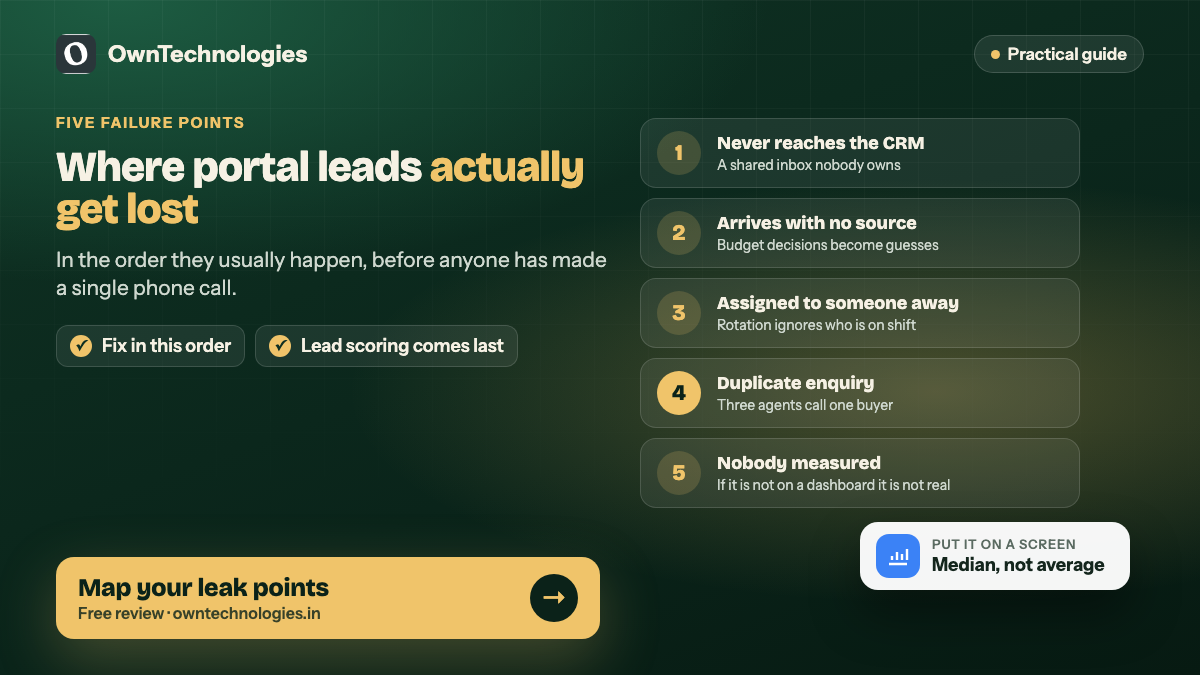
Where Portal Leads Actually Get Lost
Five failure points, in the order they usually happen.
The lead never reaches the CRM. It arrives as an email to a shared inbox that three people half-watch. Nobody owns it, so nobody acts.
It reaches the CRM with no source. The record says “web enquiry”. Nobody can tell whether Property Finder, Bayut or a Google campaign produced it, so budget decisions are guesses.
It is assigned to someone unavailable. Round robin is set up once and never updated for leave, weekends or the agent who left in March.
It is a duplicate. The same buyer enquired on three listings. Three agents call the same person within an hour, which is worse than nobody calling.
Nobody is measured on response time. If the number is not on a dashboard, it is not real.
What Good Routing Looks Like
The target is simple: every portal lead lands in the CRM within seconds, attached to the right agent, with its source intact, and someone is accountable for the first call.
Capture through the API, not through email
Portals offer lead APIs or webhooks. Email parsing is fragile: the portal changes the template and your capture breaks silently, often for weeks before anyone notices.
Deduplicate on phone number first
Match on phone, then email, then name. A returning enquirer should attach to the existing record as a new activity, not create a second one. This single rule removes most of the embarrassment.
Route on availability, not just rotation
Round robin only among agents who are on shift. Add a fallback: if the assigned agent has not opened the lead in a set number of minutes, it reassigns and someone is notified.
Stamp the source and keep it forever
Portal, campaign, listing reference and landing page, written to the record at creation and never overwritten by a later touch. Without this your cost per acquisition is fiction.
Put the clock on a dashboard
Median time to first contact, by agent and by source. Not average, median, because one forgotten lead at 40 hours distorts an average and hides a real problem.
Response Time Targets Worth Setting
These are operating targets to hold a team to, not research findings.
| Window | What it is for |
|---|---|
| Under 5 minutes | Portal enquiries during business hours |
| Under 15 minutes | Website and WhatsApp enquiries |
| Same day | Out of hours, with an automatic acknowledgement sent immediately |
| 3 touches in 72 hours | Call, WhatsApp, then email, before the lead is parked |
The automatic acknowledgement matters more than it looks. It buys you the lead’s attention for the next half hour, which is usually enough.
What to Build, in Order
Do not attempt all of it at once. Sequence it so each step produces a number you can see.
- Capture every source into one place, with the source stamped
- Deduplicate on phone number
- Assign on availability with a reassignment fallback
- Automatic acknowledgement on receipt
- Response time dashboard, by agent and by source
- Only then, lead scoring and nurture sequences
Most agencies start at step six because it sounds the most advanced. It is the only step that does nothing when steps one to five are broken.
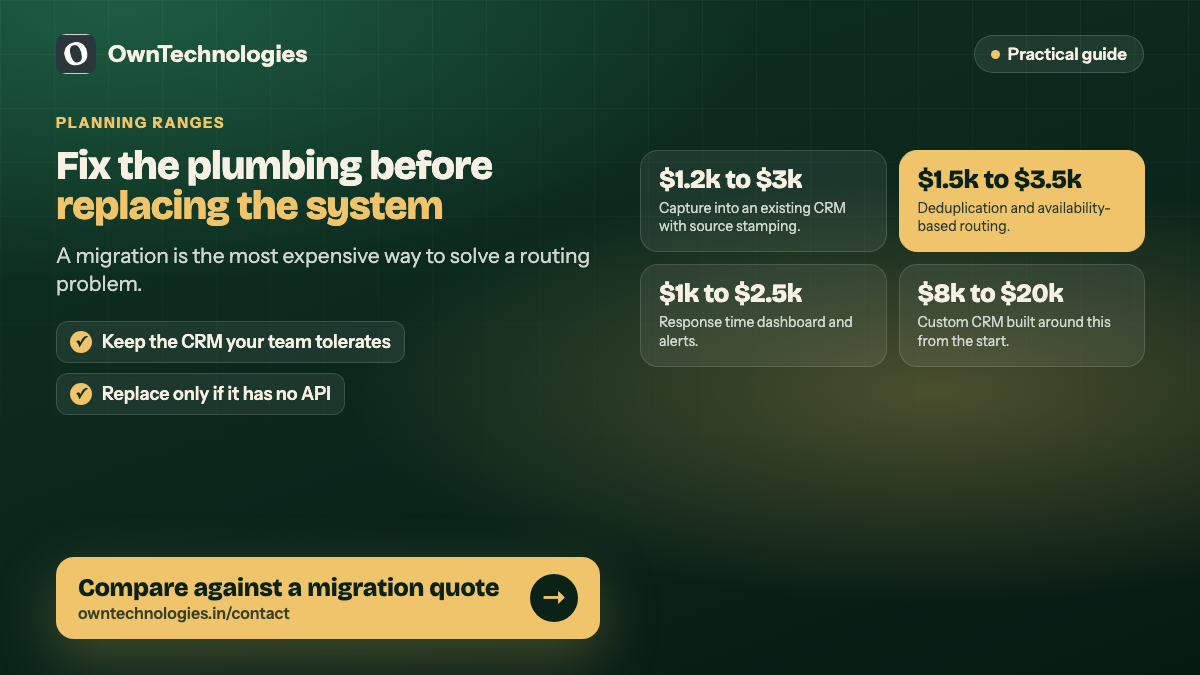
Build Cost, as Planning Ranges
| Scope | Cost (USD) | Cost (INR) |
|---|---|---|
| Portal and web capture into an existing CRM, with source stamping | $1,200 to $3,000 | 1 to 2.5 lakh |
| Deduplication and availability-based routing | $1,500 to $3,500 | 1.25 to 3 lakh |
| Response time dashboard and alerts | $1,000 to $2,500 | 85,000 to 2 lakh |
| Custom CRM built around this from the start | $8,000 to $20,000 | 6.5 to 16 lakh |
If you already have a CRM your team tolerates, fix the plumbing before replacing the system. A migration is the most expensive way to solve a routing problem. Our note on custom CRM cost versus off-the-shelf sets out when replacing is genuinely the cheaper path.
Why Agents Stop Using the CRM
Routing only works if the record gets updated after the call. Adoption fails for predictable reasons.
- Logging a call takes more than a few seconds on a phone
- The CRM asks for fields the agent cannot know yet
- Nothing in it helps the agent, it only reports upward
- Two systems hold the truth, so neither is trusted
The fix is boring: fewer required fields, a mobile view that works one-handed, and at least one feature the agent personally benefits from, usually their own follow-up list for the day.
What We Build Into This
The daily operations side of this is CRM and admin panel work, and the capture side usually touches the site itself, which is website development. Our post on the features agencies actually use covers the CRM itself, and real estate website features covers the public side.
Attribution is where this meets marketing. If the source is stamped properly, your SEO and paid search reporting becomes a real comparison rather than an argument.
Out of Hours Is Half the Week
Portal enquiries do not respect office hours. A Friday evening enquiry in Dubai, or a Sunday
browse in London, is often the most serious one of the week, because the person had time to look
properly.
Three things make out of hours survivable without putting anyone on a night shift:
- An automatic acknowledgement that sets a real expectation, naming when someone will call rather than saying “we will be in touch”
- A duty rota so one agent covers the window, with the rest untouched
- A queue that is worked first thing, oldest enquiry first, before anyone starts on new activity
The failure mode here is a Monday morning where everyone starts on the freshest leads and the
weekend queue quietly ages out.
Attribution Only Works If Nothing Overwrites It
Most CRMs record the most recent source by default. That is the opposite of what a brokerage
needs. If a buyer first arrives from Bayut, then returns from a Google search, then converts, a
last-touch-only record credits Google with a lead that Bayut produced.
Keep both. First source and last source, written as separate fields, neither overwriting the
other. Google’s own guidance on local business data is worth
following on the site side too, since accurate listings reduce the “direct” bucket that hides
real sources.
Mistakes That Cost the Most
- Parsing lead emails instead of using the portal API
- Round robin that ignores who is actually working today
- Overwriting the original source with the most recent touch
- Measuring average response time rather than median
- Buying lead scoring before fixing capture
- No automatic acknowledgement, so the lead hears nothing for hours
Frequently Asked Questions
Treat under five minutes as the working target during business hours, and send an automatic acknowledgement immediately in all cases. The exact threshold matters less than measuring it: most agencies discover their median is in hours, not minutes, the first time they put it on a dashboard.
Fix the routing first. Capture, deduplication, assignment and source stamping can usually be built around an existing CRM for a fraction of a migration. Replace the system when the team genuinely refuses to use it, or when it cannot expose an API.
Deduplicate on phone number at the point of capture, before assignment. Match phone first, then email, then name, and attach the new enquiry to the existing record as an activity rather than creating a second lead.
Yes, portal lead delivery is a standard integration. The practical work is normalising different payload shapes into one lead format and keeping the source and listing reference intact through that translation.
Median time to first contact, split by agent and by source, plus a count of leads with no contact at all. Those two numbers surface almost every routing problem without any further analysis.
Rarely at first. With fewer than a few hundred leads a month, an agent’s judgment beats a model, and the effort is better spent making sure every lead gets called quickly.
Final Thoughts
Lead routing is unglamorous and it is usually the highest return change available to a brokerage. Nothing in it requires a new CRM, a new portal contract or more budget.
Capture everything with its source, deduplicate on phone, assign to someone who is actually working, acknowledge instantly, and put the median response time where the team can see it.
If you want to know where your own leads are dying, send us how they arrive today, which portals you use and what your CRM is, and we will map the leak points for you.