A clinic owner is told two different things by two different agencies. One says build a proper website. The other says a landing page converts better. Both are selling, and both are partly right.
The honest answer depends on what you are trying to do this quarter. Here is how to decide, and what each one should cost.
The Difference, Stated Plainly
A landing page is one page with one job. Someone arrives from an ad, reads one offer, and either books or leaves. No navigation, no distractions, nothing competing.
A website is the clinic’s permanent address. Multiple pages, a treatment list, doctor profiles, location and hours, a blog, and the structure Google needs to rank you for searches you never paid for.
They are not competing products. One buys traffic, the other earns it.
When a Landing Page Is the Right Call
A landing page earns its place when all of these are true:
- You are running paid ads and sending traffic somewhere specific
- There is one offer, such as a free consultation or a single treatment
- You need something live in days, not weeks
- You want to test demand before committing to a full build
A single-treatment campaign is the clearest case. Someone clicking an ad for teeth whitening does not want your orthodontics page, your careers page, or a link to your blog. Give them the whitening offer, the price range, the location, and a booking button.
When You Need the Website
A website is the right call when any of these are true:
- You want to be found without paying for every visitor
- You offer more than two or three treatments
- Patients research you before booking, which in healthcare they always do
- You need multiple locations, multiple practitioners, or both
- You want your Google Business Profile, reviews and site to reinforce each other
The last point is the one most clinics underestimate. Organic search for “dentist near me” type queries does not reward a single page. It rewards a site with real treatment pages, a complete profile and consistent information across both. Our note on Google Business Profile for clinics covers that side.
The Trap: A Landing Page Pretending to Be a Website
The expensive mistake is building a one-page site, calling it a website, and then wondering why nothing ranks.
A single page can only rank for one cluster of terms. If you offer implants, whitening, orthodontics and hygiene, a one-pager asks Google to decide which of those you are. It usually decides none.
Equally wasteful: sending paid traffic to a homepage. The visitor arrives on a page built to serve everyone, has to navigate, and most of them do not.
What Each Should Contain
| Landing page | Website | |
|---|---|---|
| Pages | 1 | 6 to 15 |
| Primary job | Convert paid traffic | Be found and build trust |
| Navigation | None or minimal | Full |
| Treatment detail | One offer | A page per treatment |
| Booking | One obvious action | Available throughout |
| Blog | No | Yes |
| Structured data | Minimal | Full local business markup |
| Typical build | 3 to 7 days | 3 to 6 weeks |
What Each Costs
Planning ranges, not quotes.
| Scope | Cost (USD) | Cost (INR) |
|---|---|---|
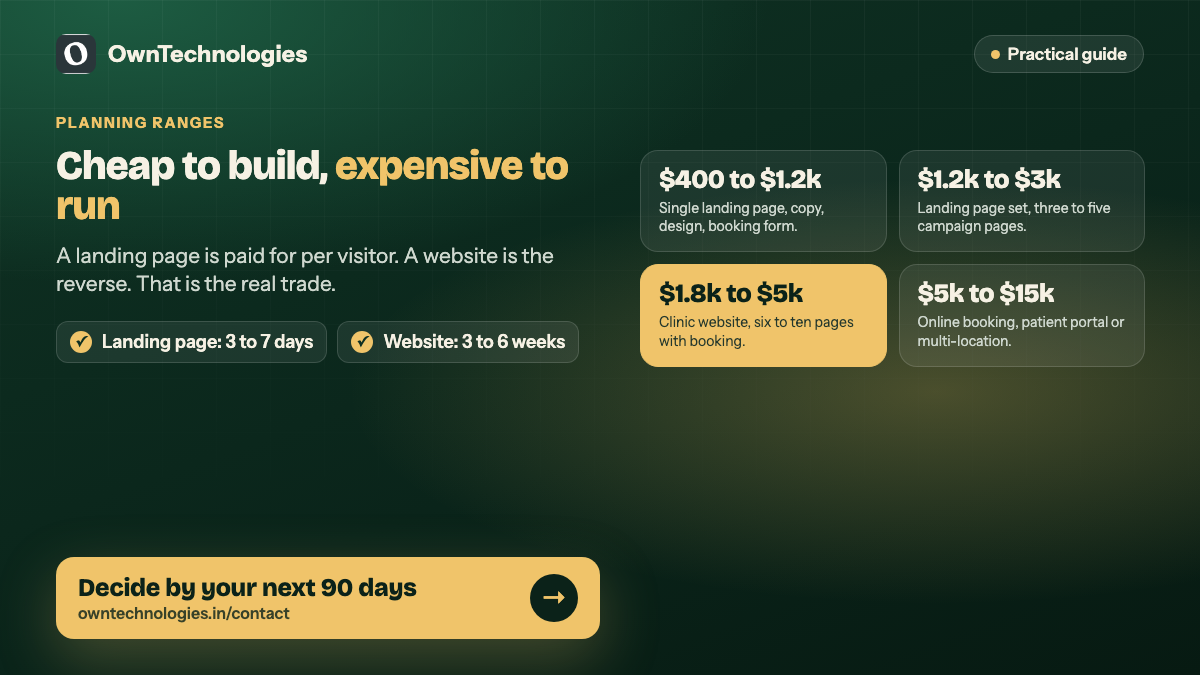
| Single landing page, copy and design, booking form | $400 to $1,200 | 33,000 to 1 lakh |
| Landing page set, 3 to 5 campaign pages | $1,200 to $3,000 | 1 to 2.5 lakh |
| Clinic website, 6 to 10 pages with booking | $1,800 to $5,000 | 1.5 to 4 lakh |
| Website with online booking, patient portal or multi-location | $5,000 to $15,000 | 4 to 12.5 lakh |
A landing page is cheap to build and expensive to run, because every visitor is paid for. A website is the reverse. That is the actual trade, and it is a cash flow decision as much as a marketing one.
The Sequence That Usually Works
For a clinic starting from nothing, in this order:
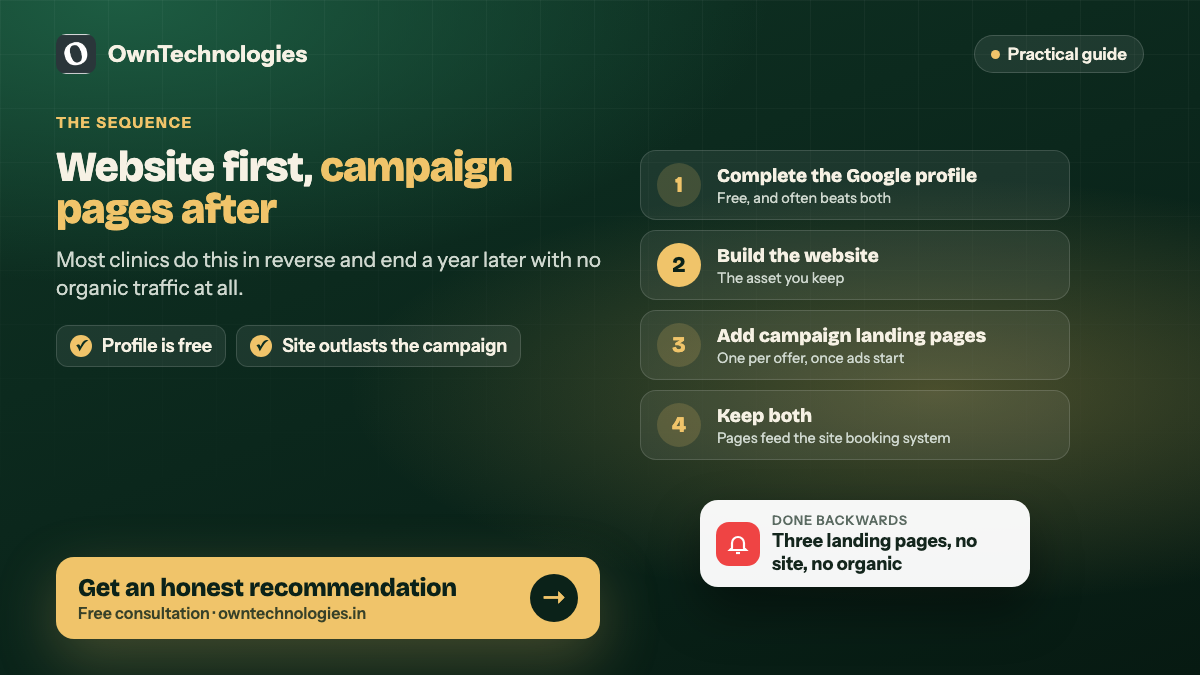
- Claim and complete the Google Business Profile, which is free and often outperforms both
- Build the website, because it is the asset you keep
- Add landing pages per campaign once you start spending on ads
- Keep both, with the landing pages feeding the site’s booking system
Most clinics do this backwards: a landing page for an ad campaign, then another, then a third, and a year later there is no site and no organic traffic at all.
Both Need the Same Three Things
Whichever you build, these decide whether it works.
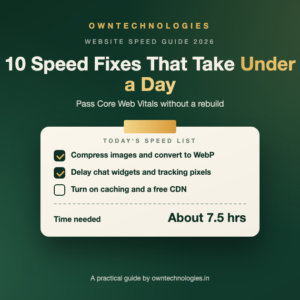
Speed on a phone. Patients search on mobile data in a waiting room or on a sofa. A slow page loses them before they read a word. Core Web Vitals are the measurable version of this, and our list of quick speed fixes covers the common causes.
Booking that takes seconds. A phone number alone loses the evening and weekend enquiries. Our post on clinic websites with online booking covers how that should behave.
Proof. Real photos of the actual clinic, named practitioners with credentials, and reviews. Stock imagery of a model with perfect teeth reads as a template, and patients notice.
Where the Money Is Usually Wasted
- Paid traffic pointed at a homepage
- A one-page site sold as a full website
- A beautiful site with the phone number as the only way to book
- Treatment pages that read as a list of procedures with no prices or ranges
- No tracking, so nobody can say which page produced a patient
- A landing page left running after the campaign ended, competing with the real site
How We Approach It
We ask what the next ninety days look like before recommending either. If there is ad budget and one clear offer, a landing page first is usually honest advice. If the clinic wants patients without paying per click, the site comes first and the pages follow.
This is website development work, and the campaign side sits with SEO and paid search. Where a clinic needs booking, patient records or multiple practitioners behind the site, that becomes admin panel and CRM work and is quoted separately rather than hidden inside a website price.
Frequently Asked Questions
For one narrow term, sometimes. For a clinic offering several treatments, no. Ranking needs a page per treatment, internal links between them and complete local business markup, which a single page cannot provide.
Six to ten is enough for most single-location clinics: home, about, a page per main treatment, the team, location and contact, and a blog index. More pages are worth it only when each one targets a real search someone performs.
Yes, on a subfolder of your own domain, so any authority it earns stays with you. A separate domain splits your SEO and is harder to track.
Three to seven days is realistic including copy, design and the booking form. A full clinic website is three to six weeks depending on how much content exists already, which is usually the real constraint.
If you run paid ads, usually yes. The point is not design quality, it is matching the page to the exact promise in the ad. A good website still asks a visitor to choose, and paid traffic converts better when there is nothing to choose.
Complete the Google Business Profile properly, then build the website. Both outlast any campaign. Add landing pages when there is ad budget to send to them.
Final Thoughts
A landing page buys you conversions while you are paying. A website earns them after you stop. Most clinics need both eventually, and almost all of them need the website first.
Decide by the next ninety days, not by which one sounds more modern.
If you are weighing this up, tell us what you offer and what you spend, and we will say plainly which one we would build first and why.