Quick answer
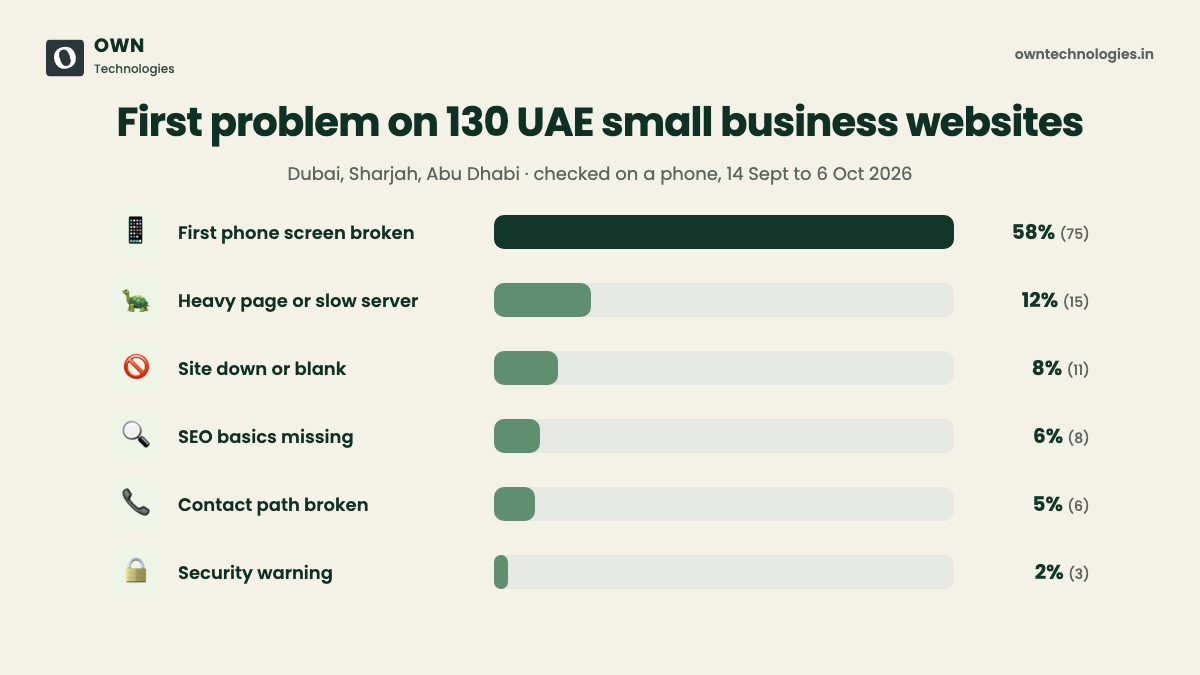
We checked 130 UAE small business websites on a phone between 14 September and 6 October 2026. The most common first problem by far was the very first screen: in 75 cases (58%) the headline was cut off, the hero was empty, or a banner covered the page before a customer saw a phone number or a book button. Slow or heavy pages came second (15 sites, 12%) and sites that were down or blank came third (11 sites, 8%).
Most owners of UAE small business websites check their site on a laptop, see a clean layout, and move on. Their customers do not use a laptop. They tap a Google Maps result on a phone, wait a second or two, and decide in one screen whether to call, book or go back.
So we looked at what those customers actually see. This data study covers 130 business websites in Dubai, Sharjah and Abu Dhabi that we audited one by one on a phone-sized screen, plus a second, unfiltered set of 51 clinic websites that we ran through a script. Every number below is a count from our own audit files. Nothing is estimated, and no business is named.
How we checked 130 UAE small business websites
The sample. 130 unique websites of local businesses in Dubai, Sharjah and Abu Dhabi, checked from 14 September to 6 October 2026. These were businesses we were preparing to contact about their website, which matters for how you read the results (more on that below).
The sectors.
| Sector | Websites |
|---|---|
| Dental clinics and physiotherapy | 60 |
| Salons | 10 |
| Barbers | 10 |
| Fitness studios | 10 |
| Car garages | 10 |
| Training institutes and food | 10 |
| Event companies | 10 |
| Photo studios | 10 |
The method. Each site was opened on a phone-sized screen and run through a small script that records the HTTP status, HTTPS, the mobile viewport tag, the page title, the meta description, the number of H1 headings, the HTML size and the time to first byte. For every site we wrote down the single most visible problem a customer would hit first.
The honest caveat. Sites with no clear problem were skipped, because we had nothing useful to tell the owner. So the shares below describe what goes wrong when something is wrong. They are not the share of all UAE websites that fail. The 51-site set further down has no such filter.
The first problem we found on each site
| First problem a customer hits | Sites | Share |
|---|---|---|
| First phone screen broken or unreadable | 75 | 58% |
| Heavy page or slow server | 15 | 12% |
| Site down, blank or never finishes loading | 11 | 8% |
| SEO basics missing (no H1, many H1s, no alt text, brand-only title) | 8 | 6% |
| Contact path broken (bad tel: link, two WhatsApp numbers, no form) | 6 | 5% |
| Security warning (expired SSL or plain http) | 3 | 2% |
| Pinch zoom switched off or fixed 320px viewport | 3 | 2% |
| Out-of-date content (old footer year, expired offer banner) | 3 | 2% |
| Bot-check screen before the site loads | 2 | 2% |
| Free hosting subdomain or another business’s domain | 2 | 2% |
| Site fine, the gap was reviews against nearby rivals | 2 | 2% |
Key takeaway
More than half of the problems were not code bugs or hosting failures. They were layout problems on the first phone screen, the kind anyone can spot in ten seconds by opening the site on their own phone.
Problem 1: the first phone screen (58%)
This was the clear winner, with 75 of 130 sites. It showed up in four shapes:
- Headline cut off at the right edge. The desktop headline was set at a fixed size, so on a phone the last words ran off the screen.
- Empty or black hero. A background video or slider that did not load on mobile left a dark block where the offer should be.
- Cookie or offer banner covering half the screen. The customer had to find a small close button before seeing anything.
- Page wider than the phone. One wide element made the whole page scroll sideways, which shrinks everything and looks broken.
Why does this hurt so much? Google ranks and shows the mobile version of a page. Its own documentation says it uses the mobile version of a site’s content for indexing and ranking. If the mobile first screen is broken, that is the version both Google and the customer judge you on.
What surprised us: in the unfiltered clinic set, 100% of the sites that loaded had a mobile viewport tag. The technical box was ticked. The screens still broke, mostly on page-builder layouts that were designed on a desktop and never checked on a real phone.
Problem 2: heavy pages and slow servers (12%)
15 sites made it into this group. We saw 400 KB to 2.2 MB of HTML before a single image loaded, and 1 to 3.4 seconds before the server sent its first byte.
For scale, Google’s web.dev guidance says a good time to first byte is 0.8 seconds or less, and anything above 1.8 seconds is poor. Several sites we checked were above that line before the page even started to draw.
The usual causes were page builders that inline huge amounts of markup, unused plugins, and cheap shared hosting a long way from the Gulf.
Problem 3: sites that were down or blank (8%)
11 sites did not work at all when we checked them: a domain that did not resolve, a hosting company placeholder page, or an empty white page. In the full-script clinic set, 7 of 51 (14%) did not load.
Tip
Put a free uptime monitor on your homepage and send its alerts to the owner’s phone, not to a developer who left two years ago. Most of the down sites we found looked like they had been down for a while without anyone noticing.
Problems 4 to 11: SEO, contact paths, security and the rest
The remaining 29 sites were spread across smaller groups, but each one costs real enquiries:
- SEO basics missing (8 sites). No H1 at all, or up to 21 H1s on one page, most images without alt text, and titles that only said the brand name.
- Contact path broken (6 sites). A tel: link with a wrong number format, two different WhatsApp numbers on one page, no form and no booking button.
- Security warnings (3 sites). An expired SSL certificate or plain http, which makes the browser warn the visitor before they see anything.
- Zoom switched off (3 sites). Pinch zoom disabled or a fixed 320px layout. The W3C accessibility guidance expects text to resize up to 200 percent without loss of content, which is impossible when zoom is blocked.
- Out-of-date content (3 sites). An old year in the footer or an offer banner that expired months ago.
- Bot-check screens (2 sites). A security check page that appears before the site, which many visitors read as a broken site.
- Wrong domain (2 sites). A free hosting subdomain or a domain that belongs to another business.
- Reviews gap (2 sites). The site was fine; the problem was far fewer Google reviews than nearby competitors.
What 51 unfiltered clinic websites showed
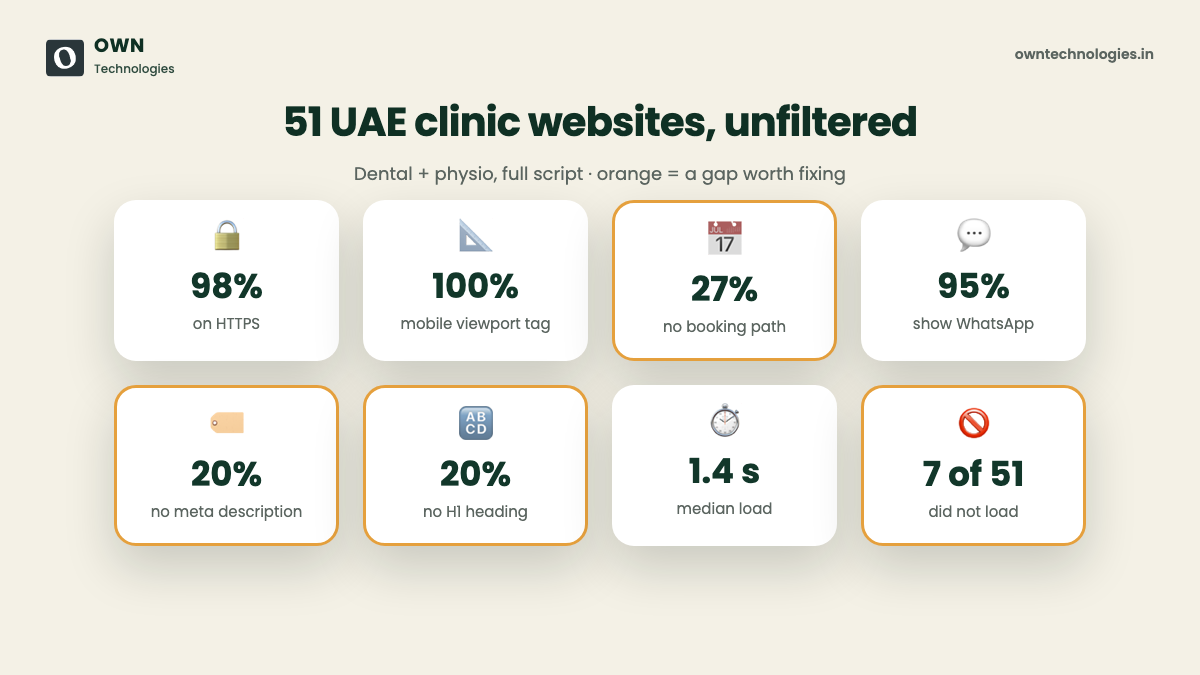
The 130-site set was filtered. To get a cleaner picture, we also ran 51 dental and physio websites (Dubai physio on 21 September and Sharjah dental on 22 September) through the full script, including the ones we did not contact.
| Check (44 sites that loaded) | Result |
|---|---|
| Served on HTTPS | 98% |
| Mobile viewport tag present | 100% |
| No meta description | 20% |
| No H1 heading | 20% |
| More than one H1 | 18% |
| No visible online booking path on the homepage | 27% |
| WhatsApp shown somewhere | 95% |
| Median homepage load in our test | 1.4 s |
| Took longer than 3 s | 6 of 44 |
| Median HTML size | 238 KB |
Platforms we saw: WordPress with Elementor 18, custom builds 13, plain WordPress 7, Wix 3, Shopify 2 and Squarespace 1.
Key takeaway
Clinics in the UAE have the basics covered (HTTPS, viewport, WhatsApp). The gaps are a booking path, headings and meta descriptions, which decide whether Google shows the page and whether a patient books once they land.
What this means for UAE small business owners
Three patterns stood out across sectors:
- Clinics lose bookings, not traffic. More than a quarter had no booking link, Calendly, Okadoc or similar on the homepage, in a sector where Google Maps sends people straight to the website.
- Salons, barbers and fitness studios lose on the first screen. Image-heavy hero sections and sliders were the main cause of broken mobile layouts in these sectors.
- Photo studios and event companies lose on weight and SEO. The problem flips from layout to heavy pages and images without alt text, so Google has little text to rank.
If you want the wider context on picking a team to fix this, read our guide to choosing a website development company in Dubai. If your problem is visibility rather than layout, our local SEO guide for Dubai covers Google Maps and reviews.
A 10-minute phone check you can do today
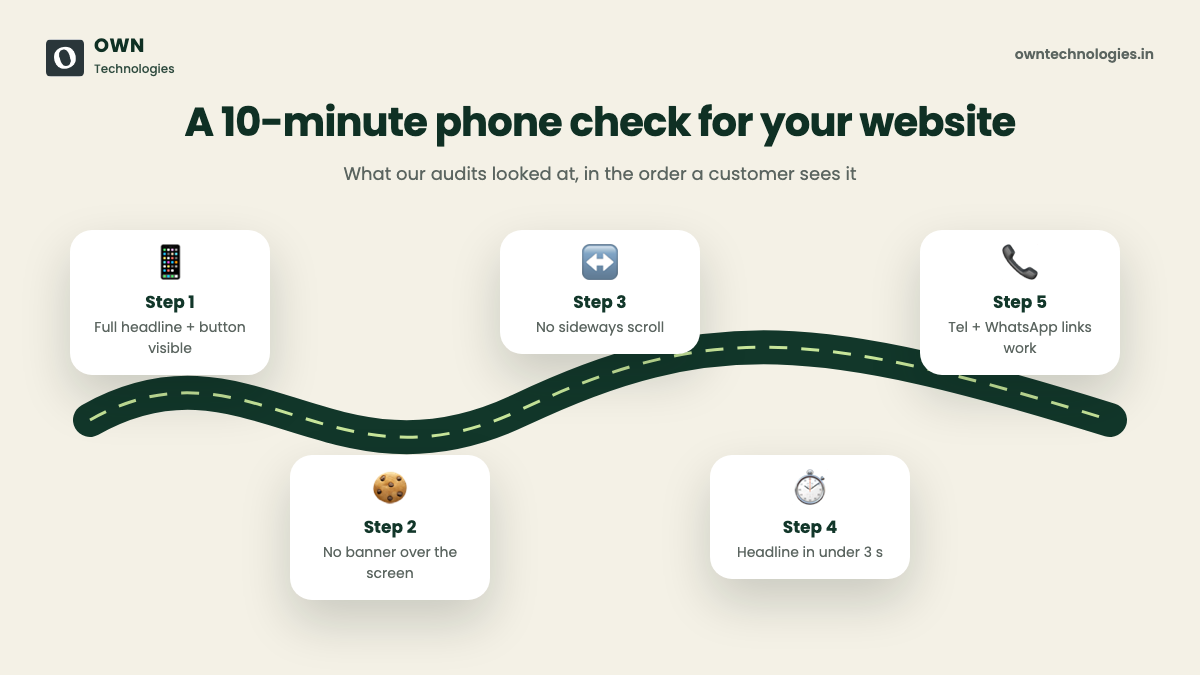
You do not need a developer to find most of what we found. Open your site on your own phone, on mobile data rather than office Wi-Fi, and work through this:
- First screen. Can you read the full headline and see a call, WhatsApp or book button without scrolling?
- Banners. Does a cookie or offer banner cover more than a third of the screen?
- Sideways scroll. Swipe left. If the page moves sideways, one element is too wide.
- Speed. Count the seconds until the headline appears. More than three is a problem.
- Tap test. Tap the phone number and the WhatsApp button. Do they open the right number?
- Booking. Can a new customer book or request a callback in two taps from the homepage?
- Search view. Google your business name. Does the title say what you do and where, not just your brand?
If any of these fail, write them down with a screenshot. That list is exactly what a developer needs to quote a fix.
How OwnTechnologies can help
We build and fix websites for small businesses in the UAE and India from our team in Gurugram, with 100+ projects delivered over 8+ years. Our website development team fixes mobile layouts, speed and contact paths, our SEO services cover headings, titles, meta descriptions and Google Maps, and if a booking flow needs more than a form, our app development team can build it.
FAQ
In our audit of 130 UAE small business websites, the most common first problem was a broken first phone screen, found on 75 sites (58%). The headline was cut off, the hero was empty, or a banner covered the page.
130 unique business websites in Dubai, Sharjah and Abu Dhabi, checked between 14 September and 6 October 2026, plus an unfiltered set of 51 dental and physio websites run through a script.
No. We skipped sites with no clear problem, so the 58% is the share of first problems found, not the share of all UAE websites. The 51-site clinic set is unfiltered and is the better guide to typical sites.
Google’s web.dev guidance says a good time to first byte is 0.8 seconds or less. In our clinic set the median homepage load was 1.4 seconds and 6 of 44 sites took more than 3 seconds.
The tag only tells the browser to use the phone’s width. Fixed-size headlines, wide elements, sliders and large banners still break the layout. Every clinic site that loaded in our set had the tag, yet many first screens were broken.
Open it on your own phone on mobile data, check that the full headline and a contact button show without scrolling, swipe sideways, time the load, and tap your phone and WhatsApp links. Our 7-step check above takes about 10 minutes.
Final thoughts
The good news from 130 audits is that most problems on UAE small business websites are visible, specific and fixable. A broken first screen, a slow server or a wrong WhatsApp number is not a strategy problem. It is a checklist item that has been missed.
Want a second pair of eyes on your site? Contact OwnTechnologies or call +91 9311228839, and we will tell you the first problem a customer hits on your website.