Quick answer
To hire an app developer in India from Dubai safely, sign a written contract that assigns all IP and source code to your company on payment, keep the App Store, Google Play, domain and cloud accounts in your own company name, pay against milestones you can test, and agree on the governing law and how disputes are settled before any work starts. A launch-ready MVP from an experienced Indian team typically costs AED 25,000 to 50,000.
If you run a business in Dubai and want to hire an app developer in India from Dubai, the price is rarely the hard part. The hard part is the paperwork: who owns the code, whose name is on the App Store account, what happens if the team disappears halfway, and which country’s law applies when something goes wrong.
This guide covers exactly that. It is written for UAE founders and managers who have already decided an Indian team makes sense on cost and now want to protect themselves. If you are still comparing a local Dubai company with an offshore team, read our Dubai vs offshore India comparison first, then come back here.
Why UAE businesses hire app developers in India
Three reasons come up in almost every conversation we have with Dubai clients:
- Cost. Experienced Indian teams quote well below typical Dubai agency rates because salaries, office rent and visa costs are lower.
- Time zone. India is 1.5 hours ahead of the UAE, so a normal Dubai working day overlaps almost fully with an Indian working day.
- Depth of talent. Flutter, React Native, Node.js and Laravel developers with UAE project experience (Arabic layouts, AED payments, WhatsApp integrations) are easy to find in India.
None of that matters if the contract is weak. The rest of this guide is about the contract.
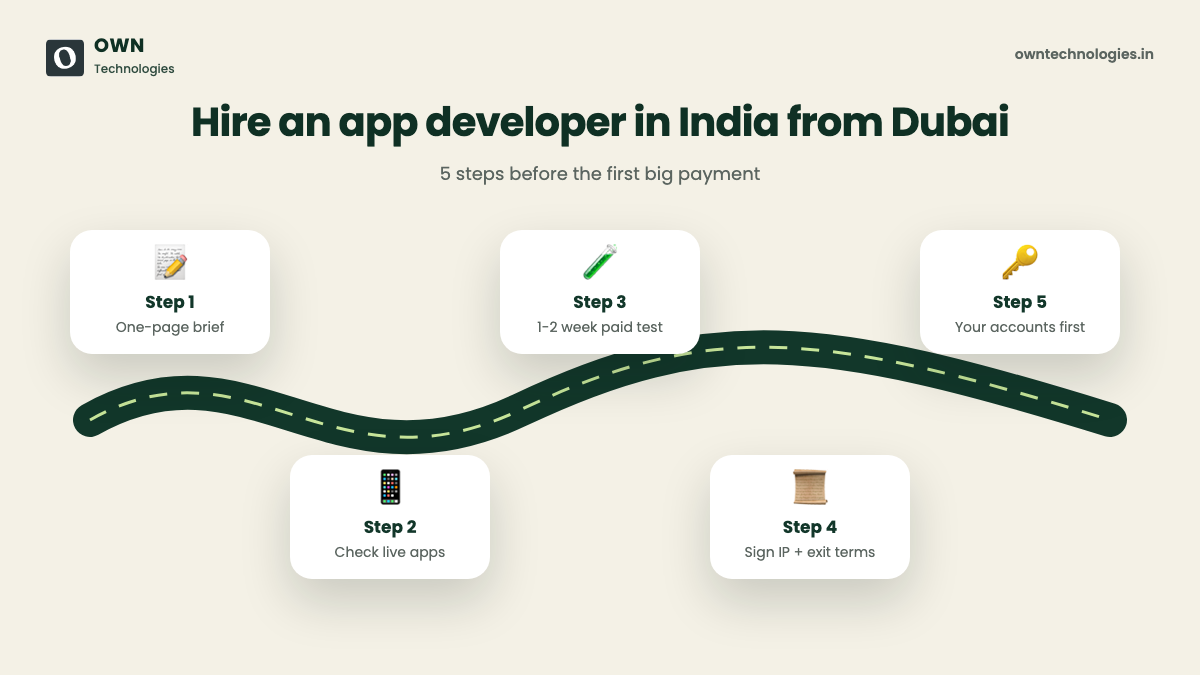
The 6-step process to hire an app developer in India from Dubai
- Write a one-page brief. The users, the 5 to 10 screens that matter most, the platforms (Android, iOS or both) and the launch date you need.
- Shortlist on relevant work. Ask for live apps on the stores, not just Dribbble shots. Download them and use them.
- Run a short paid test. One to two weeks on a real piece of your project (for example the login and onboarding flow) tells you more than any interview.
- Agree on the contract terms below. IP, accounts, payments, law, exit.
- Set up your own accounts first. Developer accounts, domain, cloud and code repository in your company name, with the team invited as users.
- Pay by milestone. Each payment releases after you test a build on your own phone.
Tip
Ask for the code repository invite on day one, not at handover. If you can see commits every week, you always know the real progress and you always hold a copy.
The contract clauses that protect you
This is the core of the guide. Whatever template you use, these points should be written down, not agreed on a call.
1. IP assignment on payment
The contract should state that all intellectual property in the work (source code, designs, database schemas, documentation) is assigned to your company once each milestone is paid. Watch for wording like “licensed to the client”. A licence is not ownership. You want assignment.
2. Source code delivery
Spell out what “delivered” means: the full source code in a repository you own, build instructions, environment variables listed (not the secret values in an email), and the admin credentials for every service the app uses.
3. Third-party and open-source components
Apps always use libraries. The contract should say the team will list them and will not use any component whose licence stops you from using the app commercially.
4. Confidentiality
A simple NDA clause covering your business data, user data and the idea itself. Make it survive the end of the contract.
5. Governing law and disputes
Decide which law applies and where disputes go. Some UAE companies choose UAE law, some choose Indian law, and some choose arbitration so that neither side has to sue in a foreign court. This is a decision for your lawyer, but the important part is that the contract names one option clearly. A blank here is the most expensive mistake on this list.
6. Exit and handover
If either side ends the contract, what happens? A good clause says the team hands over the code and credentials for all paid work within a fixed number of days, and you pay only for work completed.
Key takeaway
Ownership comes from three things together: an IP assignment clause, code in a repository you own, and store accounts in your company name. Any one of them missing is a risk.
Keep every account in your company name
This is where most disputes start. A developer creates the Apple or Google account “to save time”, the relationship ends, and the business cannot update its own app.
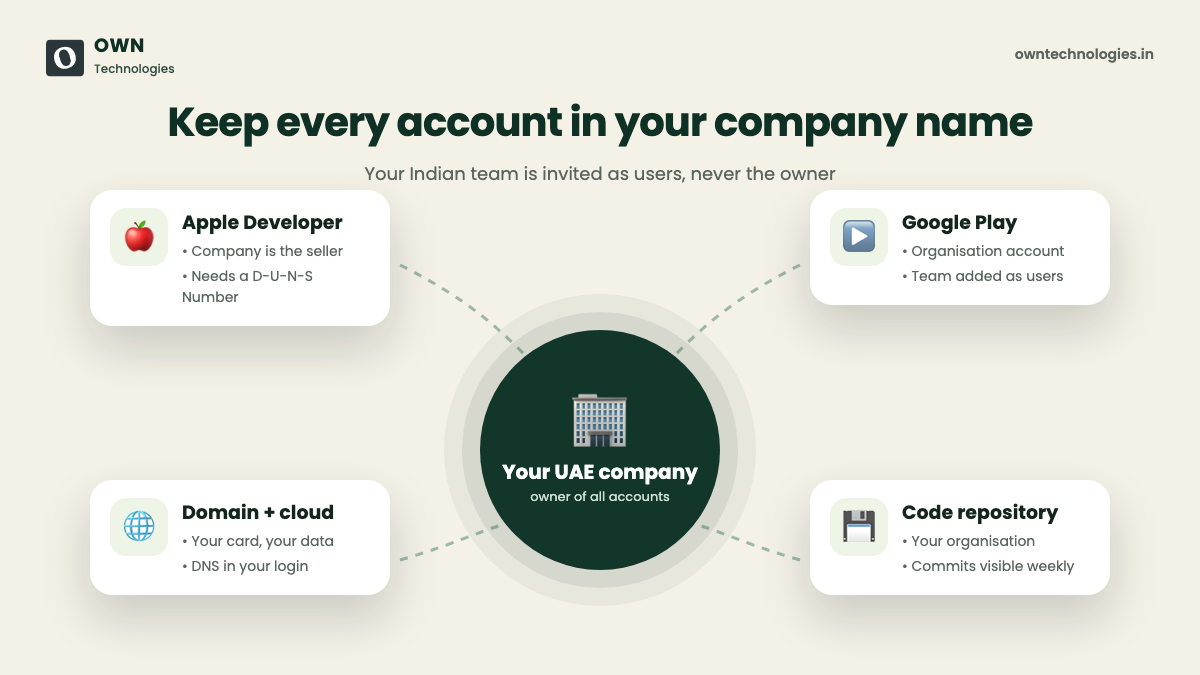
| Account | Whose name it should be in | Why it matters |
|---|---|---|
| Apple Developer Program | Your UAE company | The company name shows as the seller on the App Store |
| Google Play Console | Your UAE company | Transferring an app to another account later takes extra steps |
| Domain and DNS | Your company | Controls your website, email and app links |
| Cloud hosting (AWS, Google Cloud, Firebase) | Your company, your card | Your data and your users live here |
| Code repository (GitHub, GitLab, Bitbucket) | Your company organisation | Your proof of ownership and your backup |
| Payment gateway | Your company | Customer payments settle to your bank |
Apple says an organisation enrolling in its developer program must be a legal entity and must have a D-U-N-S Number, and that the organisation’s name is displayed as the seller of its apps (Apple Developer Program enrollment). Google Play also asks for a D-U-N-S number when you create an organisation account (Play Console Help). Start these early: getting a D-U-N-S number and passing verification can take days, and it should never block your launch.
Tip
Your Indian team should be invited as users with a developer role on each account. They can build and publish, but the account stays yours.
Payments: milestones, currency and tax
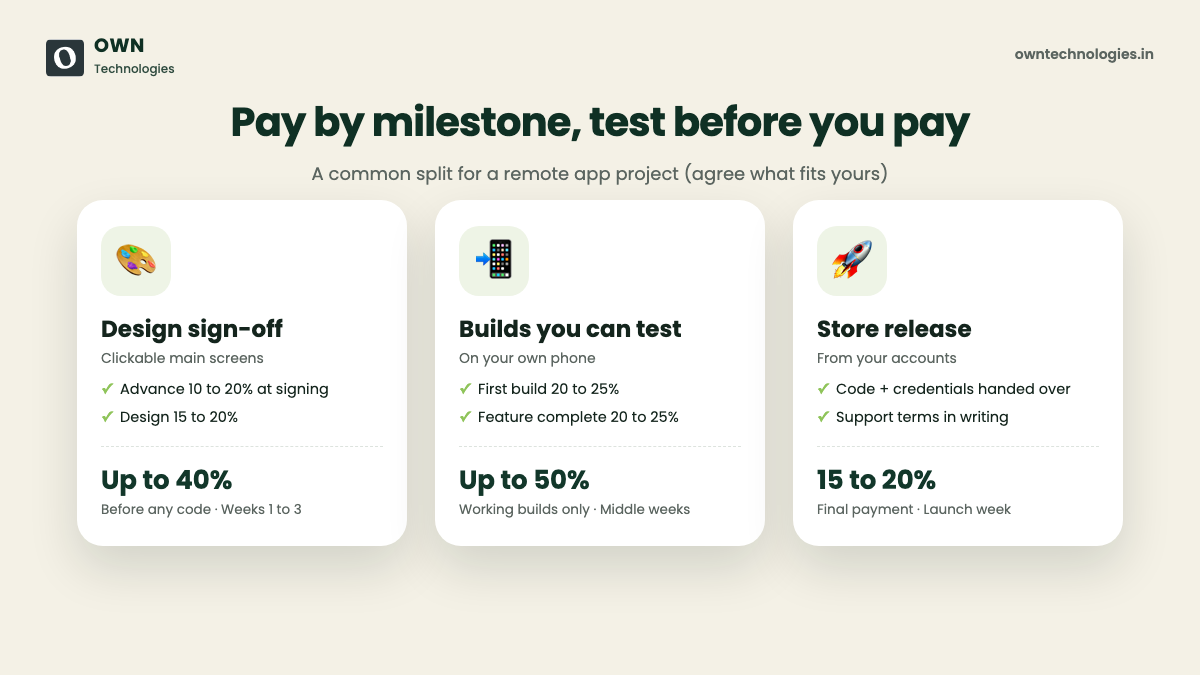
Milestones. A common structure is a small advance, then payments tied to working builds: design approved, first testable build, feature complete, store release. Never pay most of the project before you can test anything.
Currency. Agree in the contract whether the price is in AED, USD or INR, and who pays bank and transfer charges. Exchange rates move, so a fixed currency avoids arguments.
Tax. Cross-border services have tax rules on both sides. In the UAE, VAT on services bought from abroad is usually handled by the buyer under the reverse charge, and in India exported services have their own treatment. Ask your accountant how this applies to your company before the first invoice, and make sure the invoice shows the details your accountant needs.
| Milestone | What you test before paying | Typical share |
|---|---|---|
| Advance | Signed contract, accounts set up | 10 to 20% |
| Design sign-off | Clickable design of the main screens | 15 to 20% |
| First build | Core flow working on your own phone | 20 to 25% |
| Feature complete | All agreed features in a test build | 20 to 25% |
| Store release | App live on the stores, code handed over | 15 to 20% |
These shares are a common starting point, not a rule. Agree what fits your project.
What it costs to hire an app developer in India from Dubai
For a Dubai or UAE business in 2026, these are the ranges we publish for our own mobile app development work. They match our detailed mobile app development cost in Dubai guide.
| Tier | What you get | Typical range |
|---|---|---|
| MVP | One platform or cross-platform, the core flow, launch-ready | AED 25,000 to 50,000 |
| Growth | Android and iOS, backend, admin panel, payments, integrations | AED 60,000 to 150,000 |
| Enterprise | Several user roles, complex workflows, AI features, compliance | AED 180,000 to 400,000 |
| Custom | Large platforms built in phases | Above AED 400,000 |
If you would rather add one or two developers to your own team than buy a fixed project, see our guide to hiring dedicated developers in India.
A working rhythm that keeps a remote team on track
- Week 1: kickoff call, accounts set up, repository invite, first design screens.
- Every week: one 30-minute call at a fixed time, a short written update, and a test build you can open on your phone.
- Every milestone: a demo, a written list of what is done and what is not, then payment.
- Launch week: store submission from your accounts, a handover document, and a list of every credential.
- After launch: a support or maintenance agreement in writing, with a response time for urgent bugs.
The overlap between Dubai and India makes this easy. A call at 10 AM in Dubai is 11:30 AM in India.
Red flags before you sign
- The team wants to publish the app from their own store account.
- The contract says “licence” instead of “assignment” for the IP.
- No named project manager, or you only ever talk to sales.
- They will not do a short paid test.
- Most of the money is due before you see a working build.
- No live apps you can download and try.
- They avoid writing down governing law or the exit clause.
How OwnTechnologies works with UAE clients
We are a Gurugram-based team with 8+ years of work and 100+ projects delivered. For UAE clients we keep store, cloud and repository accounts in the client’s company name, hand over source code at every milestone, and agree the contract terms above before work starts. Beyond apps, we also build websites and custom CRMs that connect to the app. You can see our work on the portfolio page.
Frequently Asked Questions
Yes. Hiring an Indian company to build software is a normal cross-border service contract. Your accountant should confirm how VAT applies to your company, and your contract should name the governing law.
You own it only if the contract assigns the IP to your company and the code sits in a repository you control. Without a written assignment, ownership can be unclear.
Always in your company’s name. Apple shows the organisation’s name as the seller on the App Store, and moving an app between accounts later is extra work.
For an experienced team, a launch-ready MVP typically costs AED 25,000 to 50,000, a growth-stage app AED 60,000 to 150,000, and enterprise builds AED 180,000 to 400,000.
Pay by milestone, with each payment released after you test a working build on your own phone. Agree the currency and who pays transfer charges in the contract.
A good exit clause makes the team hand over code and credentials for all paid work within a fixed number of days. If the code is already in your repository, you can hand it to another team.
Final Thoughts
Hiring an app developer in India from Dubai works well for many UAE businesses because the cost and time zone are on your side. The risk sits in the details: ownership, accounts, payments and the exit. Get those six clauses written down, keep every account in your company name, and pay only for builds you can test.
If you want a team that works this way by default, talk to OwnTechnologies or call +91 9311228839. We will send a written scope with milestones before you pay anything.