Quick answer
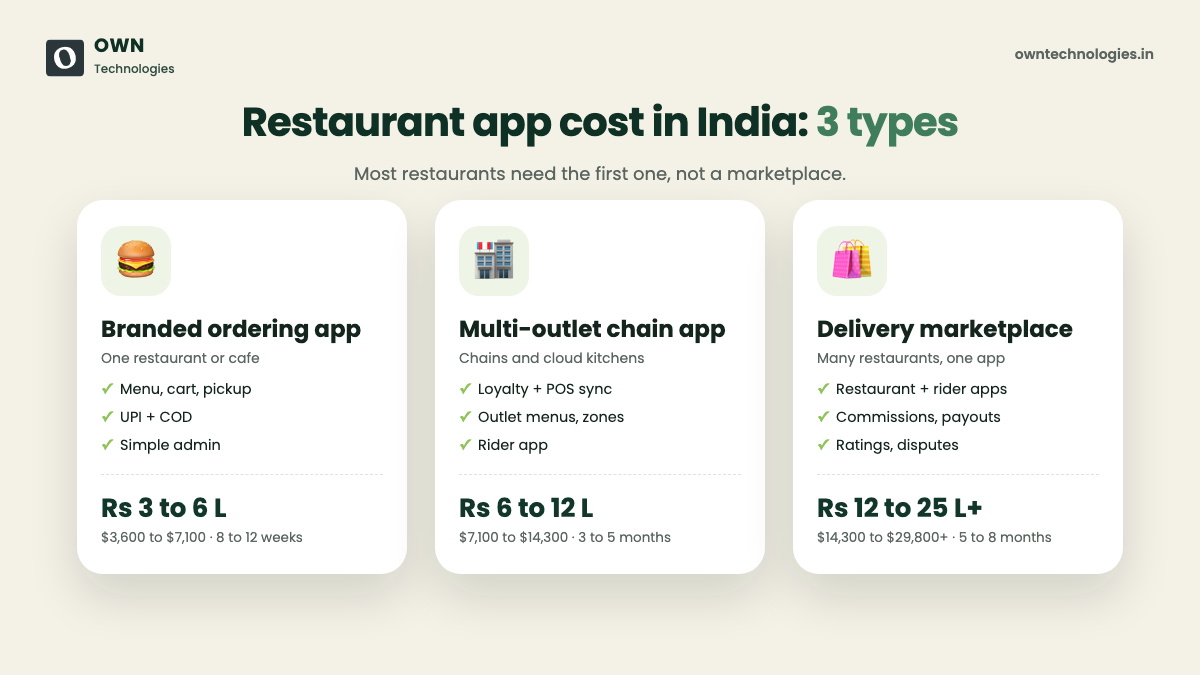
A restaurant app in India costs about $3,600 to $7,100 (Rs 3 to 6 lakh) for a branded ordering app for one restaurant or cloud kitchen, $7,100 to $14,300 (Rs 6 to 12 lakh) for a multi-outlet chain app with POS sync, loyalty and your own delivery riders, and $14,300 to $29,800+ (Rs 12 to 25 lakh+) for a food delivery marketplace with many restaurants. Timelines run from about 8 weeks to 8 months.
Paying a big commission on every delivery order and still not knowing who your regular customers are? That is the question pushing many Indian restaurants, cafes and cloud kitchens to build their own app.
This guide explains restaurant app development cost in India for 2026 in plain numbers: the 3 types of app, the features that bring repeat orders, how to work alongside delivery aggregators, the monthly running costs, and an example budget for a 3-outlet restaurant.
Restaurant app development cost in India: 3 types
| App type | Who it suits | What you get | Cost (2026) | Timeline |
|---|---|---|---|---|
| Branded ordering app | One restaurant, cafe or cloud kitchen | Menu, cart, delivery and takeaway orders, UPI and card payments, kitchen alerts, admin | $3,600 to $7,100 (Rs 3 to 6 lakh) | 8 to 12 weeks |
| Multi-outlet chain app | Chains and multi-brand cloud kitchens | Everything above + outlet selection, POS sync, loyalty, rider app, reports by outlet | $7,100 to $14,300 (Rs 6 to 12 lakh) | 3 to 5 months |
| Food delivery marketplace | Many restaurants in one app | Customer app, restaurant app, rider app, admin, commissions and payouts | $14,300 to $29,800+ (Rs 12 to 25 lakh+) | 5 to 8 months |
Ranges assume a professional Indian team, Android and iOS from one cross-platform codebase, and a web admin panel. USD figures use about Rs 84 to the dollar.
Key takeaway
Most restaurants do not need a marketplace. A branded ordering app brings regular customers to order directly, while aggregators keep doing what they are good at: finding new customers.
Why Indian restaurants build their own app
- Lower cost on repeat orders. A regular who orders twice a week through your app does not pay an aggregator commission.
- You keep the customer list. Names, numbers and order history stay with you, so you can send offers to people who already like your food.
- Your brand comes first. Your photos, your combos and your loyalty rewards, without a competitor’s banner above your restaurant.
- Better margins on bulk and office orders. Party orders and office lunches can be booked directly, with your own rules.
The smart setup for most restaurants is both: stay on aggregators for discovery, and move repeat customers to your own app with a loyalty reward. Our guide on restaurant delivery integration and menu sync explains how to run both without menu chaos.
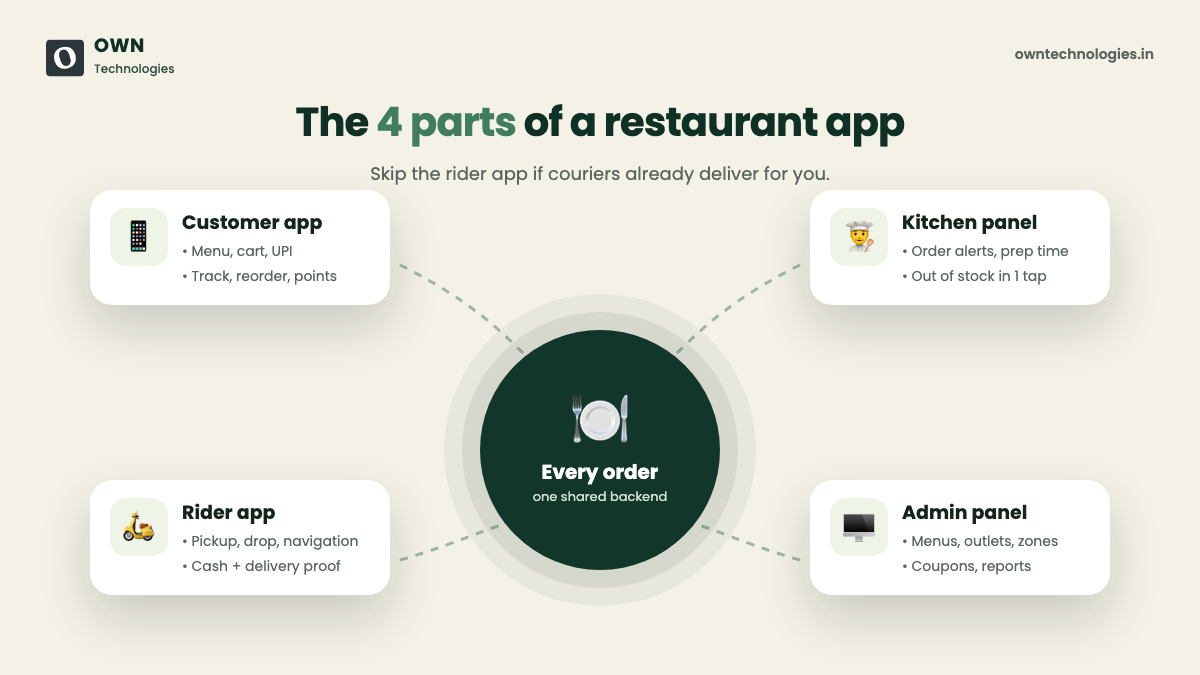
The parts of a restaurant app
1. Customer app
- Login with mobile OTP, saved addresses with a map pin
- Menu with photos, veg and non-veg labels, add-ons and combos
- Delivery or takeaway, now or scheduled
- UPI, cards, wallets and cash on delivery
- Live order status and rider tracking
- Reorder in one tap, loyalty points and coupons
2. Kitchen panel
- New order alert with sound, accept and set preparation time
- Mark items out of stock in seconds
- Print or show kitchen tickets
3. Rider app (if you deliver yourself)
- Assigned orders, pickup and drop navigation
- Cash collected and delivery proof
- Online and offline status
4. Admin panel
- Menu, prices, outlets, delivery zones and charges
- Orders, refunds, customers and coupons
- Reports on sales, best sellers and repeat customers
What Indian customers expect at checkout
- UPI first. Most customers expect to pay in one tap from their UPI app.
- Cash on delivery for first orders, with limits by area or order value.
- Clear veg and non-veg marking on every dish and combo.
- Delivery time and charges shown before payment, by zone.
- GST-compliant invoices sent automatically after each order.
- Hindi or a regional language in cities where many customers prefer it.
Tip
Keep checkout to 3 taps for a returning customer: saved address, UPI, place order. Every extra screen costs orders, especially at lunch and dinner peaks.
Features that push the cost up
| Feature | Adds roughly | Needed in V1? |
|---|---|---|
| POS integration for orders and menu sync | Rs 80,000 to 2 lakh | Yes if your kitchen runs on a POS |
| Own rider app with live tracking | Rs 1.5 to 3 lakh | Only if you deliver yourself |
| Loyalty points and wallet | Rs 60,000 to 1.5 lakh | Strong for repeat orders |
| Multi-outlet menus and zones | Rs 80,000 to 2 lakh | Only for chains |
| Table QR ordering for dine-in | Rs 50,000 to 1.2 lakh | Optional |
| Hindi or regional language | Rs 50,000 to 1.5 lakh | Yes in many cities |
| Bulk and party orders with advance payment | Rs 50,000 to 1 lakh | Good for caterers and cloud kitchens |
Monthly running costs after launch
The build is a one-time cost. These keep running every month:
- Payment gateway fees. For example, Razorpay’s standard pricing lists 2% on domestic transactions, plus GST.
- Maps and location for address pins and rider tracking. Check the Google Maps Platform pricing page for current rates.
- SMS OTP and push notifications for login and order updates.
- Cloud hosting and database, which grows with orders and menu photos.
- Maintenance: OS updates, bug fixes and menu changes. See our breakdown of app maintenance cost in India and the UAE.
- Marketing to move existing customers to the app: table QR codes, bag stickers and a first-order reward.
Example budget: a 3-outlet restaurant in India
Here is how a 3-outlet restaurant could budget its own app. This is an illustration, not a quote, and your scope will change the numbers.
| Item | Example cost |
|---|---|
| Customer app (Android + iOS, one codebase) | Rs 2,20,000 |
| Kitchen panel with order alerts and stock toggles | Rs 60,000 |
| Admin: menus, outlets, zones, coupons, reports | Rs 1,00,000 |
| Payments: UPI, cards and COD rules | Rs 40,000 |
| Loyalty points and reorder | Rs 70,000 |
| POS integration for orders | Rs 1,00,000 |
| Testing, store launch and staff training | Rs 40,000 |
| Total | Rs 6,30,000 (about $7,500) |
Key takeaway
This restaurant uses its existing delivery staff and third-party couriers instead of building a rider app, which keeps the budget near Rs 6 lakh. Add a rider app later only if delivery volume justifies it.
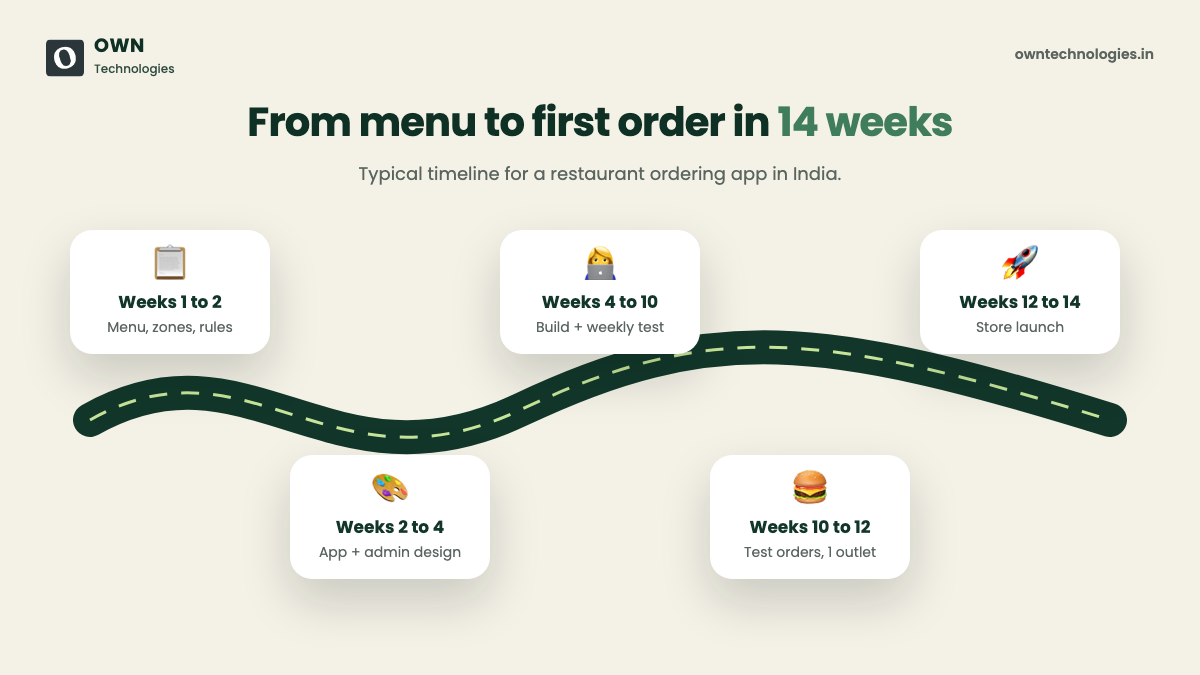
Timeline: from menu to first order
- Weeks 1 to 2: menu structure, outlets, zones, payment and delivery rules agreed.
- Weeks 2 to 4: app and admin design.
- Weeks 4 to 10: build, with a test app on your phone every week.
- Weeks 10 to 12: test orders in one outlet with staff and regular customers.
- Weeks 12 to 14: Play Store and App Store launch, then the other outlets.
How to get customers to actually use your app
- Give a clear first-order reward that beats the aggregator price, because you are not paying a commission.
- Put a QR code everywhere: tables, bills, bags and delivery boxes.
- Train staff to mention the app at the counter and on phone orders.
- Send a reorder reminder at the time each customer usually orders.
- Rank on Google too. A fast restaurant website with an order button catches people searching for your dishes nearby. Our SEO team can set this up with the app.
5 mistakes that make restaurant apps cost more
- Building a marketplace when you need an ordering app. Restaurant onboarding, payouts and disputes add months.
- No POS plan. If staff type every app order into the POS by hand, mistakes and delays follow.
- Copying every aggregator feature. Start with ordering, payment, tracking and loyalty, then add the rest with real data.
- Ignoring the kitchen. If the kitchen does not hear a new order instantly, food goes out late and reviews suffer.
- Cheap clone scripts. Ask who owns the code and whether it can be changed and updated safely.
How to choose a restaurant app developer in India
Ask these questions before you sign:
- Can you show live ordering or delivery apps you built?
- Are the customer app, kitchen panel and admin all in the quote?
- Which payment gateway and POS will you connect, and who pays their fees?
- Who owns the source code, the app store accounts and the server?
- How do you test payments and order alerts before launch?
- What does monthly support cost after launch?
At OwnTechnologies, we have delivered 100+ projects over 8+ years, including apps with 10M+ downloads. See our portfolio, our Flutter development services for one codebase on Android and iOS, and web development if you also want online ordering on your website. Building for the UAE too? Read our guide to food delivery app development cost in Dubai.
Frequently Asked Questions
A branded ordering app for one restaurant costs about Rs 3 to 6 lakh ($3,600 to $7,100). A multi-outlet chain app with POS sync, loyalty and a rider app costs about Rs 6 to 12 lakh. A food delivery marketplace with many restaurants costs Rs 12 to 25 lakh or more.
A branded ordering app takes about 8 to 12 weeks. A multi-outlet chain app takes 3 to 5 months, and a food delivery marketplace takes about 5 to 8 months.
Usually not. Aggregators are good for finding new customers. Use your own app for repeat customers, where you keep the data and avoid a commission on every order.
No. Many restaurants start with their existing delivery staff or third-party couriers and add a rider app with live tracking only when volume grows.
Yes. Most modern restaurant POS systems offer an integration, so app orders go straight to the kitchen and menu availability stays in sync. Check this with your POS provider early, because it affects cost and timeline.
Yes. The app can connect to an Indian payment gateway for UPI, cards, wallets and net banking, with automatic receipts and refunds.
Expect payment gateway fees, maps and SMS charges, cloud hosting, app store accounts, maintenance and some marketing to move customers to the app.
Final Thoughts
Restaurant app development cost in India depends on one choice first: a branded ordering app, a multi-outlet chain app or a full marketplace. Most restaurants get the best return from a branded app that turns regular customers into direct, repeat orders, while aggregators keep bringing in new ones.
Want a fixed quote for your restaurant app? Share your outlets, menu size and delivery setup, and we will send a clear plan with cost and timeline. Book a free consultation with OwnTechnologies.